
The era we are entering is multi-layered, interconnected, AI-driven, and fast.
Markets no longer move in straight lines. They move through parallel realities, accelerated technologies, new risks, and new decision dynamics.
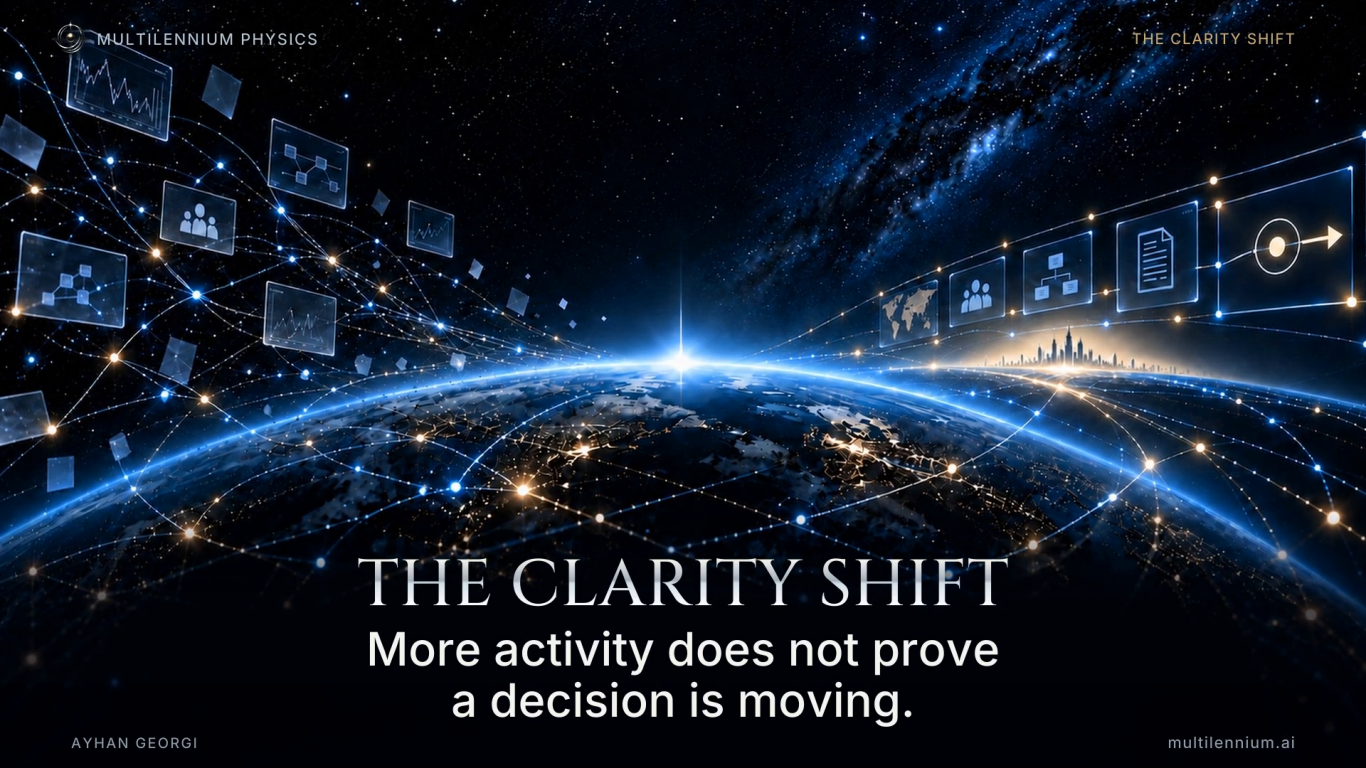
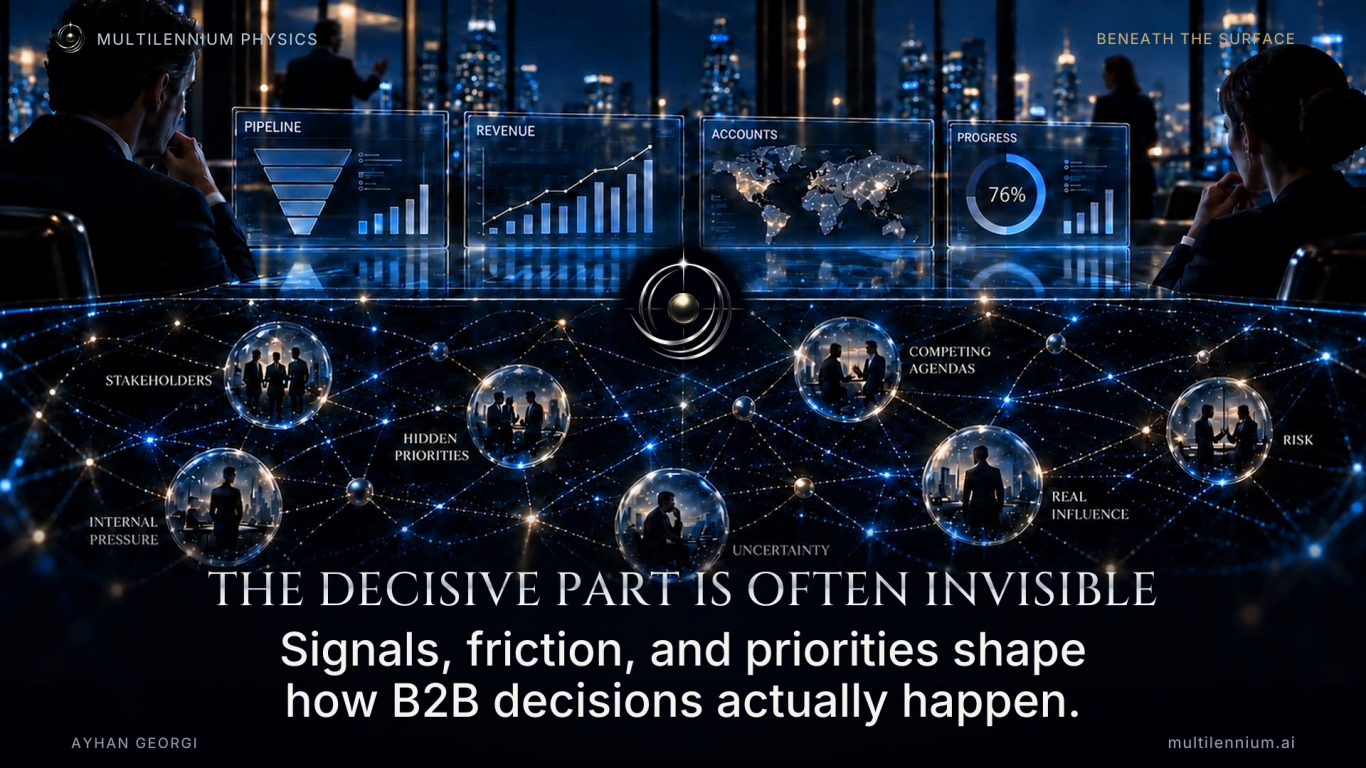
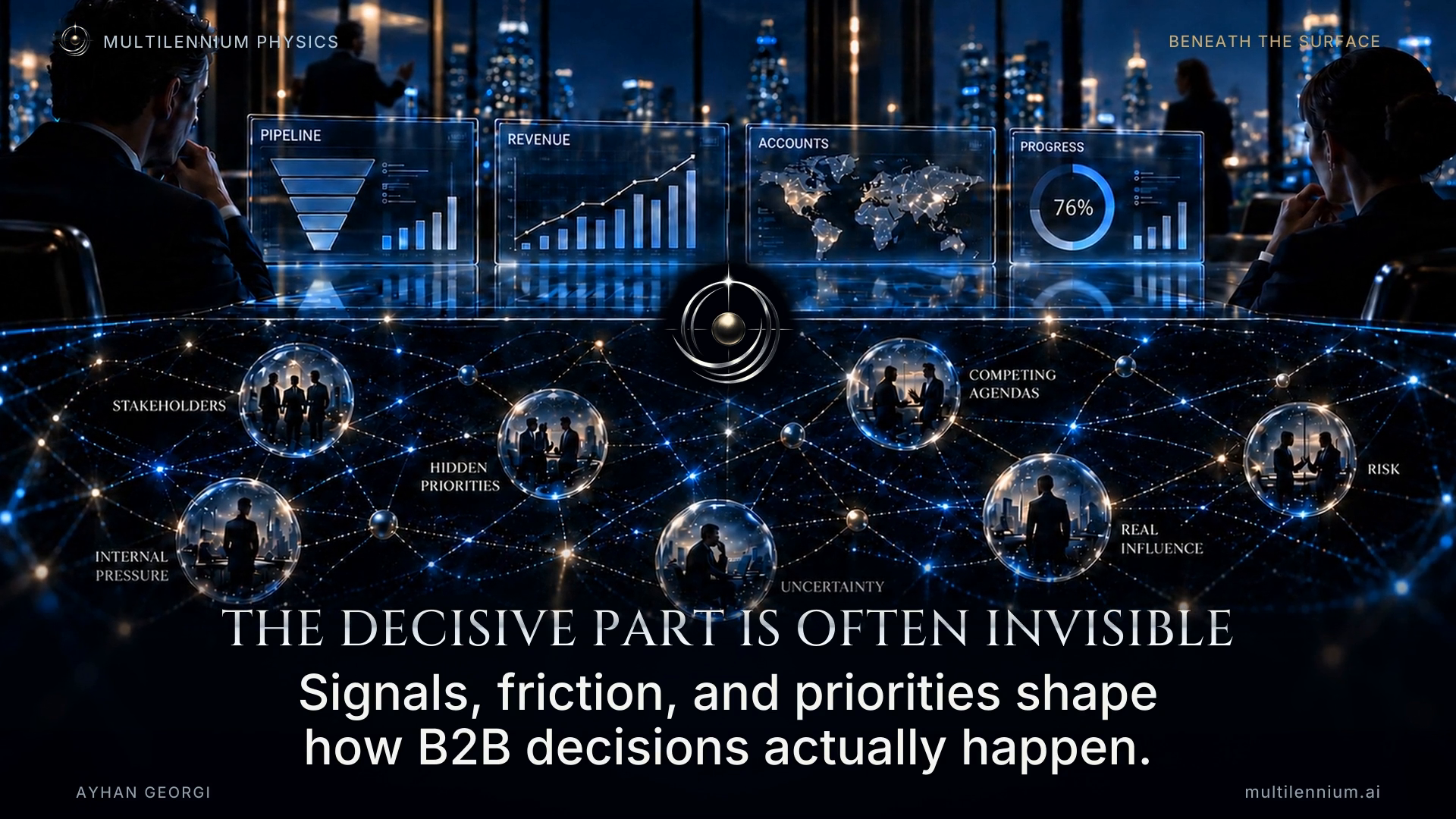
The most important part of a B2B decision
is often the part you cannot see.
Pipeline activity is visible.
Meetings are visible.
Proposals, forecasts and CRM stages are visible.
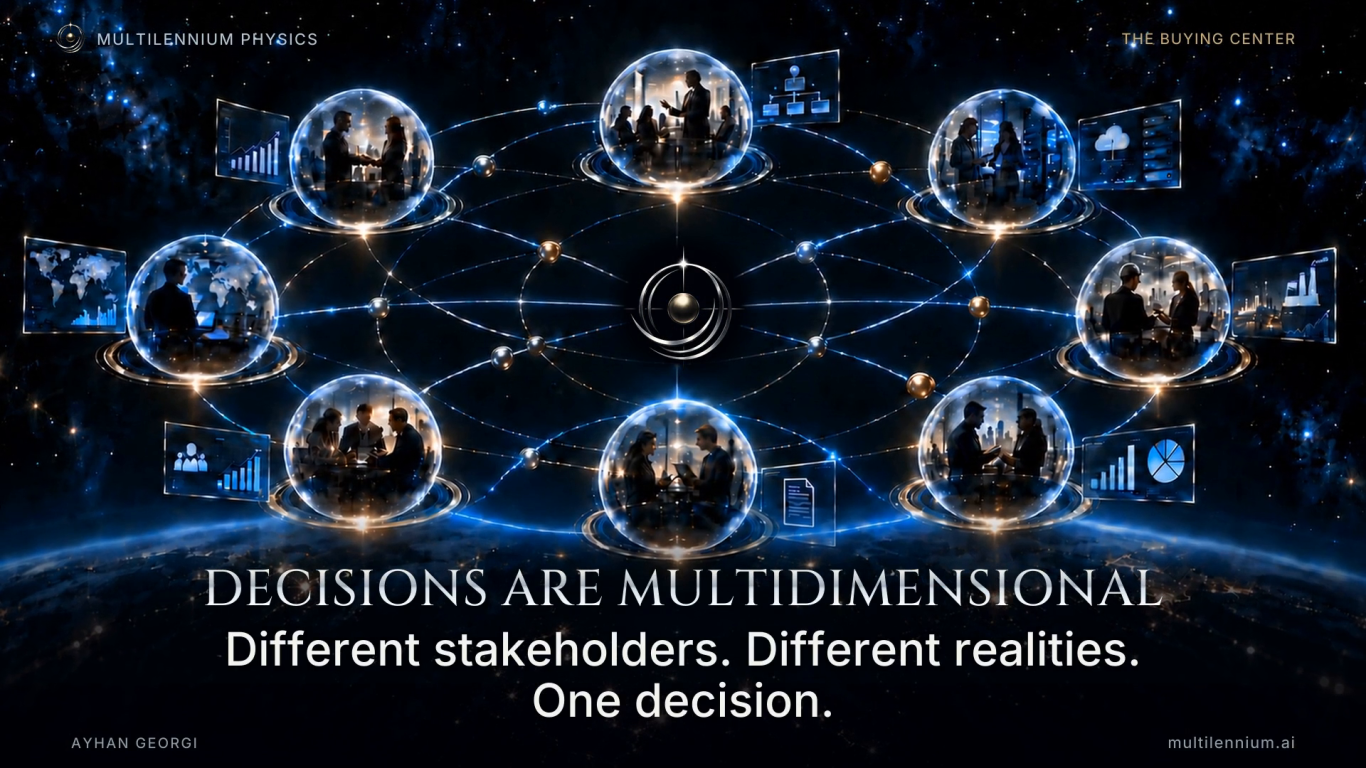
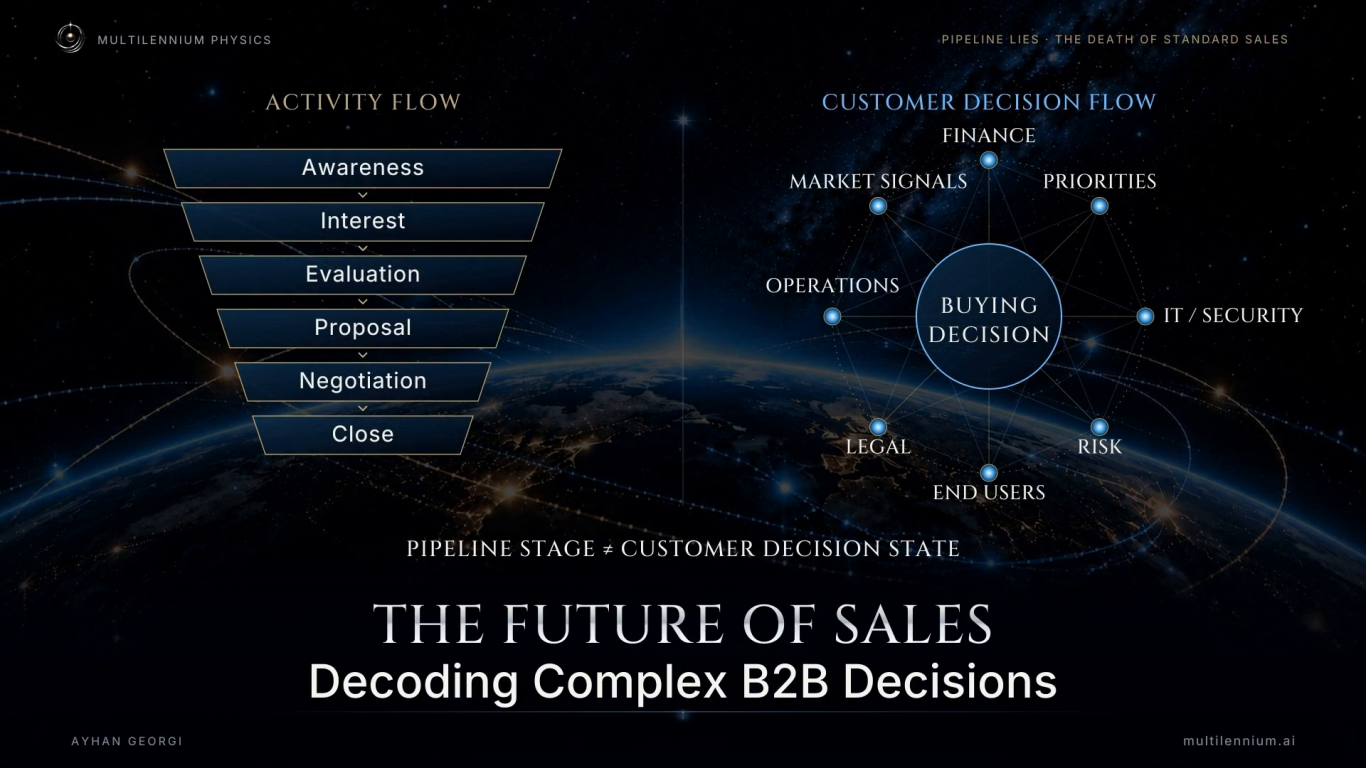
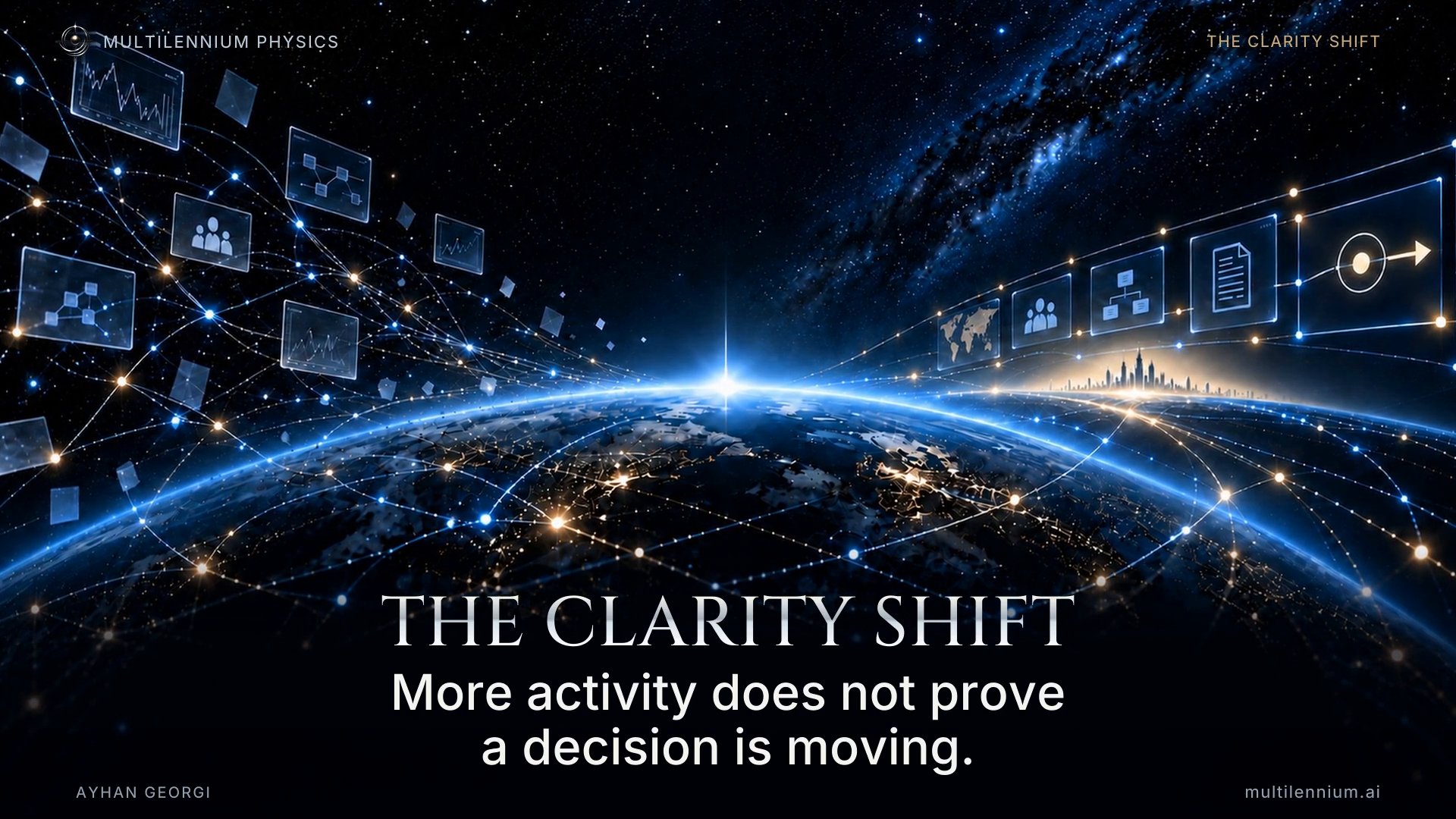
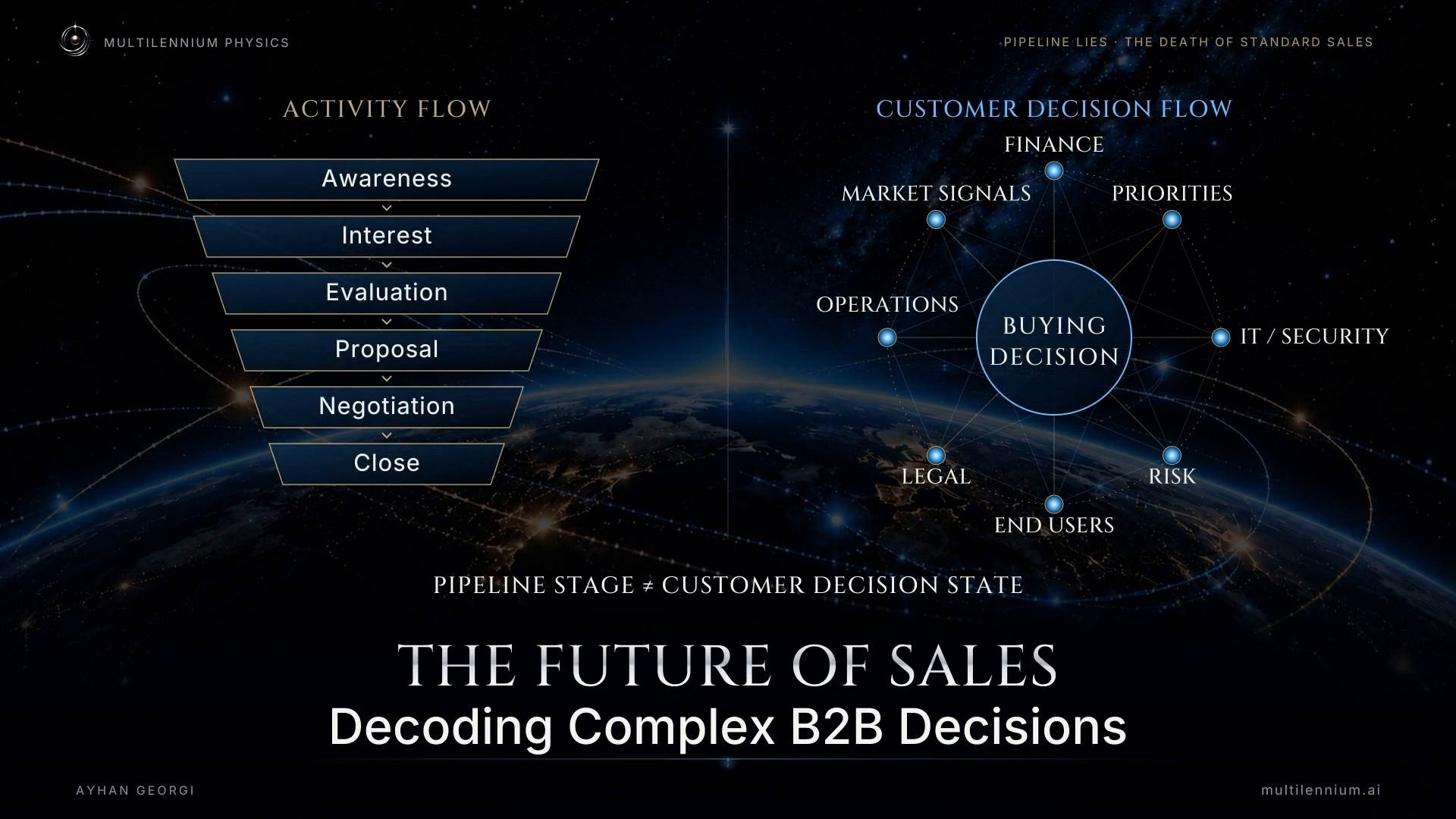
But a customer decision is not simply the sum of those activities.
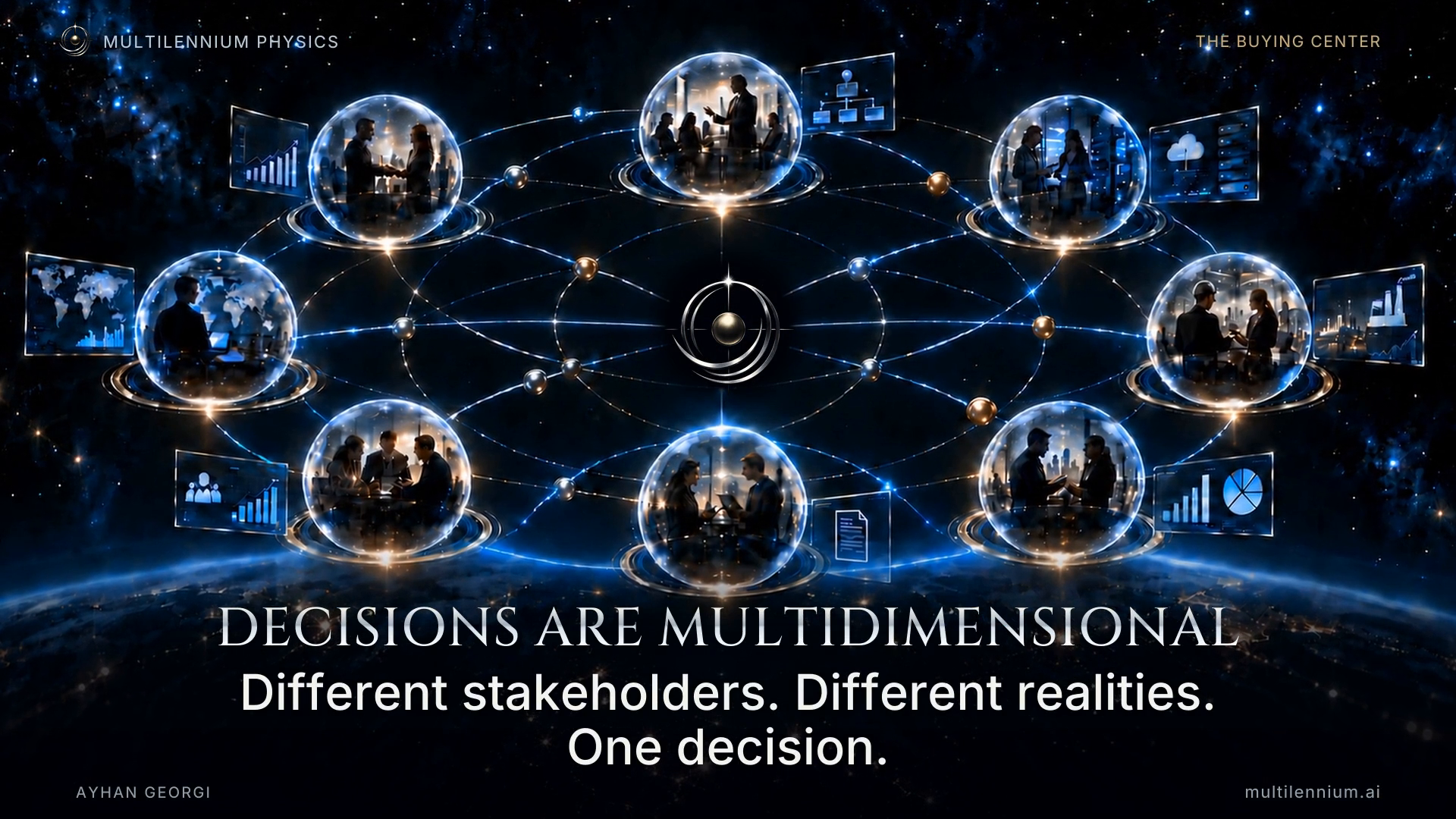
Much of what ultimately determines whether a complex B2B decision moves, slows down or stops develops beneath the visible sales process.
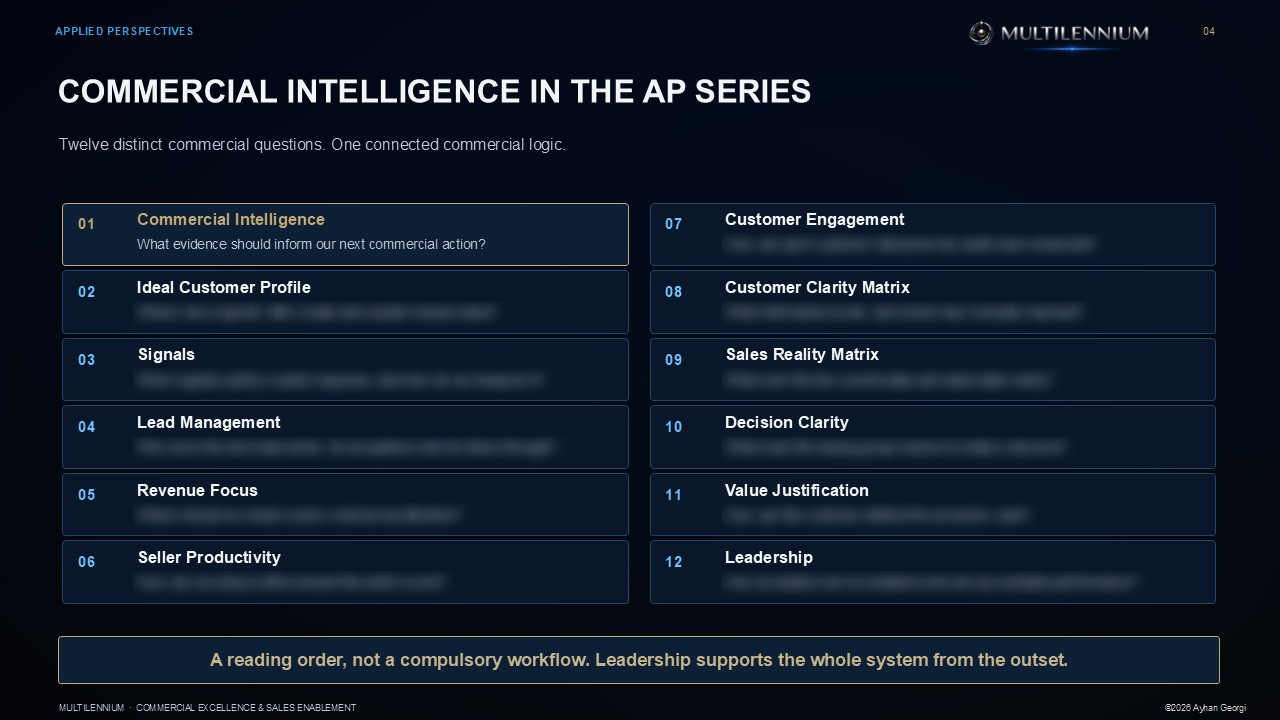
See below the bigger picture through Twelve Applied Perspectives that connect the thinking behind the book with commercial practice - while the underlying mechanics remain where they belong: in the book itself.

MULTILENNIUM reveals why traditional sales reaches its limits when customers show interest but are not yet ready to decide. It connects the rise of a new technological era with the hidden reality of modern B2B decisions. It is not about more pressure, more pipeline, or more activity. It is about clarity, trust, relevance, and the moment interest becomes real decision power.
What was once lived in practice has become mere theory for many - long since detached from reality. A New Era Begins and MULTILENNIUM decodes how decisions move inside it.
B2B Sales has Changed
The Future of Sales
The Physics of Modern Sales and Decision-Making
Two Ways of seeing Commercial Progress
Activity Flow vs. Customer Decision Reality

Sound on. Think differently.
Start the Slide Show instead









New ideas travel fast, often faster than their origin.
Multilennium Physics™ is my independently developed approach to decoding the multidimensional dynamics of B2B decisions and making them work in sales. Its strength lies not in individual terms but in how the insights interlock, refined through more than twenty years of international sales practice and deepened through continuous independent study and critical reflection.
Individual elements can be borrowed. The system behind them cannot.
This is where it originated, and this is where it continues to evolve.
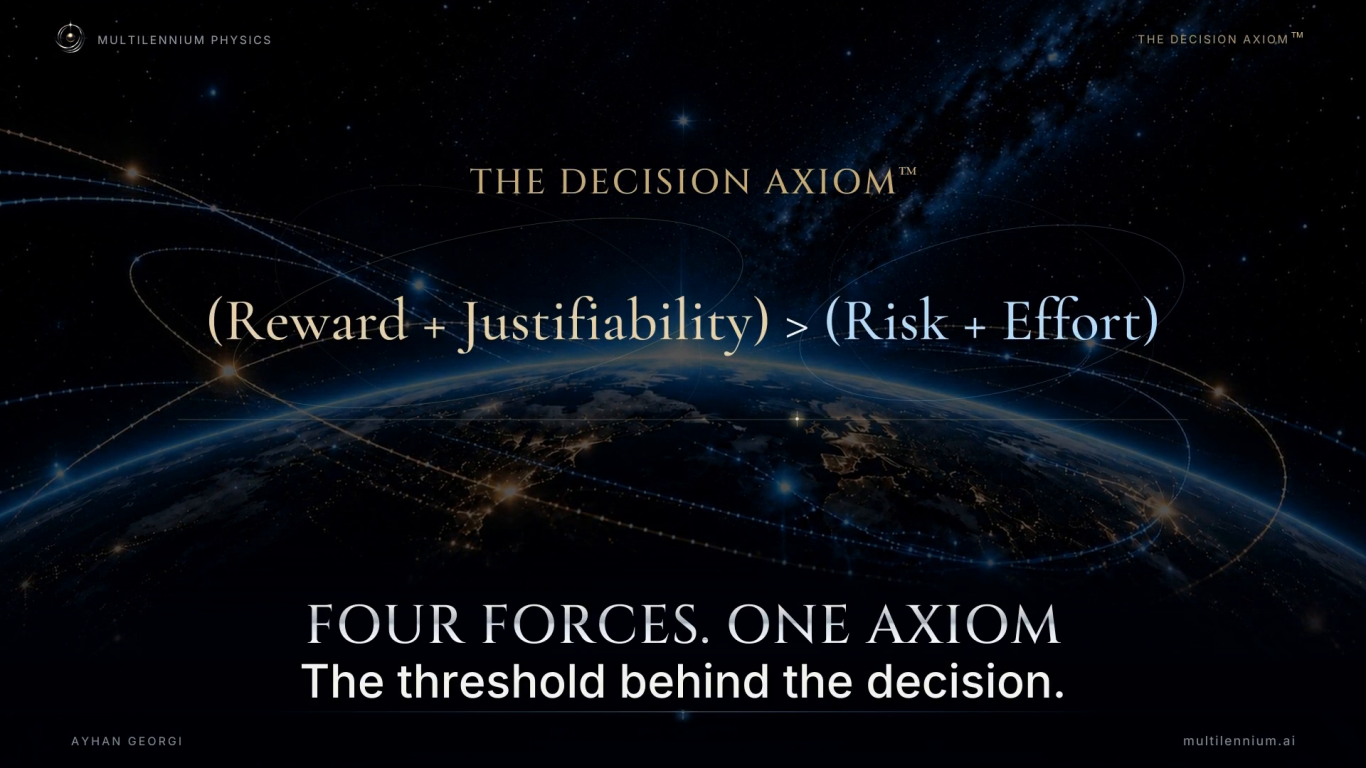
These materials, including MULTILENNIUM PHYSICS™ with its practical decision models, frameworks and tools such as the Decision Axiom™, Customer Clarity Matrix™, Clarity State™ and Sales Reality Matrix™, as well as the twelve Applied Perspectives, represent original first-mover work. I kindly ask that the intellectual property behind them be respected. Please ensure that any use, reproduction or adaptation is appropriately authorised and clearly attributed to Ayhan Georgi and MULTILENNIUM PHYSICS™. (MR)
Multilennium Physics™ is available for licensed use, supported by a Train-the-Trainer (TtT) programme. The Applied Perspectives 01–12 materials can be licensed separately for a one-time fee. Usage rights and scope are defined in the respective licence agreement.
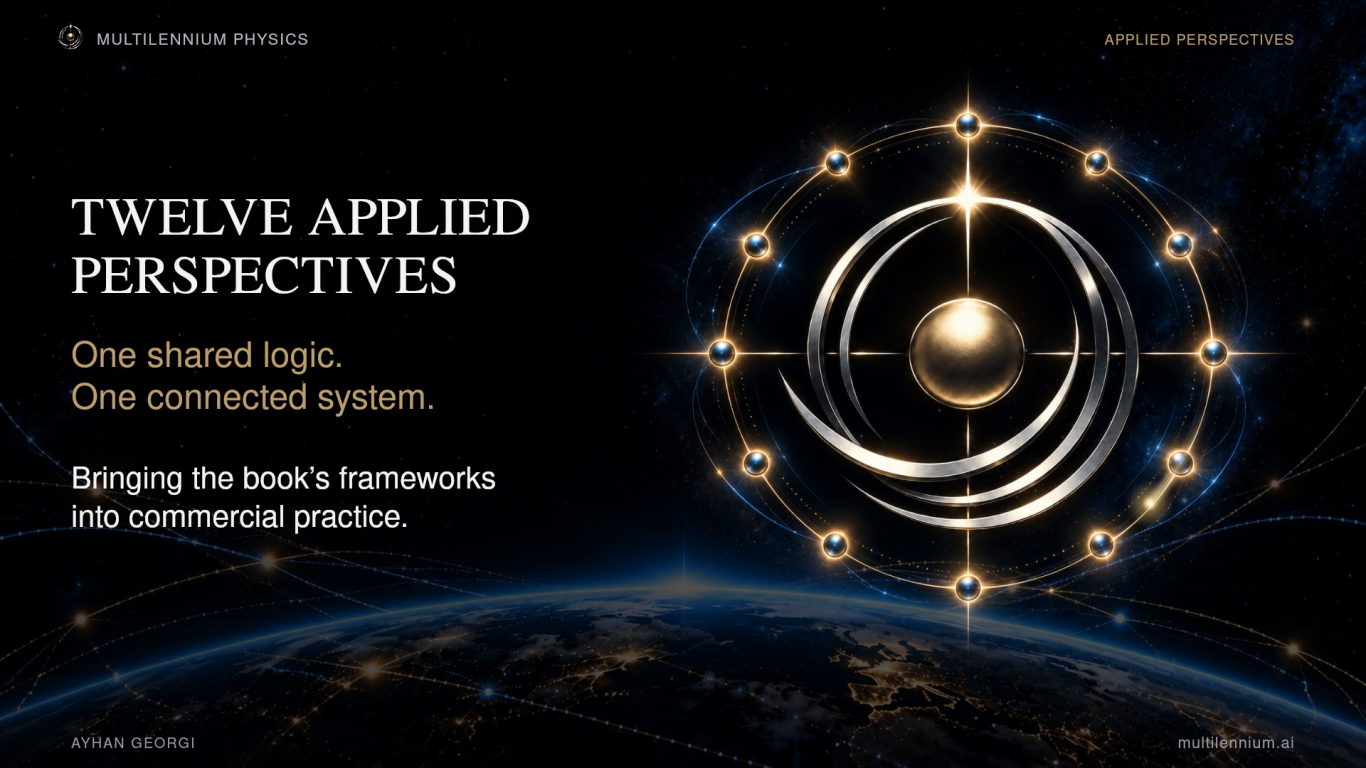
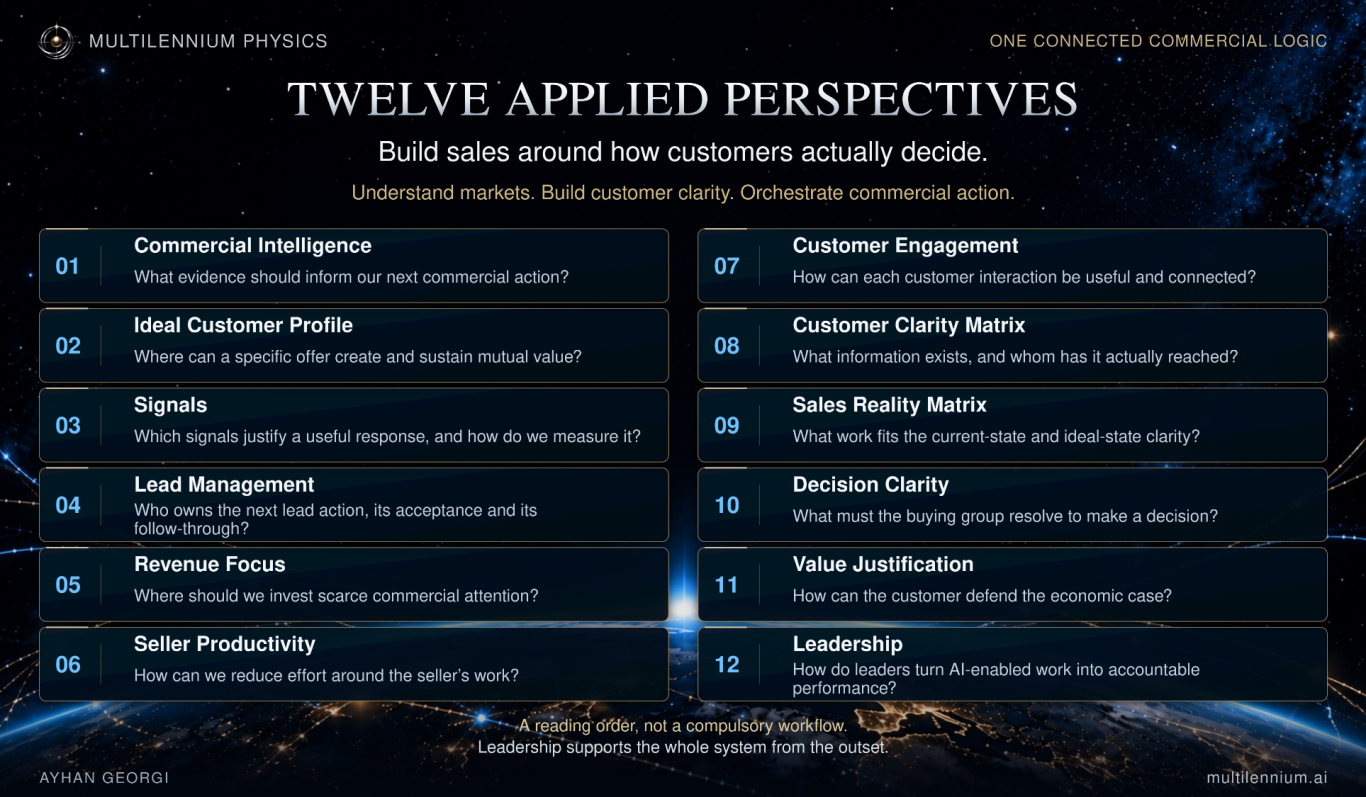
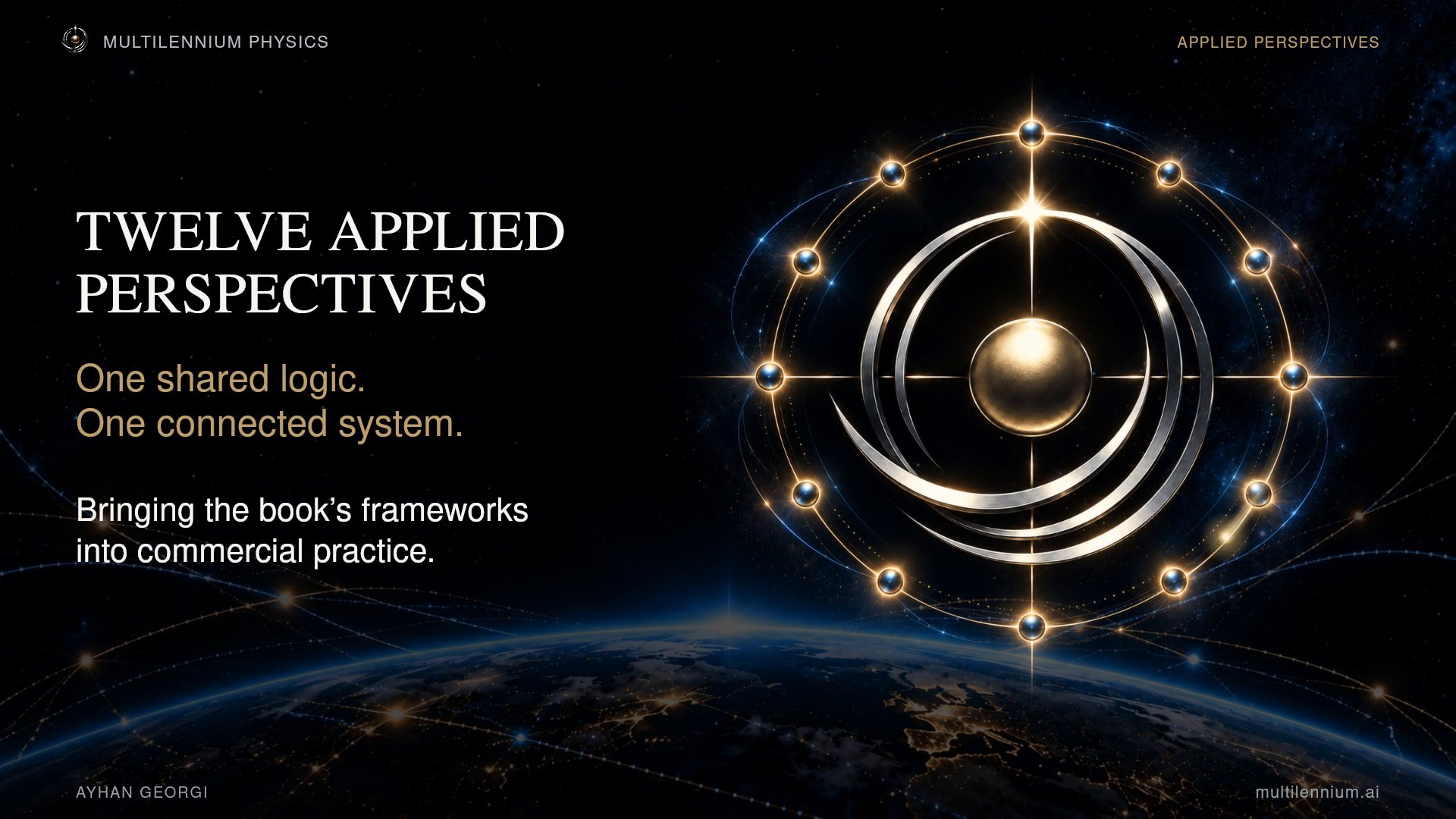
Twelve Applied Perspectives
Build sales around how customers actually decide.
Understand markets. Build customer clarity.
Orchestrate commercial action.
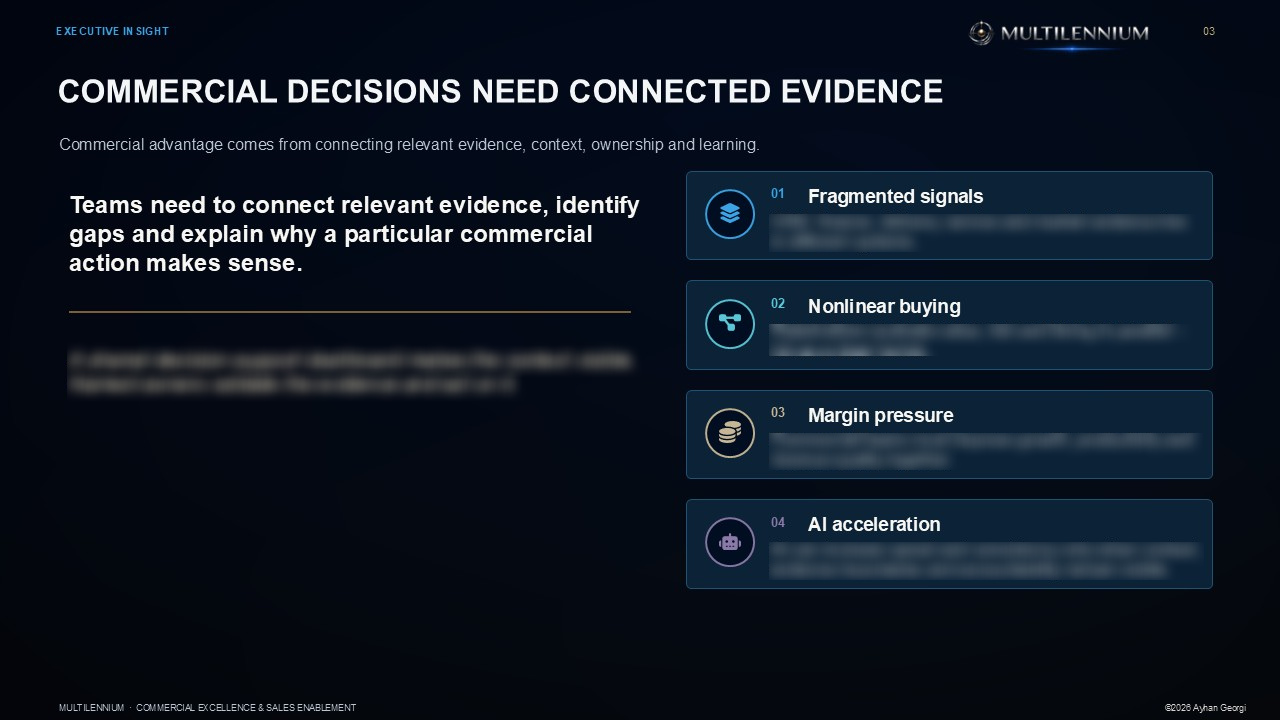
Changing markets and buying behaviour demand a sales approach that connects market development, customer engagement and commercial processes with the reality of B2B decisions.
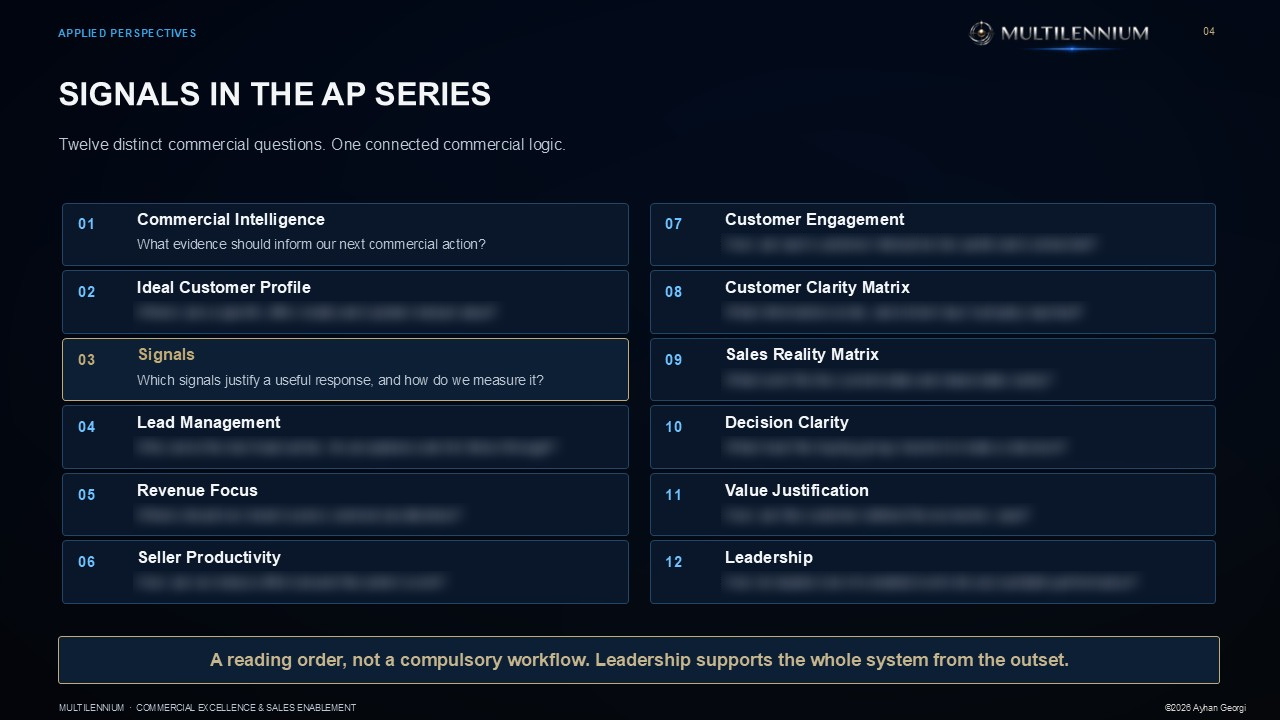
The Twelve Applied Perspectives bring these challenges into one connected commercial logic. Grounded in MULTILENNIUM PHYSICS™, they offer practical models and frameworks to identify the right customers, interpret signals, focus resources and make interactions more relevant. They help teams examine what stakeholders know, share and understand, clarify what still needs to be resolved, and develop a value case customers can justify.
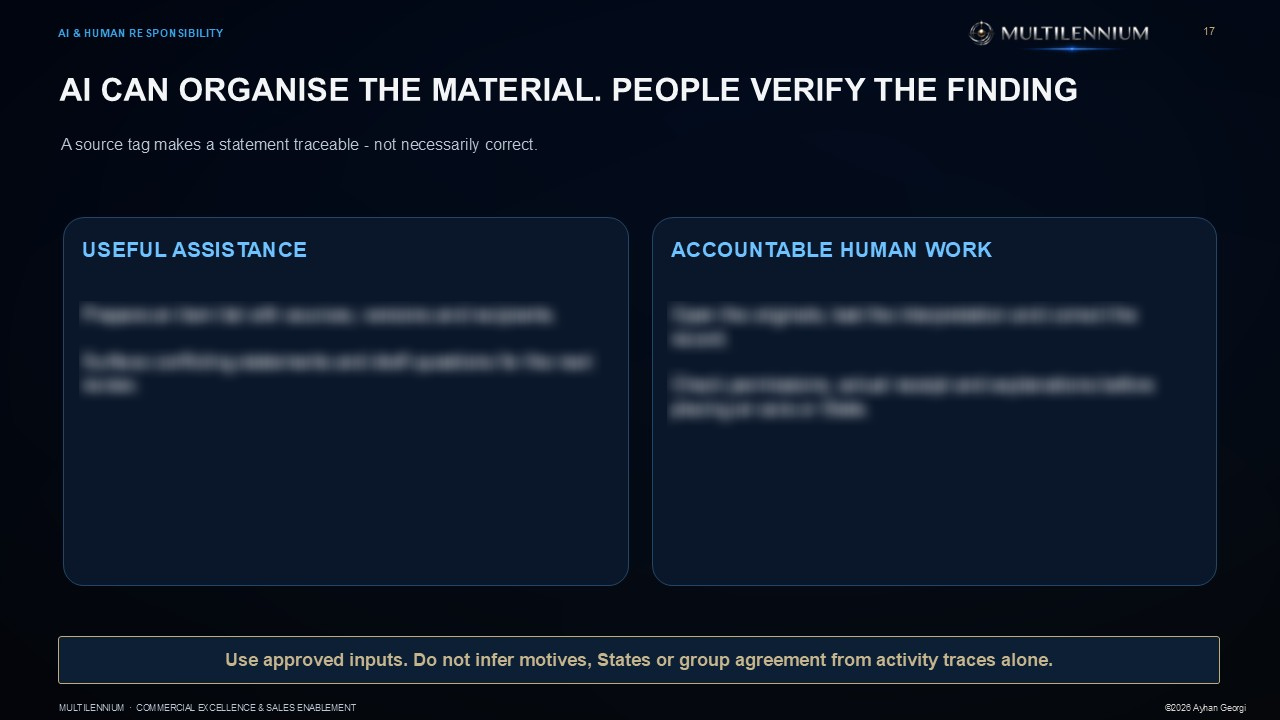
Use them to adapt processes and orchestrate marketing, sales and service around the customer’s situation and decision needs. Leadership connects priorities, capabilities and ownership across the system. AI supports analysis and preparation. People remain accountable for judgement, commitments and results.
Explore the twelve perspectives.

APPLIED PERSPECTIVE 01
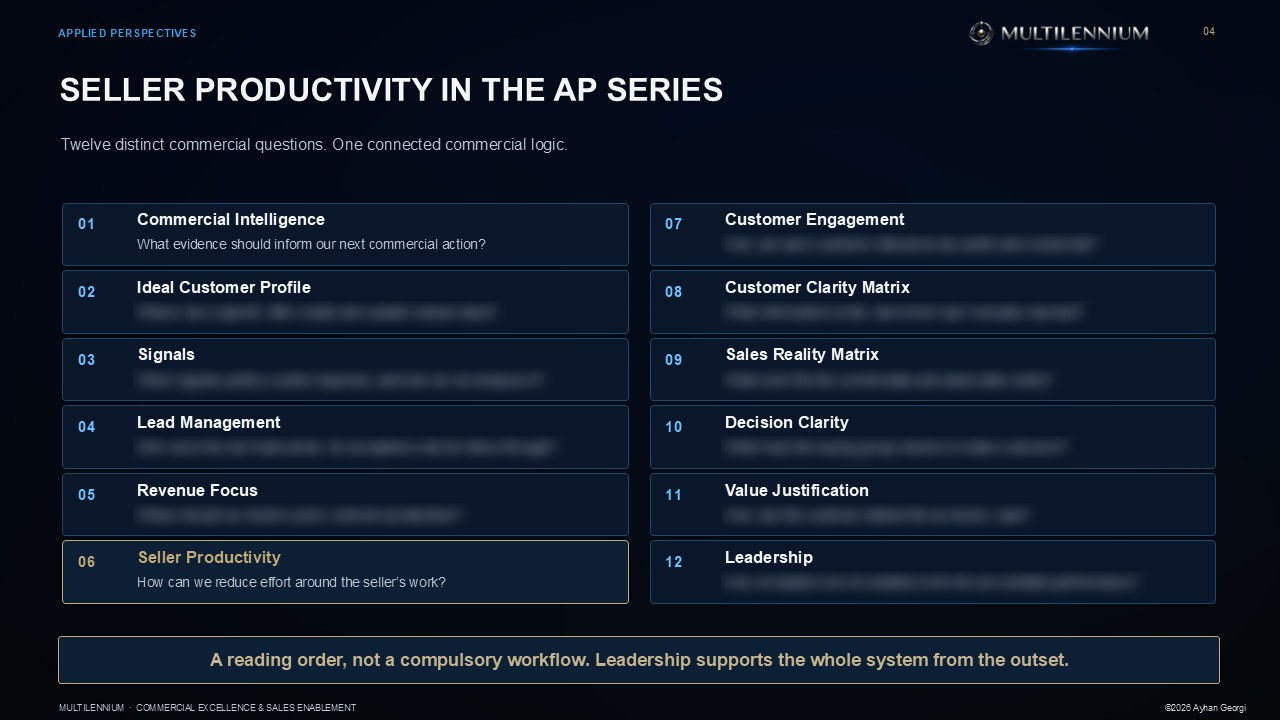
Commercial Intelligence
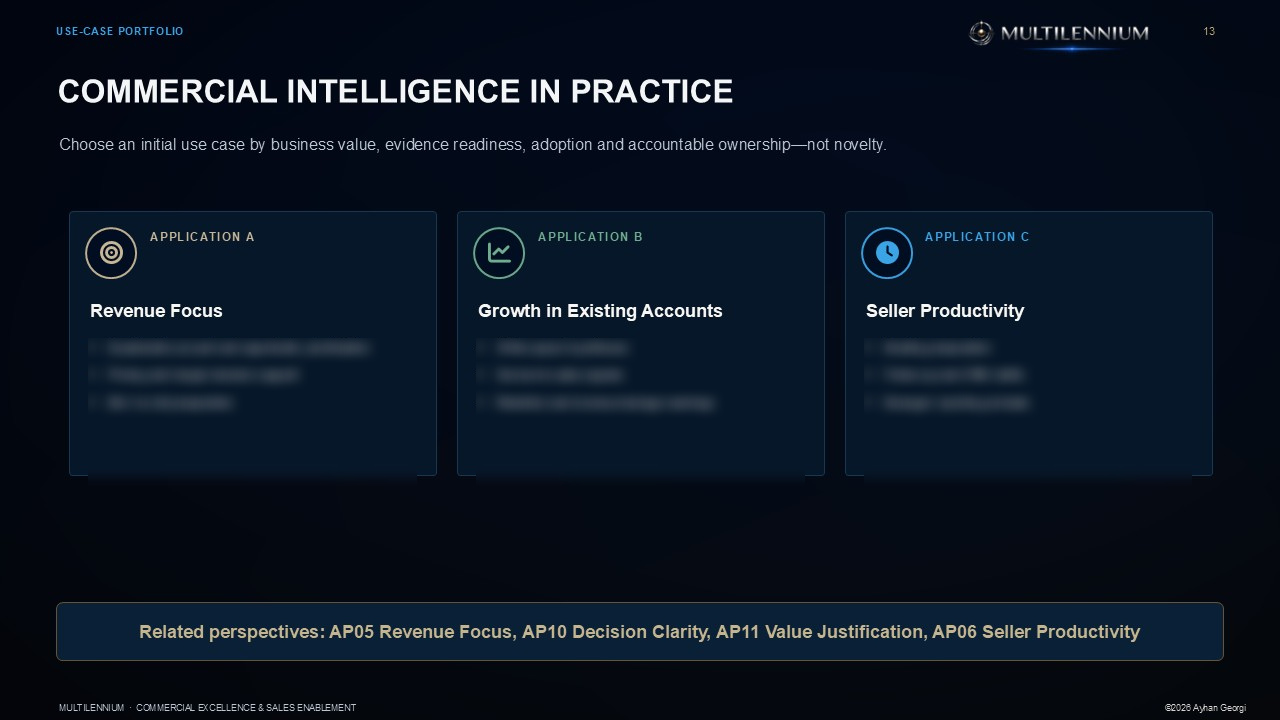
What evidence should inform our next commercial action?
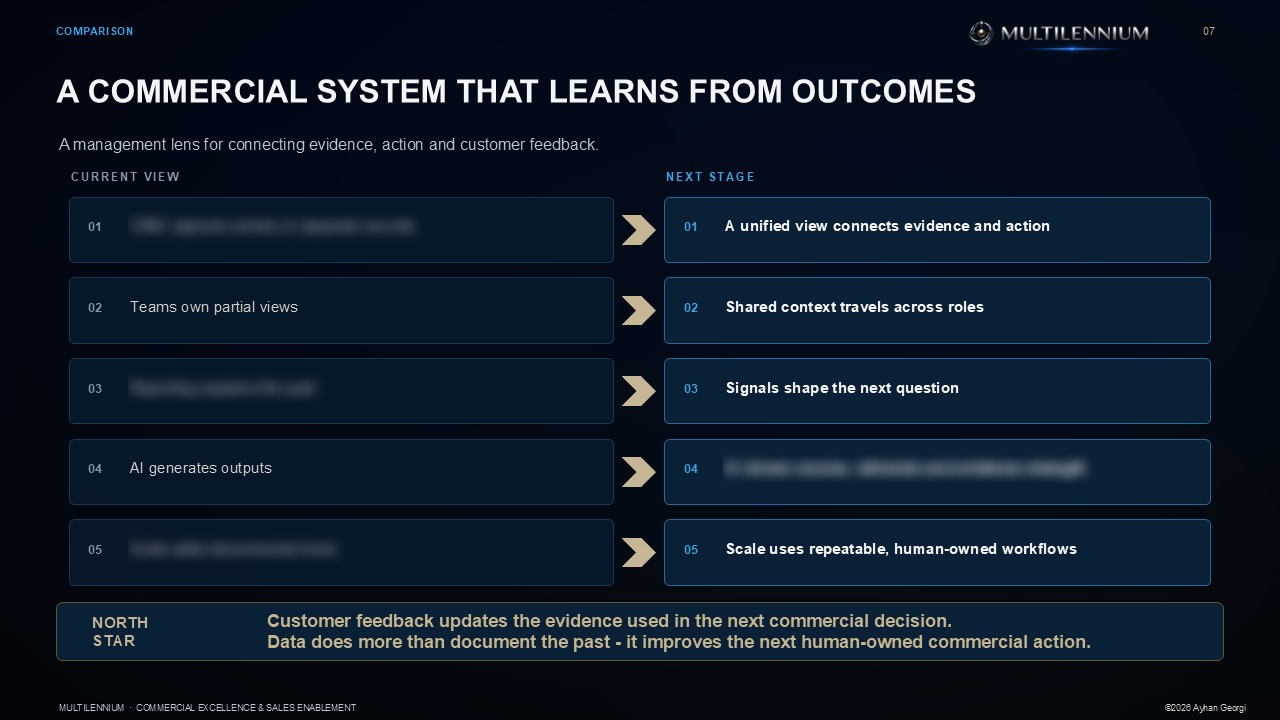
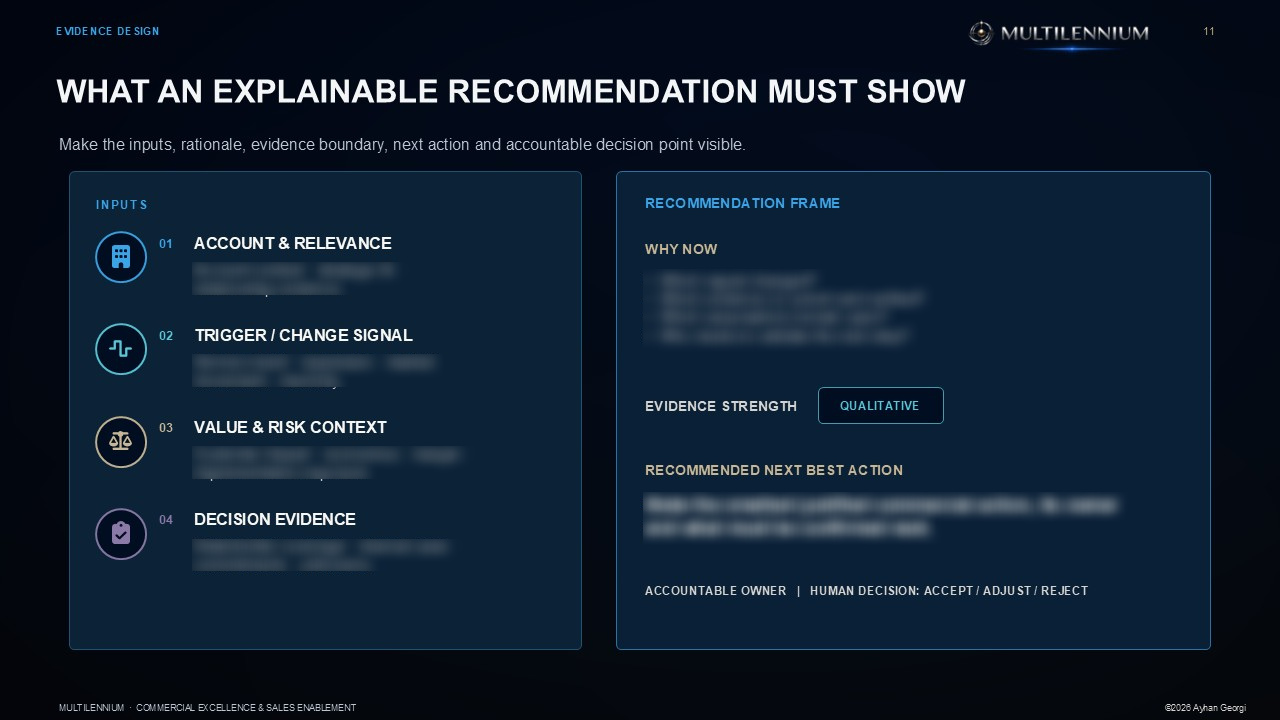
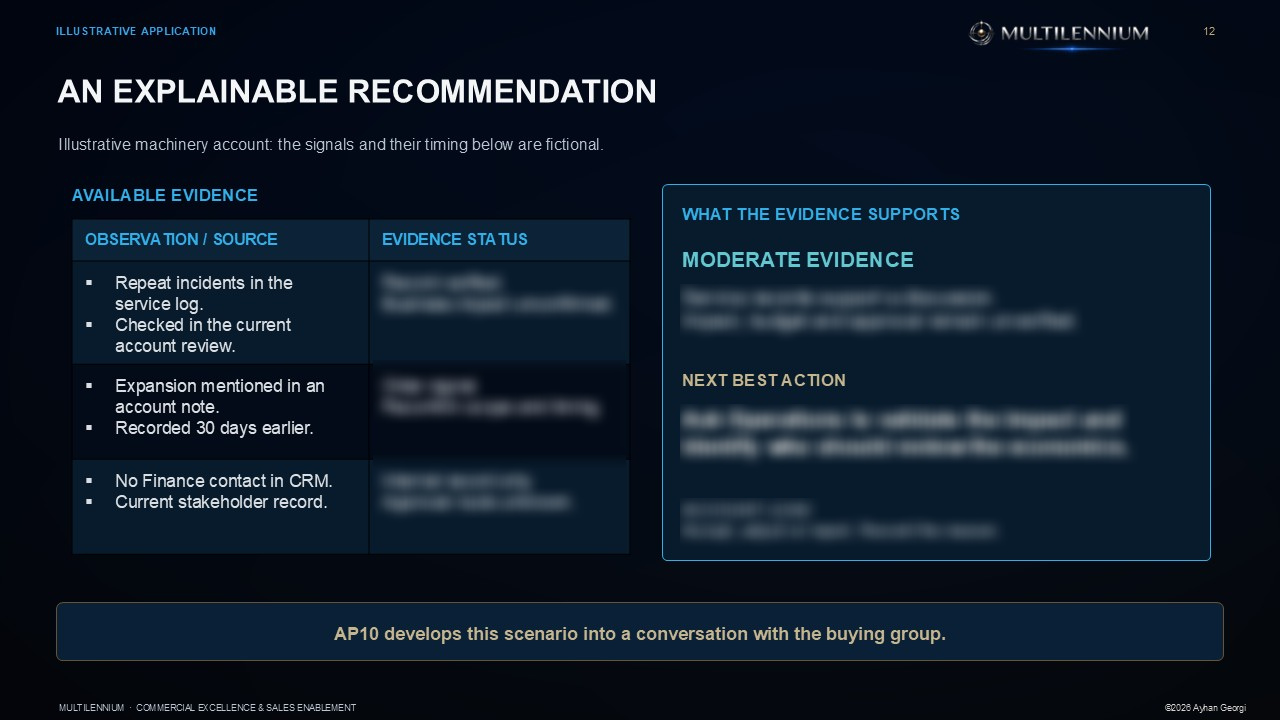
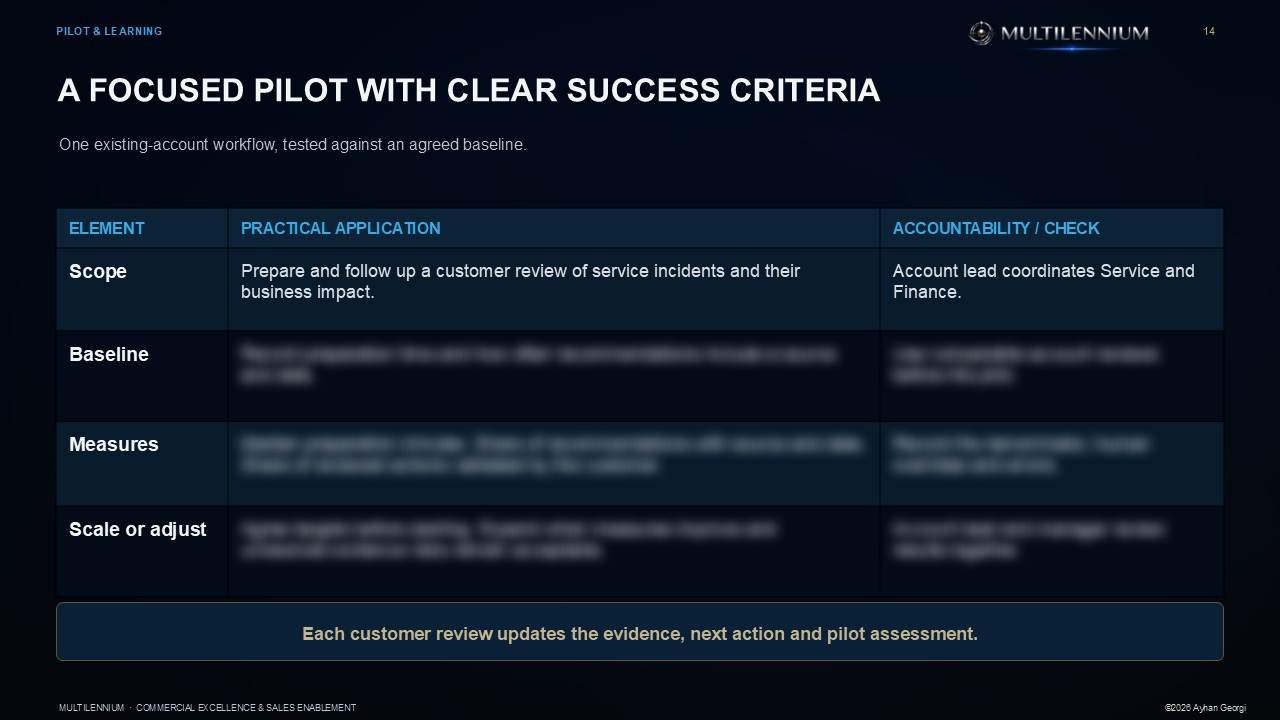
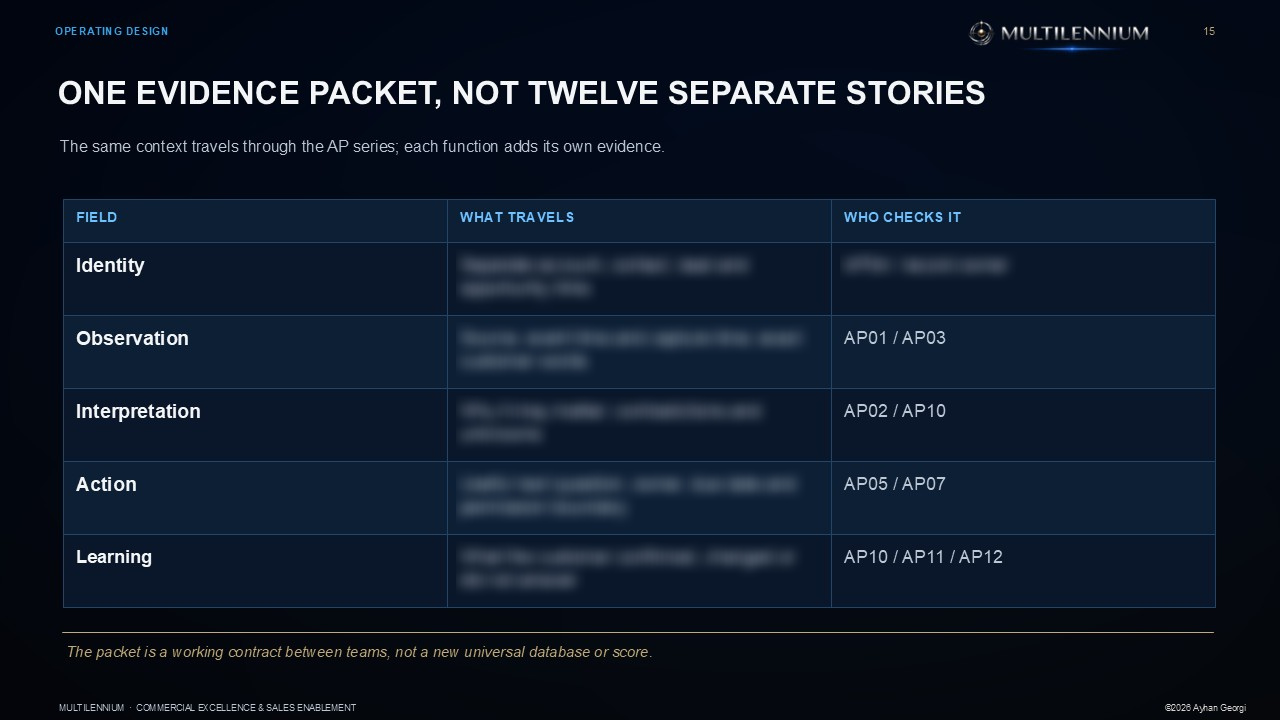
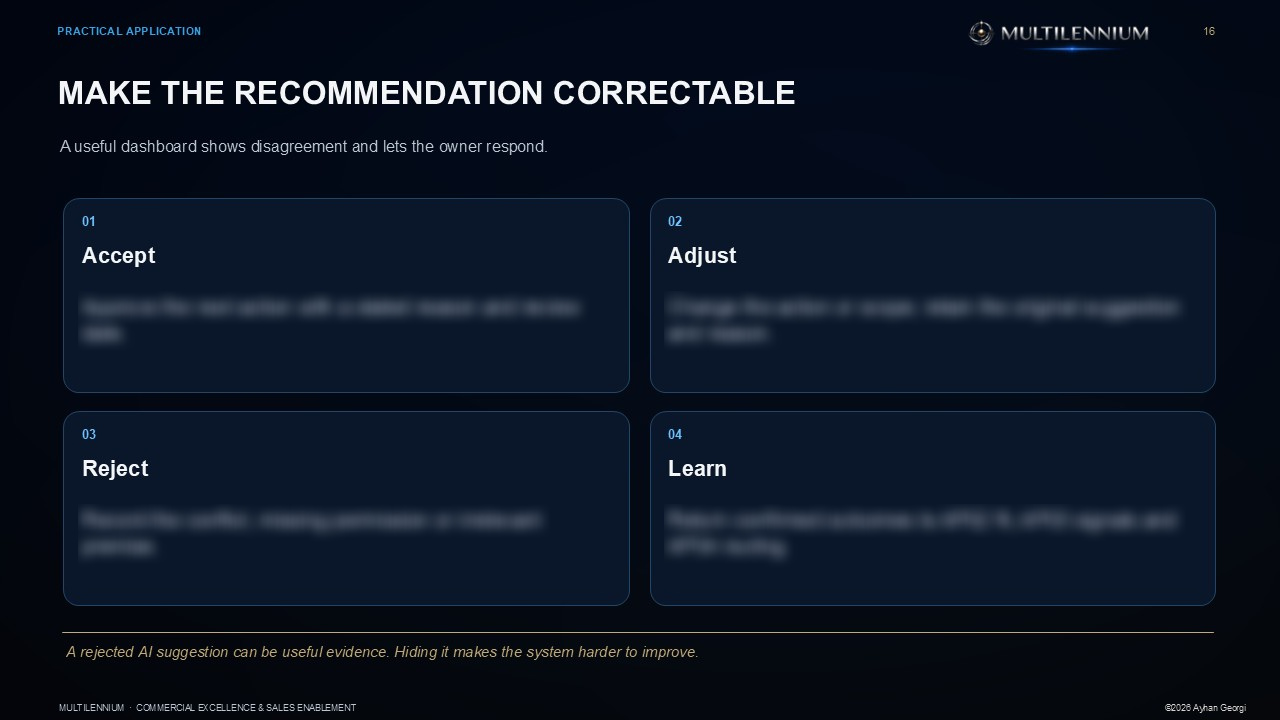
Turn fragmented account, market and customer information into an explainable next action - with sources, uncertainty and ownership intact.
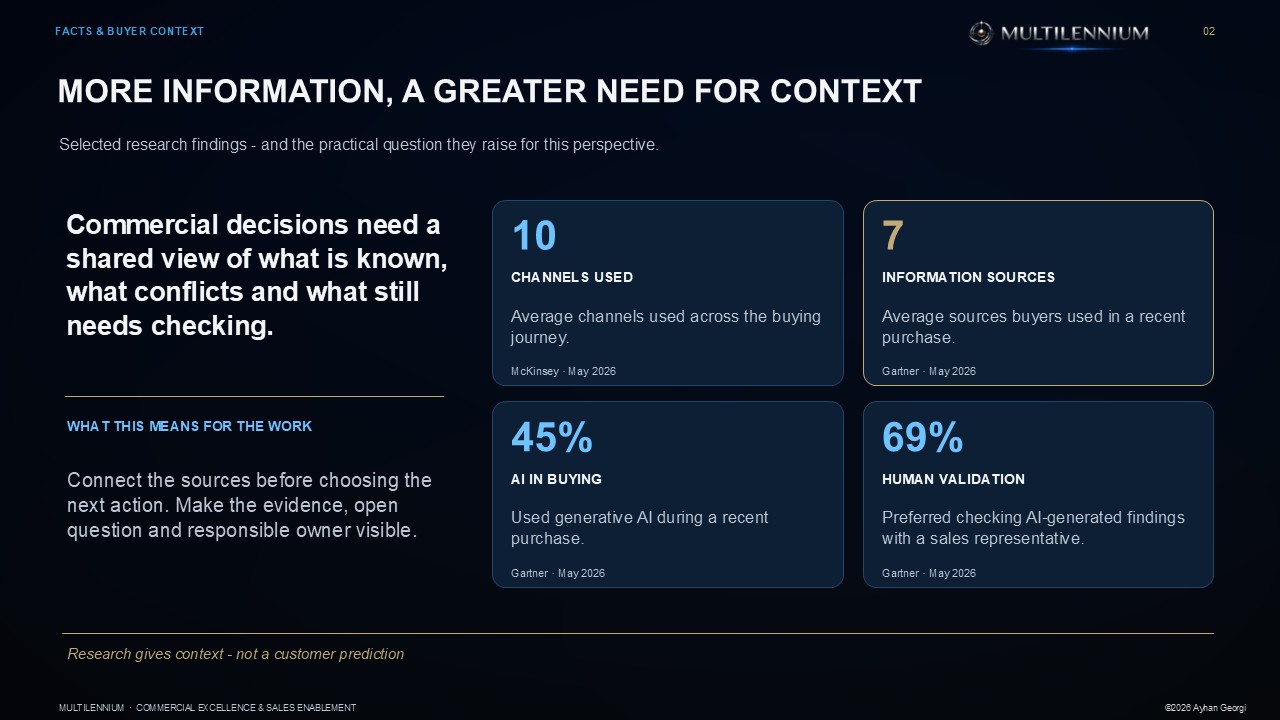
Your team has more information than it can use. What matters is whether the next commercial action can be explained: what changed, what supports the interpretation and what still needs to be checked.
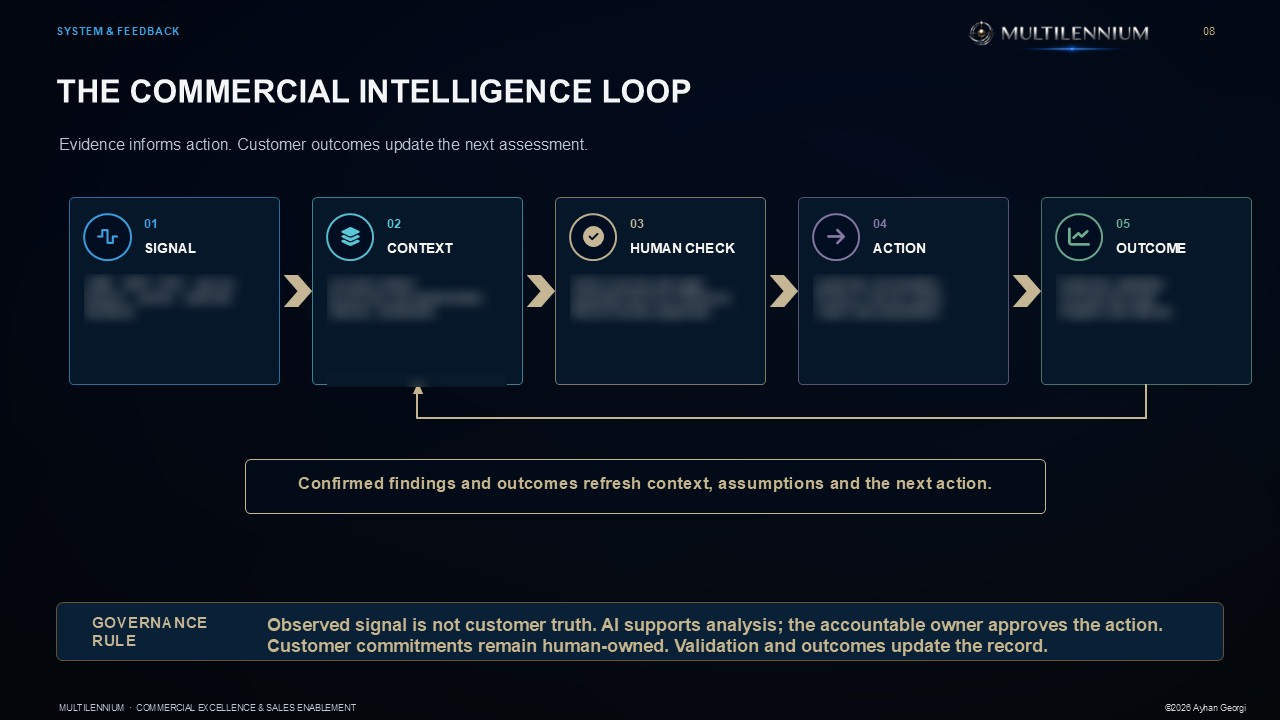
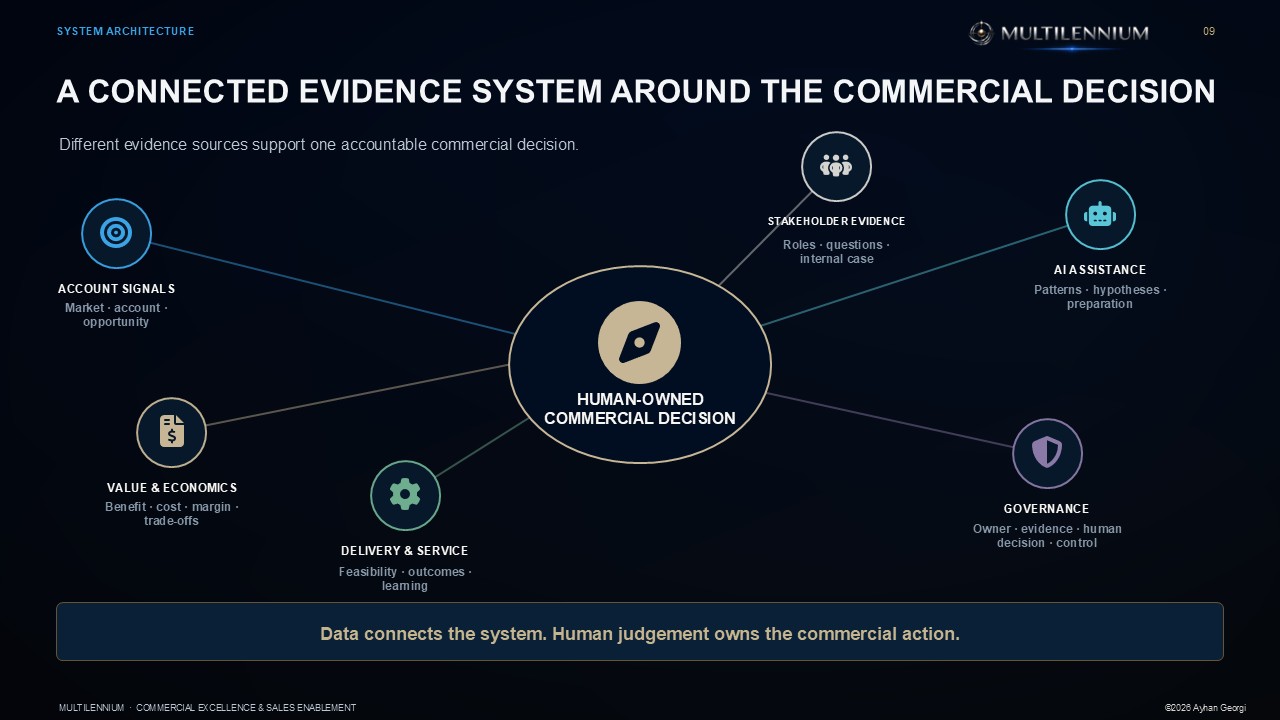
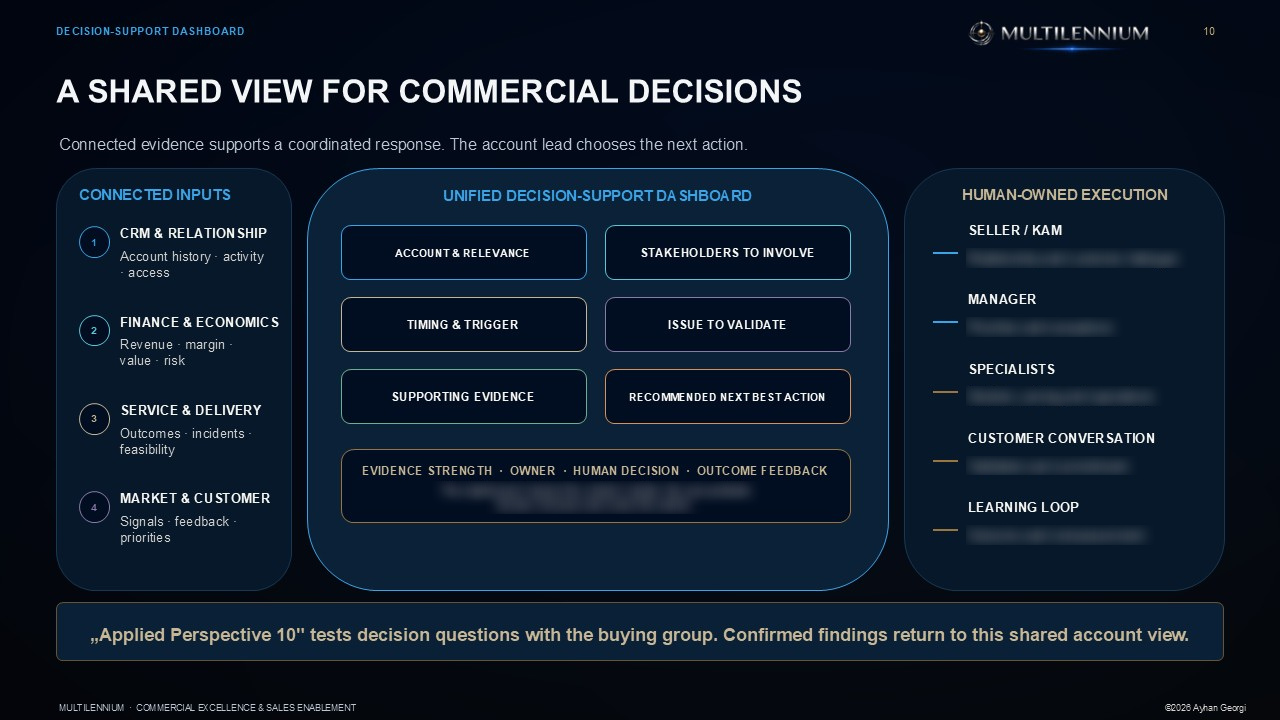
Commercial Intelligence connects customer, service, market and relationship evidence around a specific commercial question. It separates the observed fact from the interpretation, keeps contradictions visible and gives a named person responsibility for the next action.
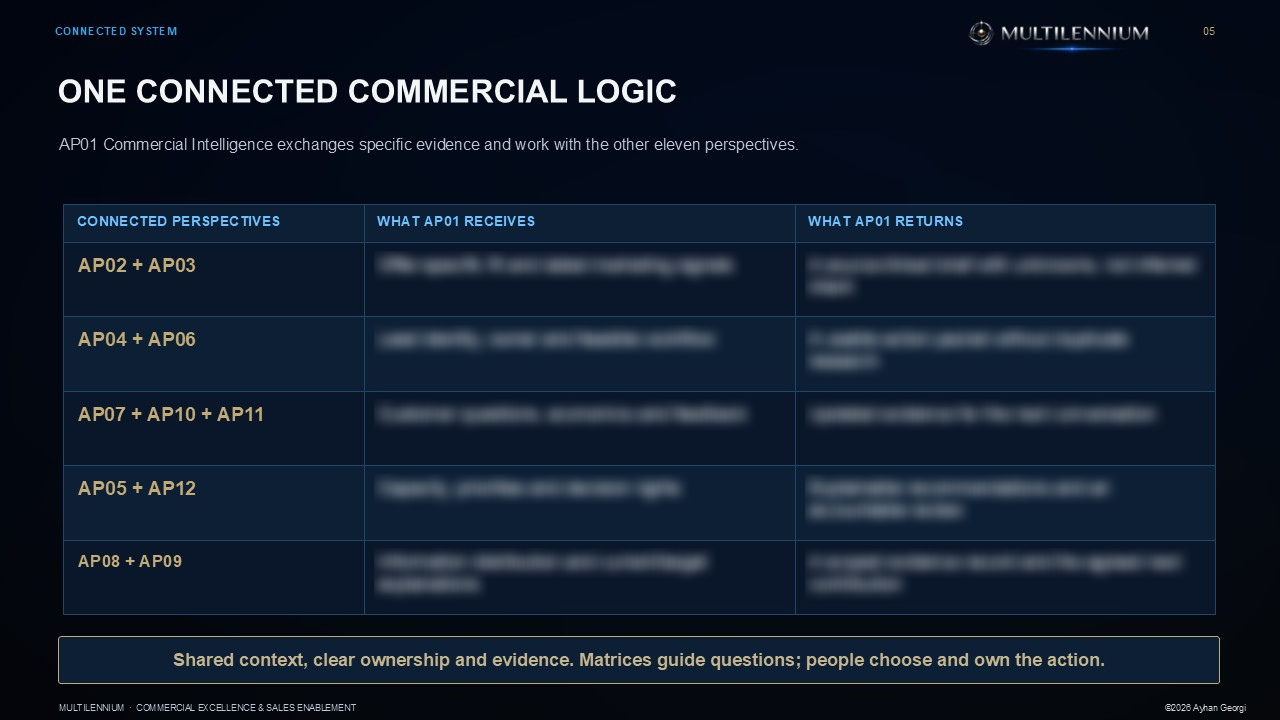
In the connected AP series, Signals supplies dated observations, Lead Management supplies the existing relationship and owner, and Decision Clarity tests the customer question. The result is not another report to read. It is a practical way to prepare, challenge and improve the decision about what the team should do next.
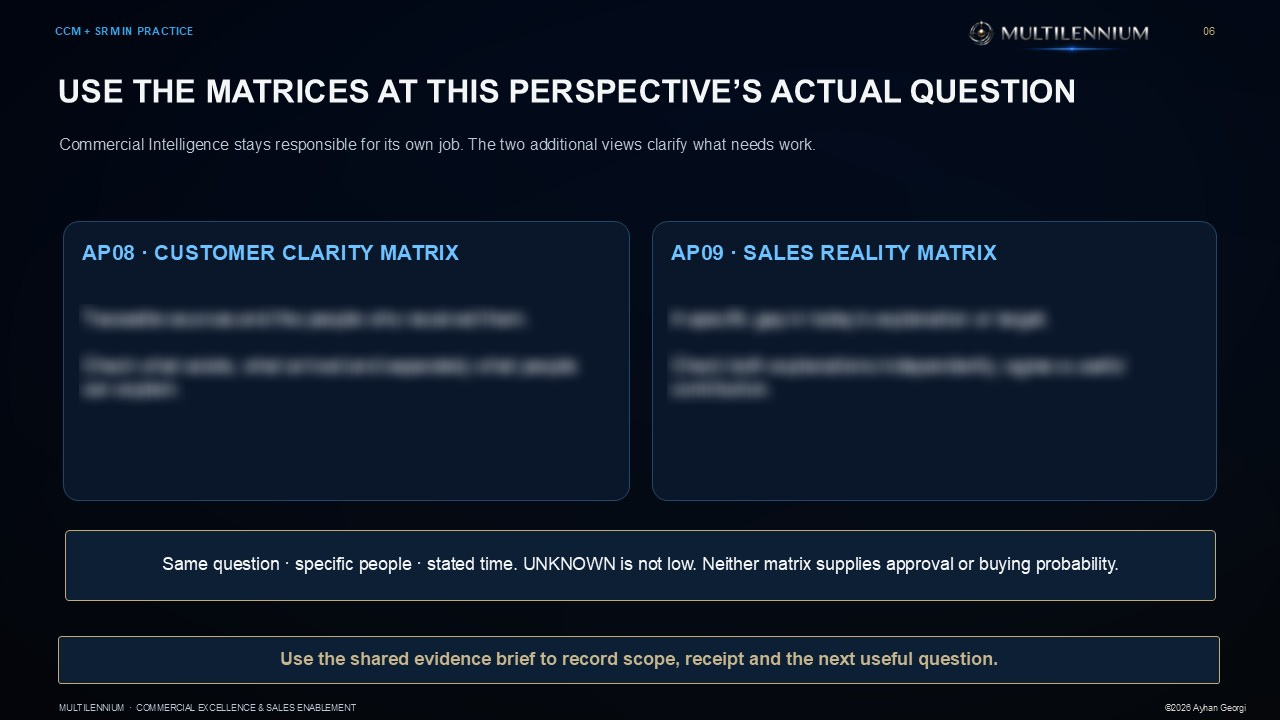
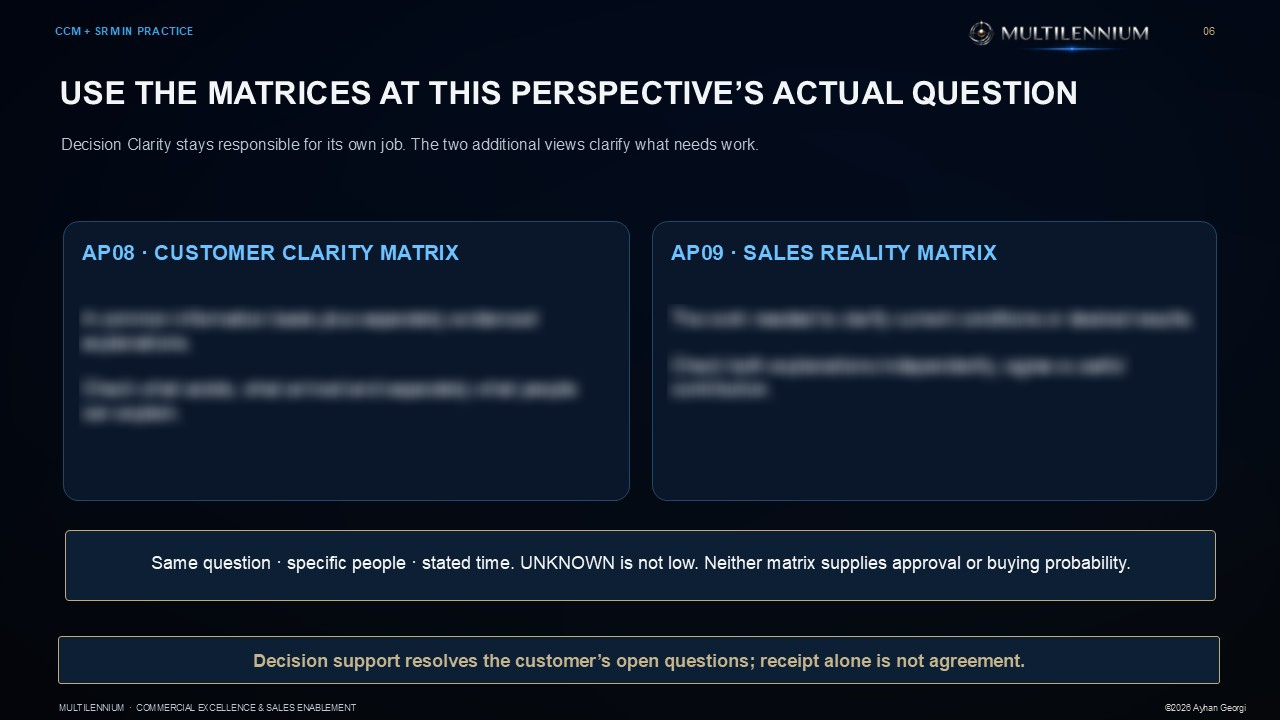
The two clarity perspectives add a practical check here: AP08 makes the relevant information and confirmed sharing visible; AP09 helps select work from current-state and ideal-state explanations. Use the shared evidence brief to record scope, receipt and the next useful question.



FOCUS
Source-linked account brief; evidence and inference boundary; next-action record; customer-feedback loop.
WHEN TO USE
When research is repeated, reports disagree or recommendations cannot be traced to their evidence.
CONNECTIONS
AP03 Signals, AP04 Lead Management, AP05 Revenue Focus, AP10 Decision Clarity, AP08 Customer Clarity Matrix, AP09 Sales Reality Matrix.
APPLIED PERSPECTIVE 02
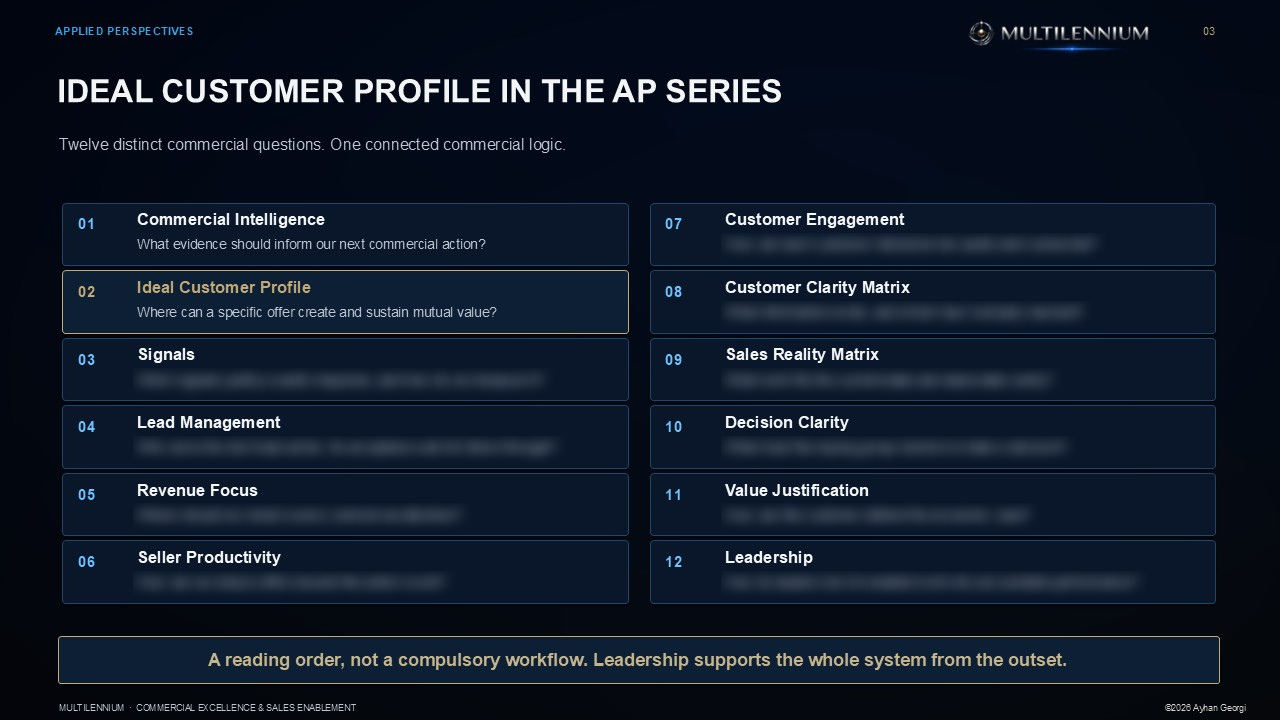
Ideal Customer Profile
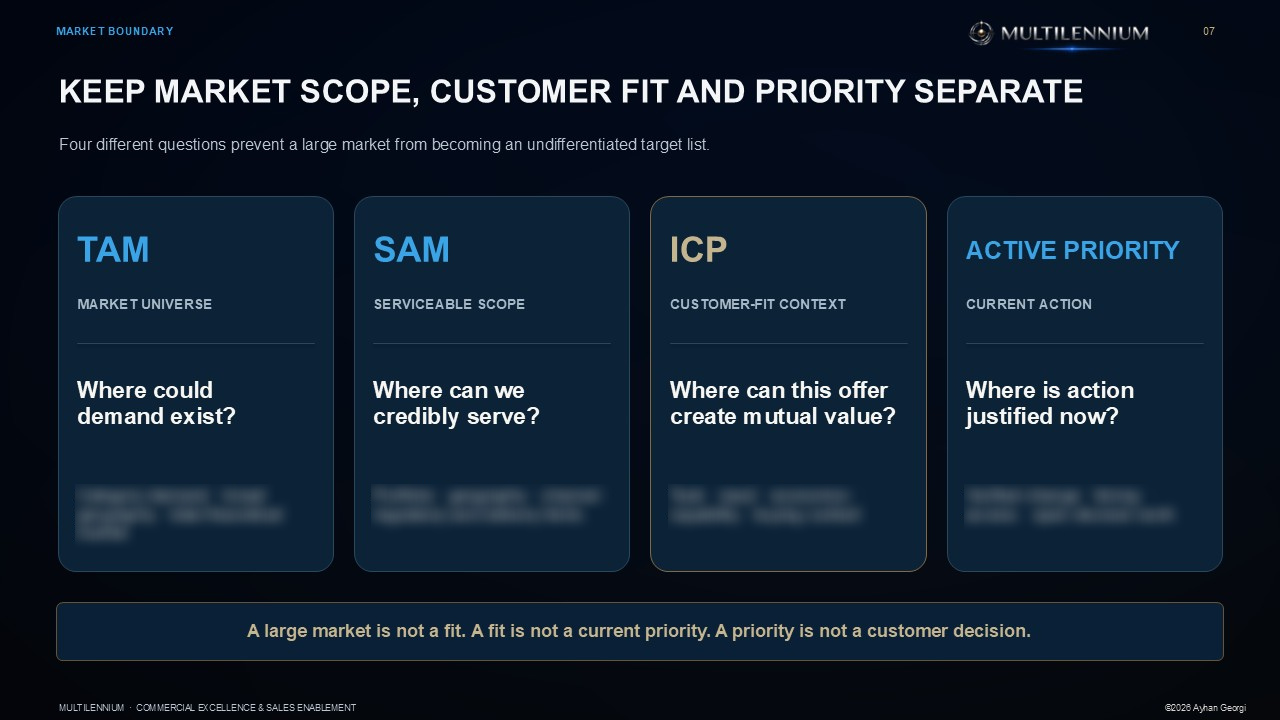
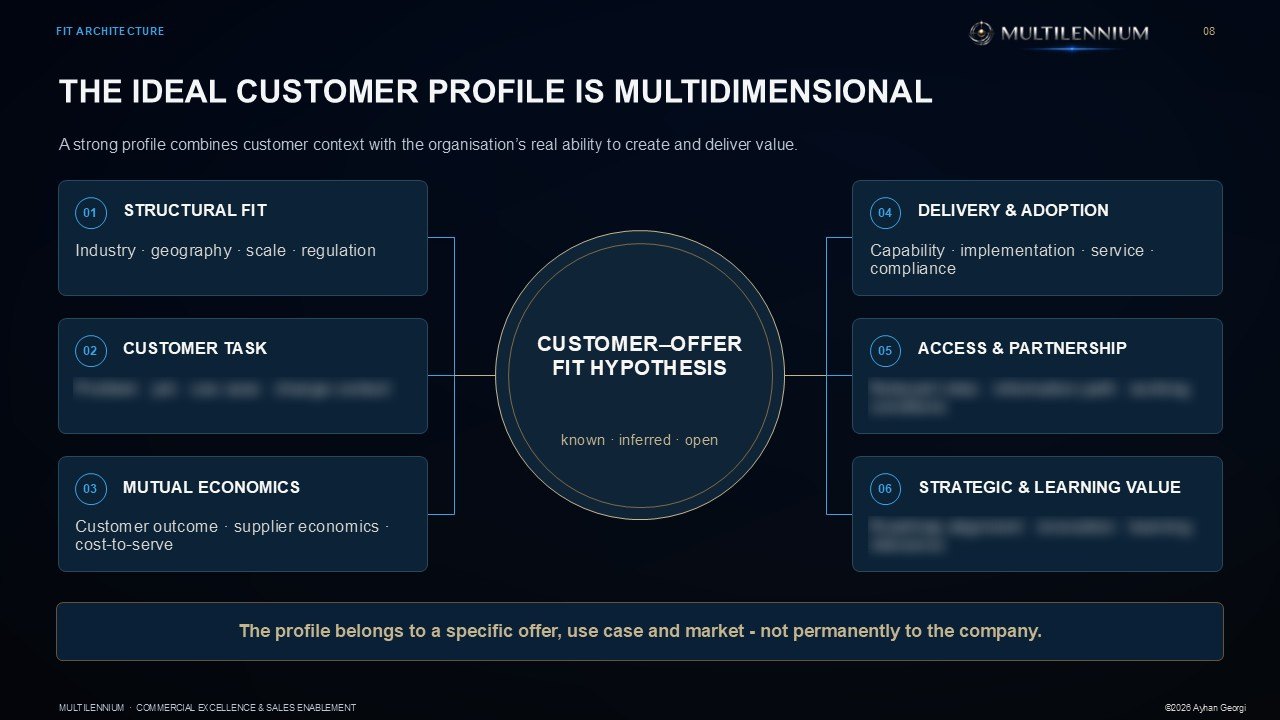
Where can a specific offer create and sustain mutual value?
Turn fragmented account, market and customer information into an explainable next action - with sources, uncertainty and ownership intact.
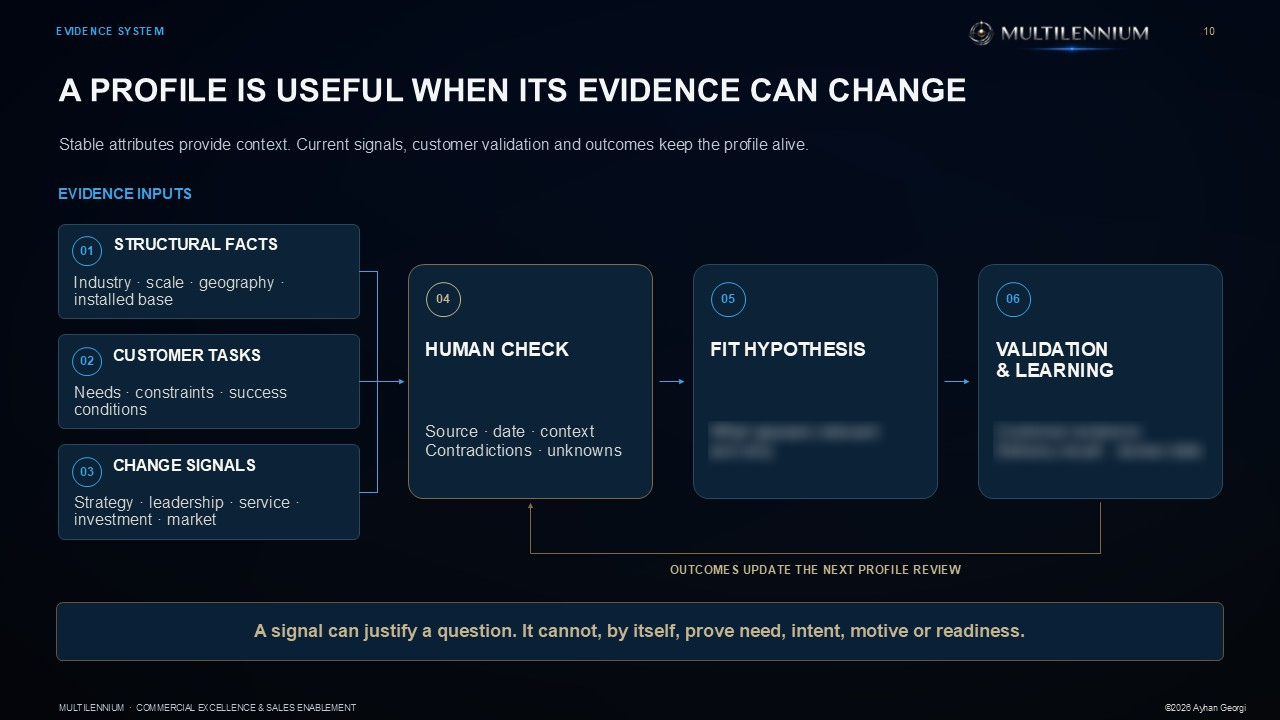
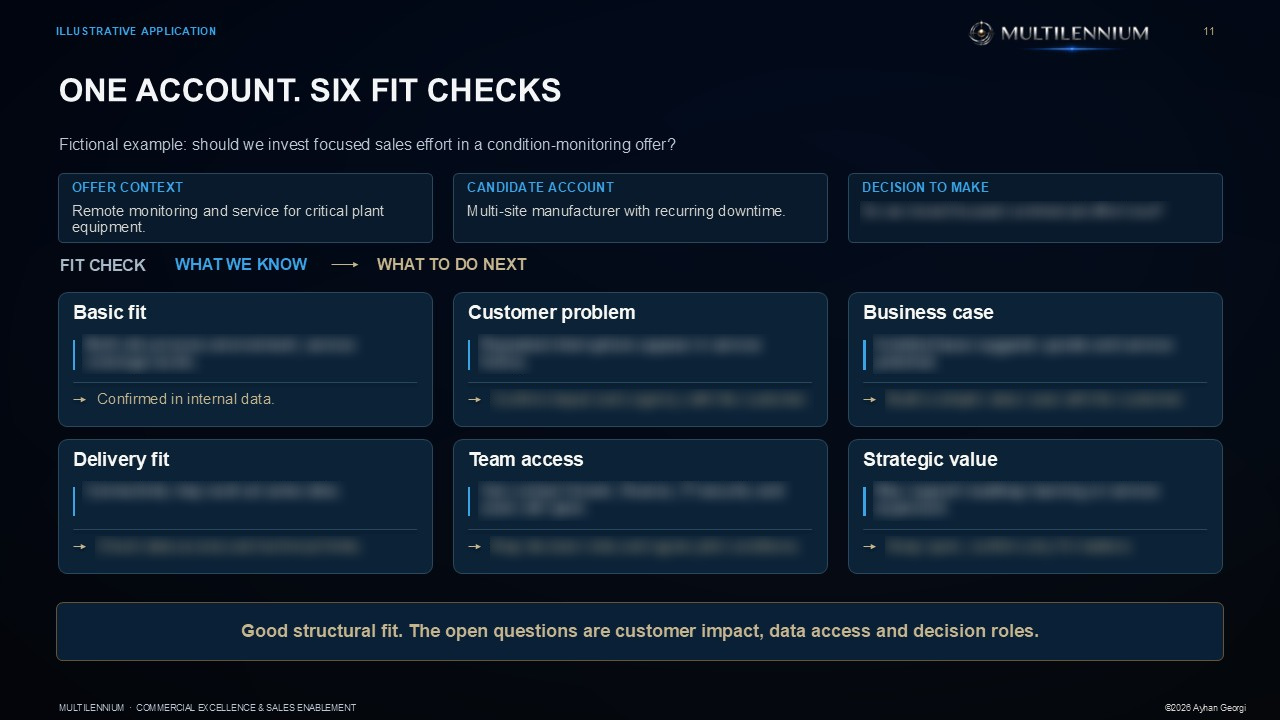
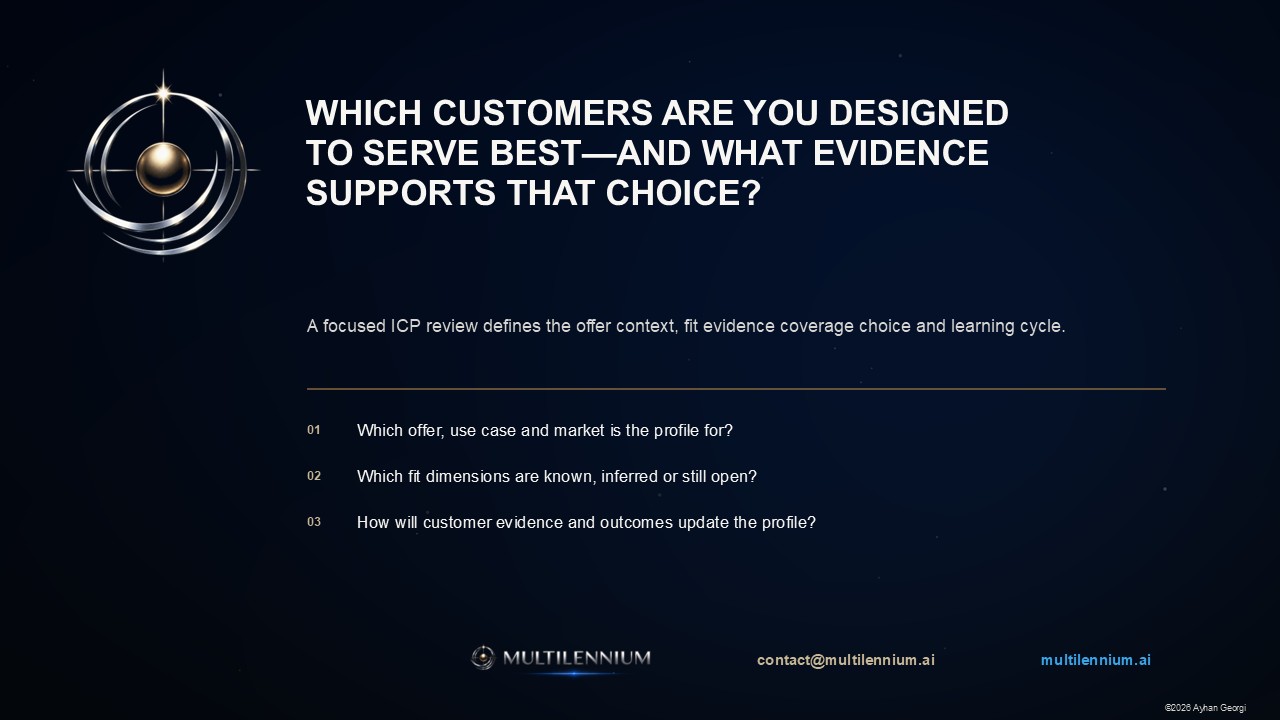
Define where a specific offer can create and sustain mutual value, then revise the profile as customer evidence and delivery experience change.
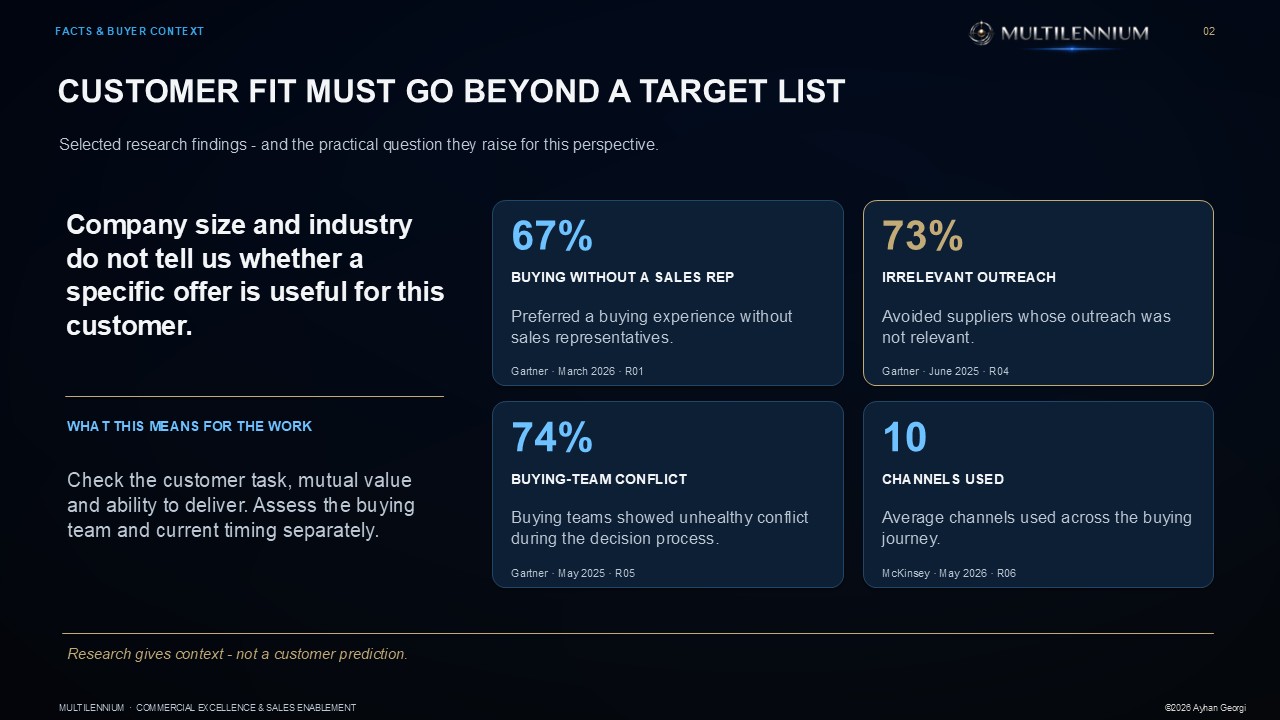
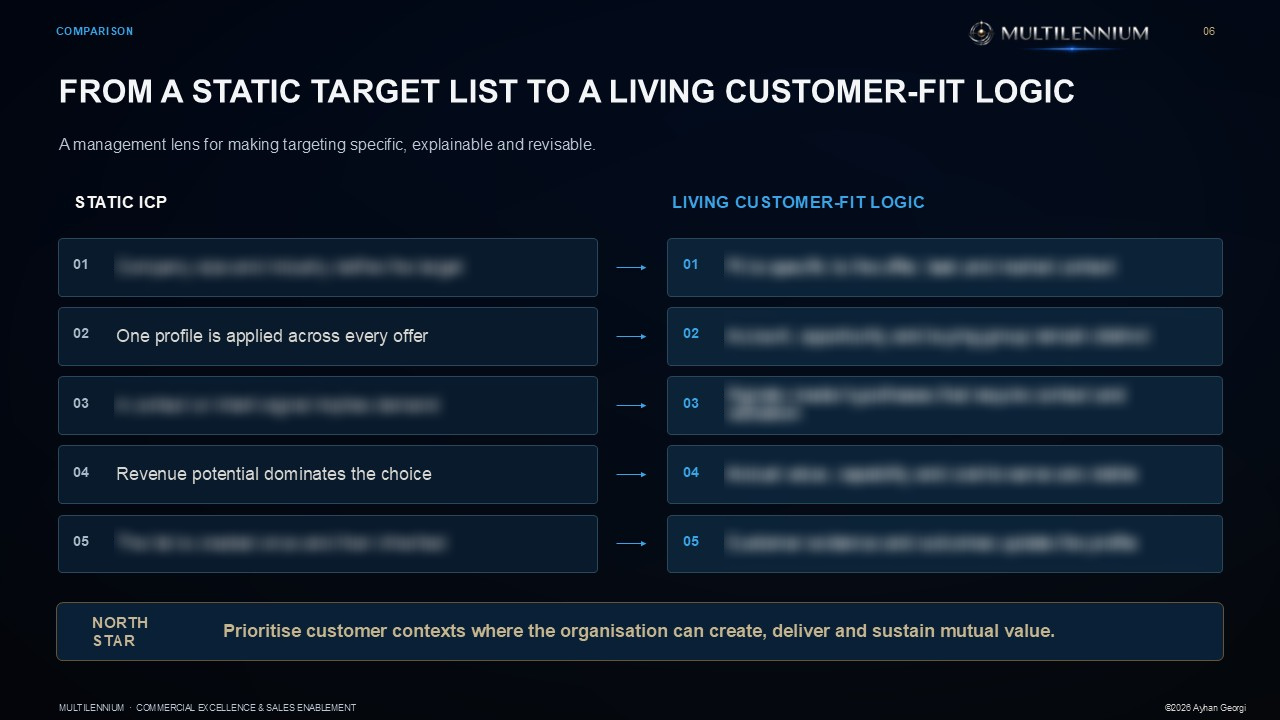
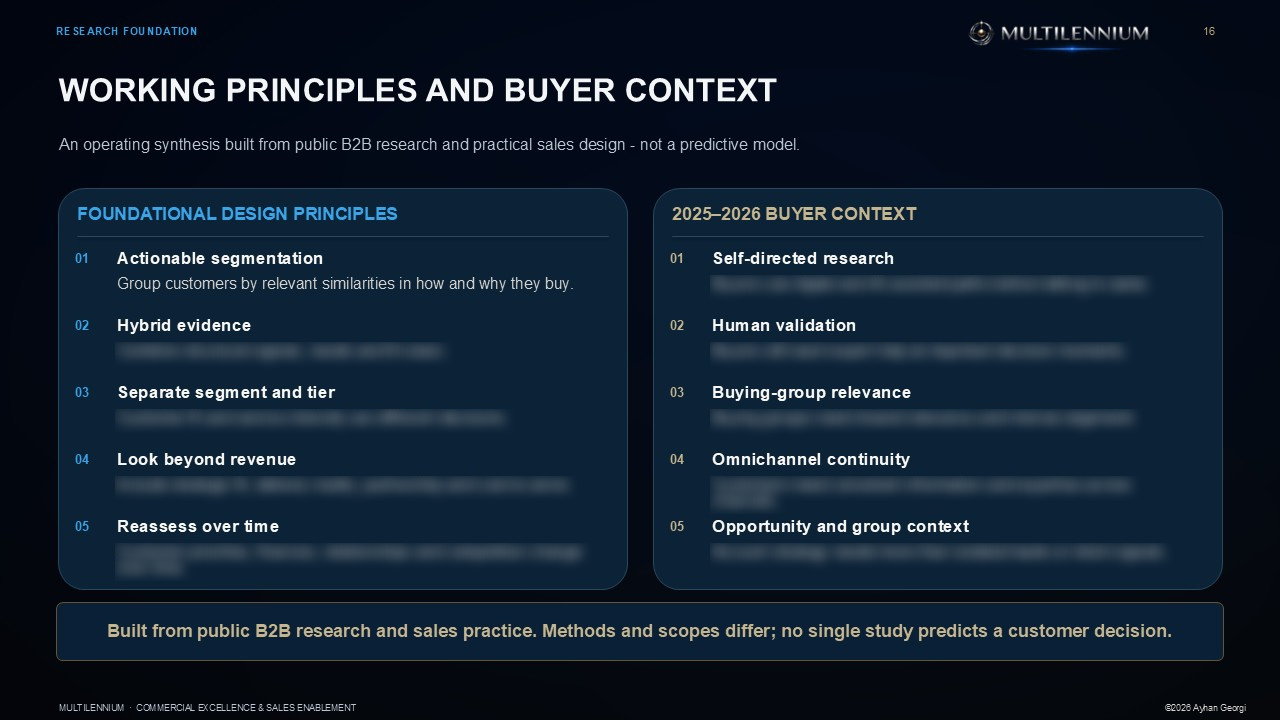
Company size and industry can help define a market. They cannot, on their own, tell you whether a particular offer is relevant or whether the organisation can deliver mutual value.
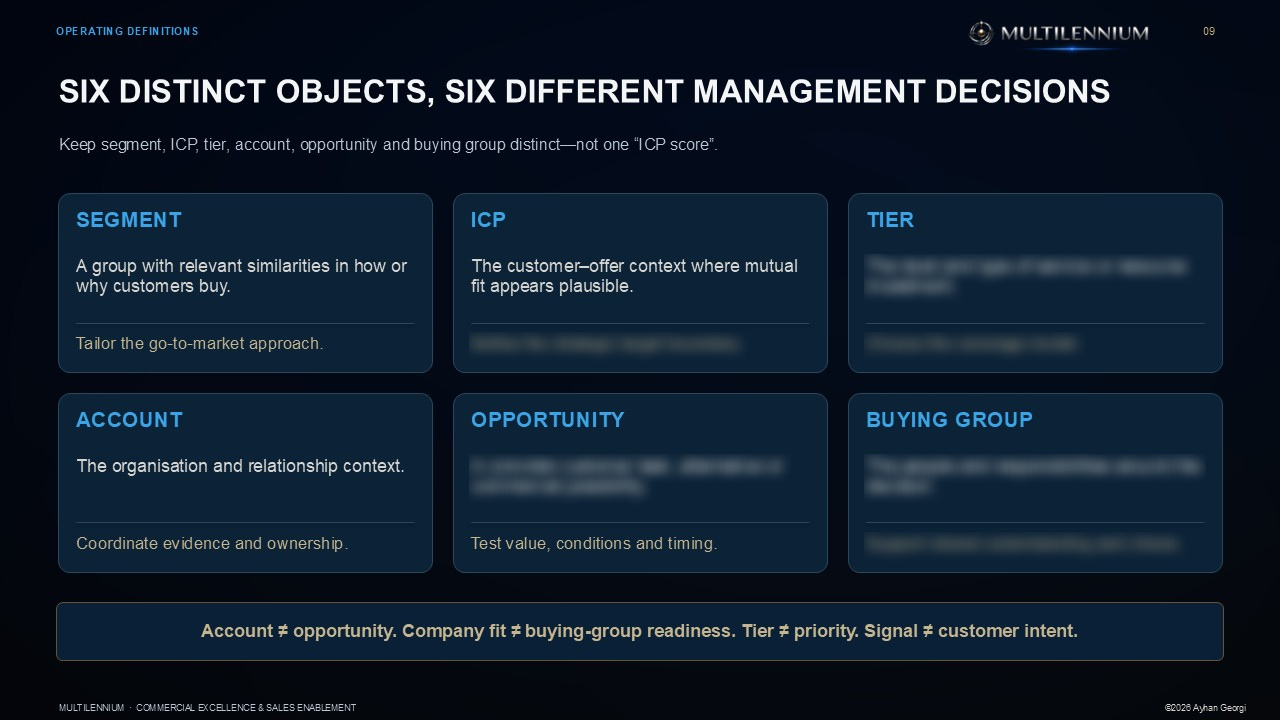
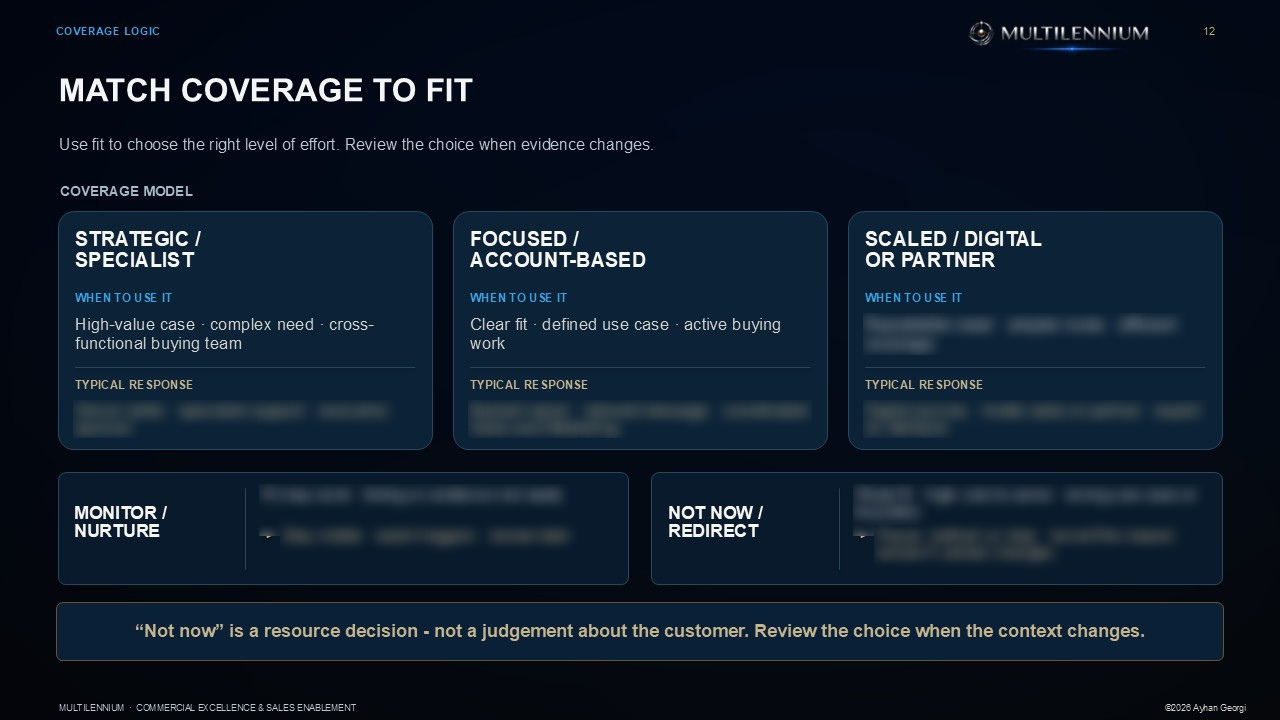
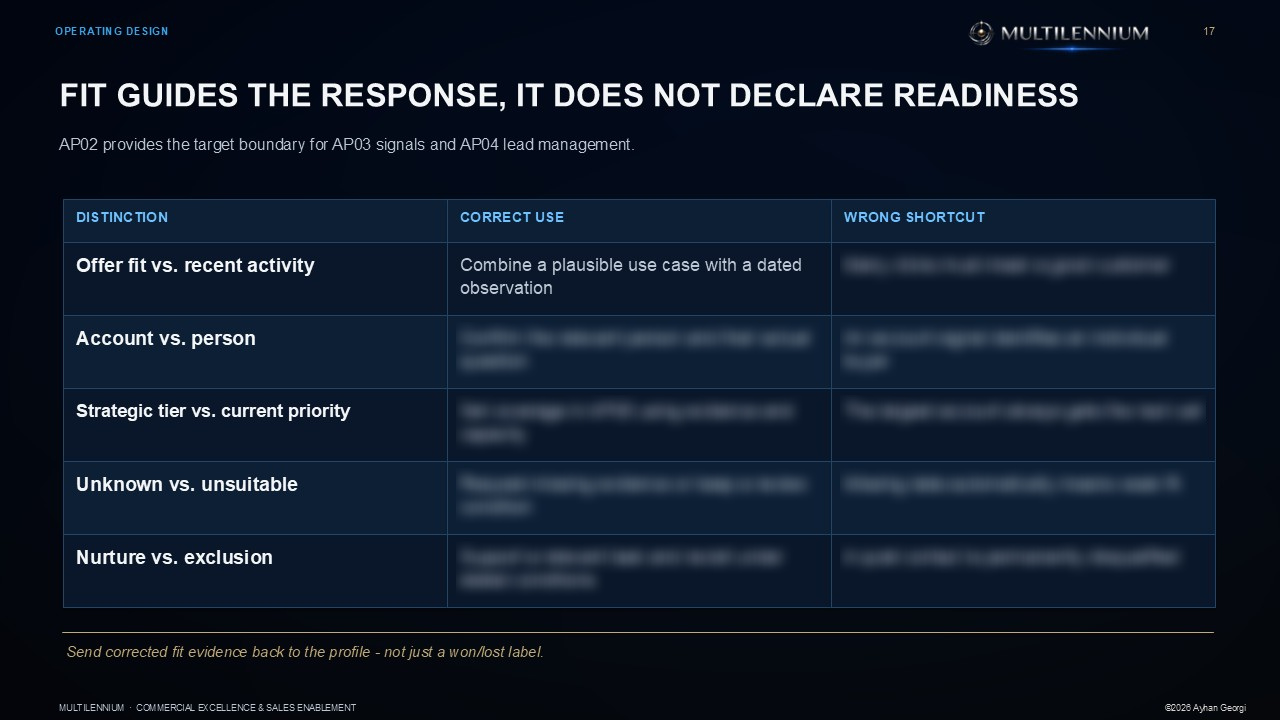
Ideal Customer Profile connects the customer task with economics, delivery and adoption requirements, access and working conditions. The profile belongs to an offer and use case - not permanently to a company. Fit, coverage tier and current priority remain different decisions.
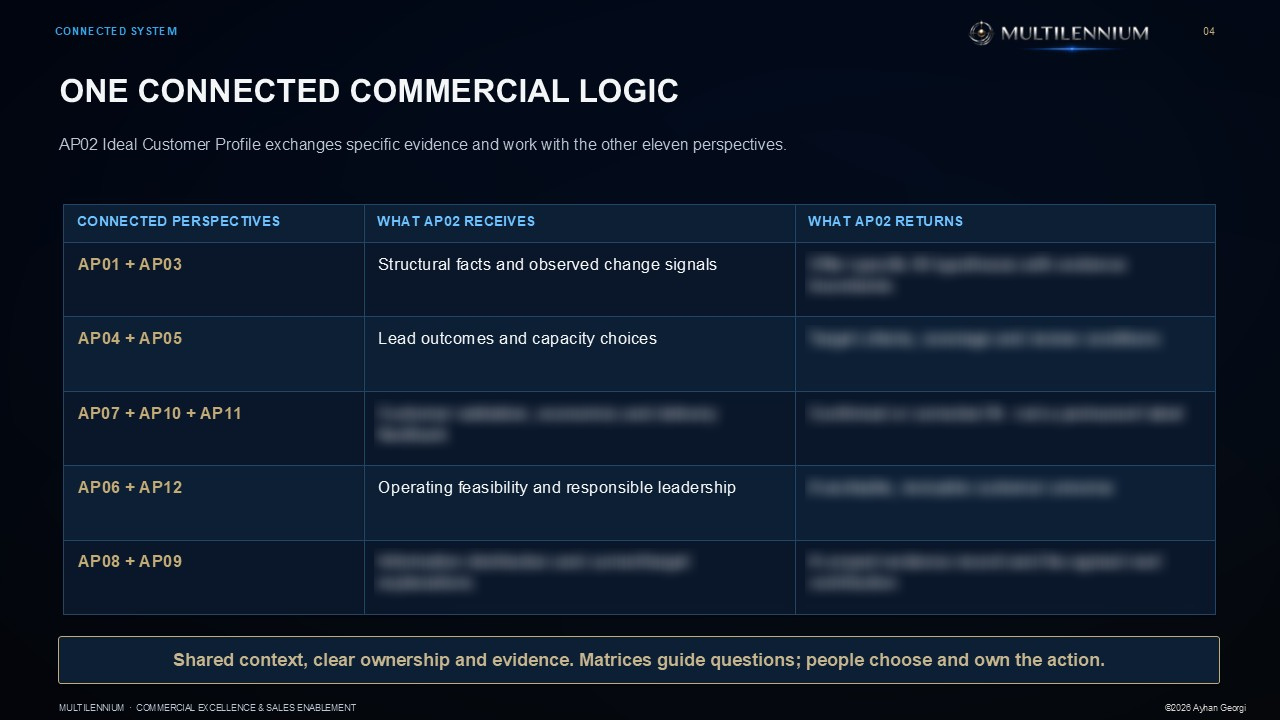
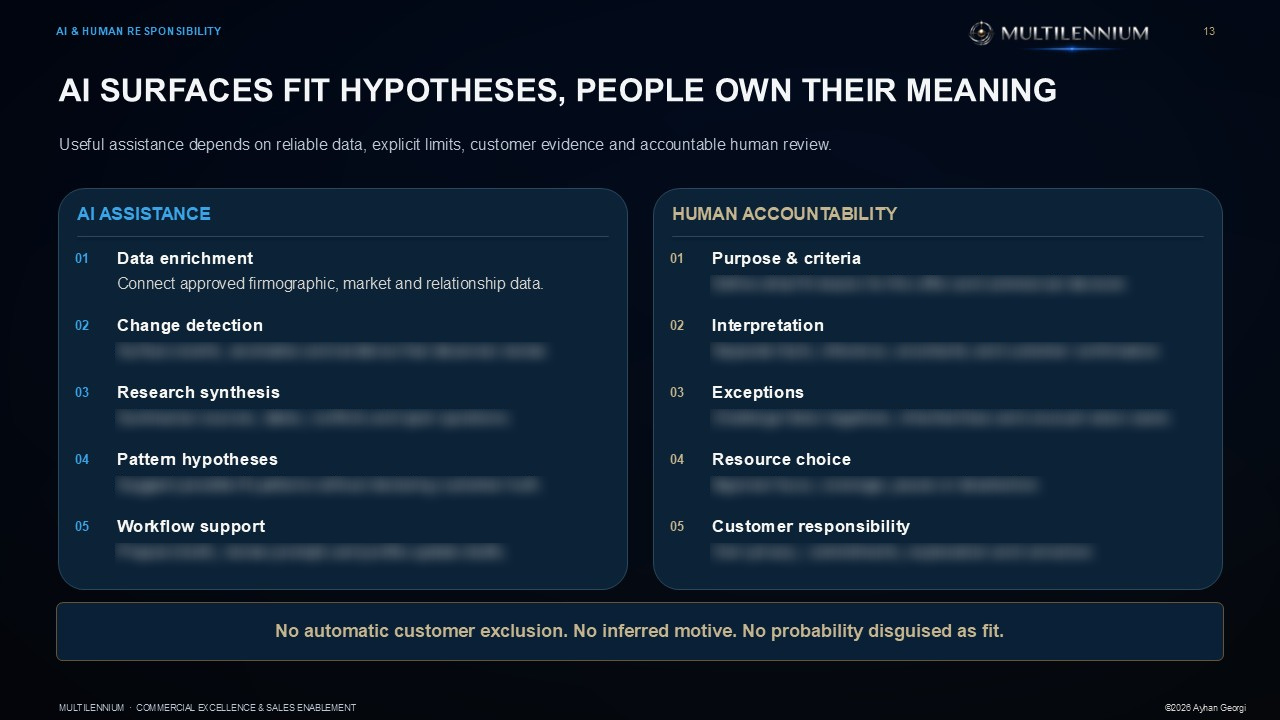
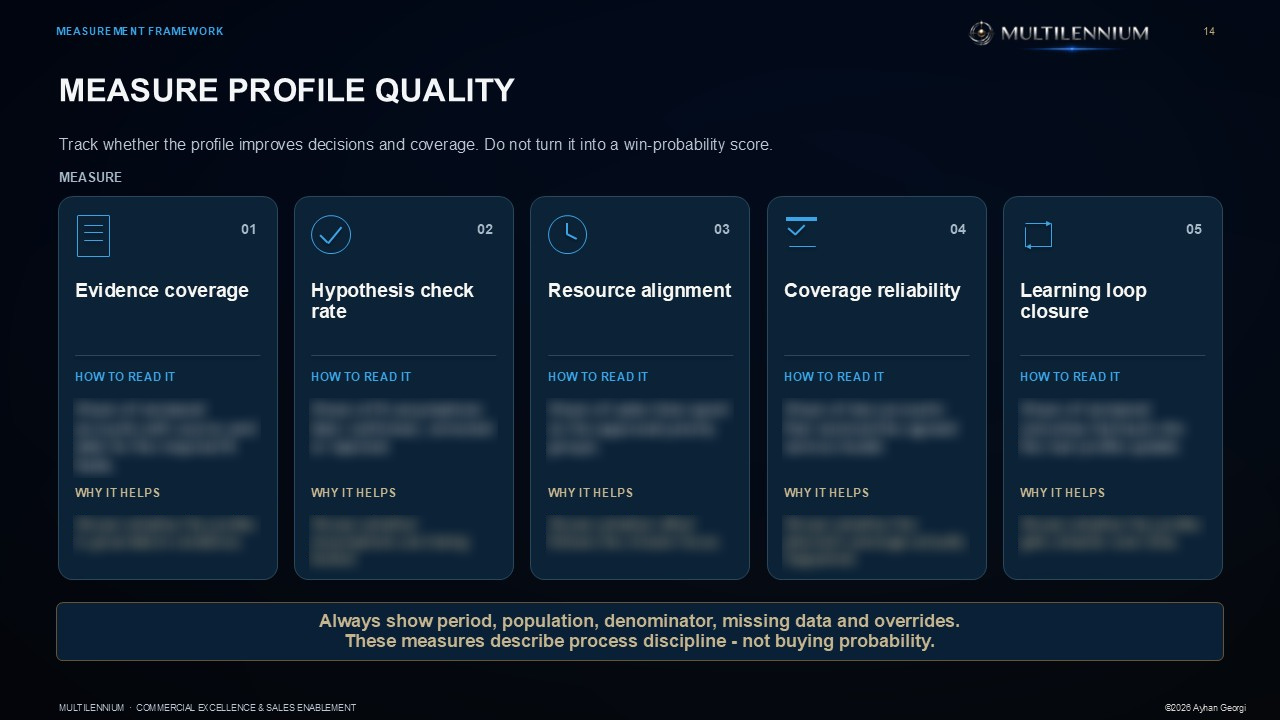
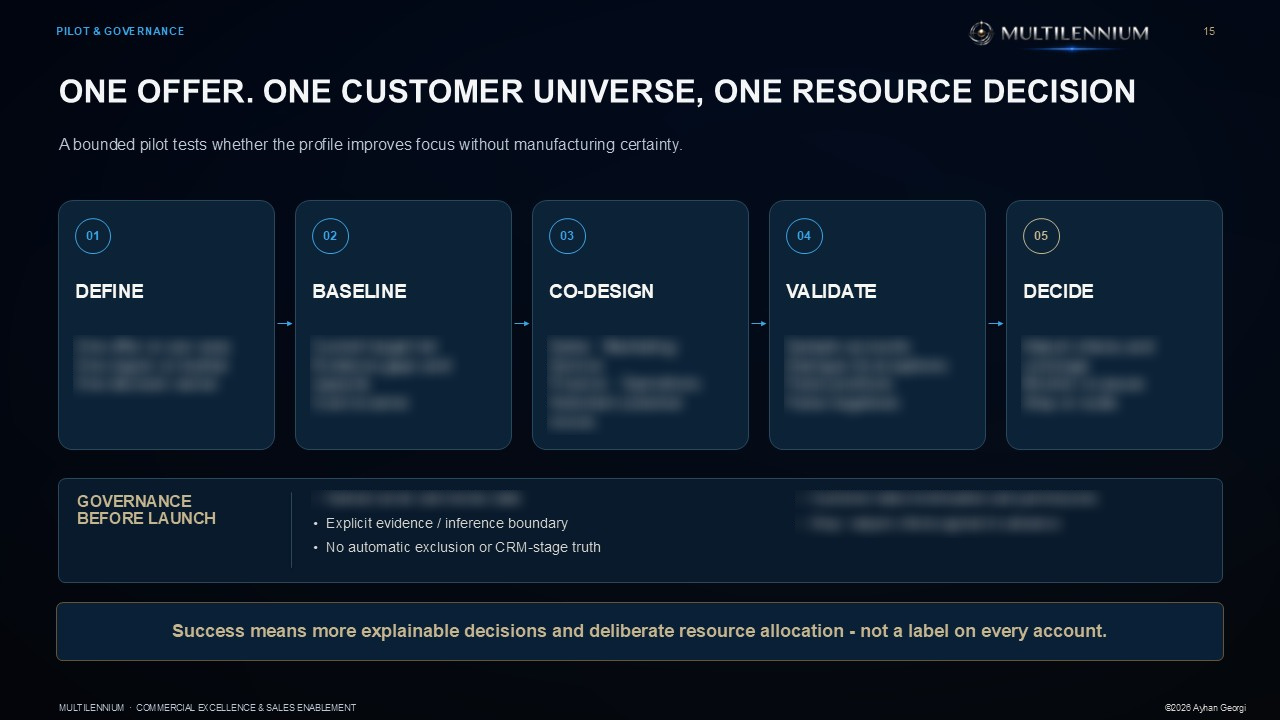
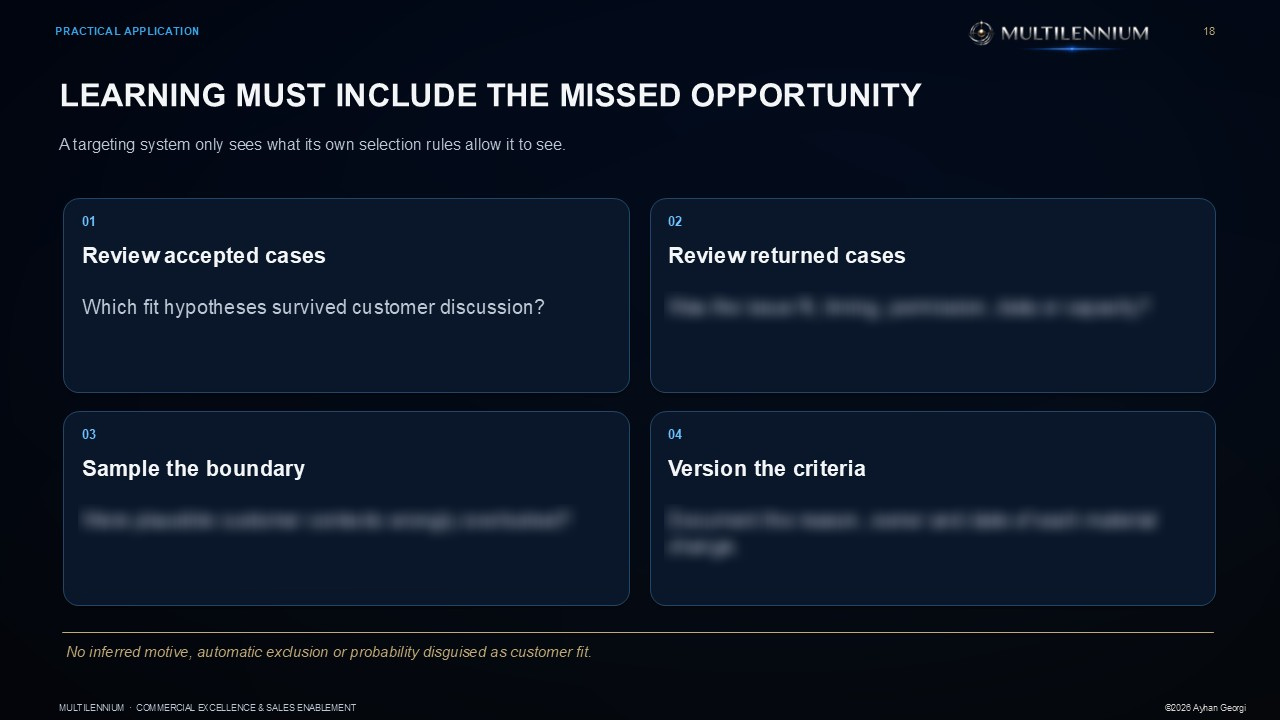
In the updated series, AP03 tests the profile against current signals and AP04 returns evidence about accepted, corrected and returned leads. The learning must include missed opportunities as well as successes. A company can fit without being ready to buy; an unknown field is not a negative verdict. AP05 decides the current resource priority and AP12 ensures that exceptions can be examined.
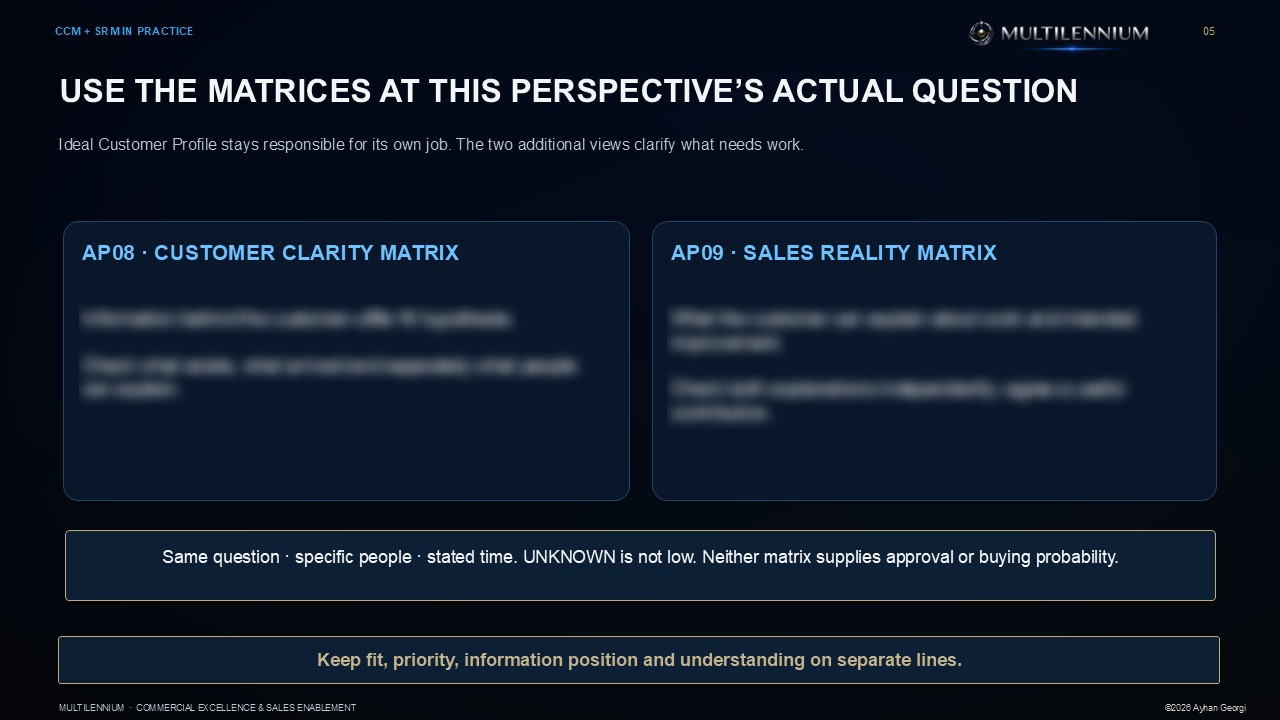
The two clarity perspectives add a practical check here: AP08 makes the relevant information and confirmed sharing visible; AP09 helps select work from current-state and ideal-state explanations. Keep fit, priority, information position and understanding on separate lines.



FOCUS
Offer-specific fit hypothesis; evidence and open questions; coverage choice; review and exception process.
WHEN TO USE
When a static target list is driving outreach without enough regard for the actual offer, task or delivery context.
CONNECTIONS
AP03 Signals, AP04 Lead Management, AP05 Revenue Focus, AP08 Customer Clarity Matrix, AP09 Sales Reality Matrix, AP12 Leadership.
APPLIED PERSPECTIVE 03
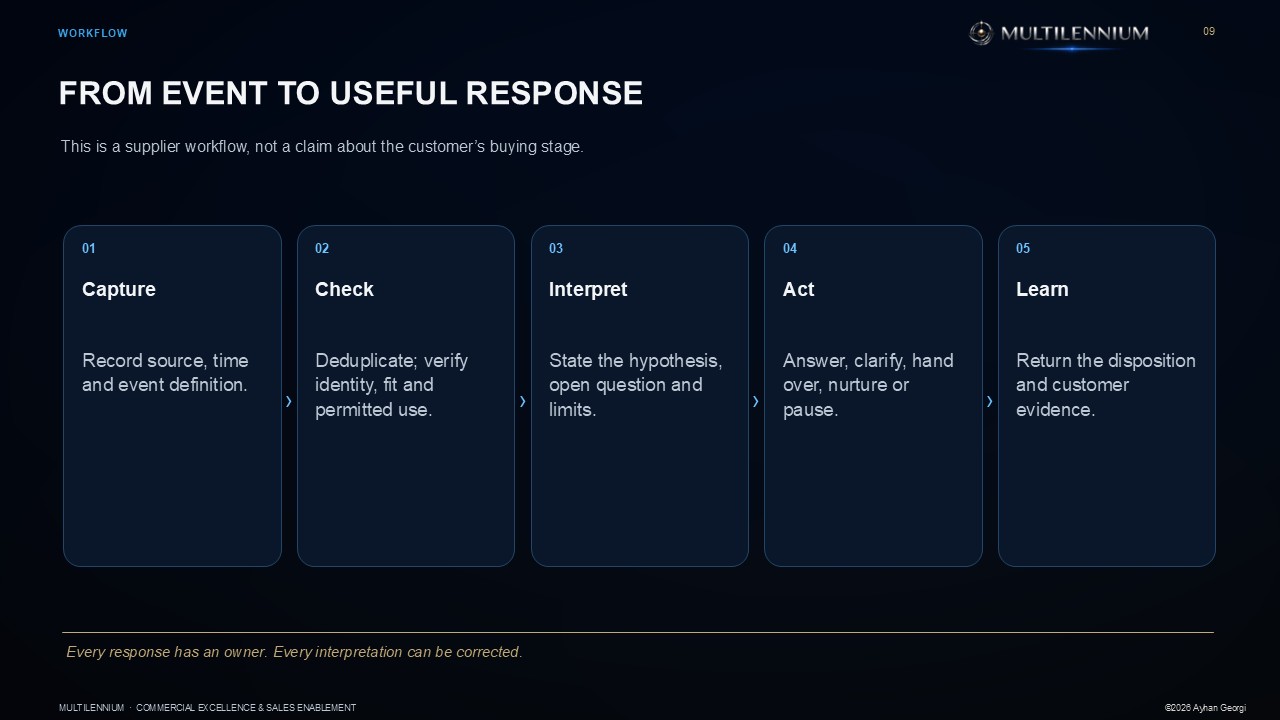
Signals
Which signals justify a useful response, and how do we measure it?
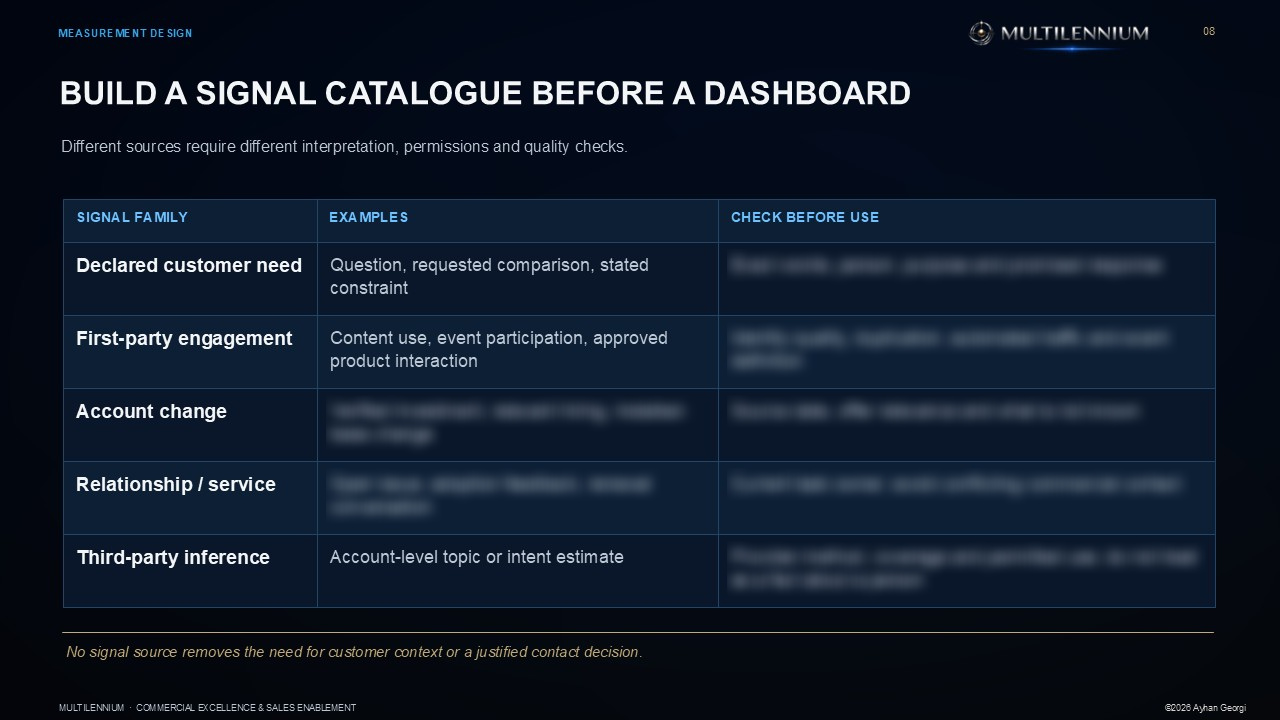
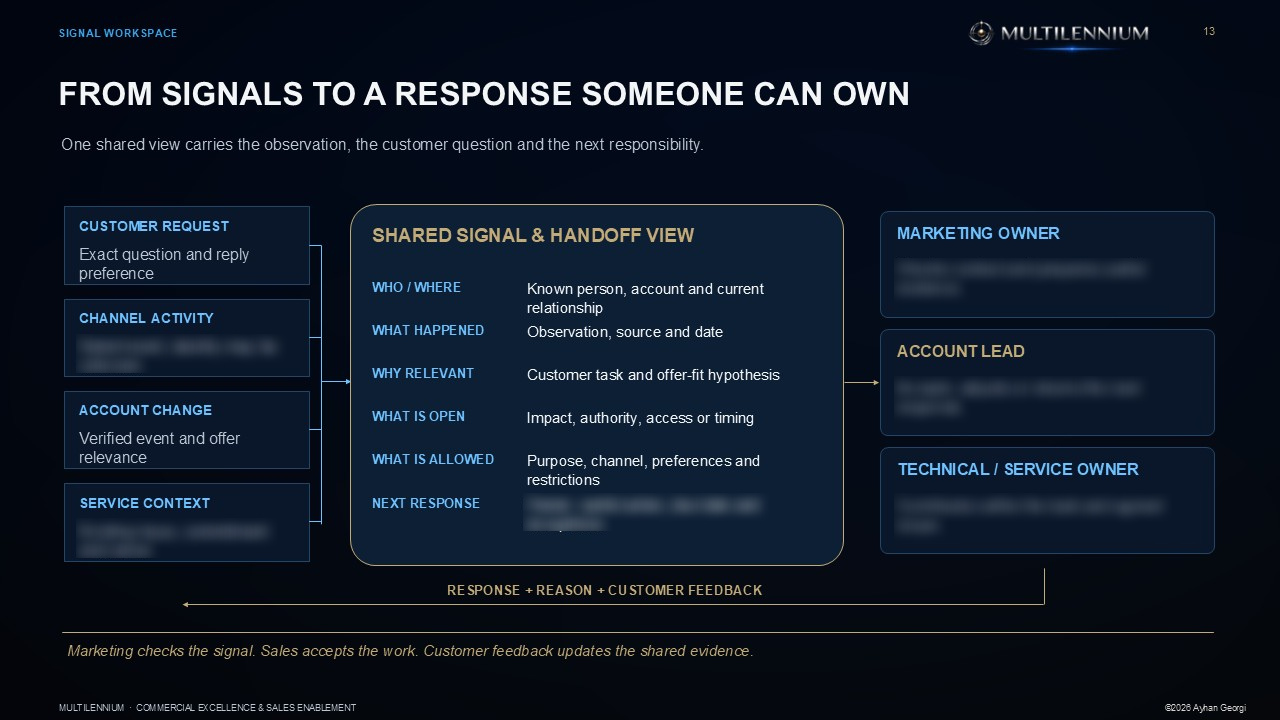
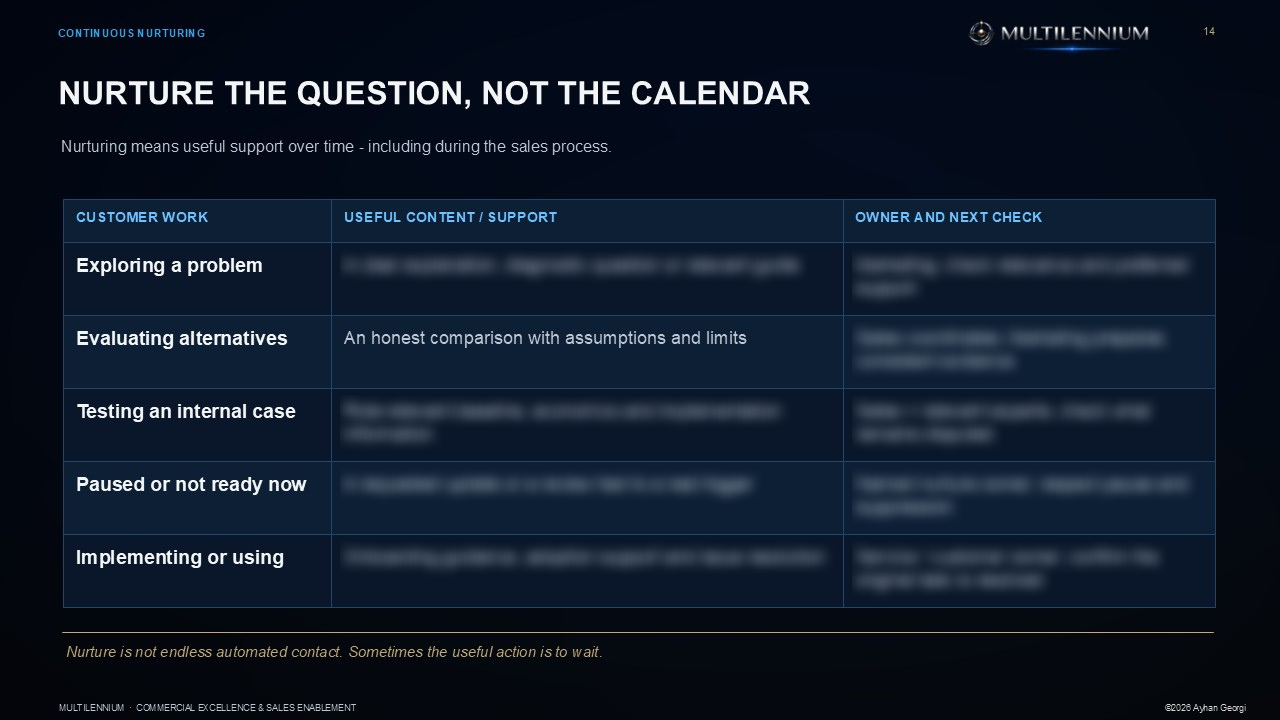
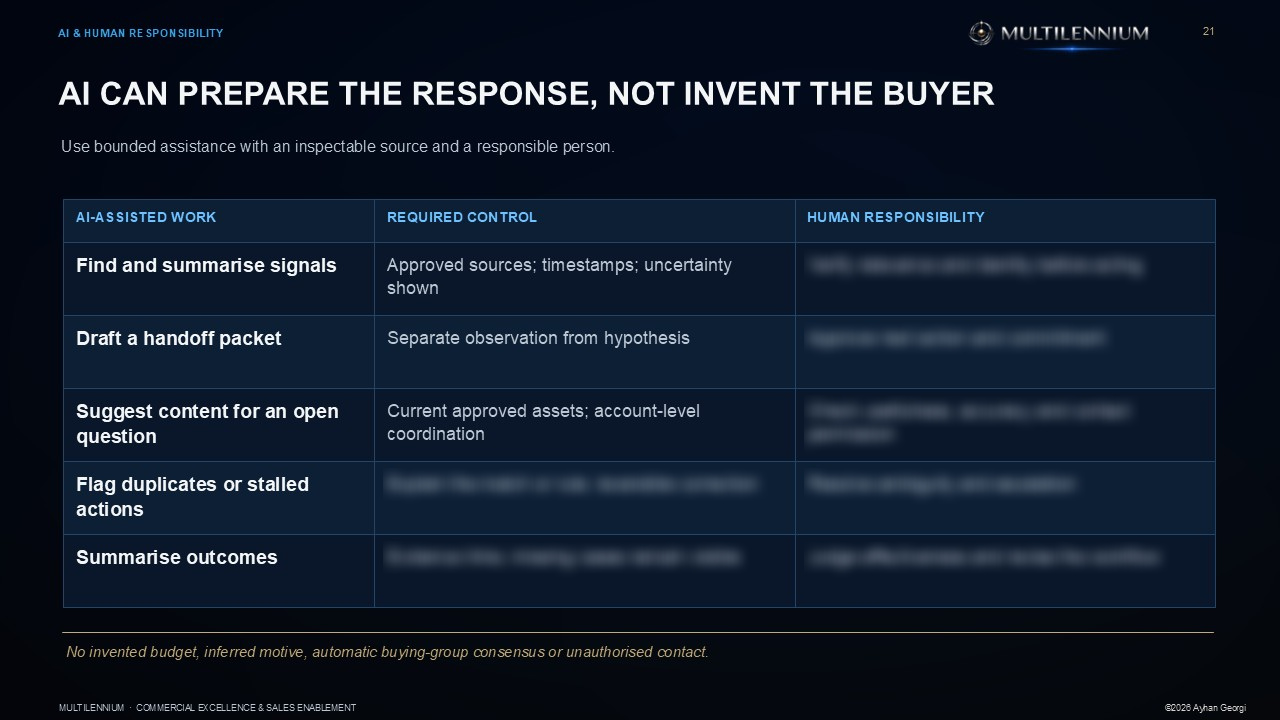
Make marketing signals measurable, hand over a usable customer question and keep nurturing useful throughout the sales process.
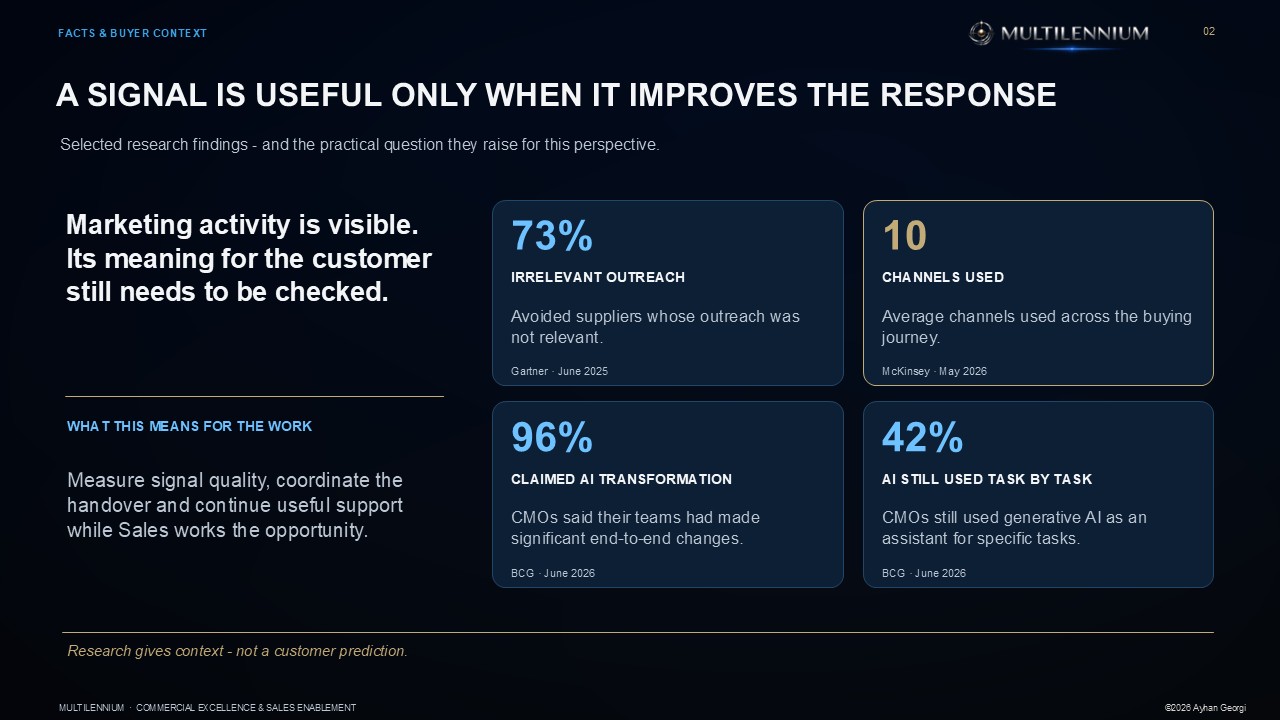
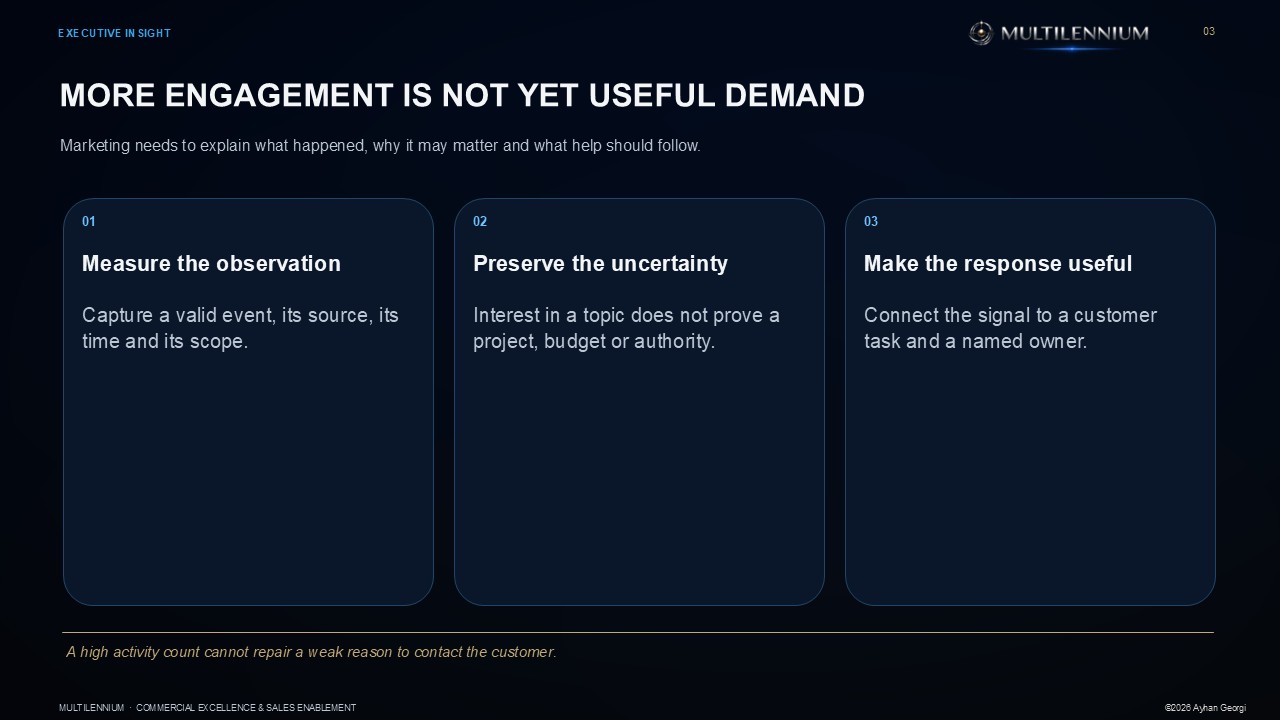
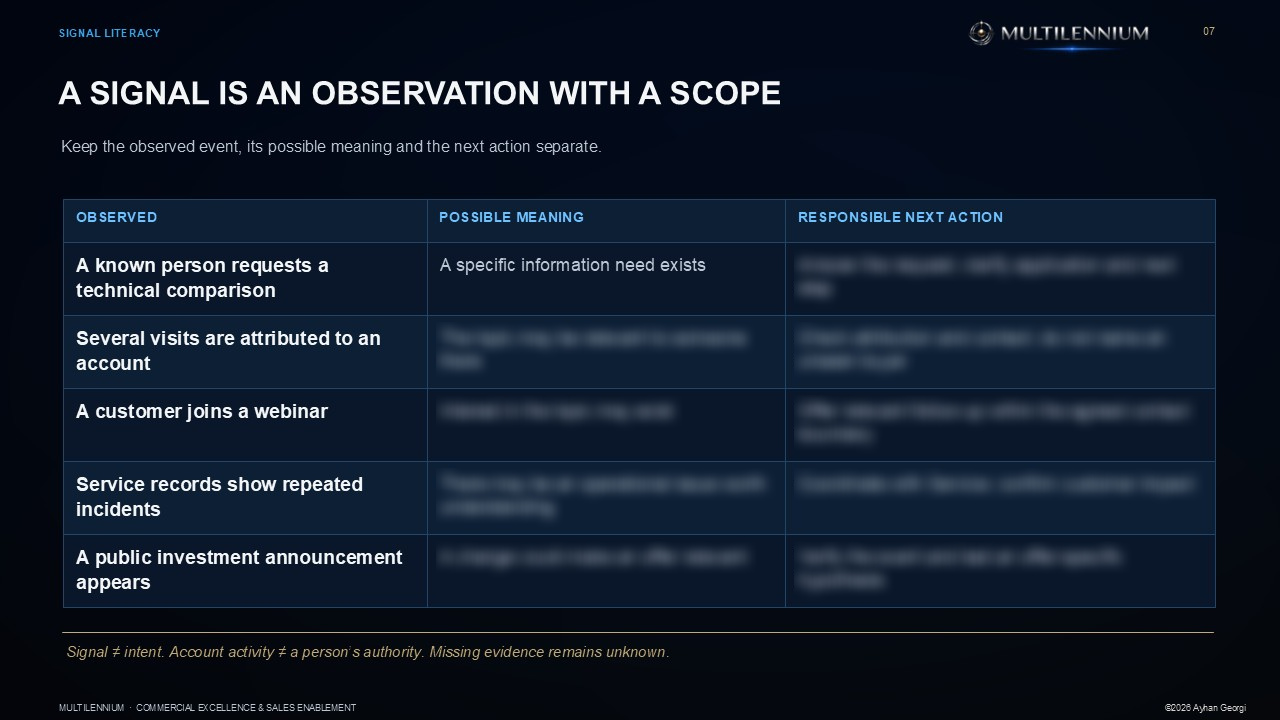
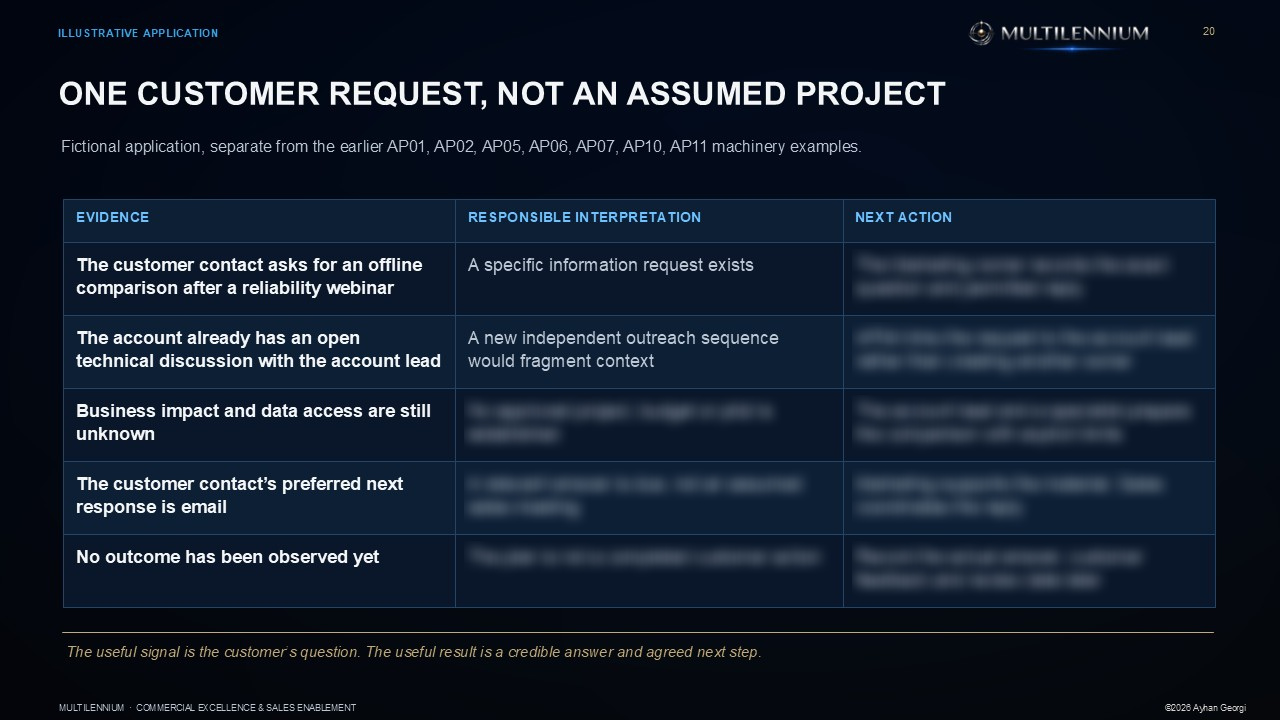
A visit, a webinar question and a request for a technical comparison are different observations. Treating them as the same kind of intent can produce a busy pipeline and an irrelevant response.
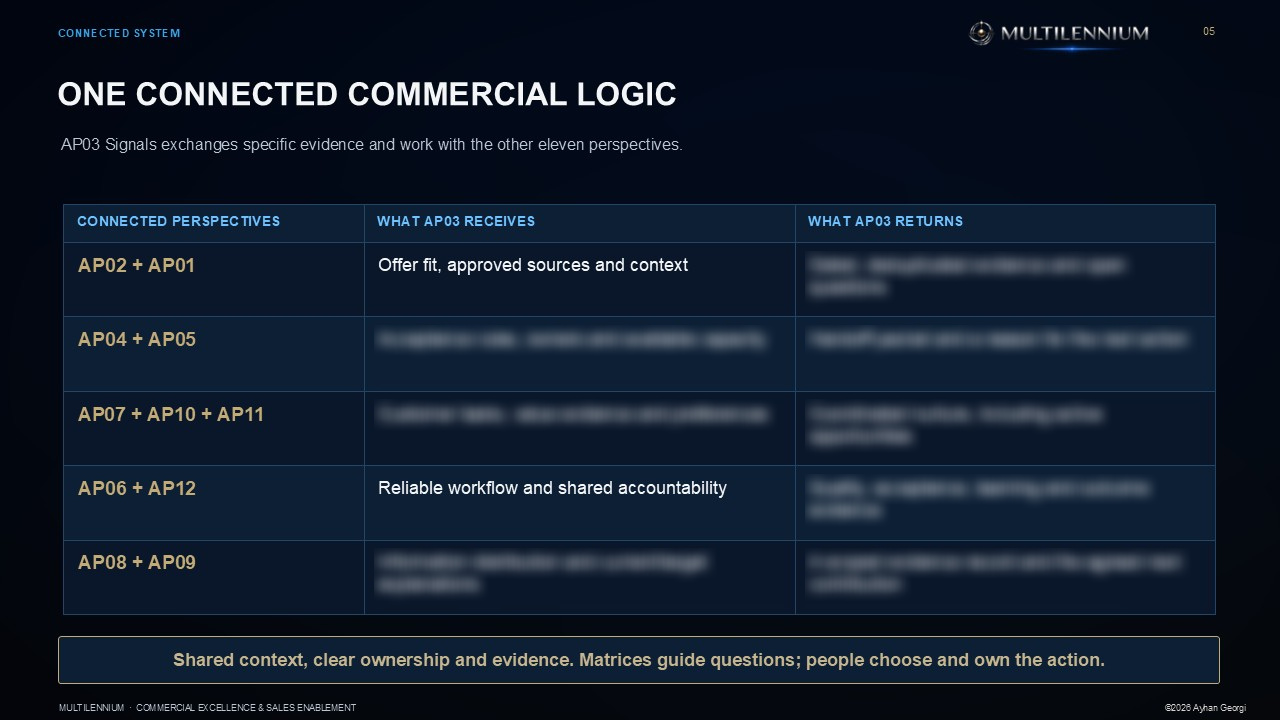
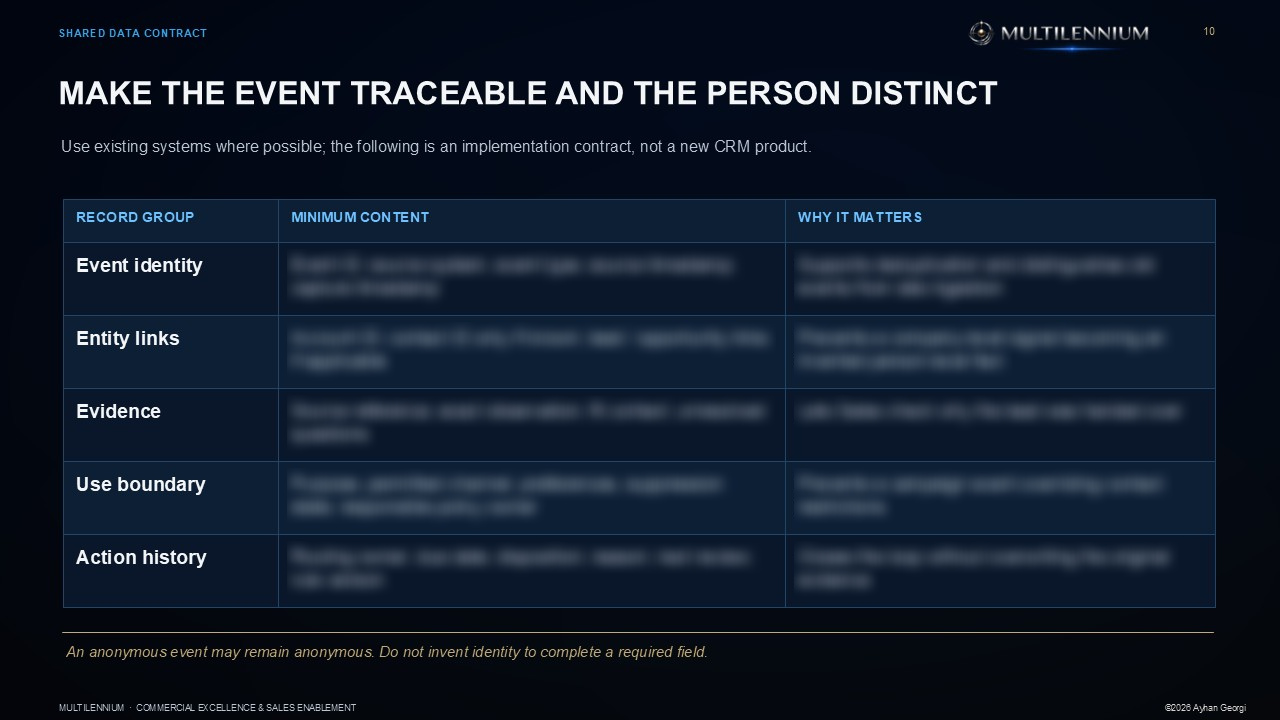
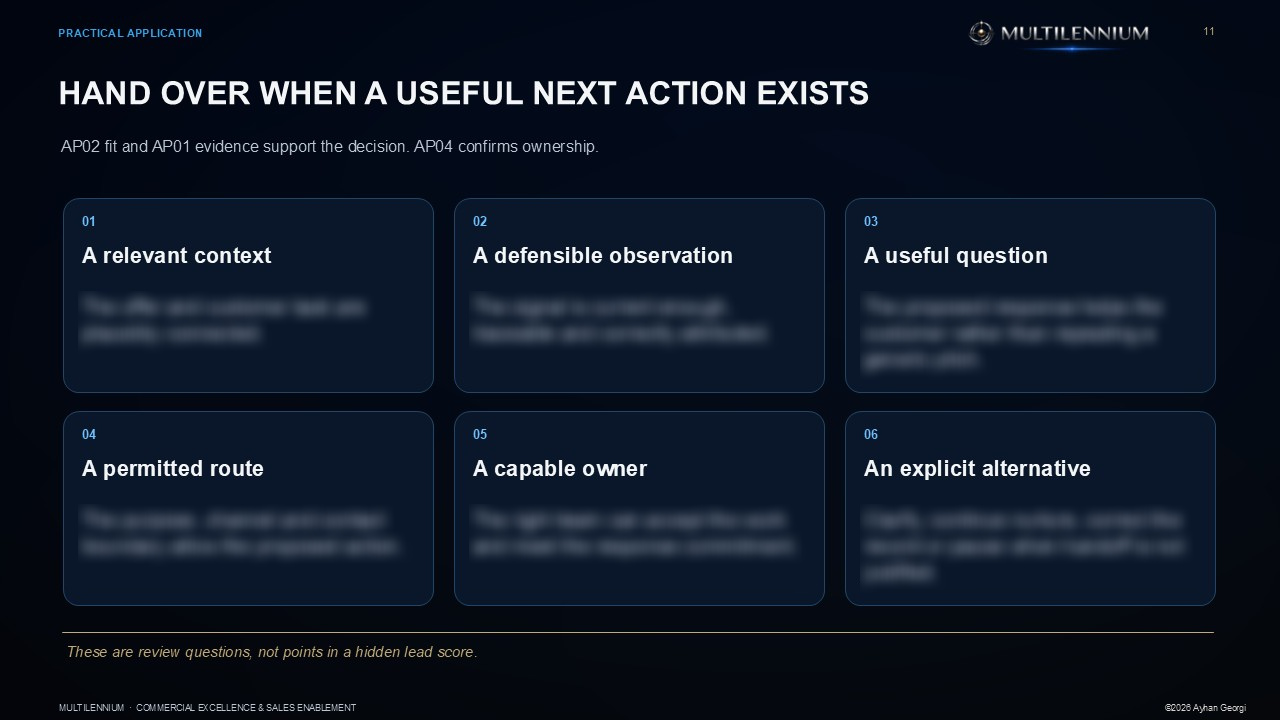
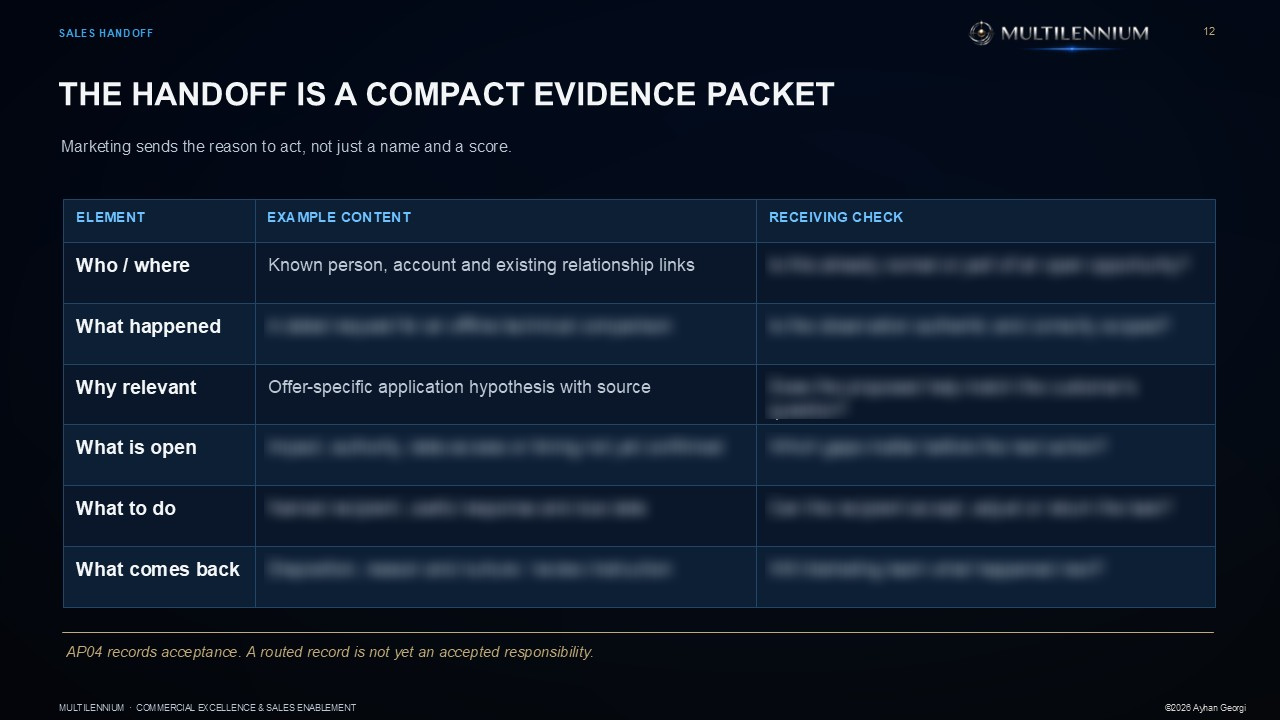
Signals defines what Marketing observes, how it measures quality and when a handoff is justified. Source, time, identity, offer context and contact boundaries remain visible. Sales receives the reason to act, the unresolved question and the proposed next step -not merely a name or an unexplained score.
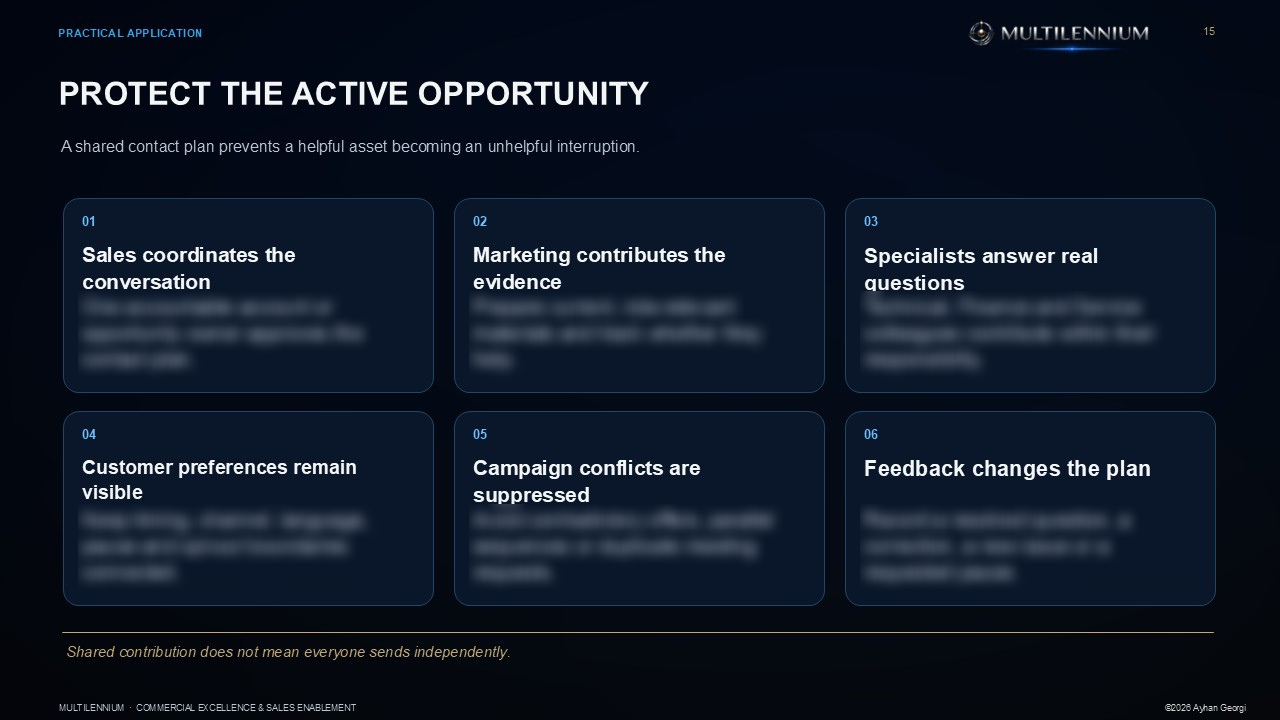
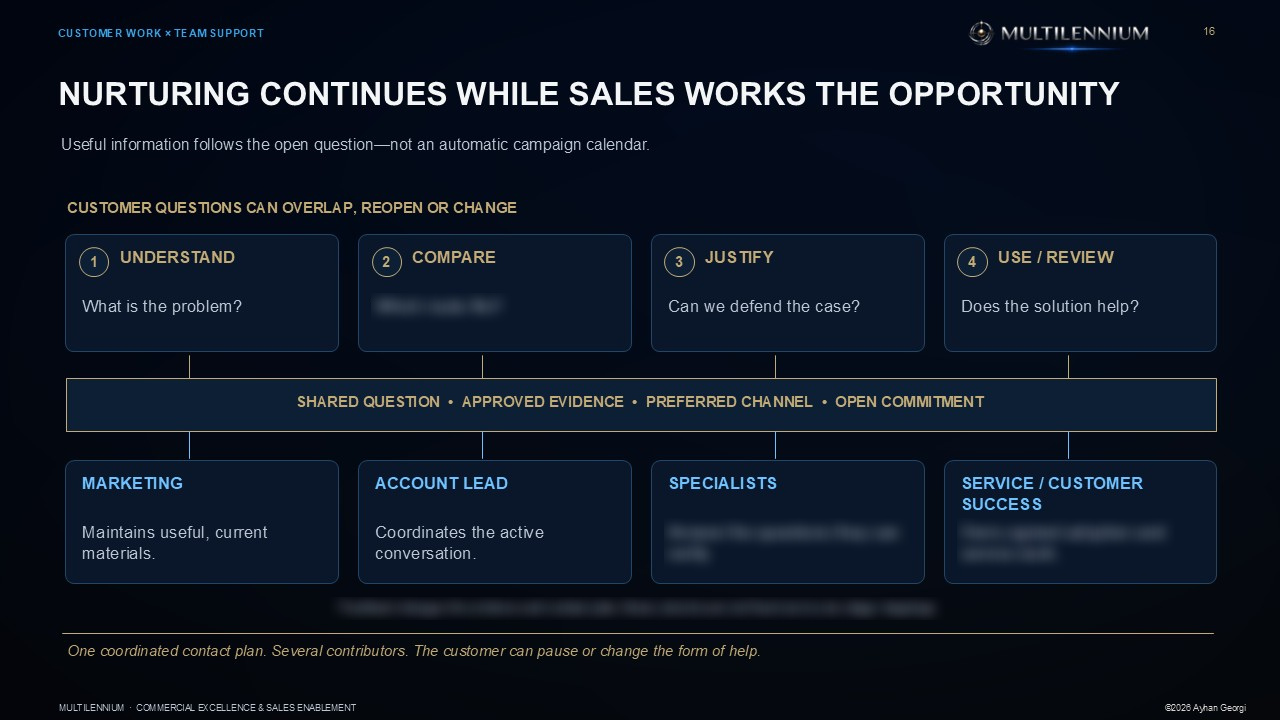
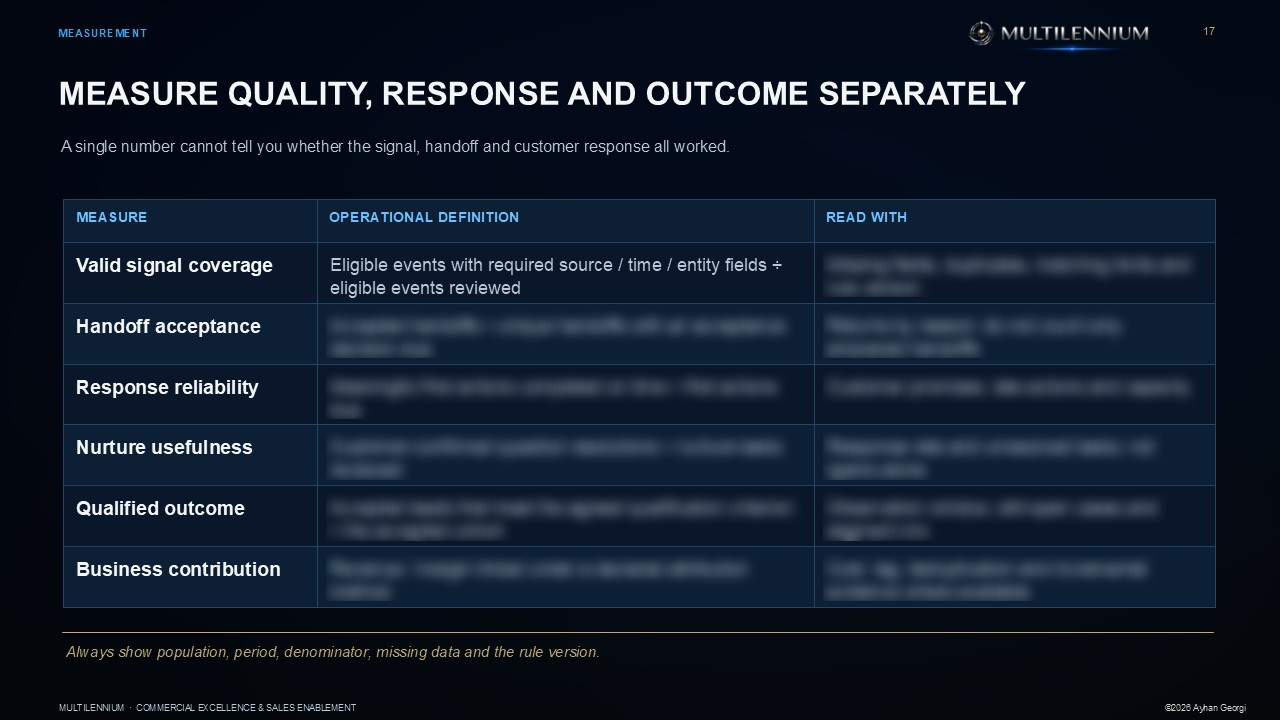
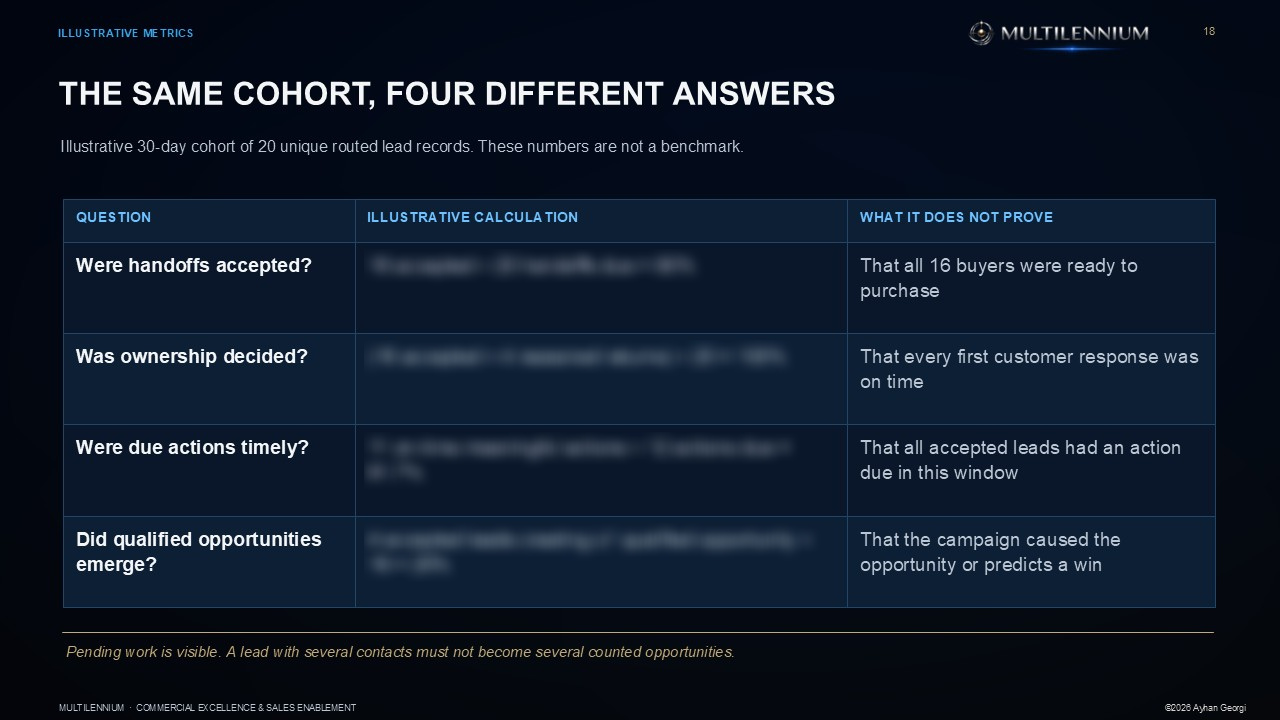
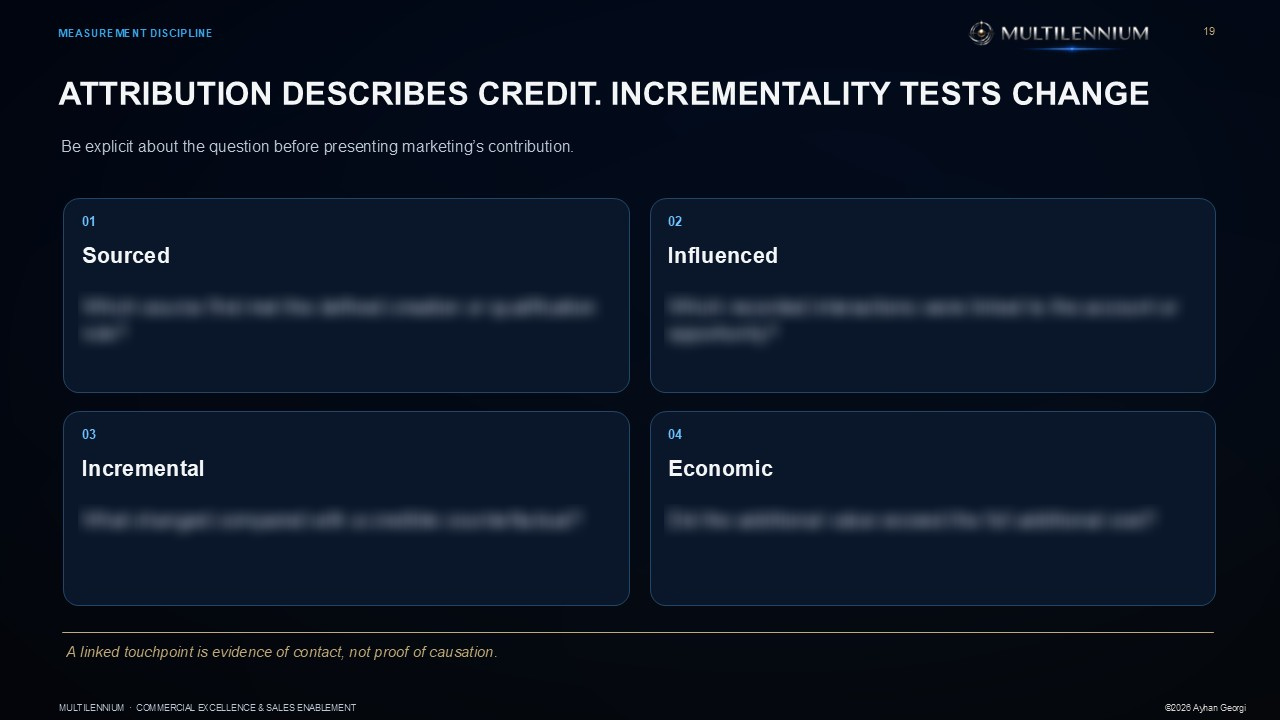
Nurturing continues during the sales process. Marketing prepares useful evidence; Sales coordinates the active conversation; specialists help with the customer’s real questions. Measurement separates signal quality, acceptance, response reliability, customer usefulness and business contribution. Attribution describes recorded credit; it is not automatically proof that the campaign caused the result.
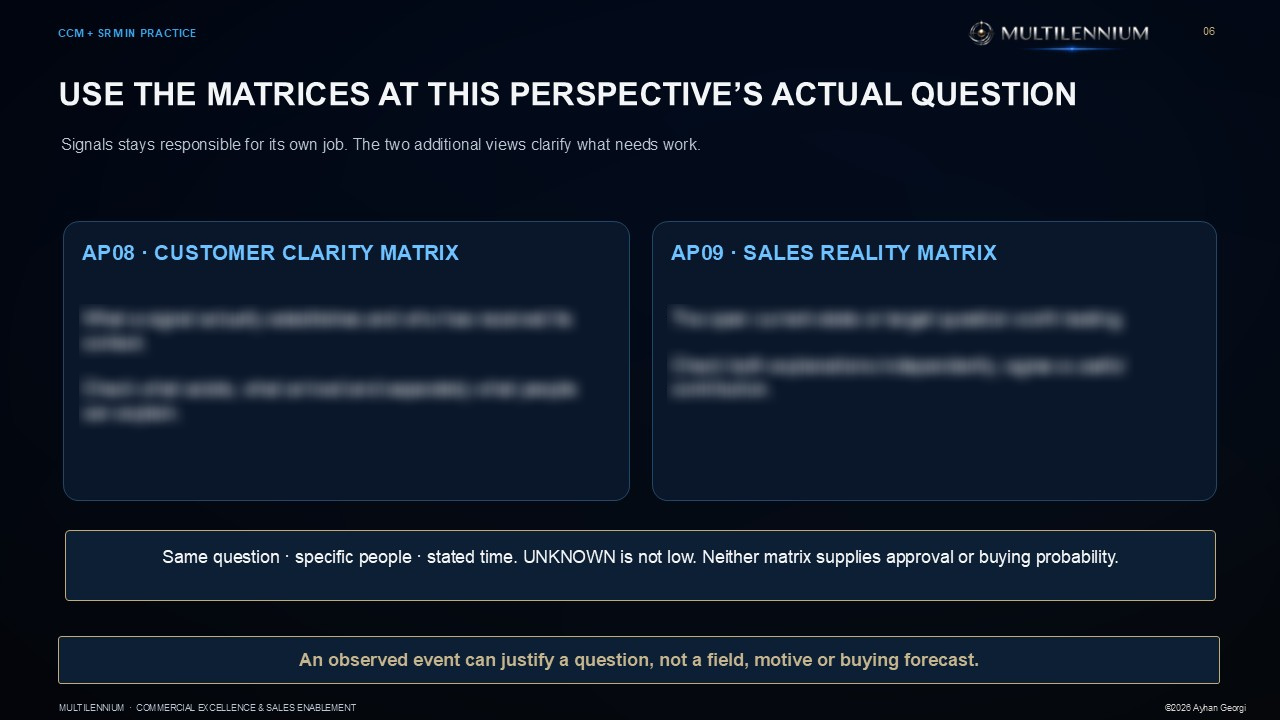
The two clarity perspectives add a practical check here: AP08 makes the relevant information and confirmed sharing visible; AP09 helps select work from current-state and ideal-state explanations. An observed event can justify a question, not a field, motive or buying forecast.



FOCUS
Signal catalogue; traceable event record; handoff packet; coordinated nurture plan; cohort and contribution measures.
WHEN TO USE
When engagement is measurable but its relevance, handoff quality or contribution to useful customer action is unclear.
CONNECTIONS
AP01 Commercial Intelligence, AP02 Ideal Customer Profile, AP04 Lead Management, AP07 Customer Engagement, AP08 Customer Clarity Matrix, AP09 Sales Reality Matrix, AP12 Leadership.
APPLIED PERSPECTIVE 04
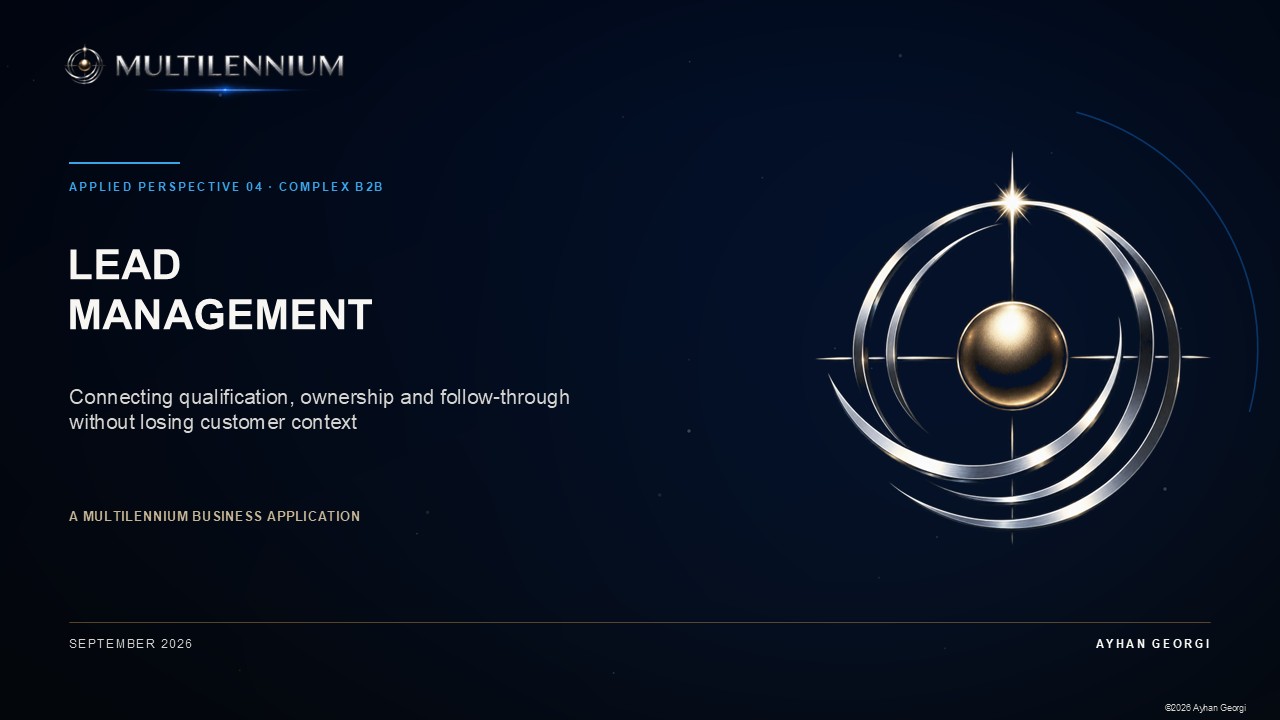
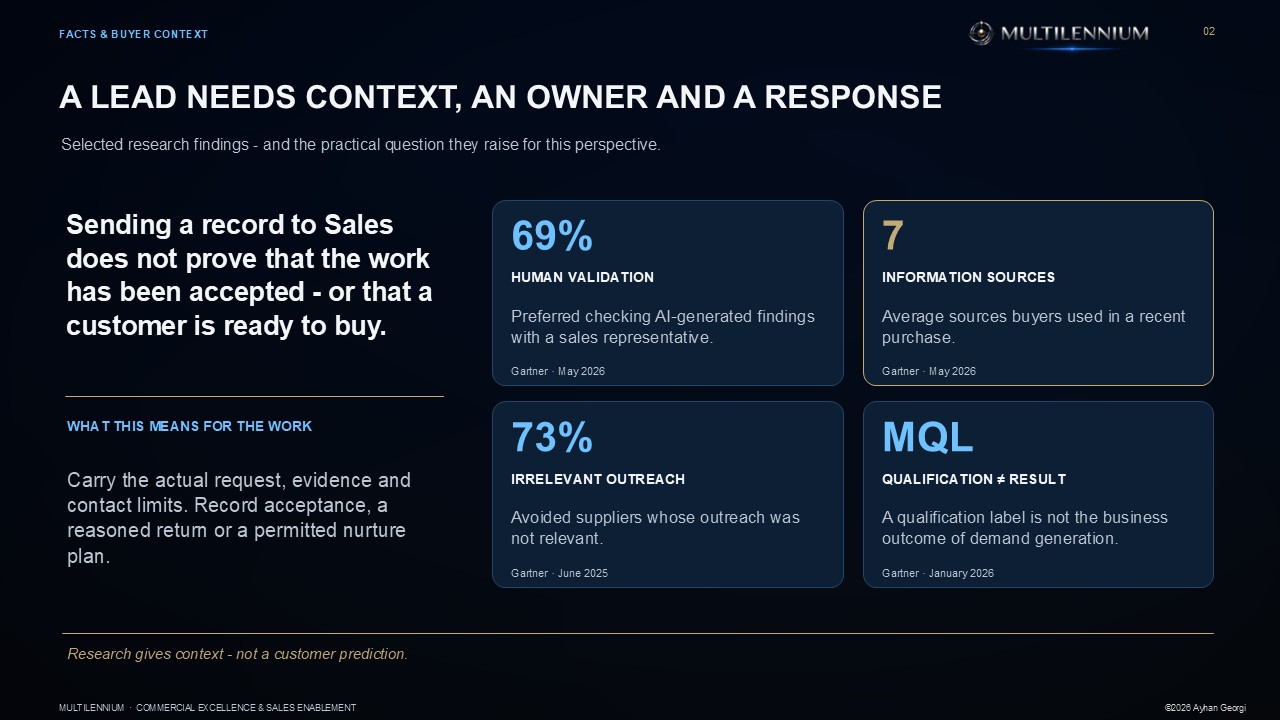
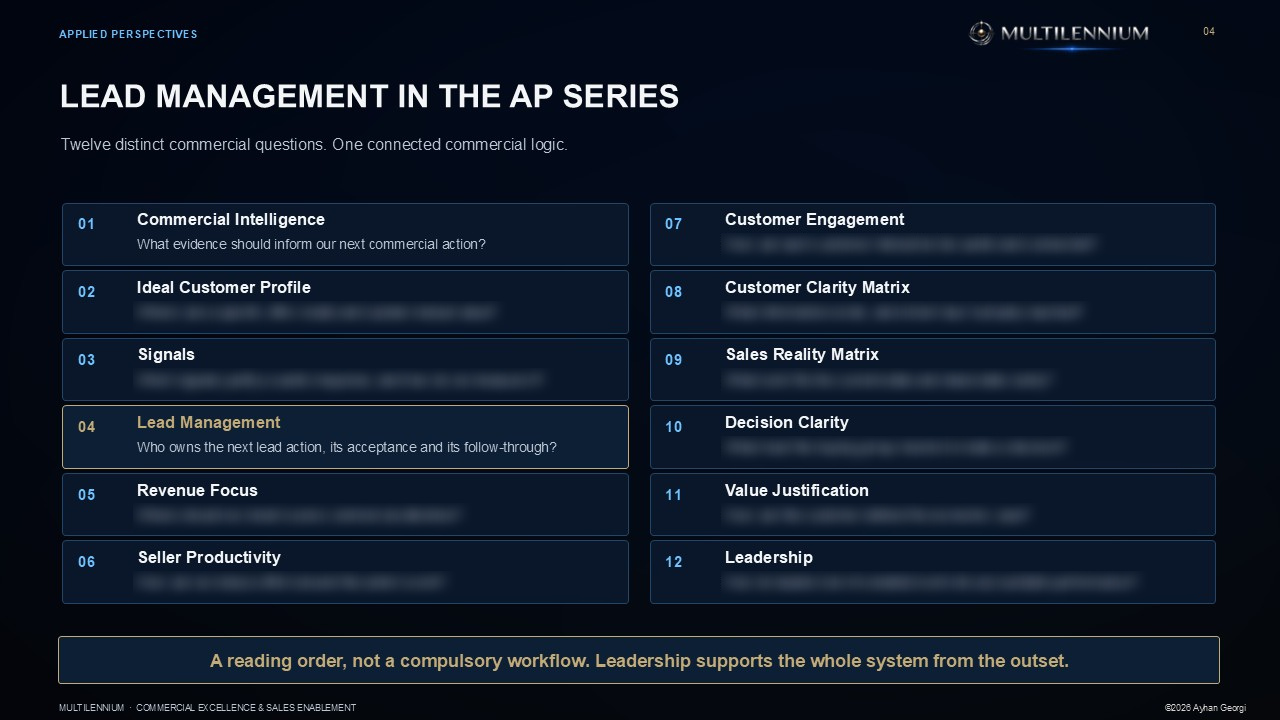
Lead Management
Who owns the next lead action, its acceptance and its follow-through?
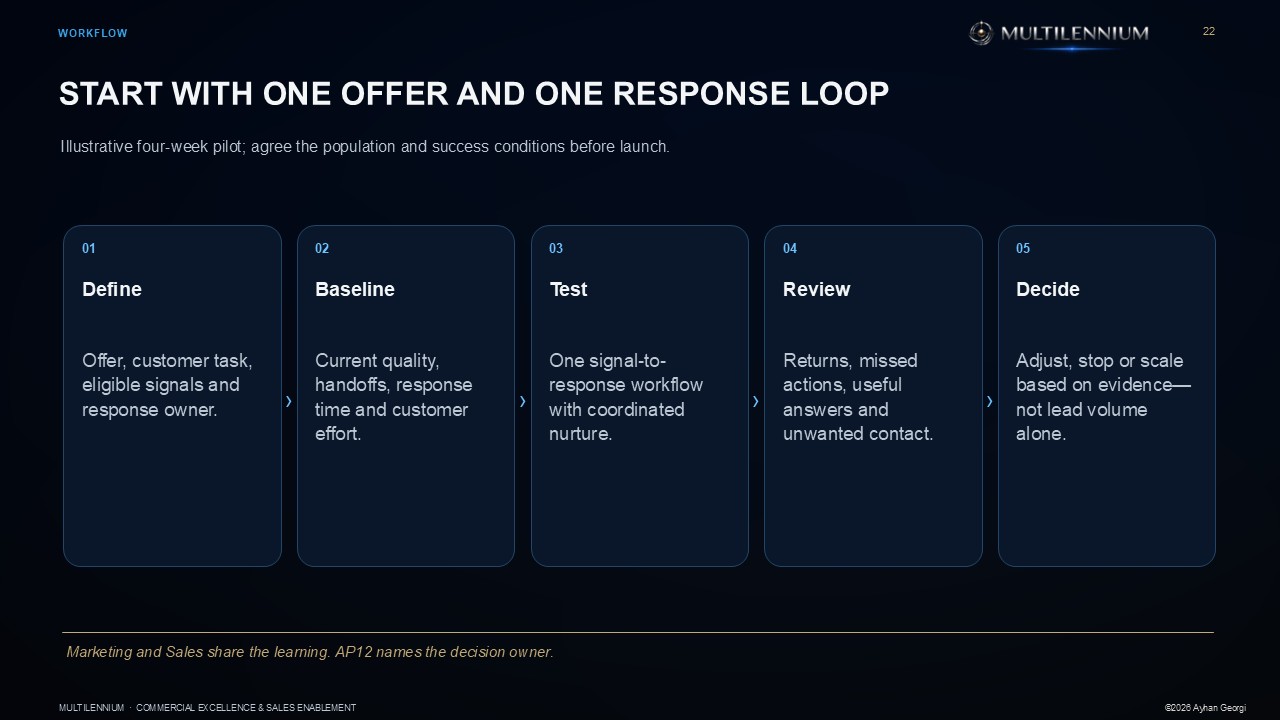
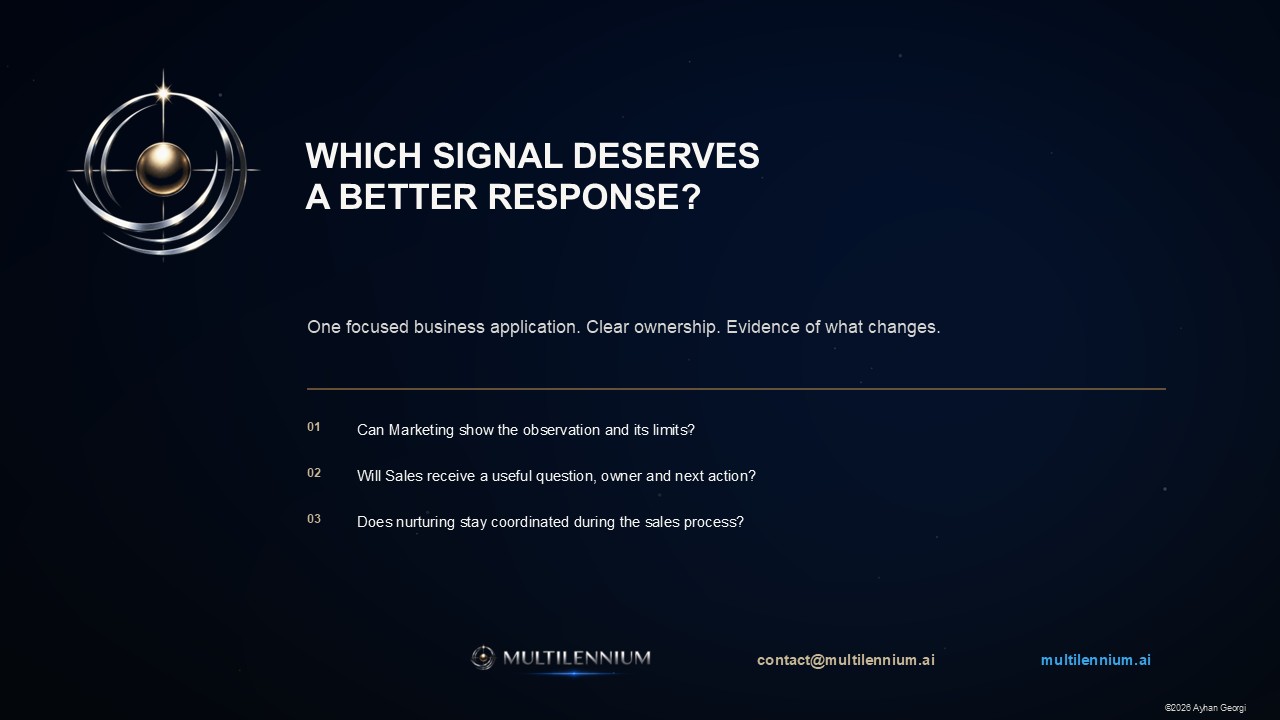
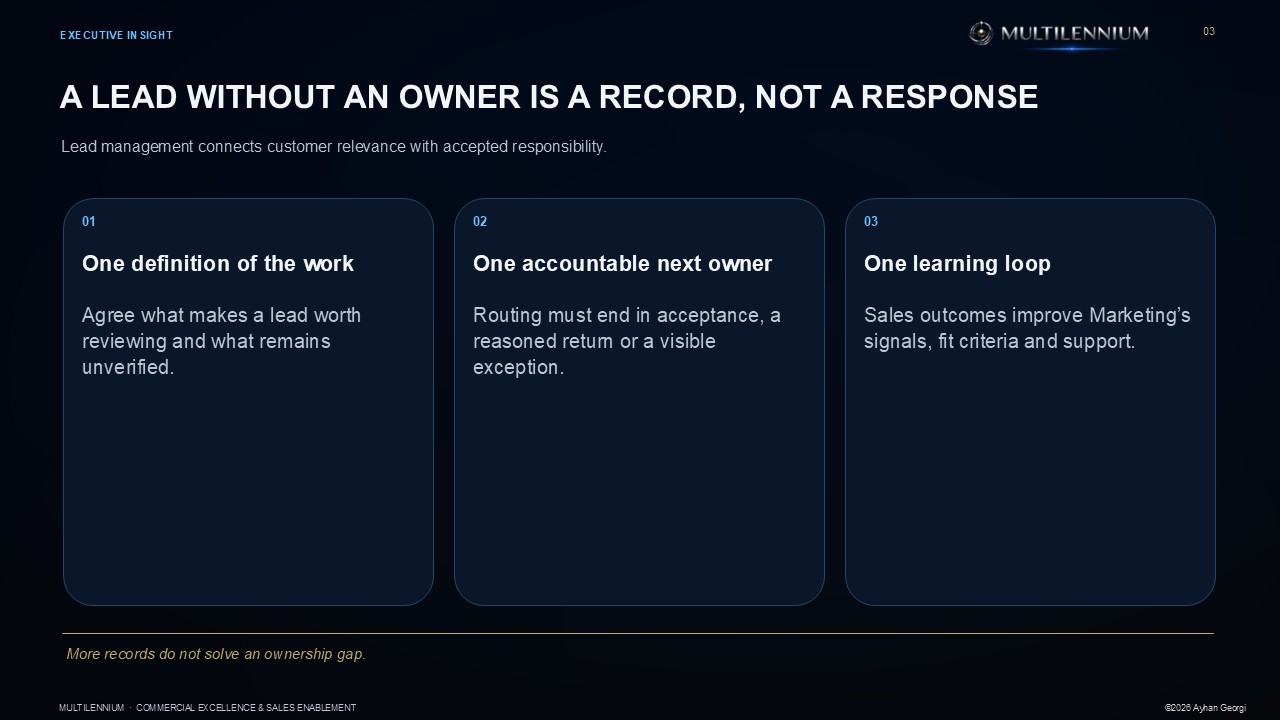
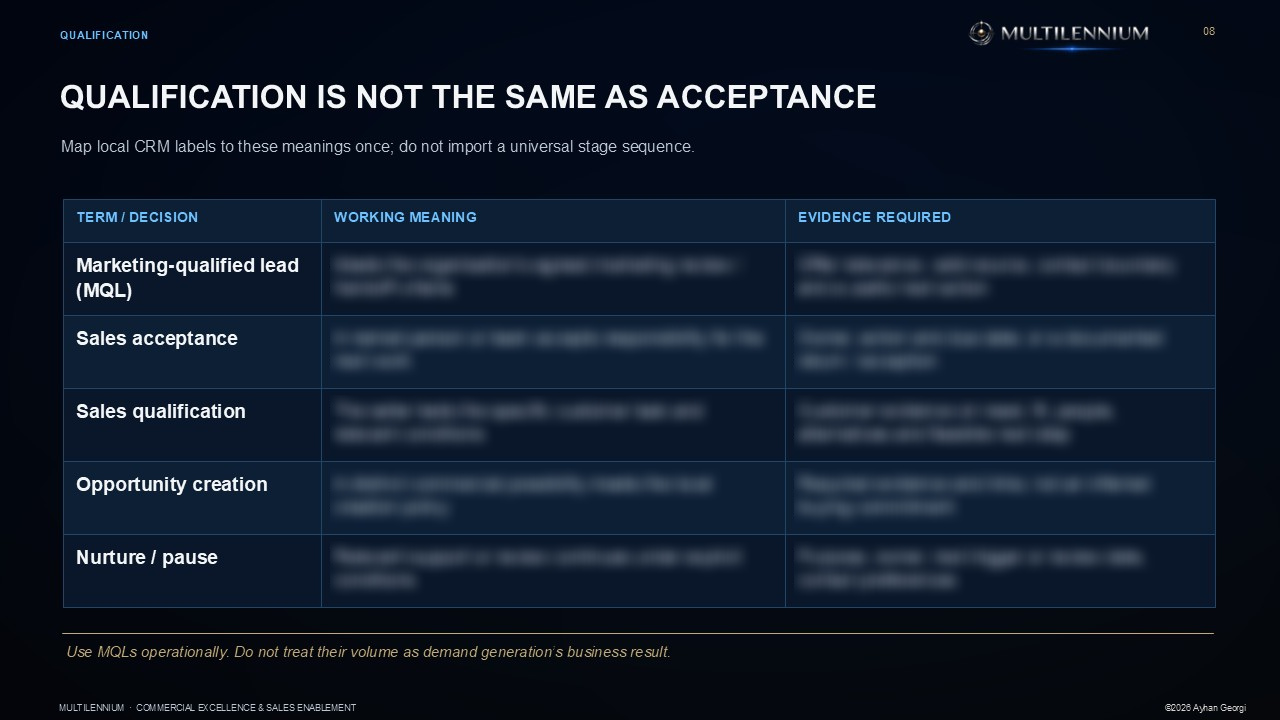
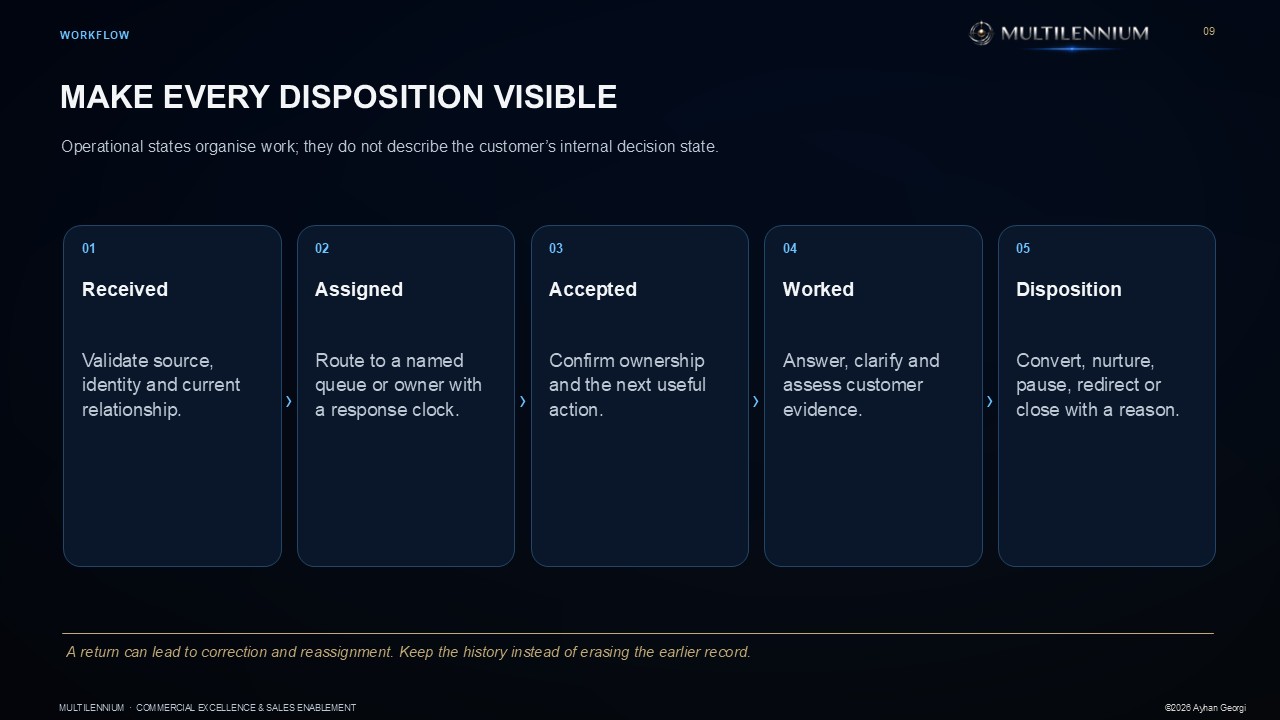
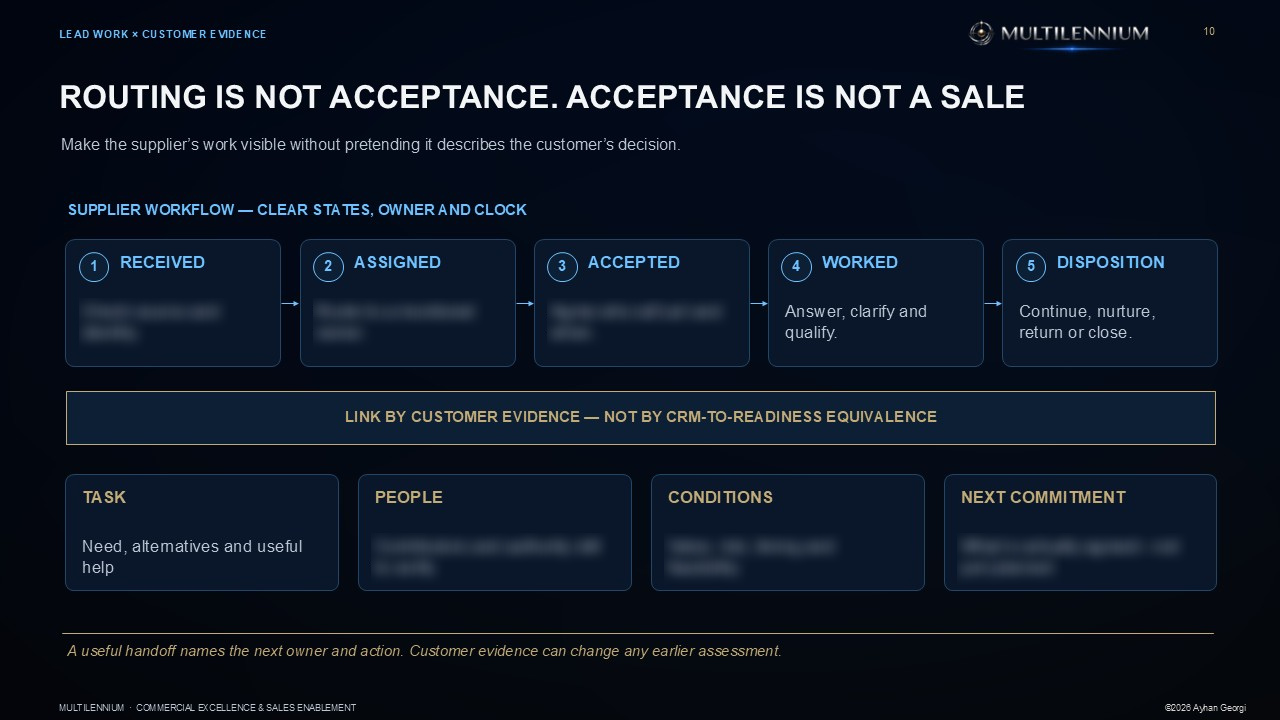
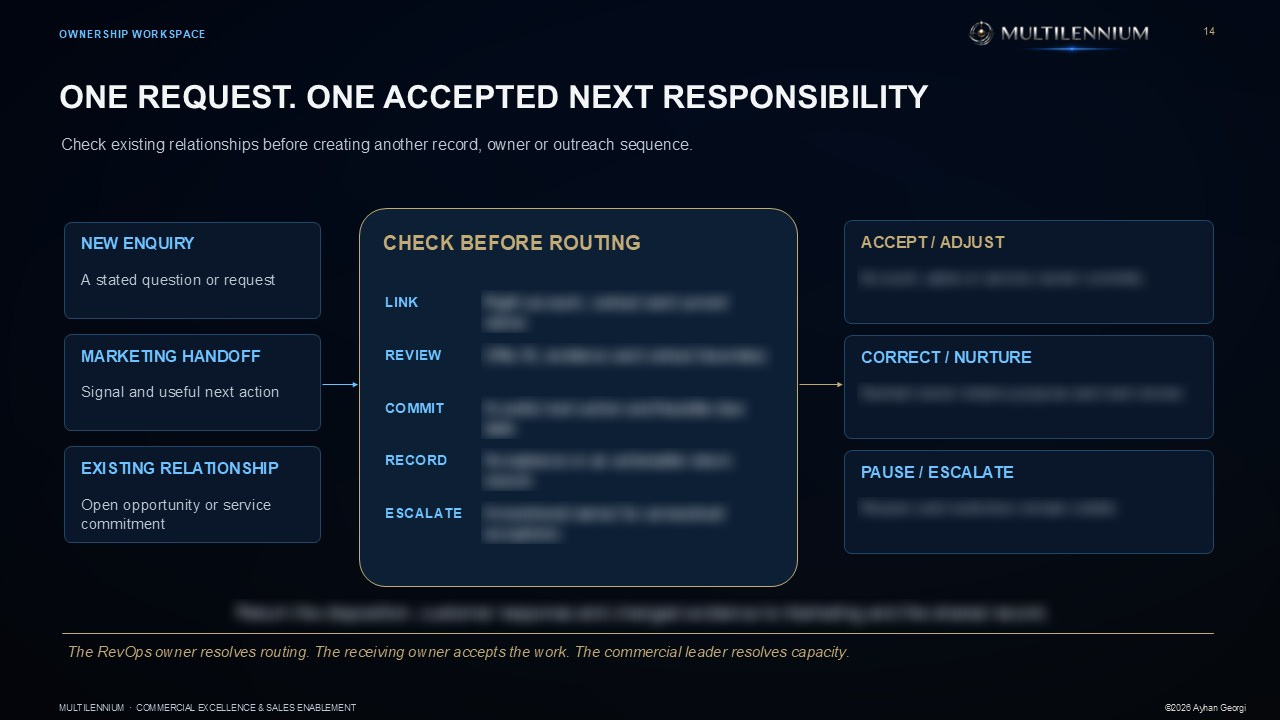
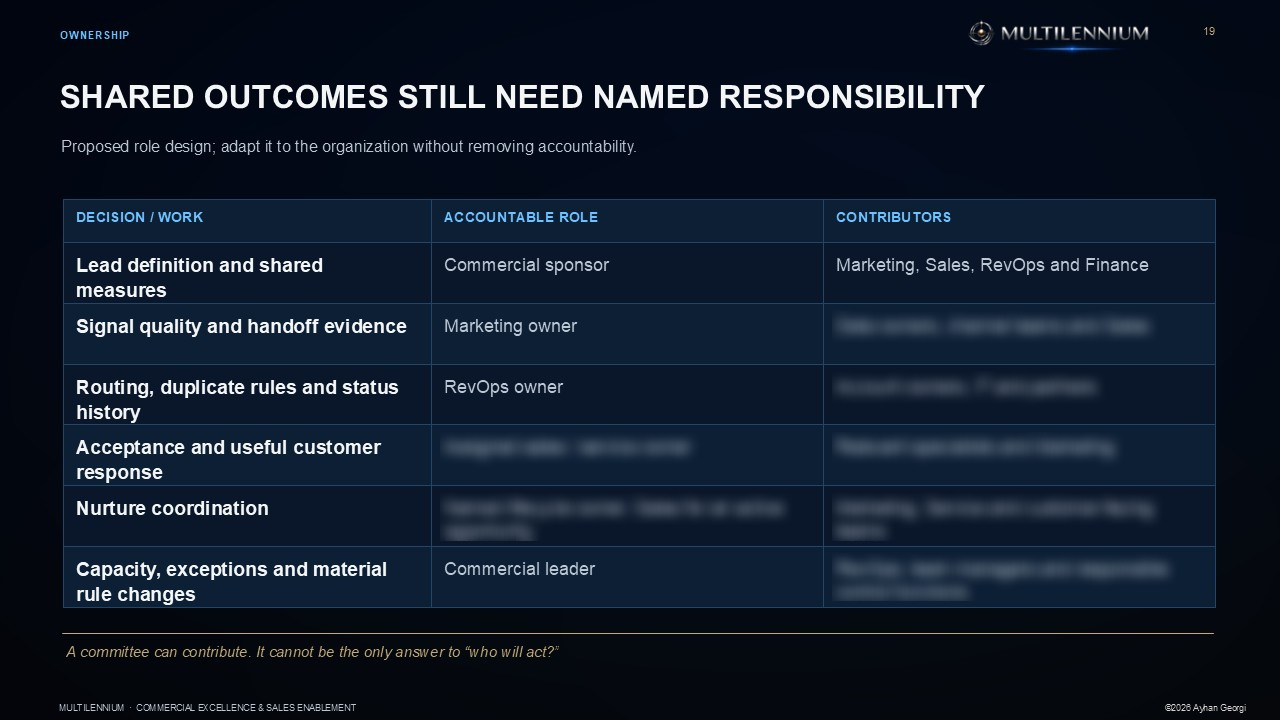
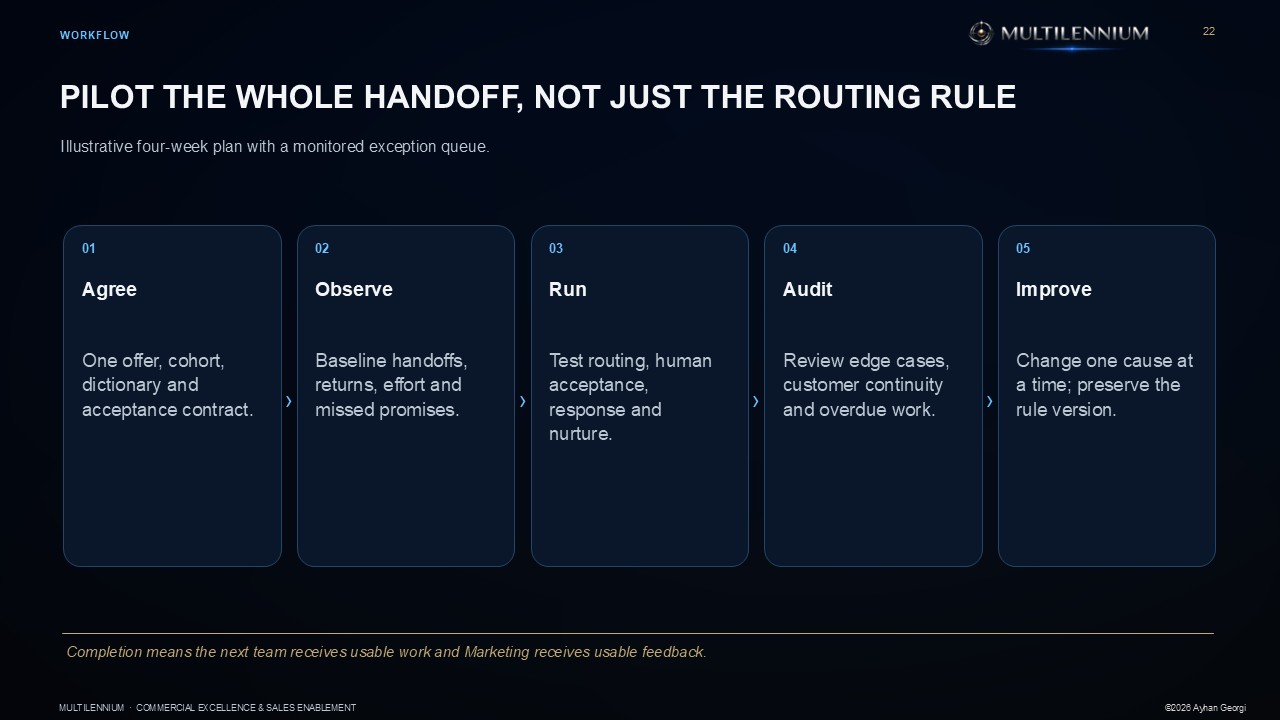
Connect lead qualification, routing, acceptance and follow-through so every customer request has a next owner - or an explicit, actionable return.
A routed lead can still have no accepted owner. A qualified record can still contain an unanswered customer question. Lead Management makes those differences operational.
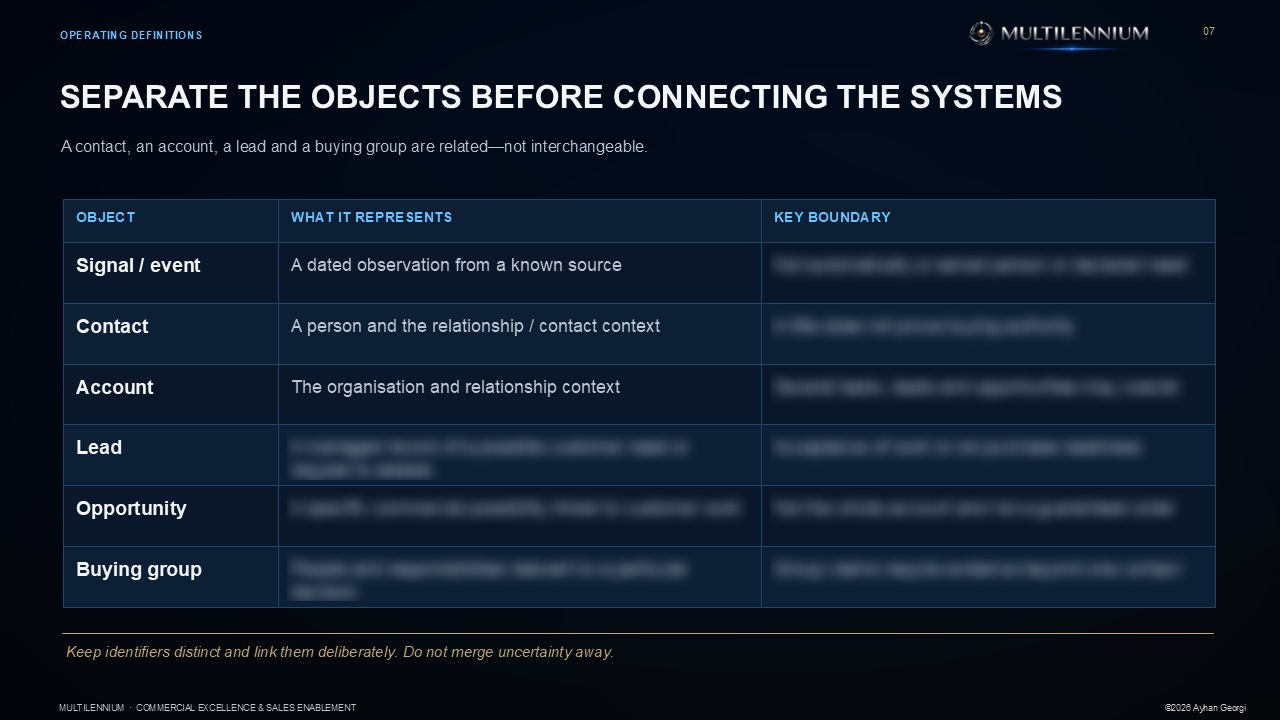
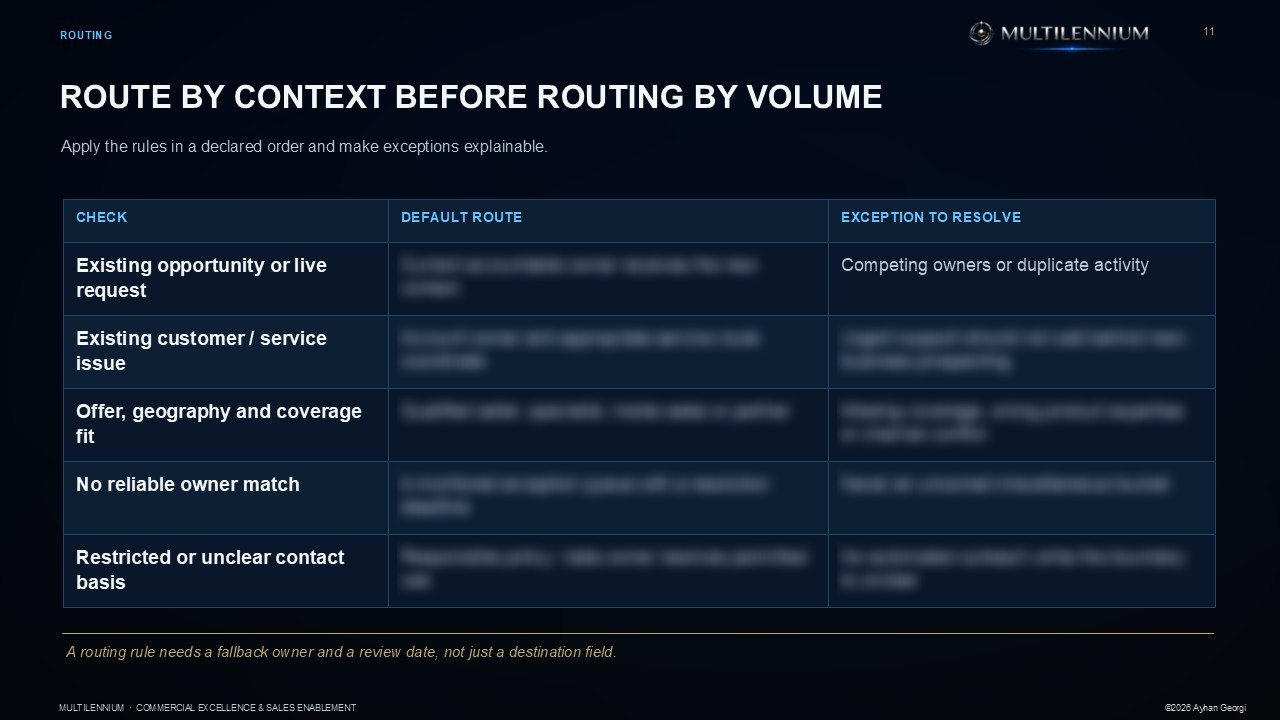
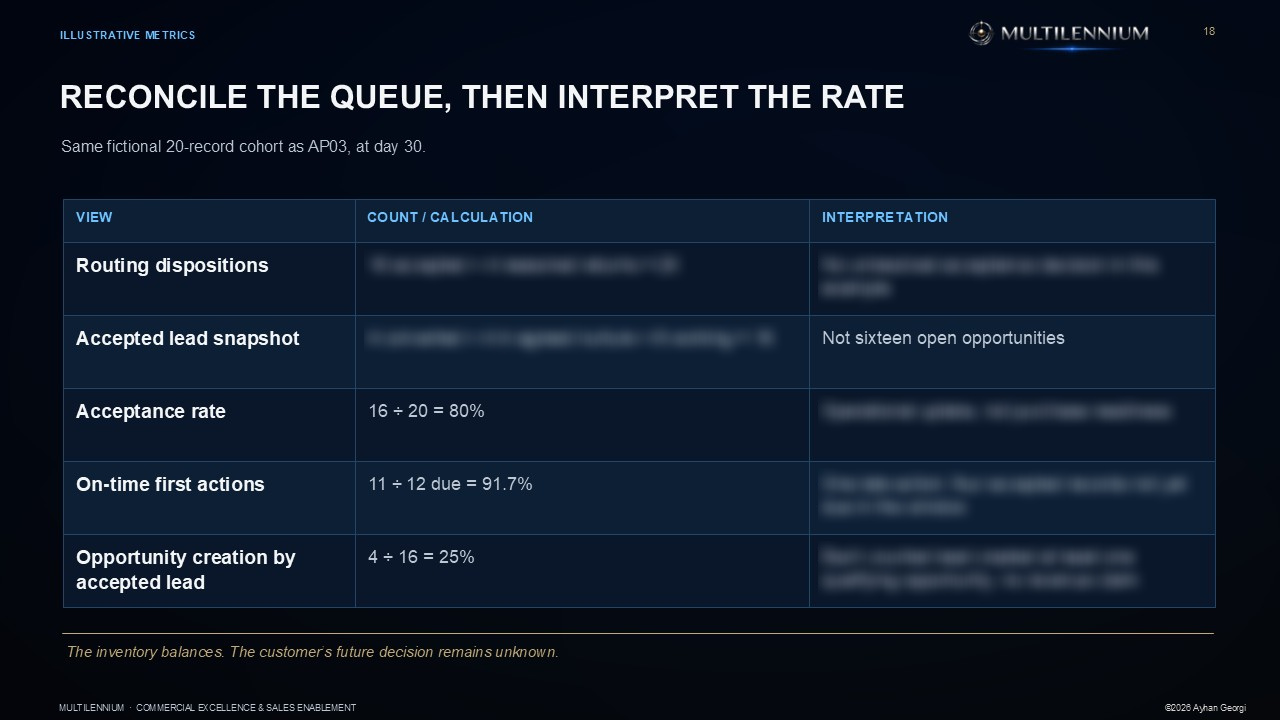
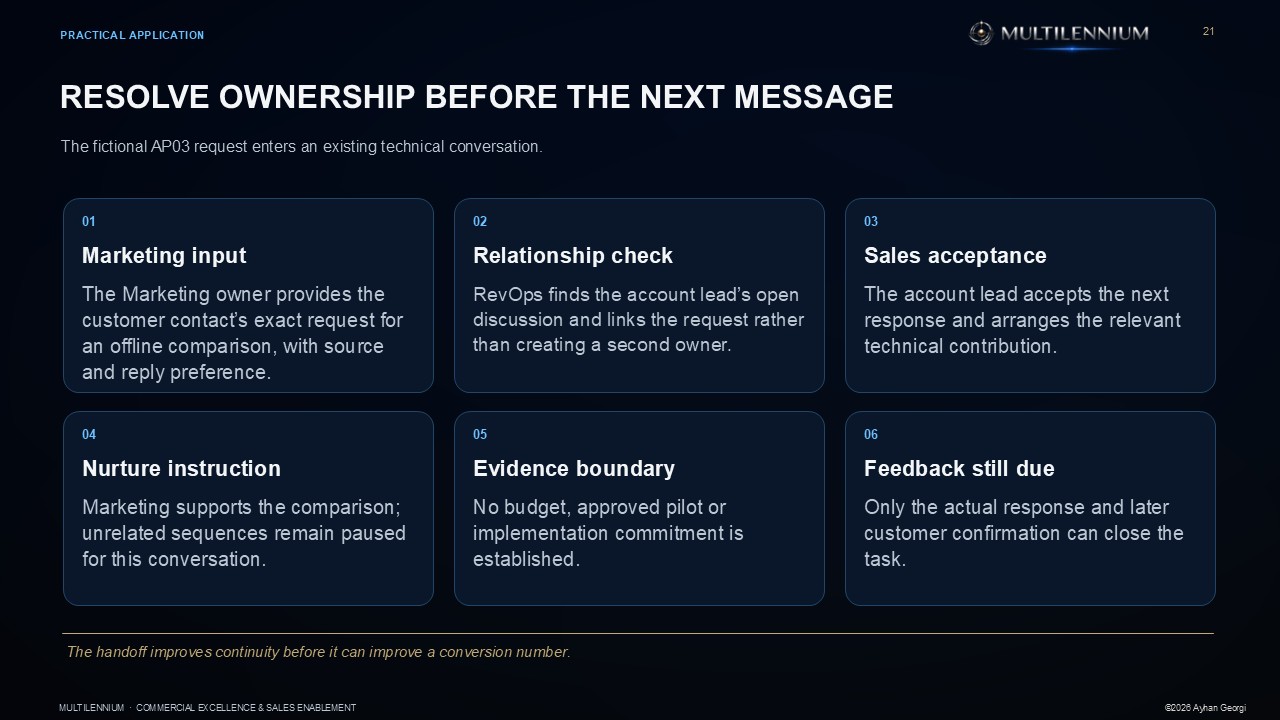
The perspective separates signal, contact, account, lead, opportunity and buying group. It defines the evidence for qualification, the responsibility for acceptance and the route for an exception. Existing relationships, open opportunities and service issues are checked before a new sequence begins.
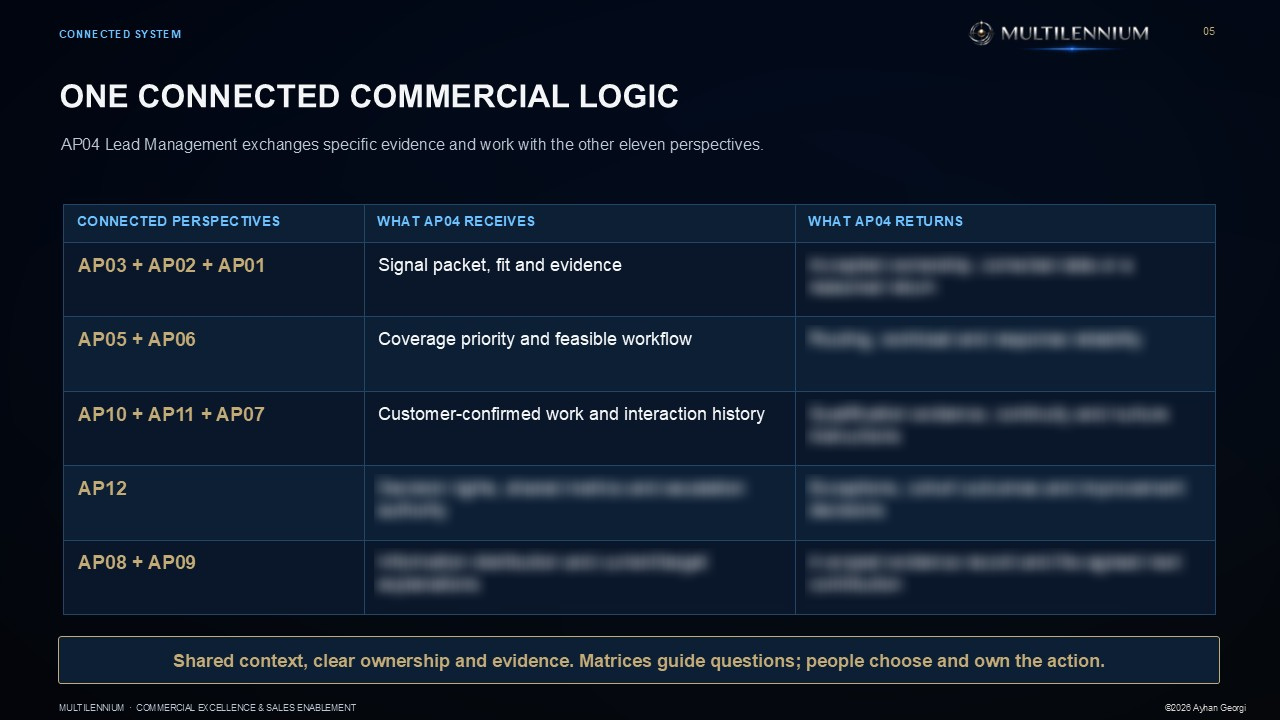
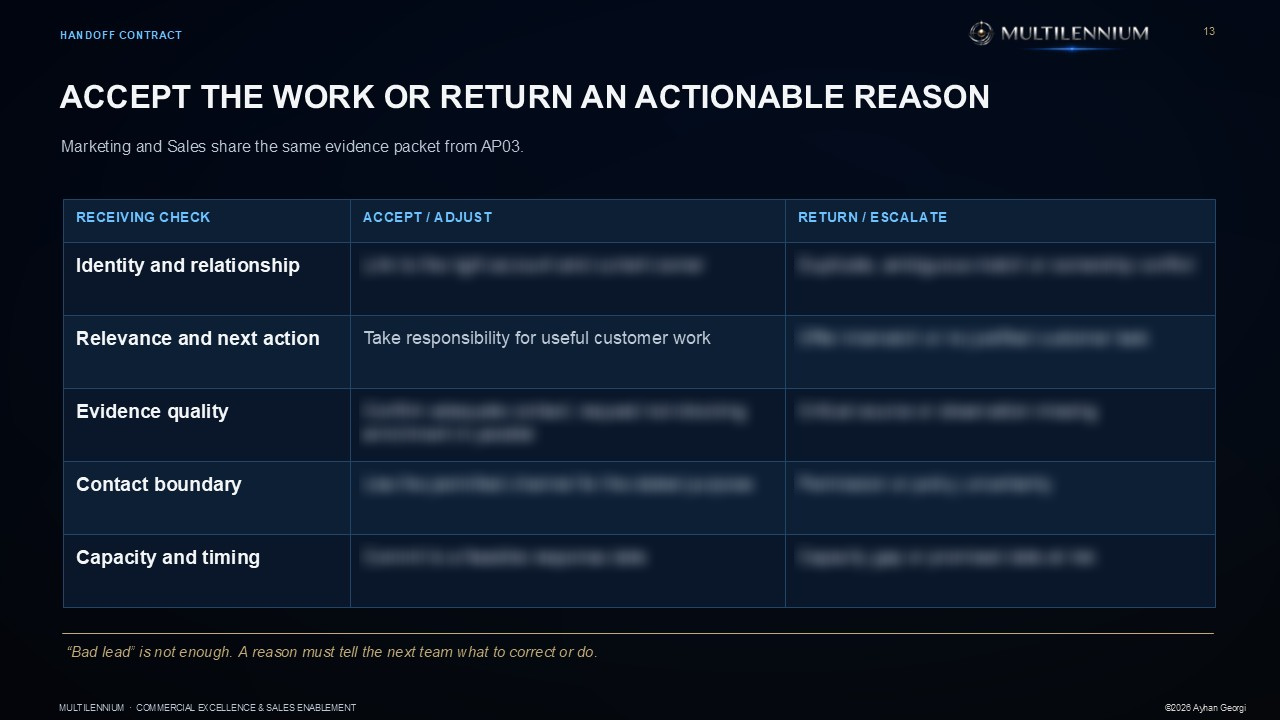
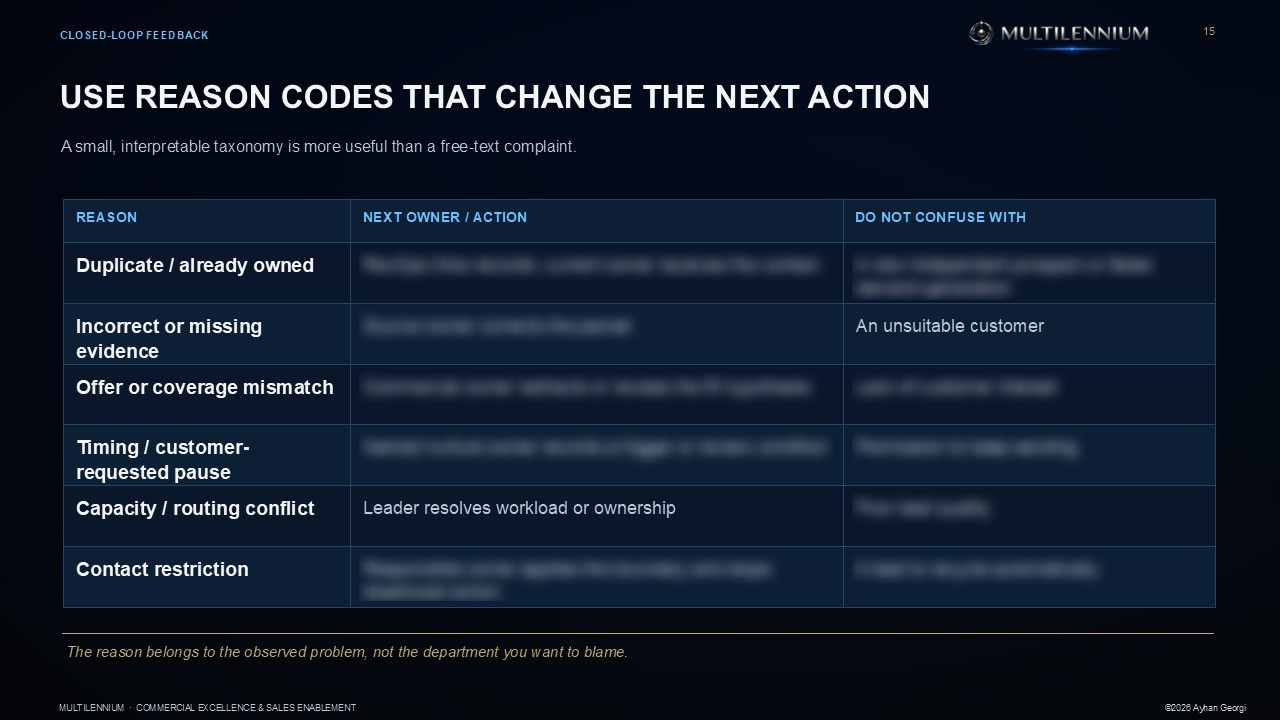
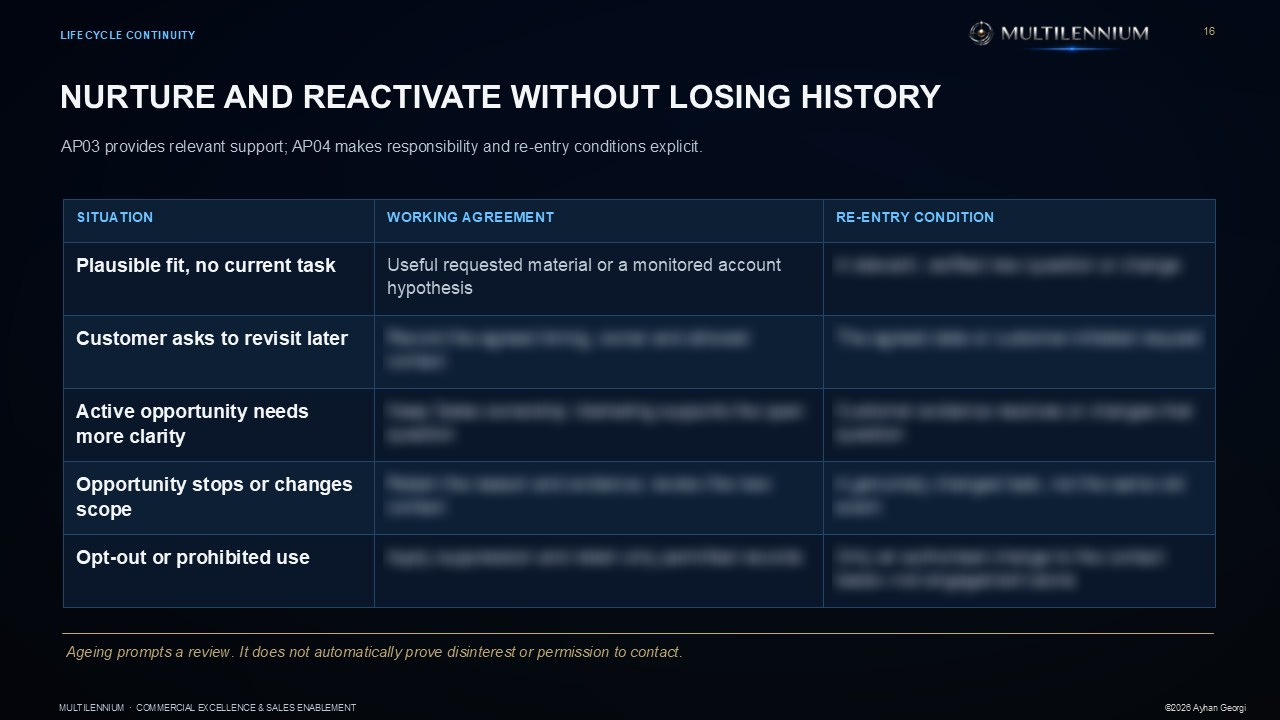
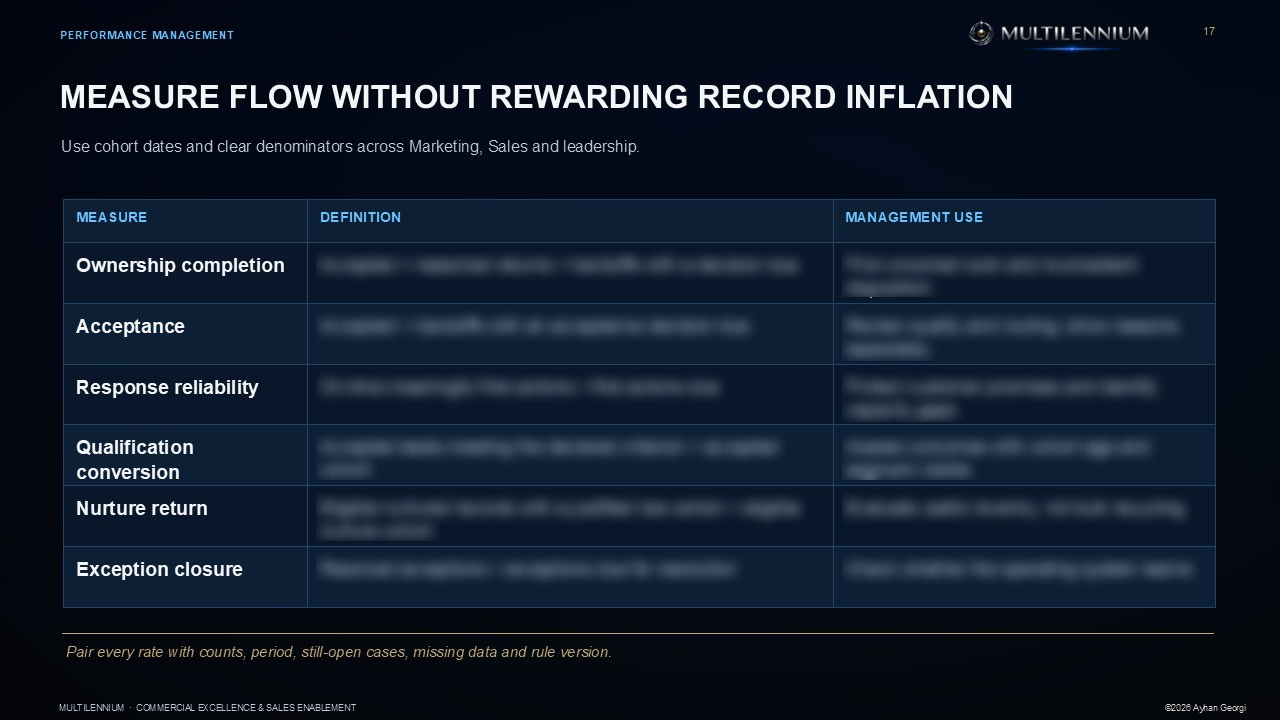
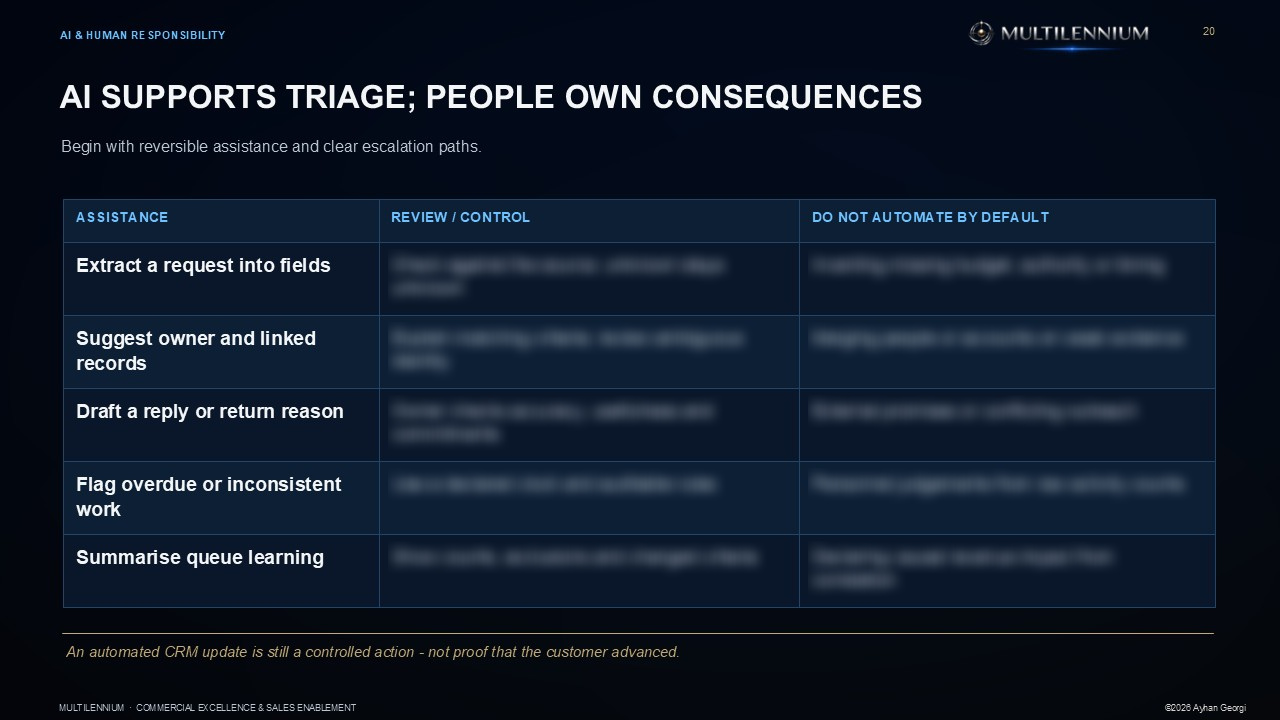
Sales feedback is part of the design. A return identifies what should change: the data, relevance, timing, contact boundary, ownership or available capacity. Nurture retains history and has a reason to restart. Shared cohort measures expose unanswered handoffs and late actions without counting the same opportunity several times. AP03 supplies the evidence; AP12 supplies accountable decision rights and the capacity to act.
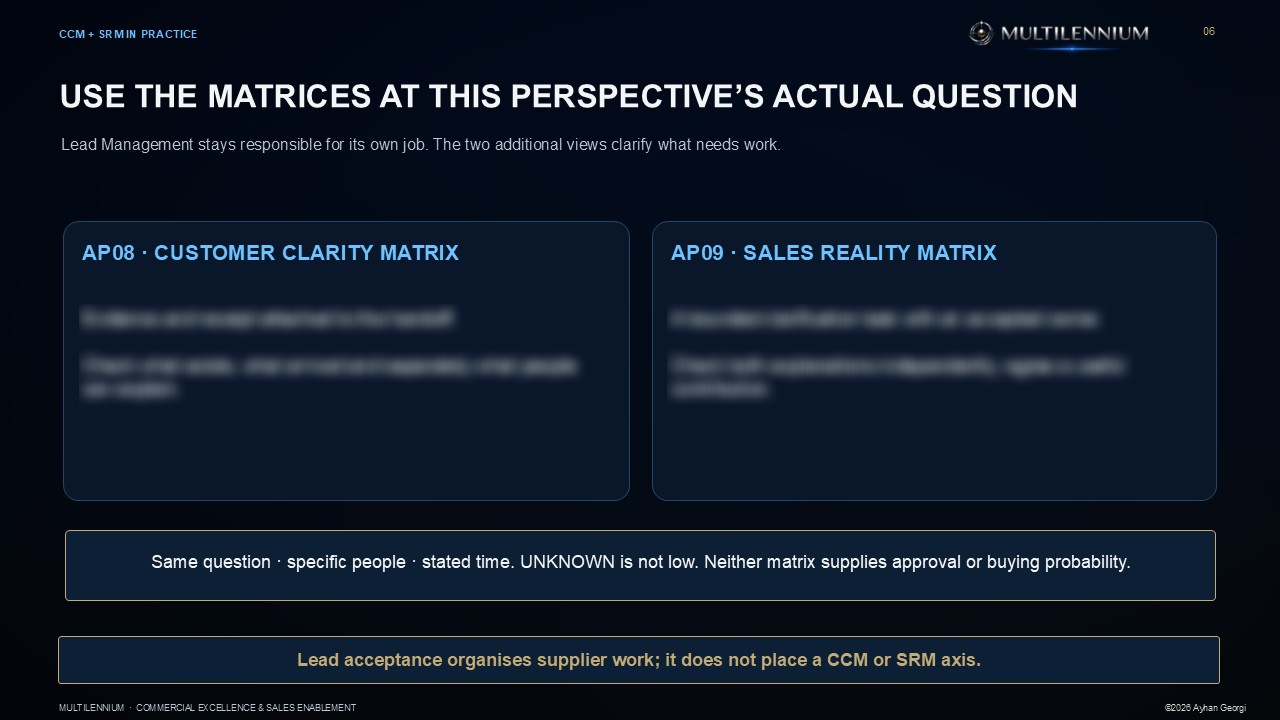
The two clarity perspectives add a practical check here: AP08 makes the relevant information and confirmed sharing visible; AP09 helps select work from current-state and ideal-state explanations. Lead acceptance organises supplier work; it does not place a CCM or SRM axis.


FOCUS
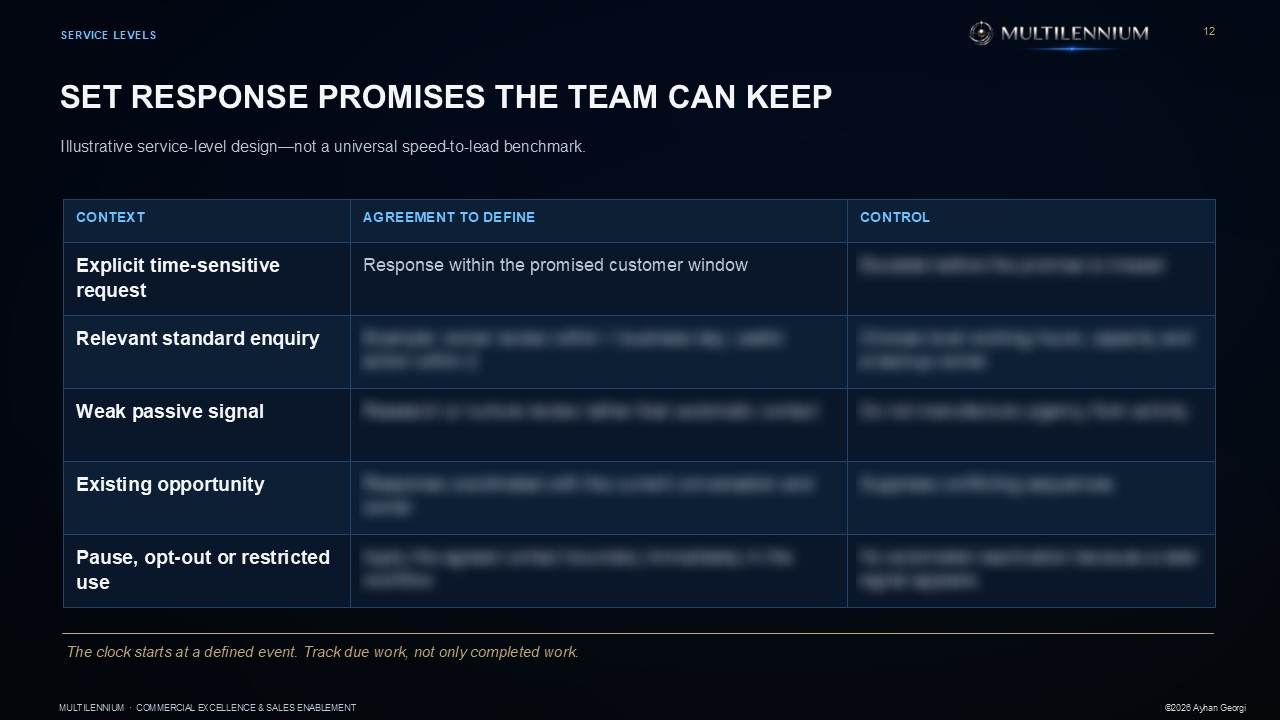
Lifecycle dictionary; context-first routing; acceptance and return rules; response commitments; shared cohort review.
WHEN TO USE
When Marketing and Sales disagree about lead quality, handoffs disappear or ownership changes without enough context.
CONNECTIONS
AP02 Ideal Customer Profile, AP03 Signals, AP05 Revenue Focus, AP07 Customer Engagement, AP08 Customer Clarity Matrix, AP09 Sales Reality Matrix, AP12 Leadership.
APPLIED PERSPECTIVE 05
Revenue Focus
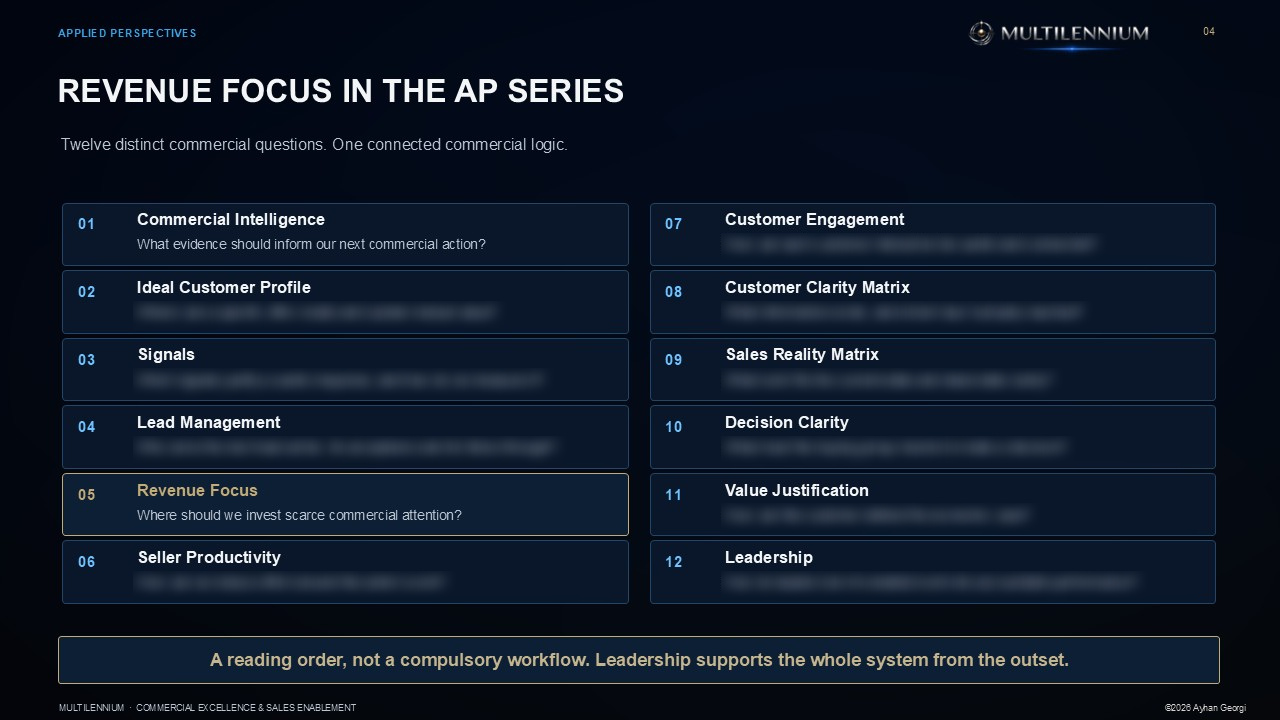
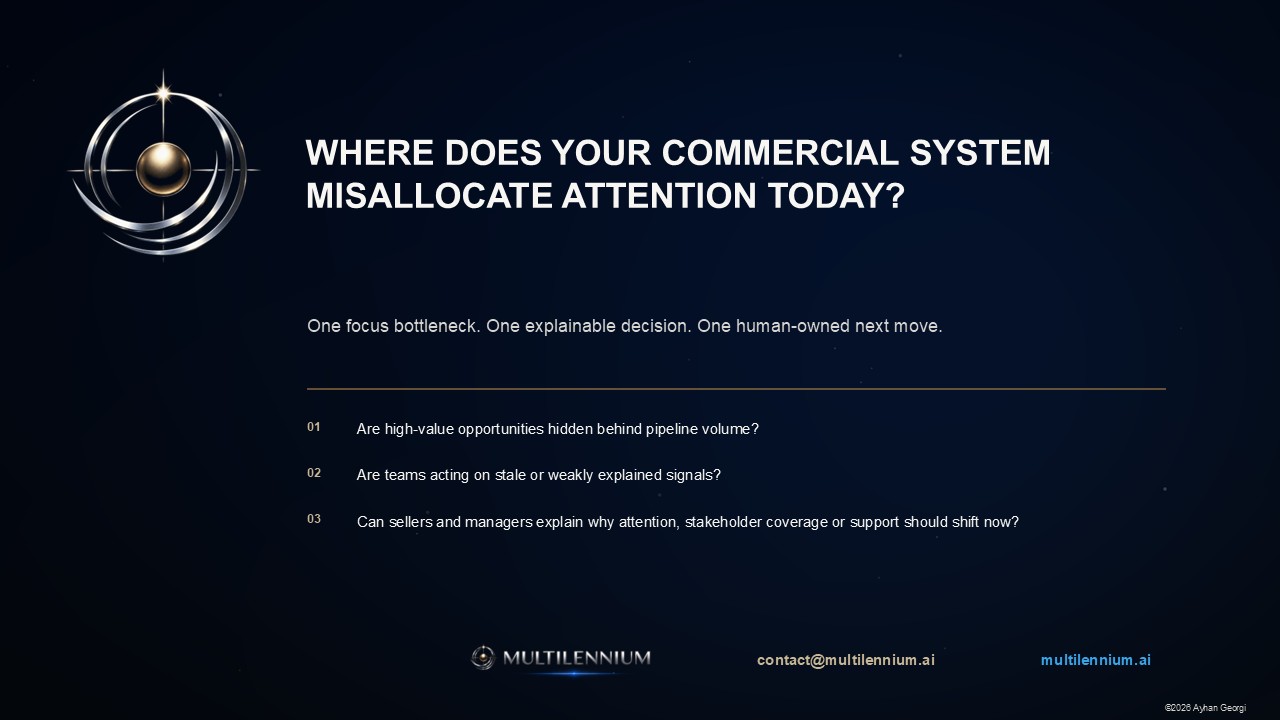
Where should we invest scarce commercial attention?
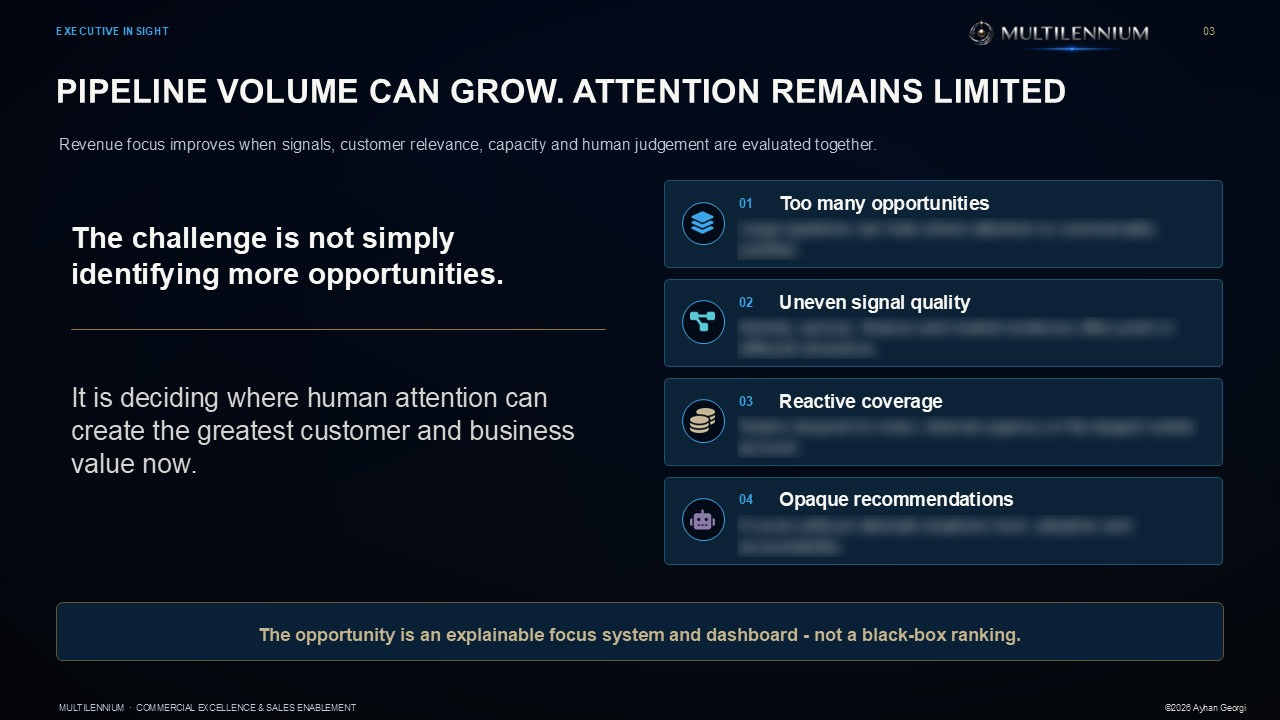
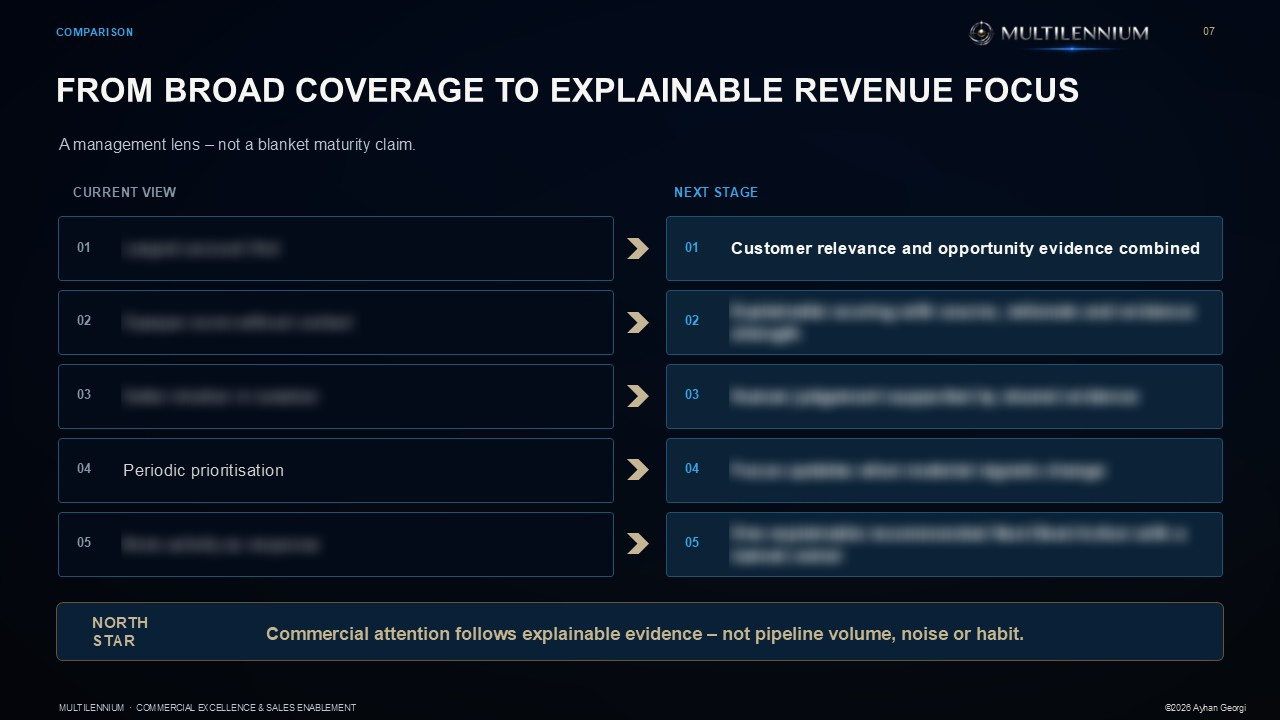
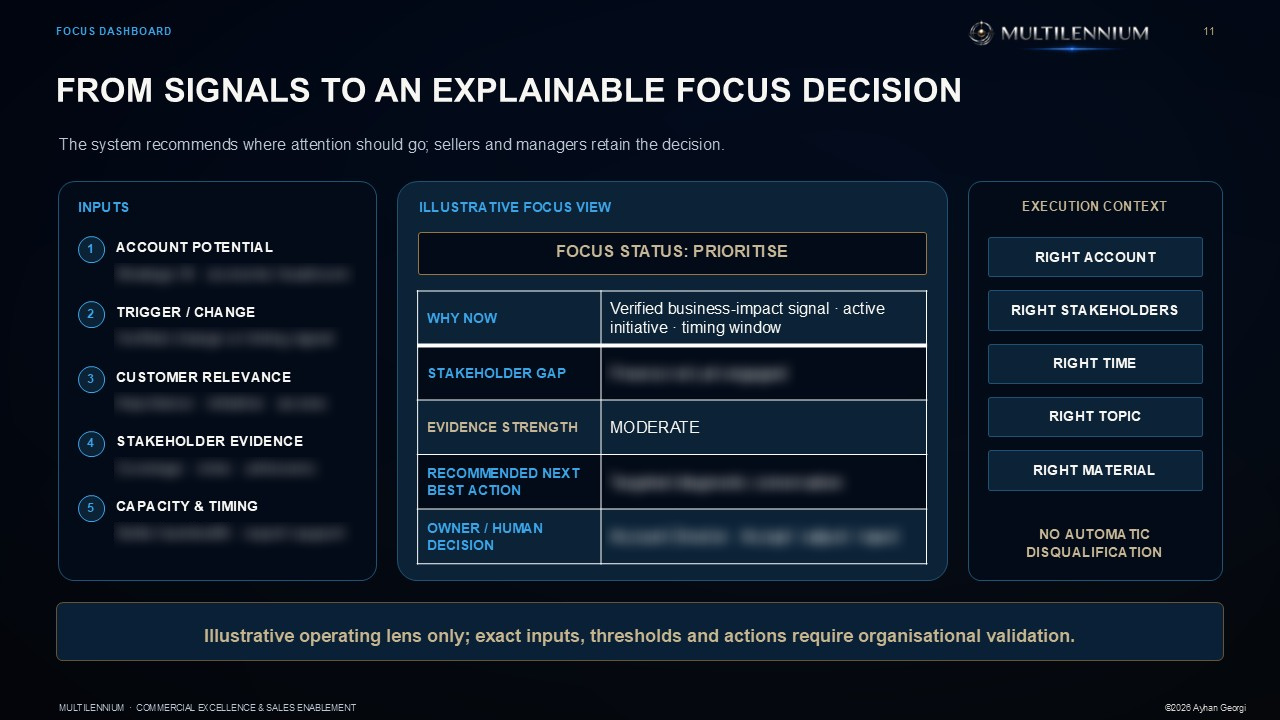
Direct scarce commercial attention toward the work that is justified now - not simply toward the loudest account or largest pipeline number.
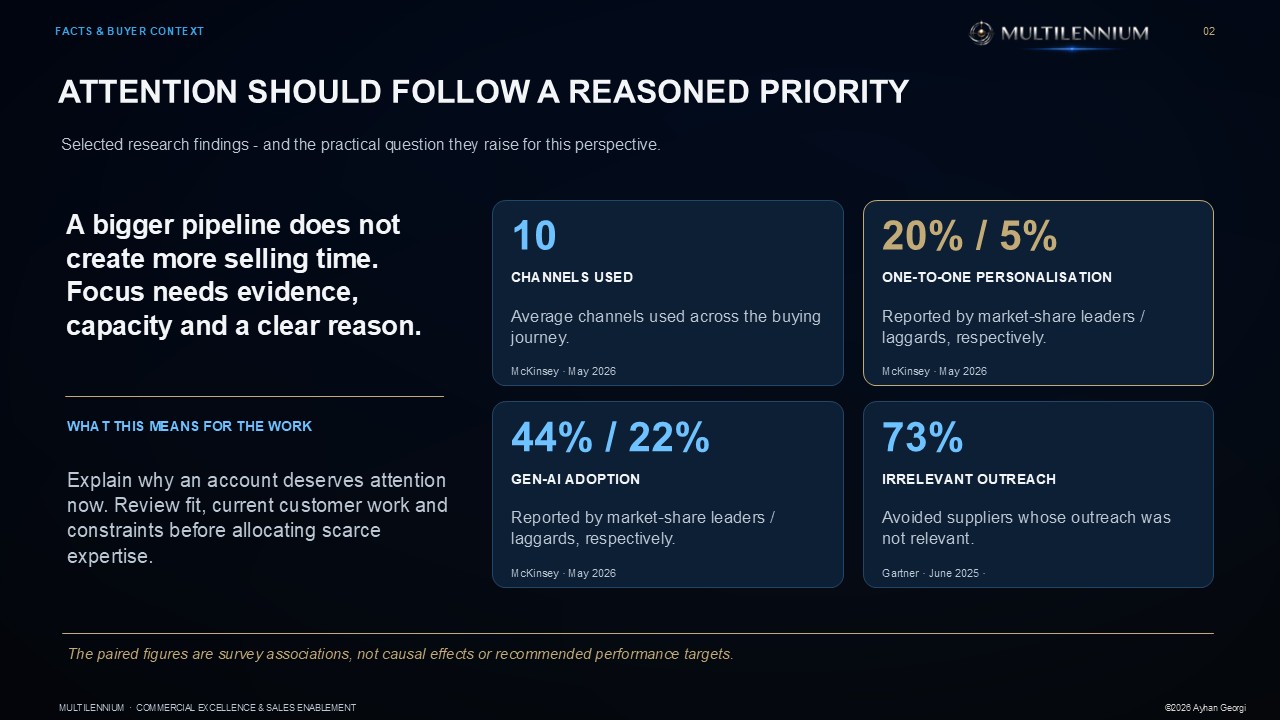
A growing pipeline does not create more hours in the team’s week. Someone still has to decide which account needs attention, what that attention should accomplish and what can reasonably wait.
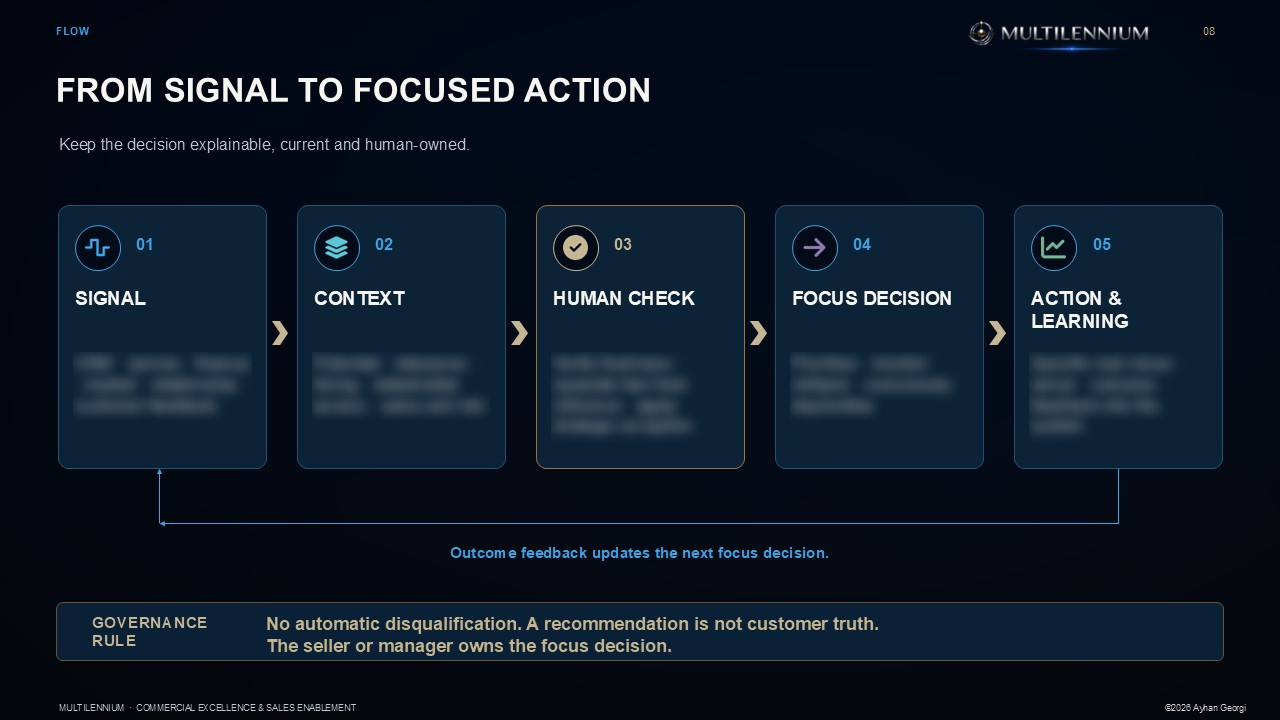
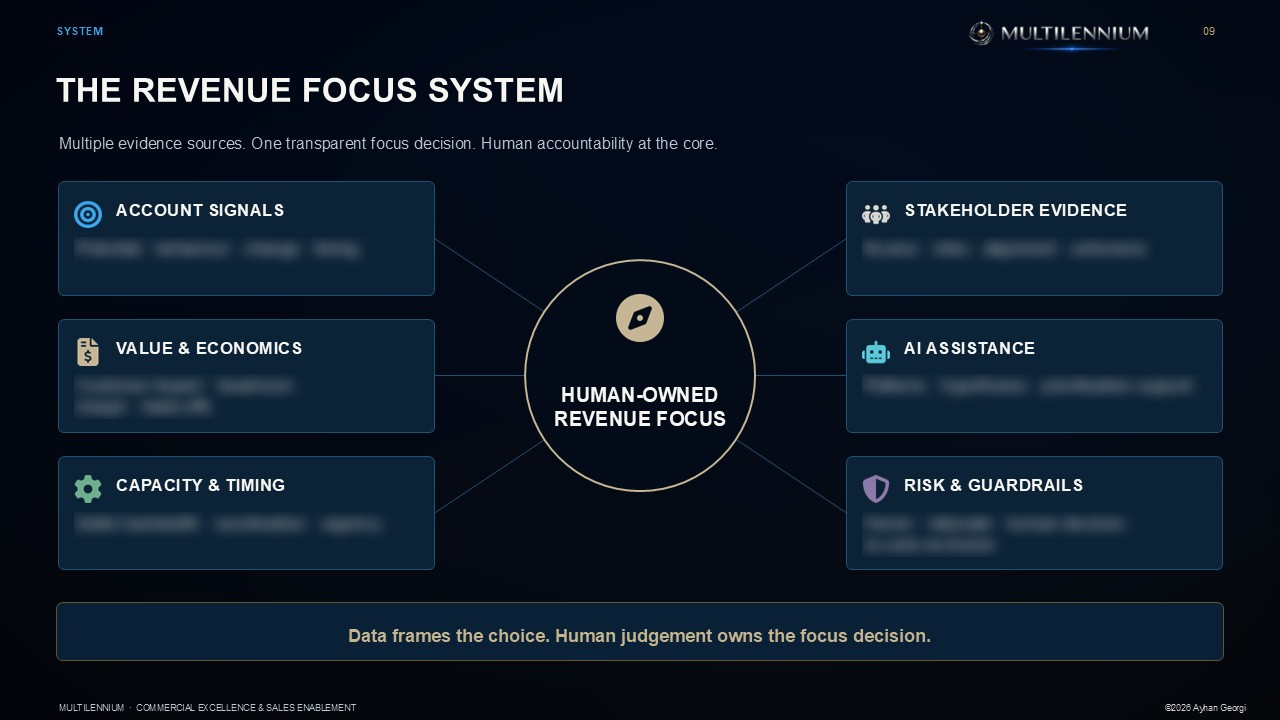
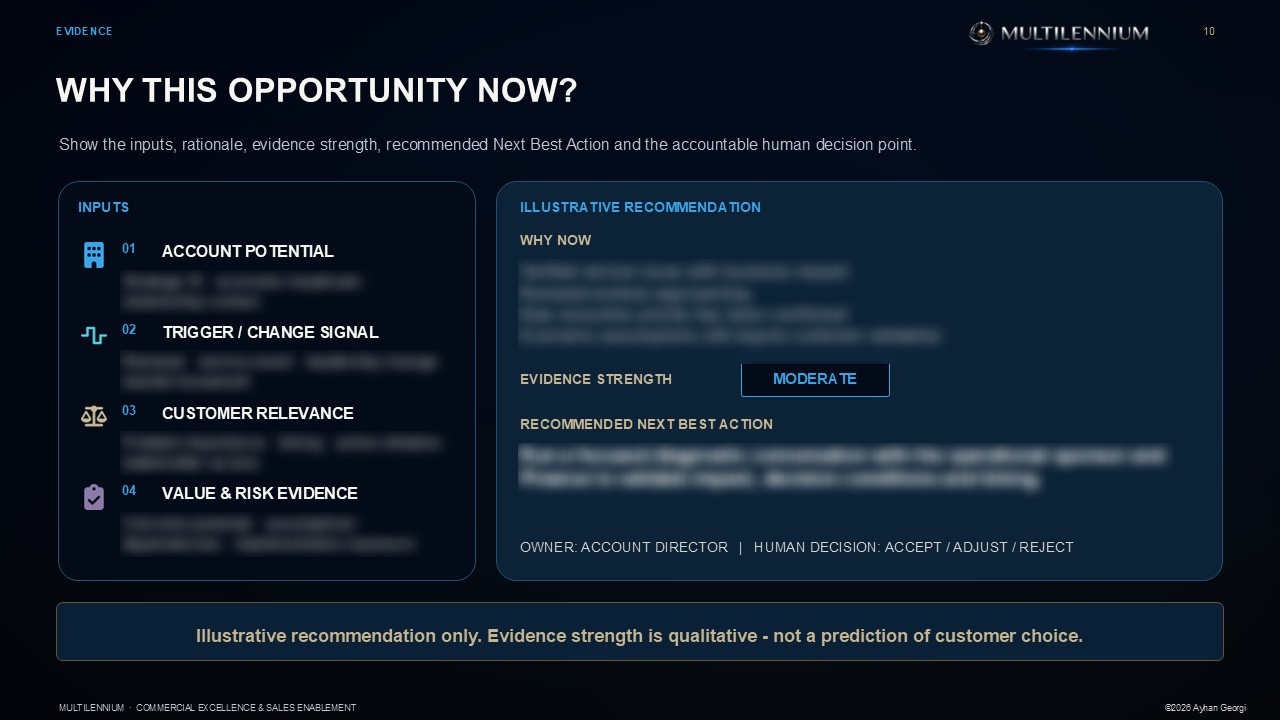
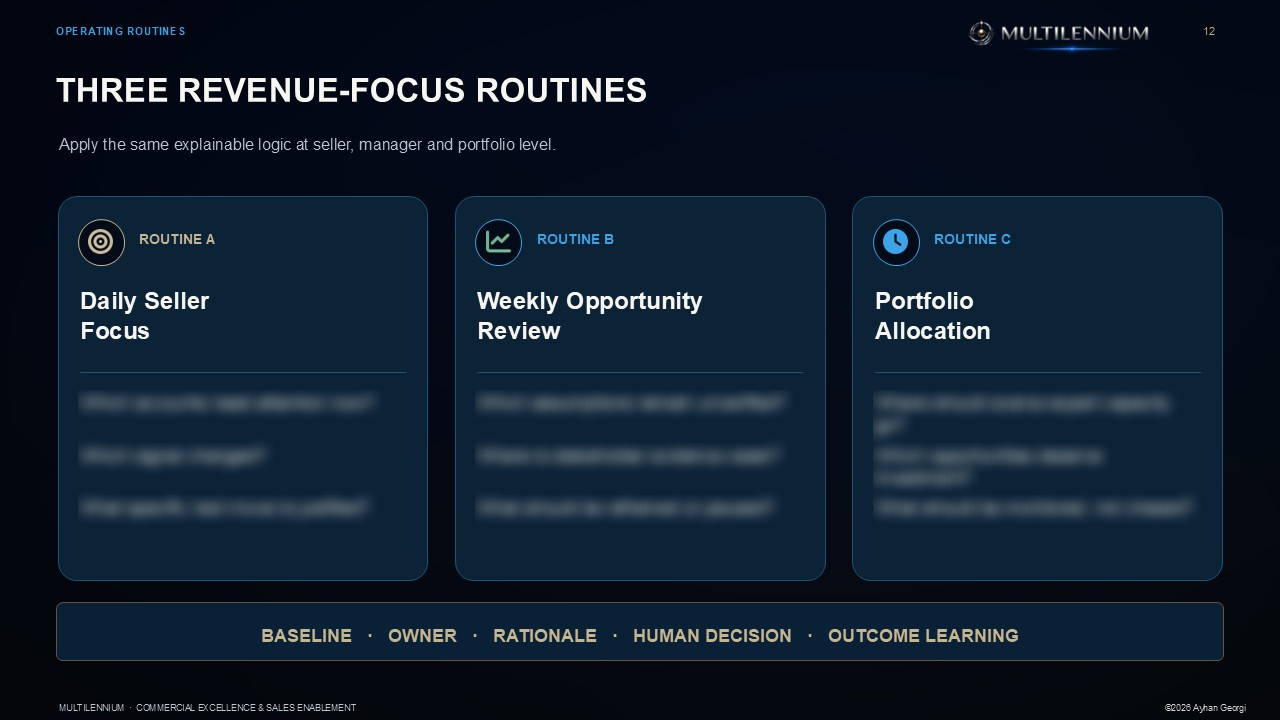
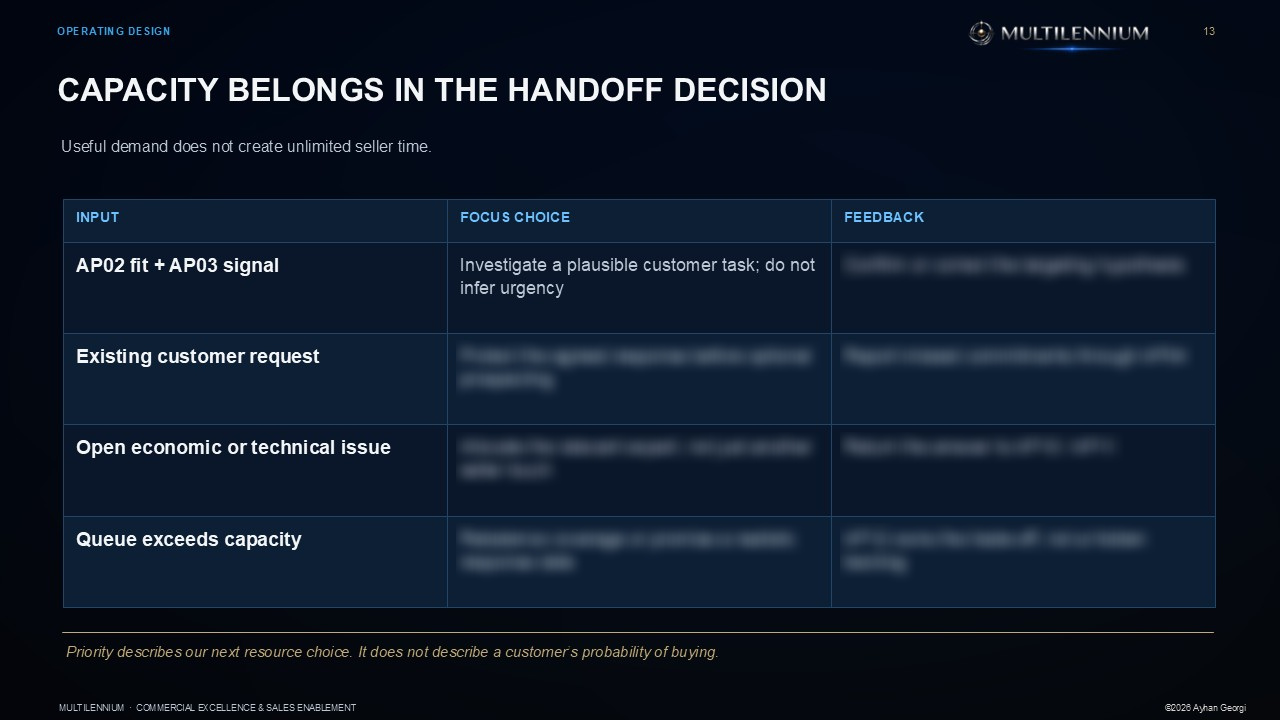
Revenue Focus makes that choice explainable. It brings together offer-specific fit, current evidence, customer work, economics and available capacity. A priority is a resource decision, not a probability that the customer will buy.
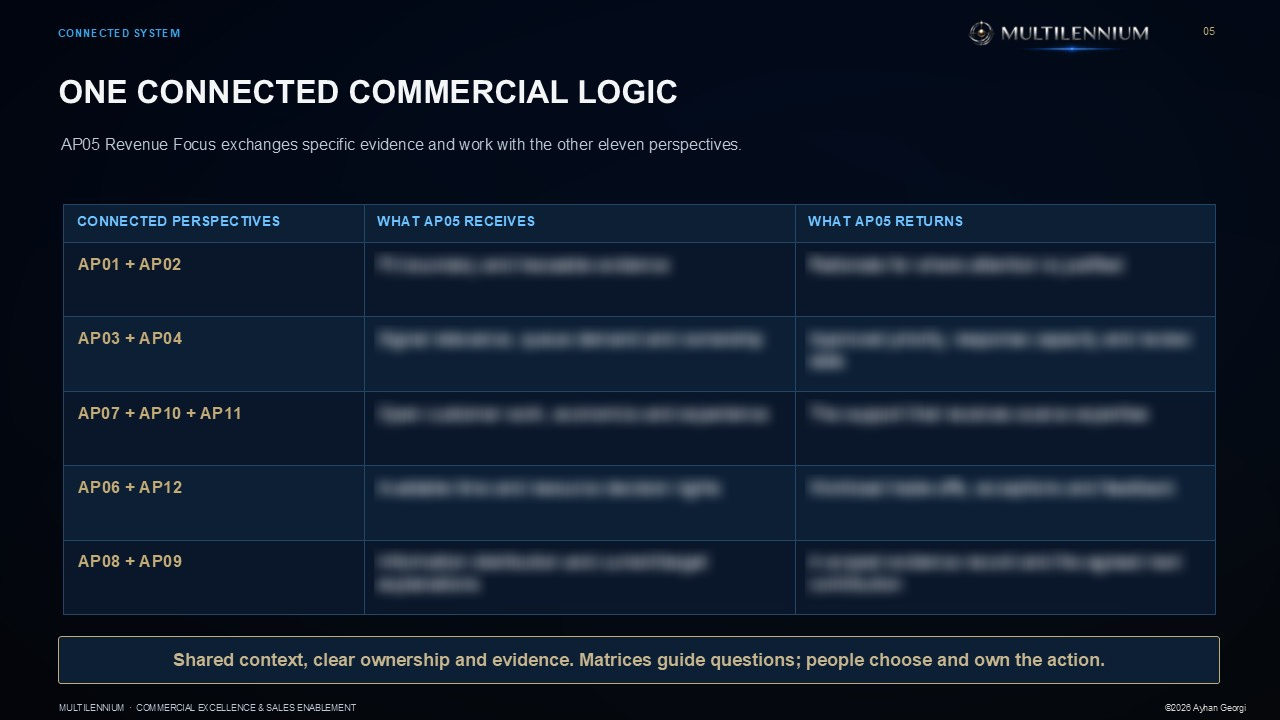
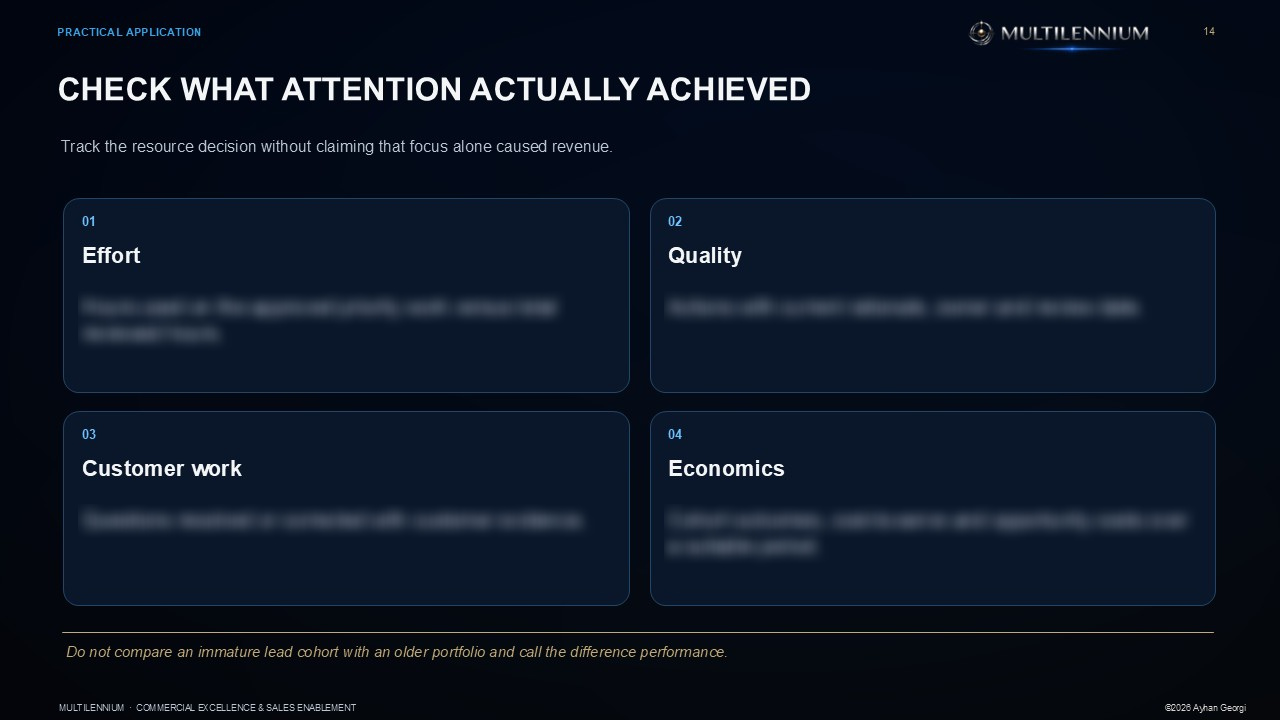
AP03 and AP04 extend the perspective into the response queue: explicit customer requests, existing opportunities and new signals compete for different kinds of attention. AP06 shows what the team can actually deliver. AP12 makes the trade-offs visible. The review then asks what the chosen effort achieved, including customer help, quality and cost-to-serve—not only whether more activity was recorded.
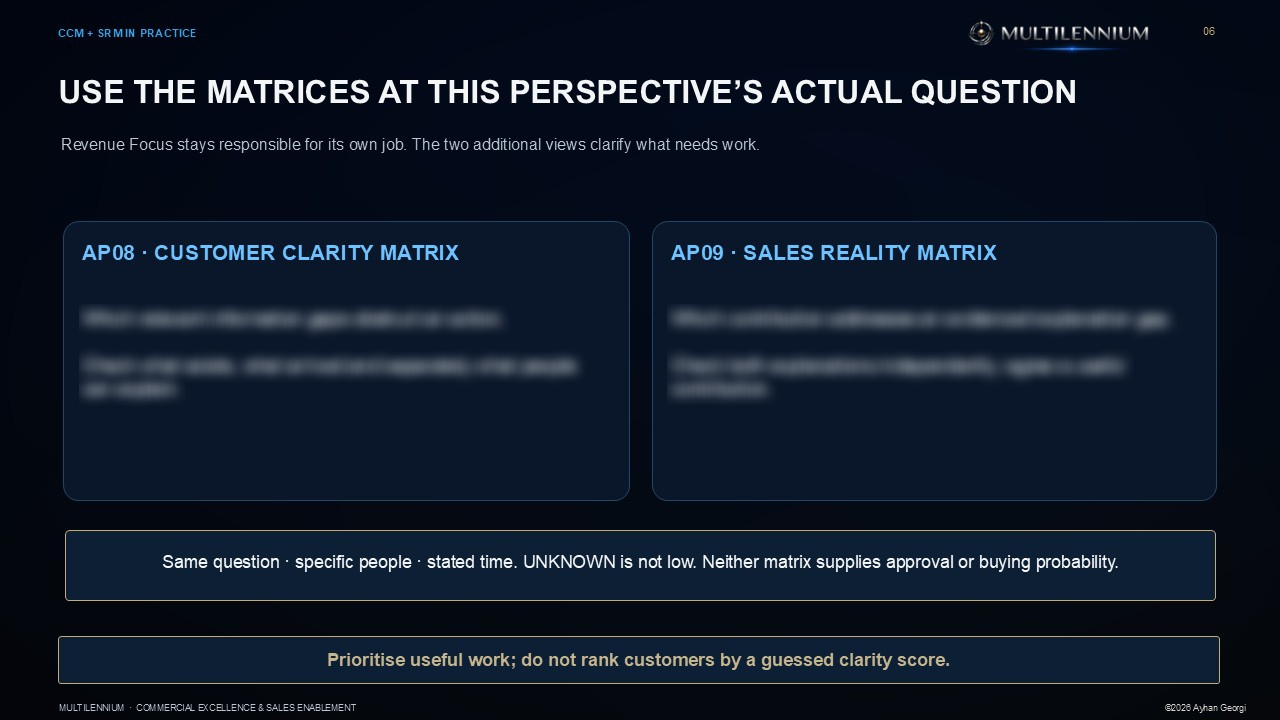
The two clarity perspectives add a practical check here: AP08 makes the relevant information and confirmed sharing visible; AP09 helps select work from current-state and ideal-state explanations. Prioritise useful work; do not rank customers by a guessed clarity score.


FOCUS
Evidence-based focus review; capacity and coverage choices; next-action rationale; outcome feedback.
WHEN TO USE
When lead volume, account size or internal urgency is crowding out deliberate commercial choices.
CONNECTIONS
AP02 Ideal Customer Profile, AP03 Signals, AP04 Lead Management, AP06 Seller Productivity, AP08 Customer Clarity Matrix, AP09 Sales Reality Matrix, AP12 Leadership.
APPLIED PERSPECTIVE 06
Seller Productivity
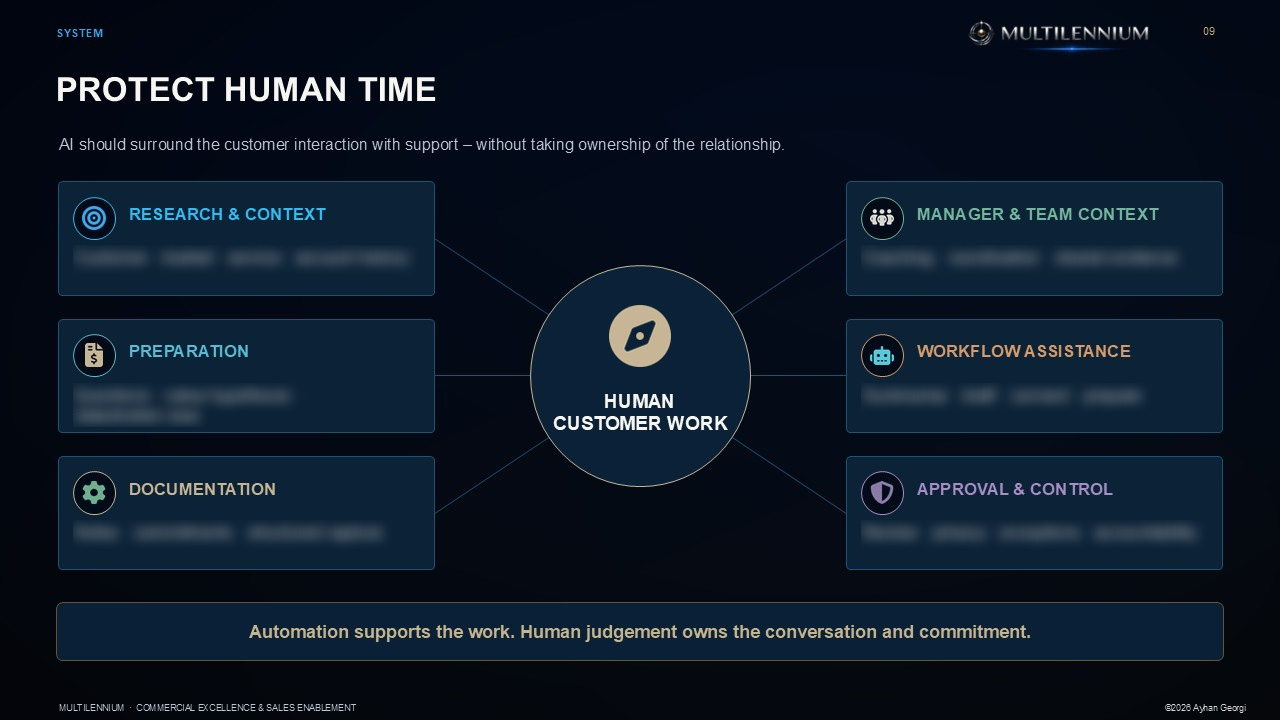
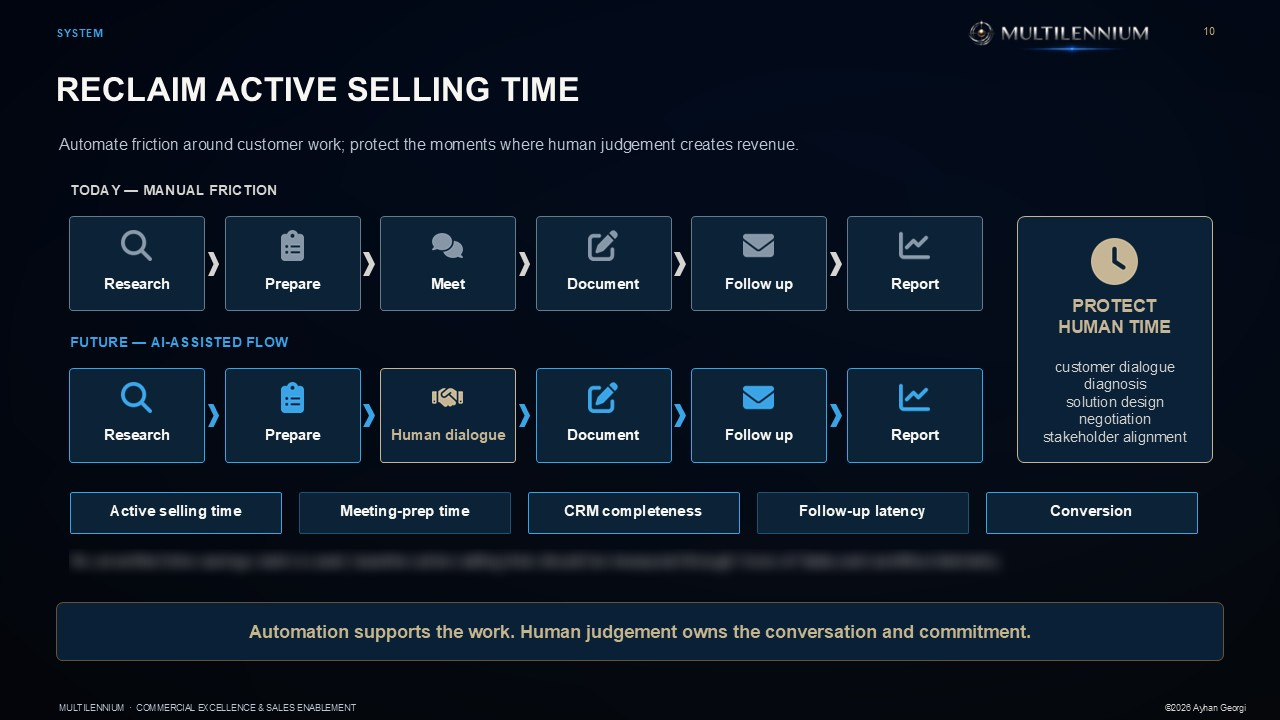
How can we reduce effort around the seller’s work?
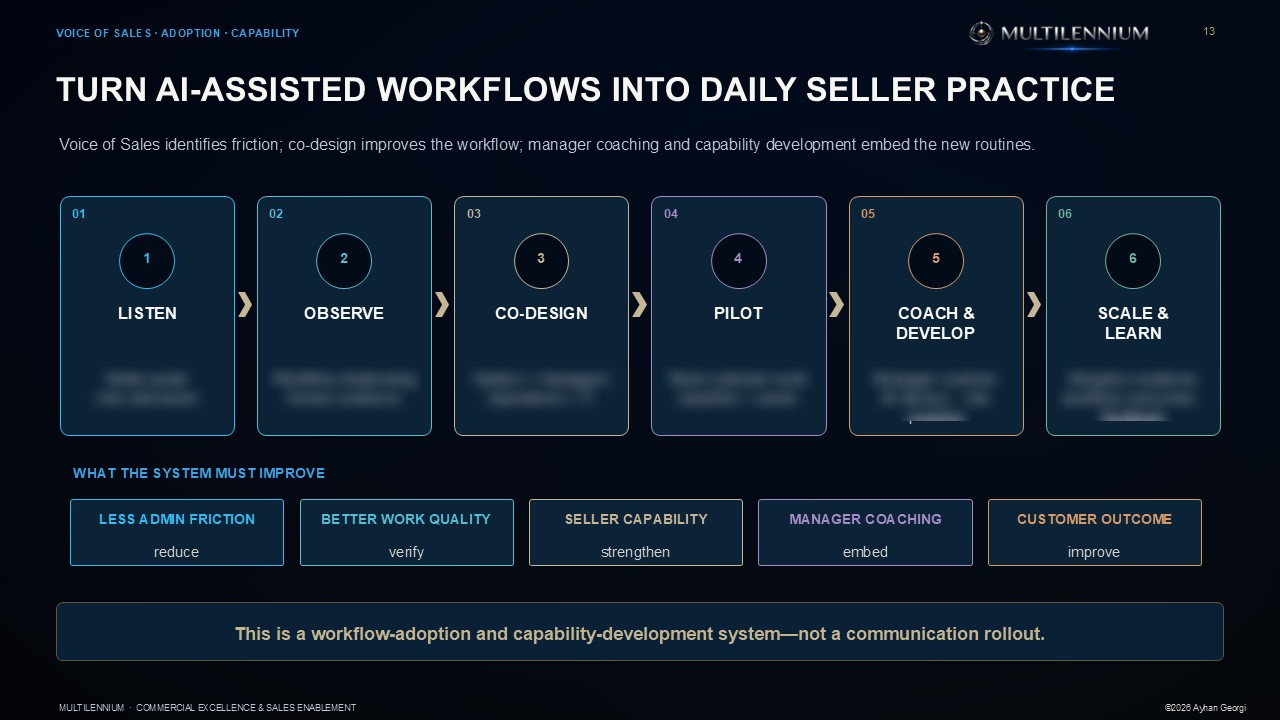
Reduce avoidable work around the seller so more capacity can go into useful customer conversations, preparation and reliable follow-through.
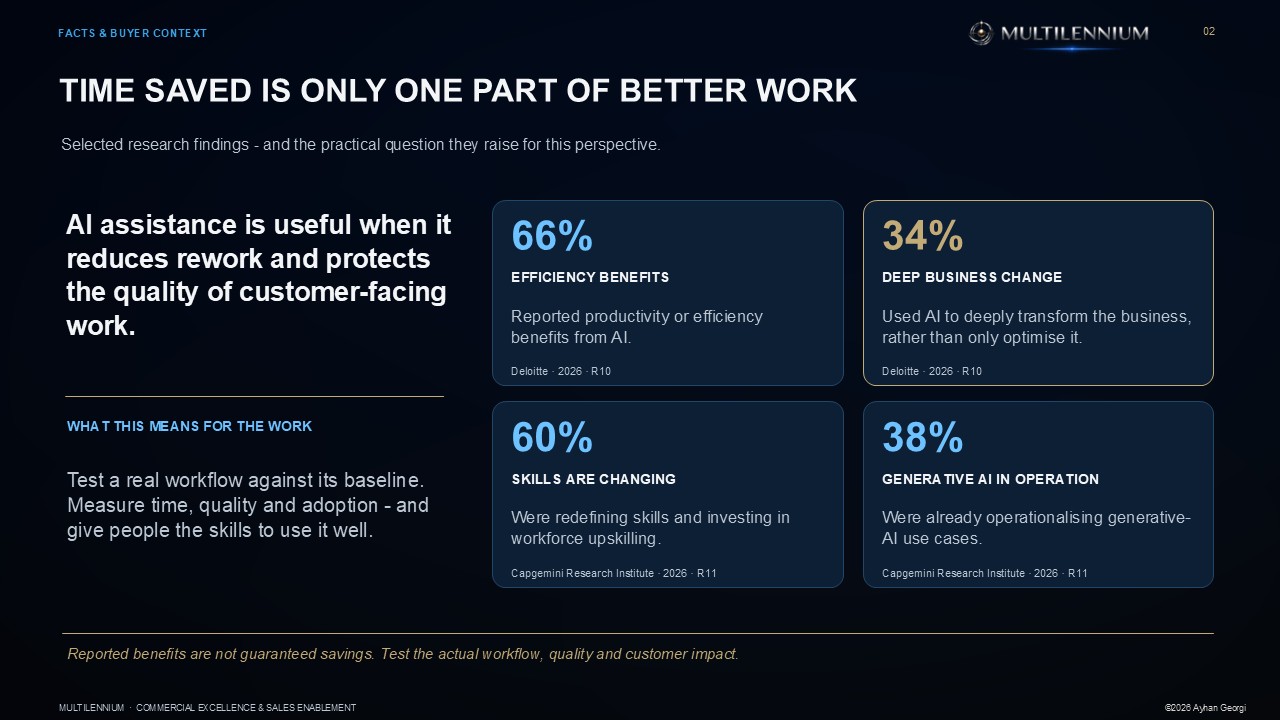
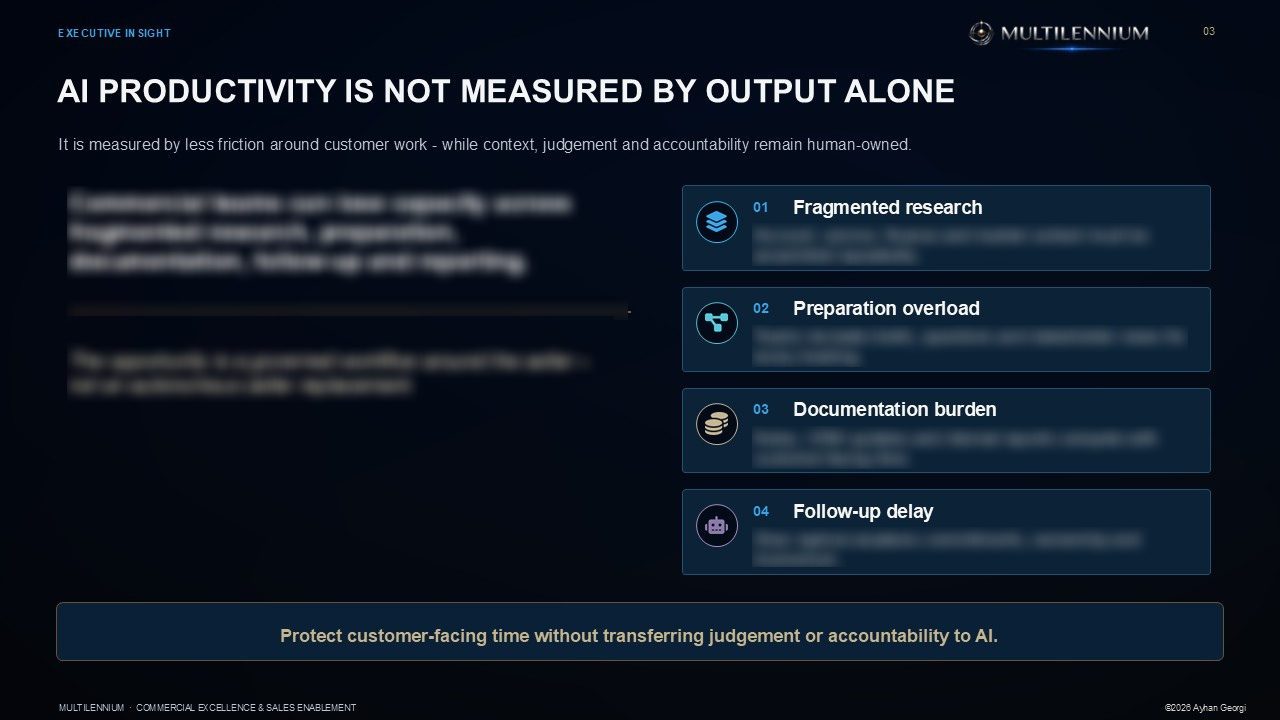
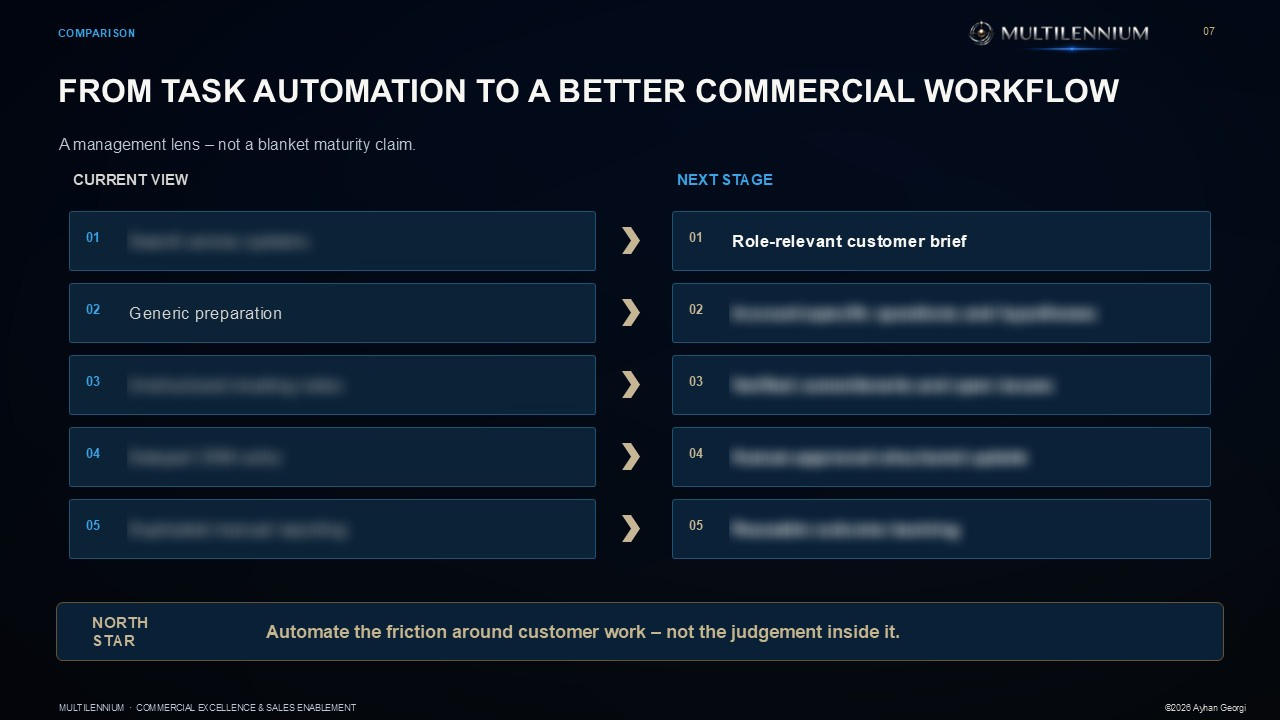
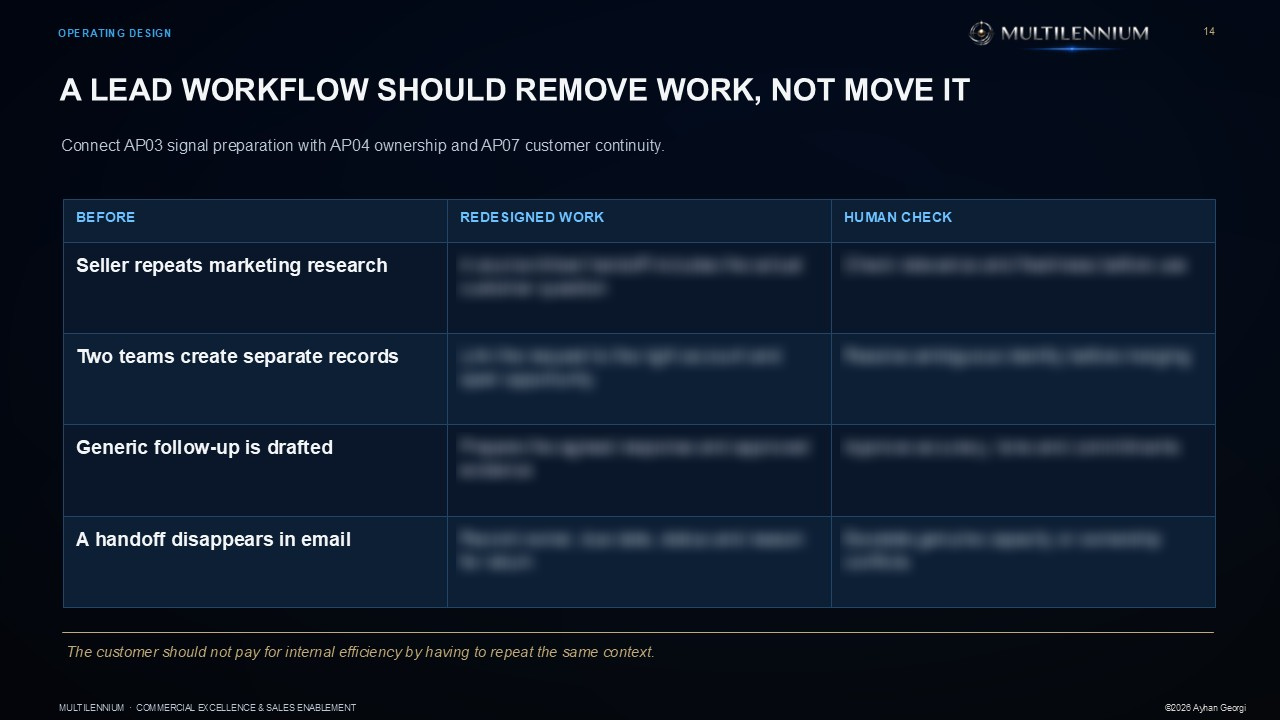
Sellers can lose time searching for information, rebuilding the same account context and documenting an action that another team has already recorded. Adding an AI tool does not automatically remove that work.
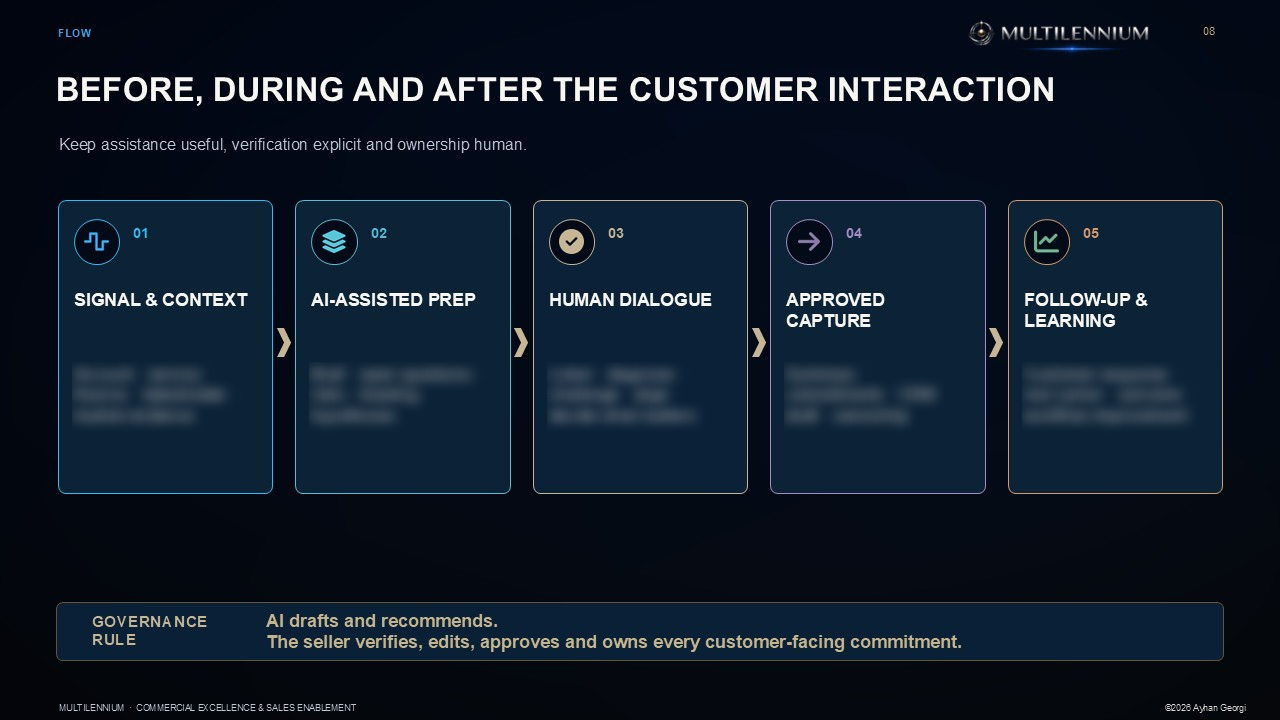
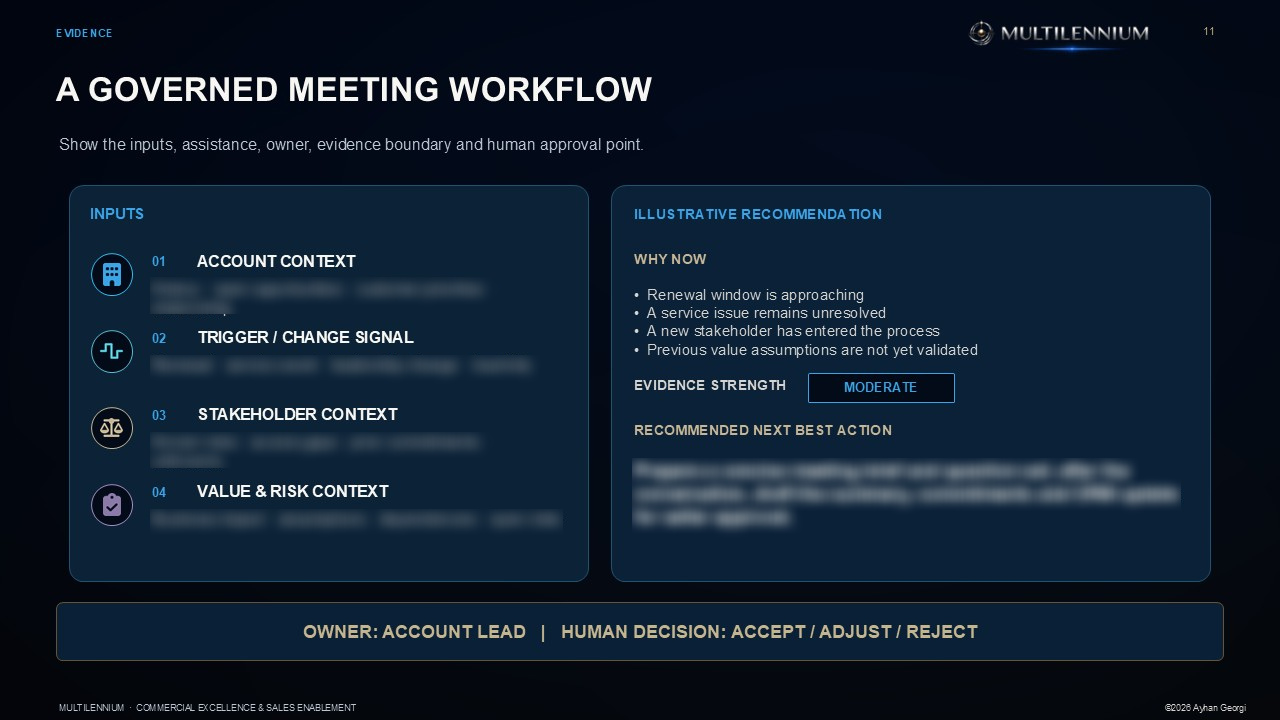
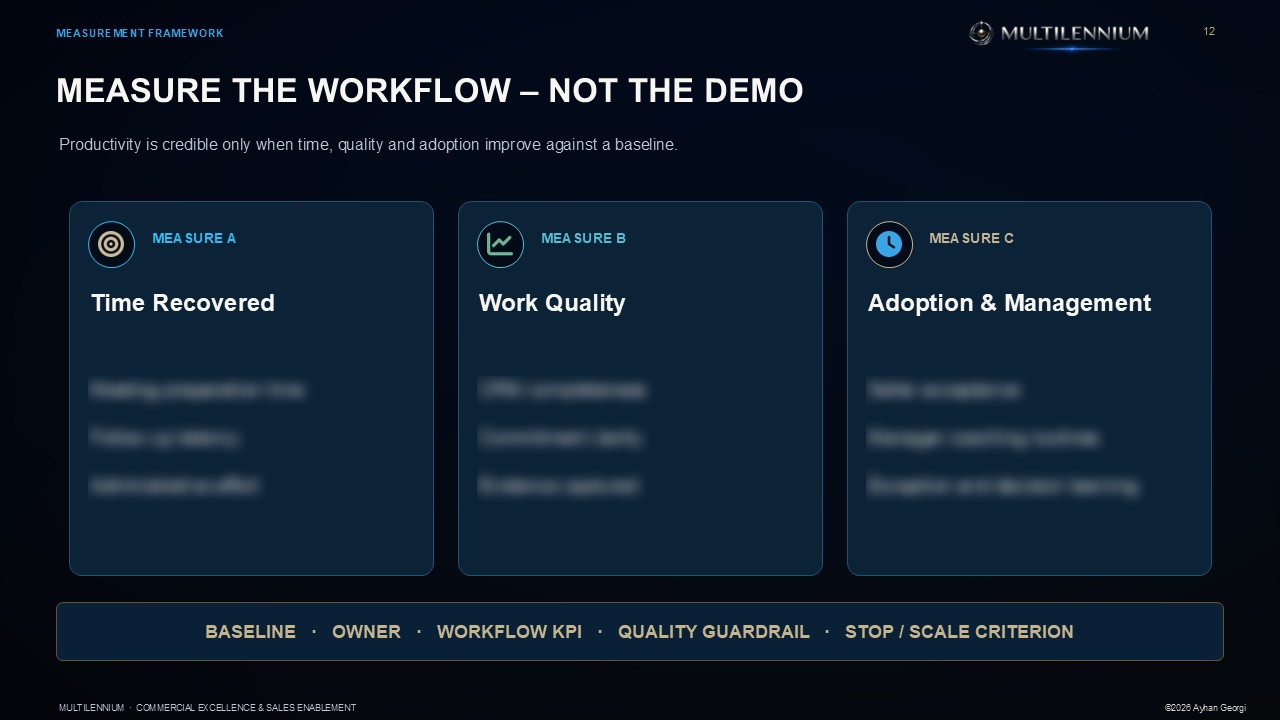
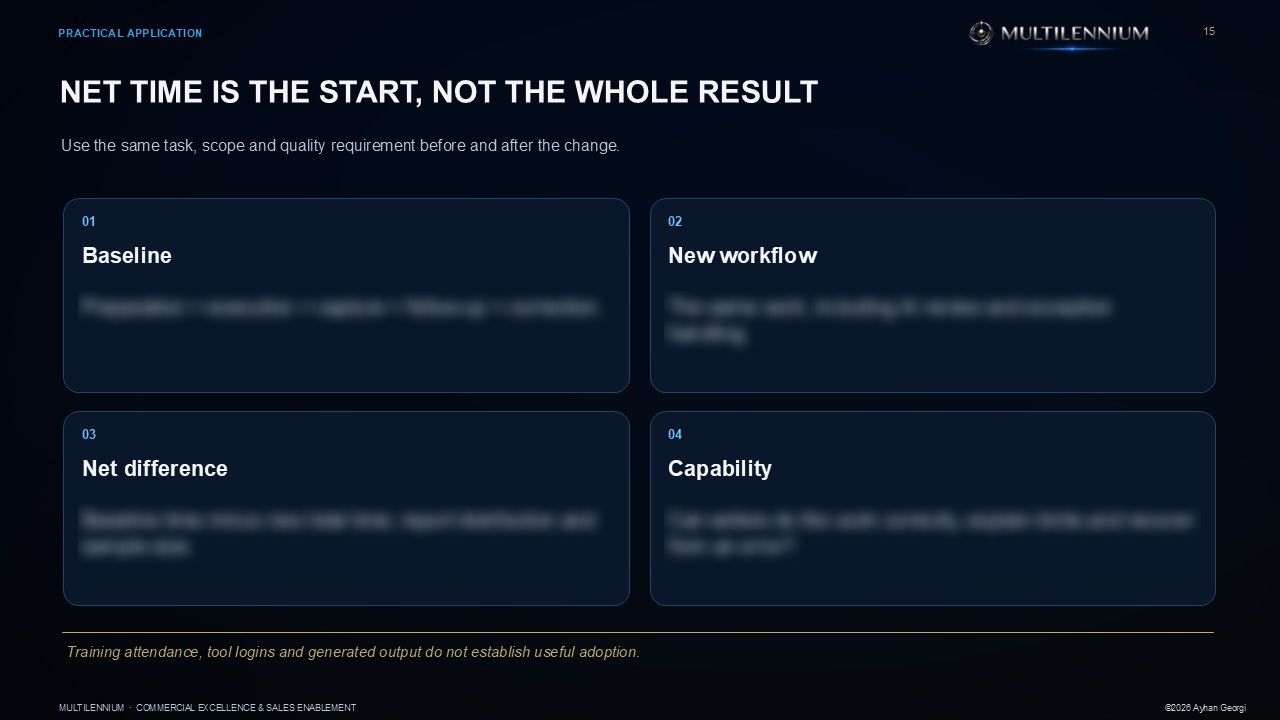
Seller Productivity starts with the actual workflow. It identifies repeated effort, redesigns the handoffs and tests where assistance helps. Preparation, review, correction and exception handling all belong in the measurement - not just the time taken to generate a draft.
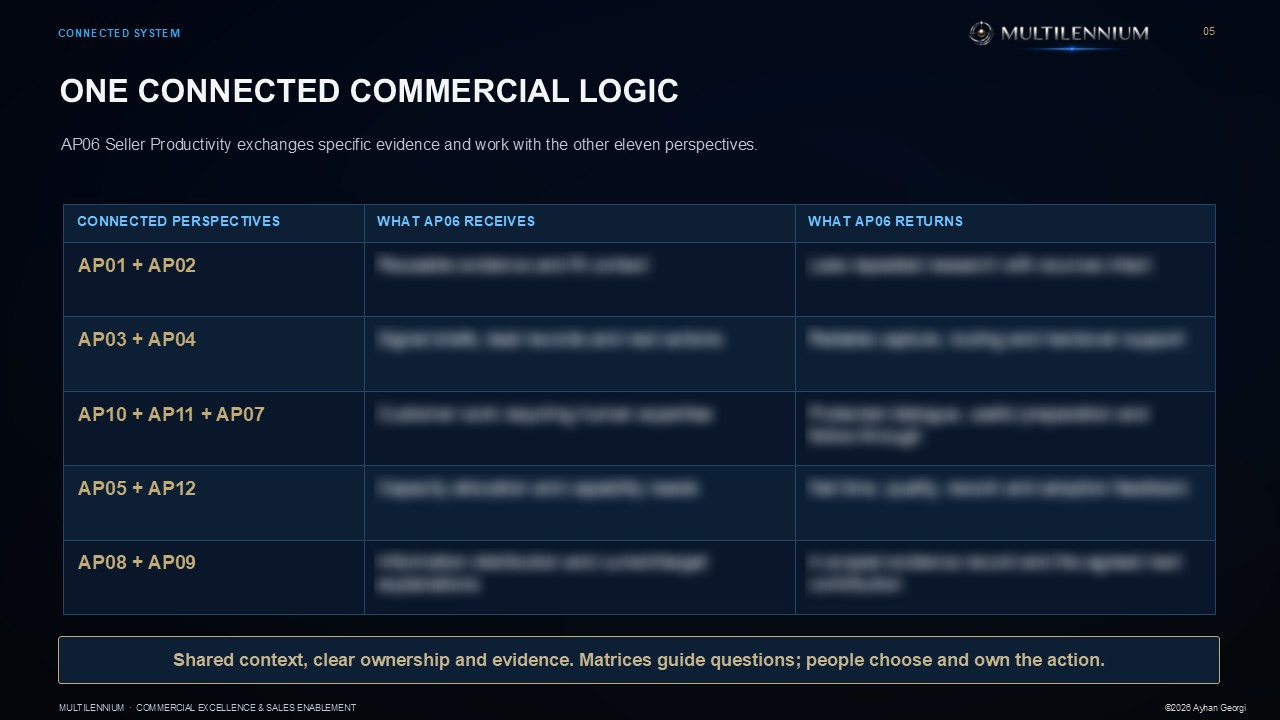
The updated AP connects signal preparation, lead ownership and customer-experience continuity. AP03 supplies usable context; AP04 prevents duplicate work and abandoned handoffs; AP12 provides practice, support and a deliberate choice about the capacity released. The aim is not maximum output. It is a workflow people can use well, with room for the human judgement the customer needs.
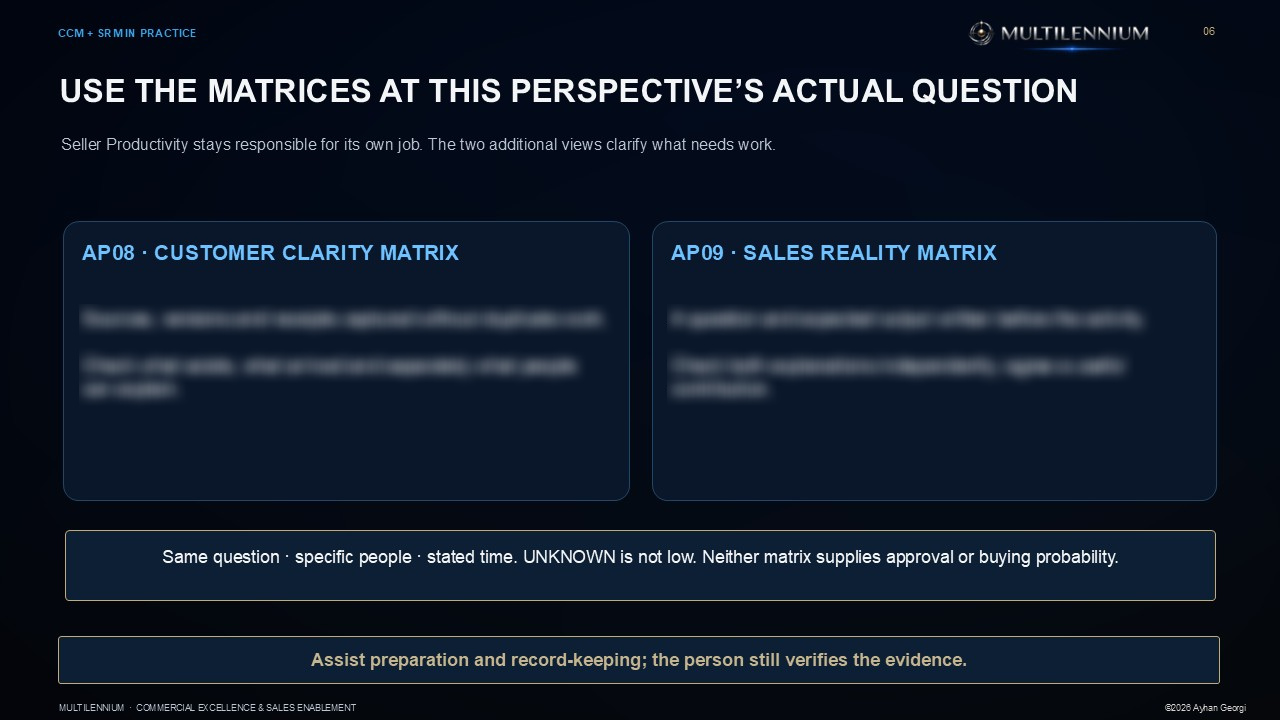
The two clarity perspectives add a practical check here: AP08 makes the relevant information and confirmed sharing visible; AP09 helps select work from current-state and ideal-state explanations. Assist preparation and record-keeping; the person still verifies the evidence.



FOCUS
Observed workflow and baseline; redesigned handoff; bounded AI use case; quality and net-effort measures; practice plan.
WHEN TO USE
When tools produce more output but customer-facing time, work quality or follow-through do not improve.
CONNECTIONS
AP03 Signals, AP04 Lead Management, AP07 Customer Engagement, AP08 Customer Clarity Matrix, AP09 Sales Reality Matrix, AP12 Leadership.
APPLIED PERSPECTIVE 07
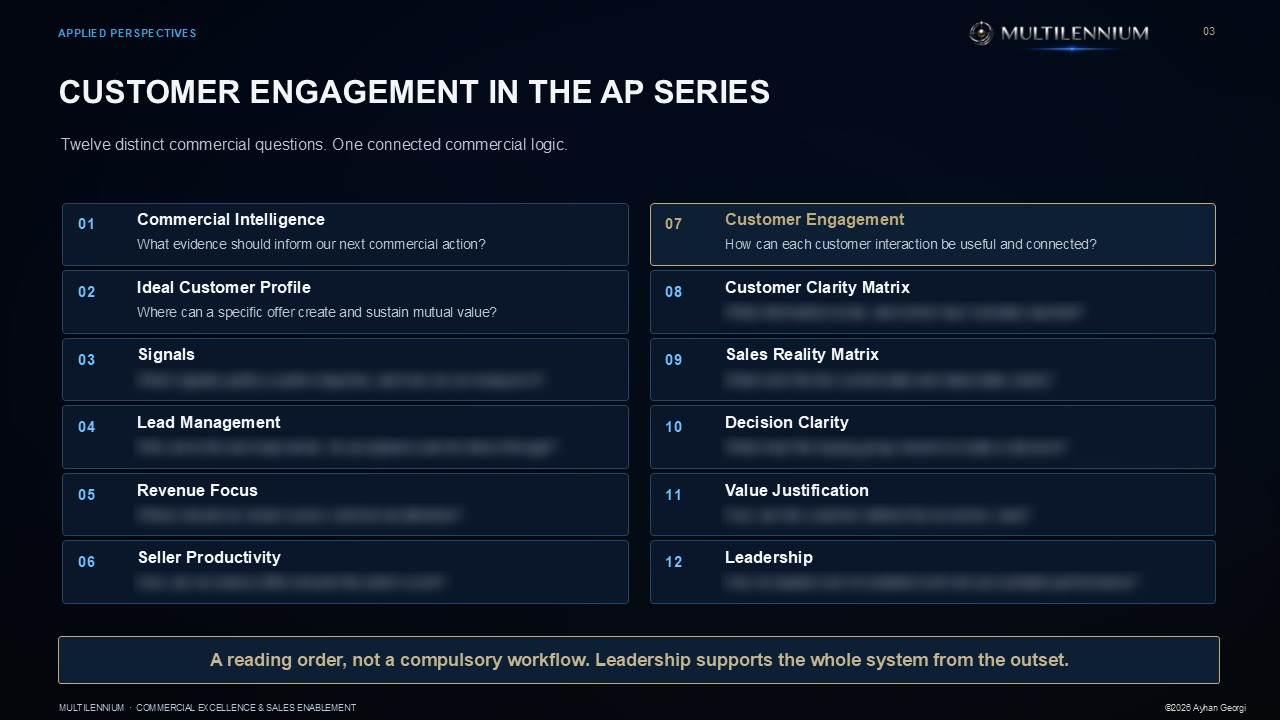
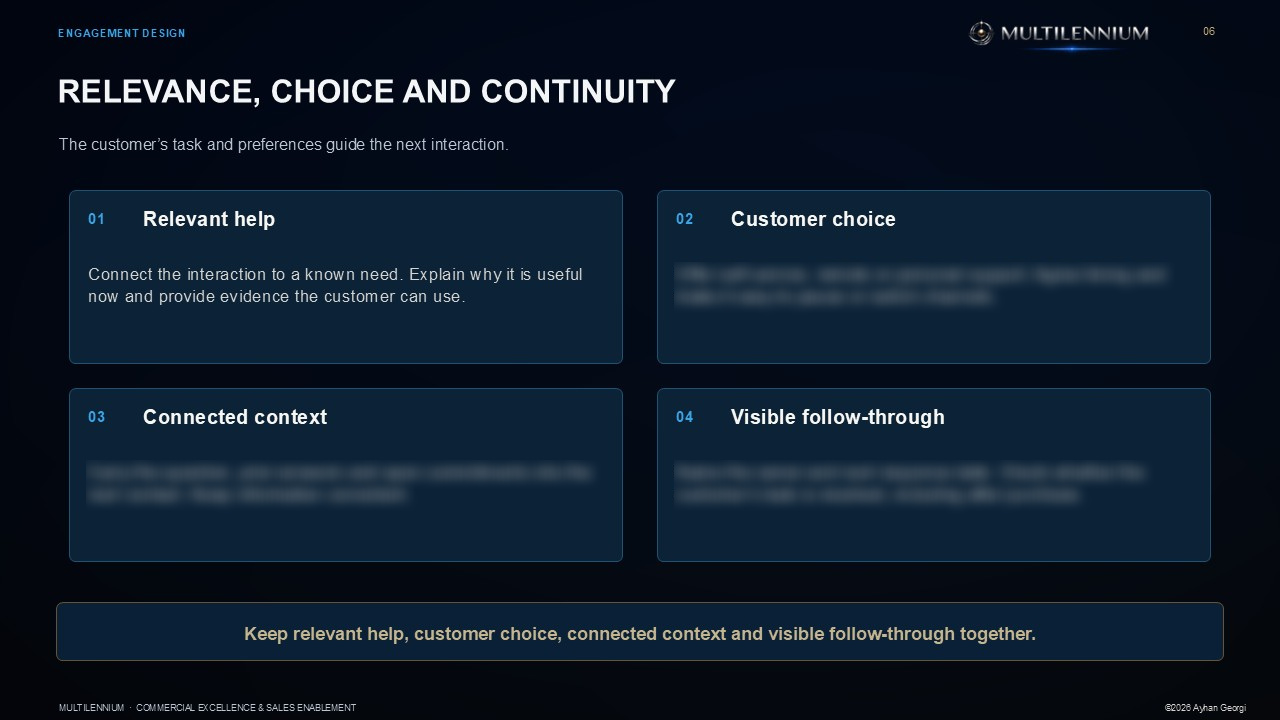
Customer Engagement
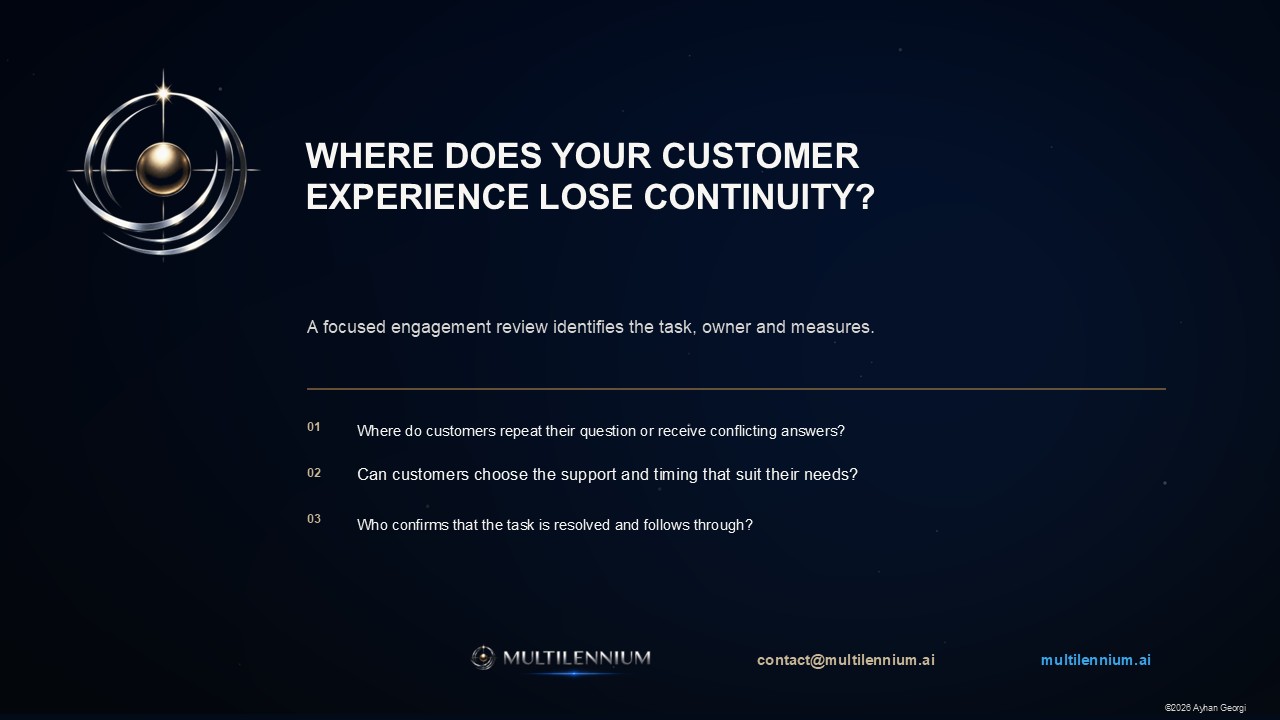
How can each customer interaction be useful and connected?
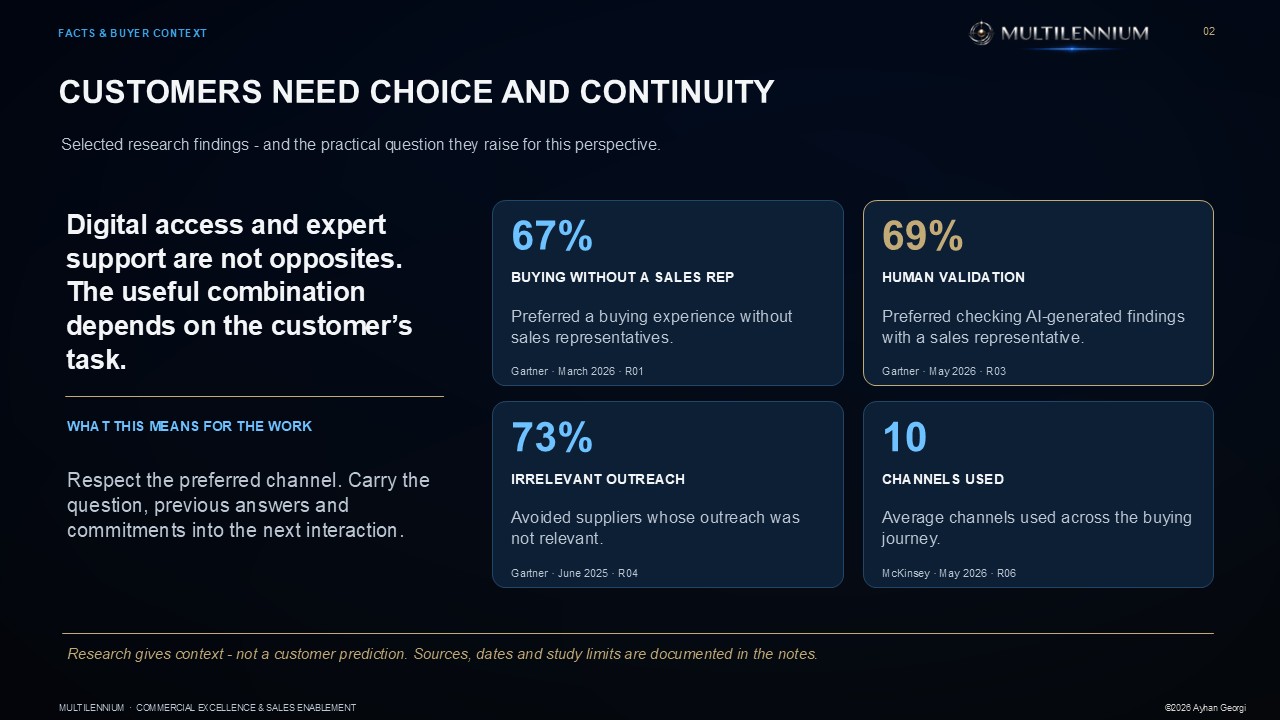
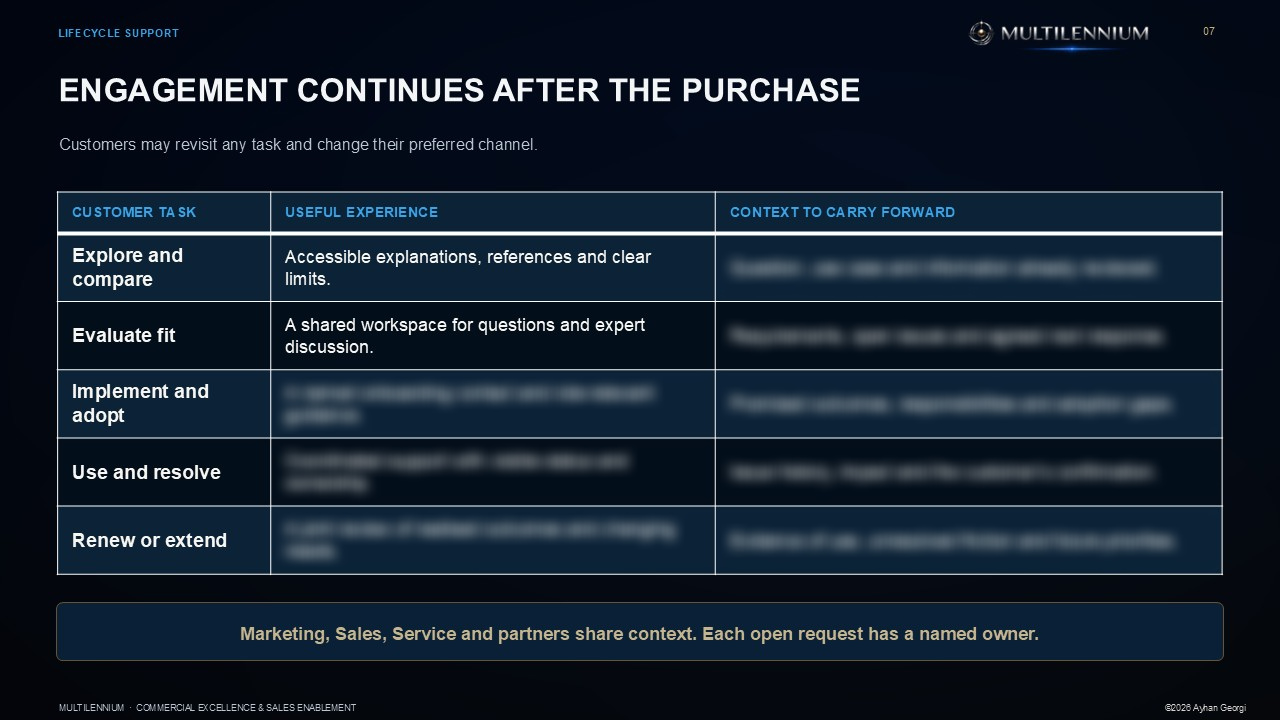
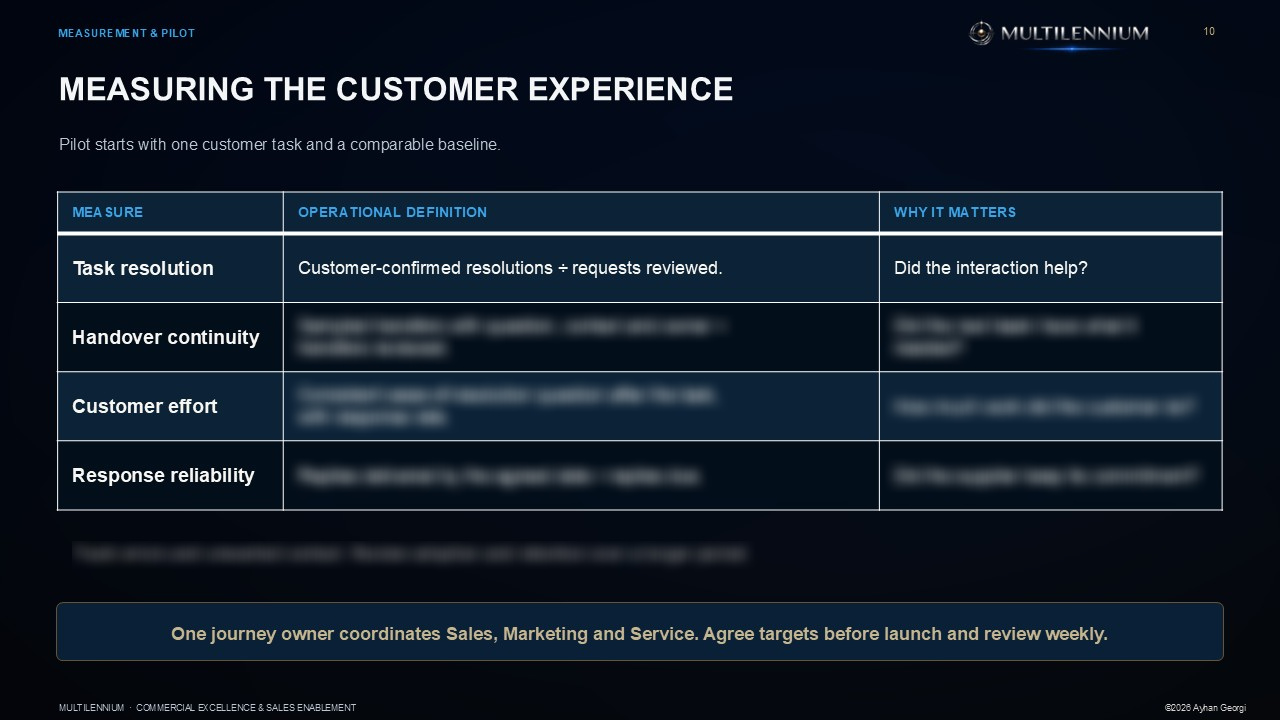
Keep every interaction useful and connected, with customer choice, consistent information and visible follow-through across channels and teams.
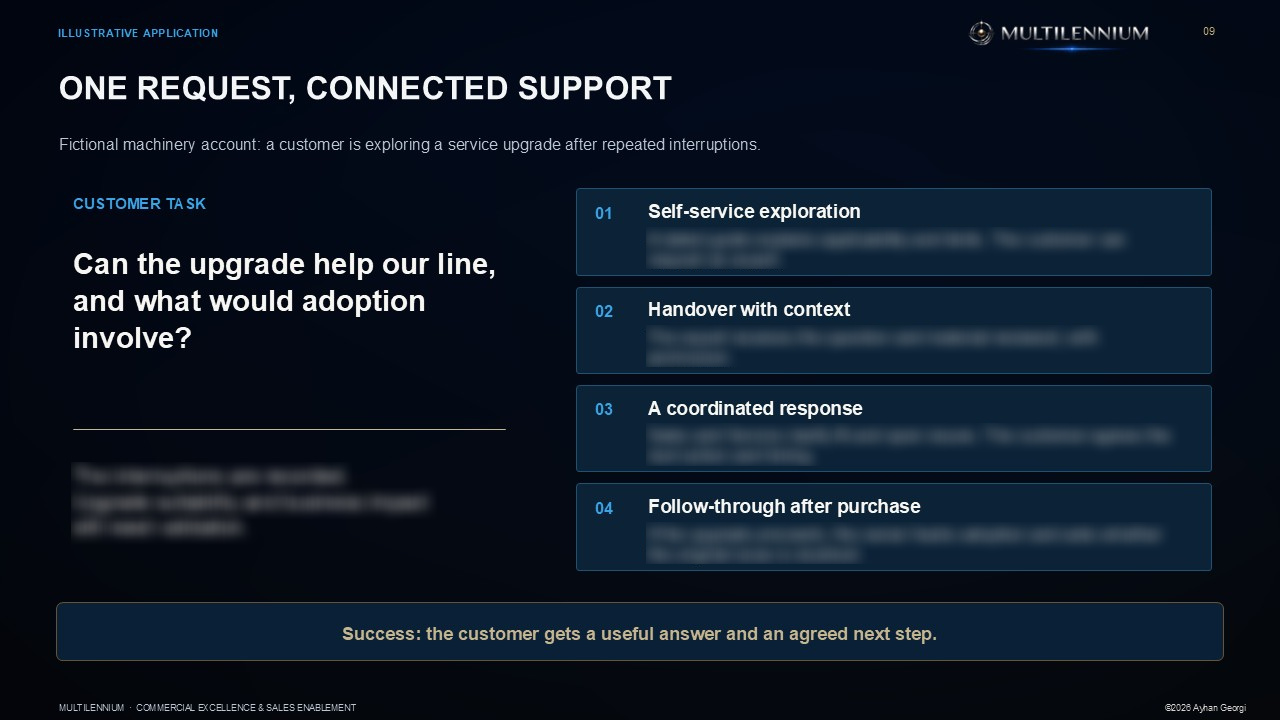
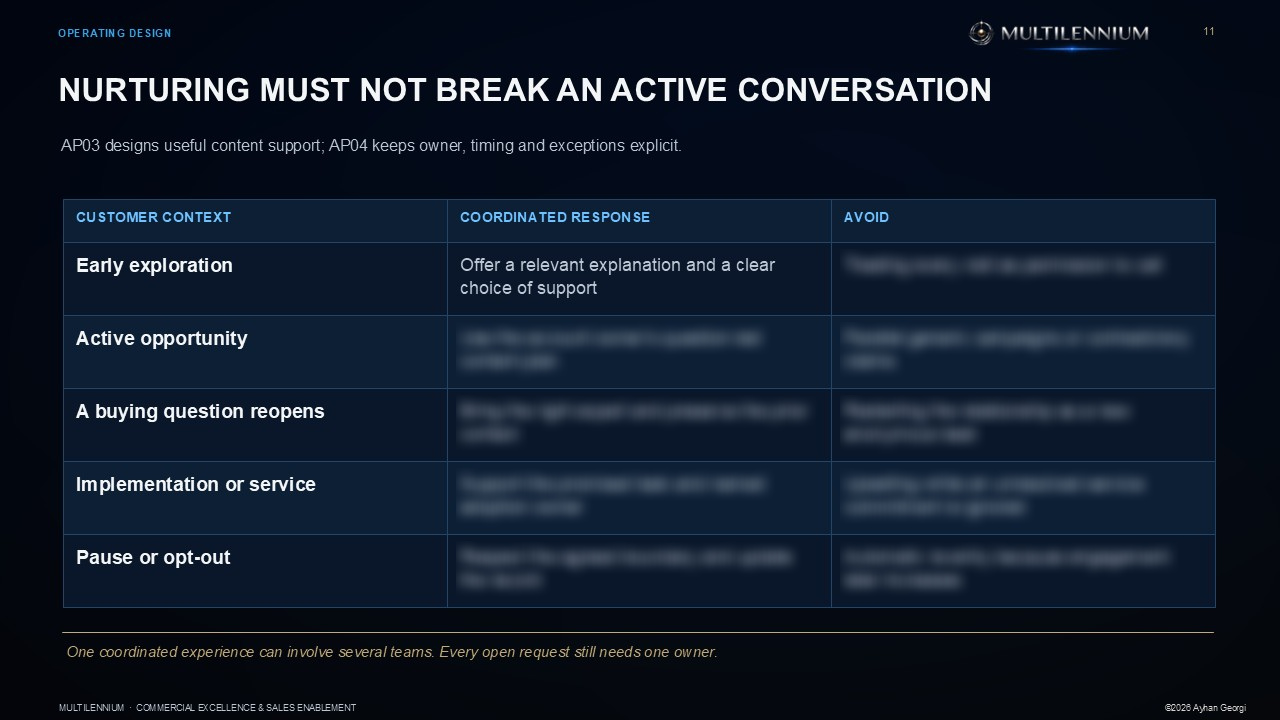
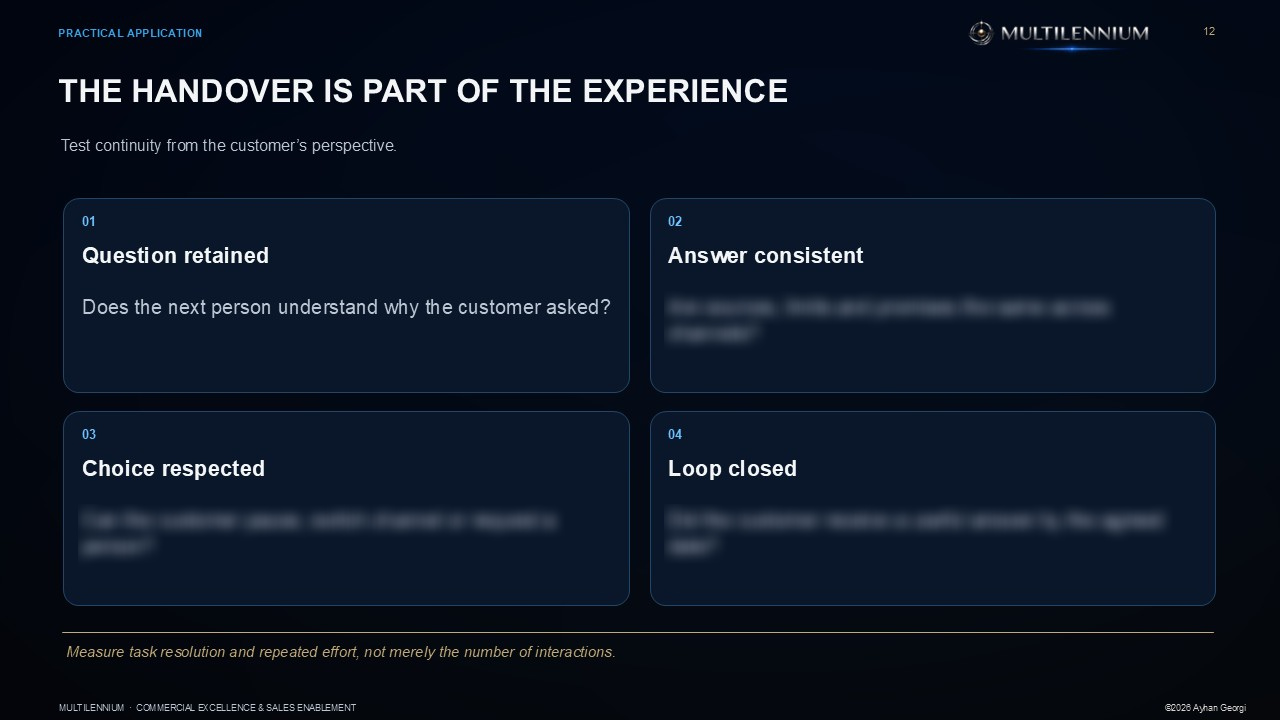
A customer should not have to restart the conversation because the channel or internal owner changed. The question, previous answers, commitments and contact preferences need to travel with the work.
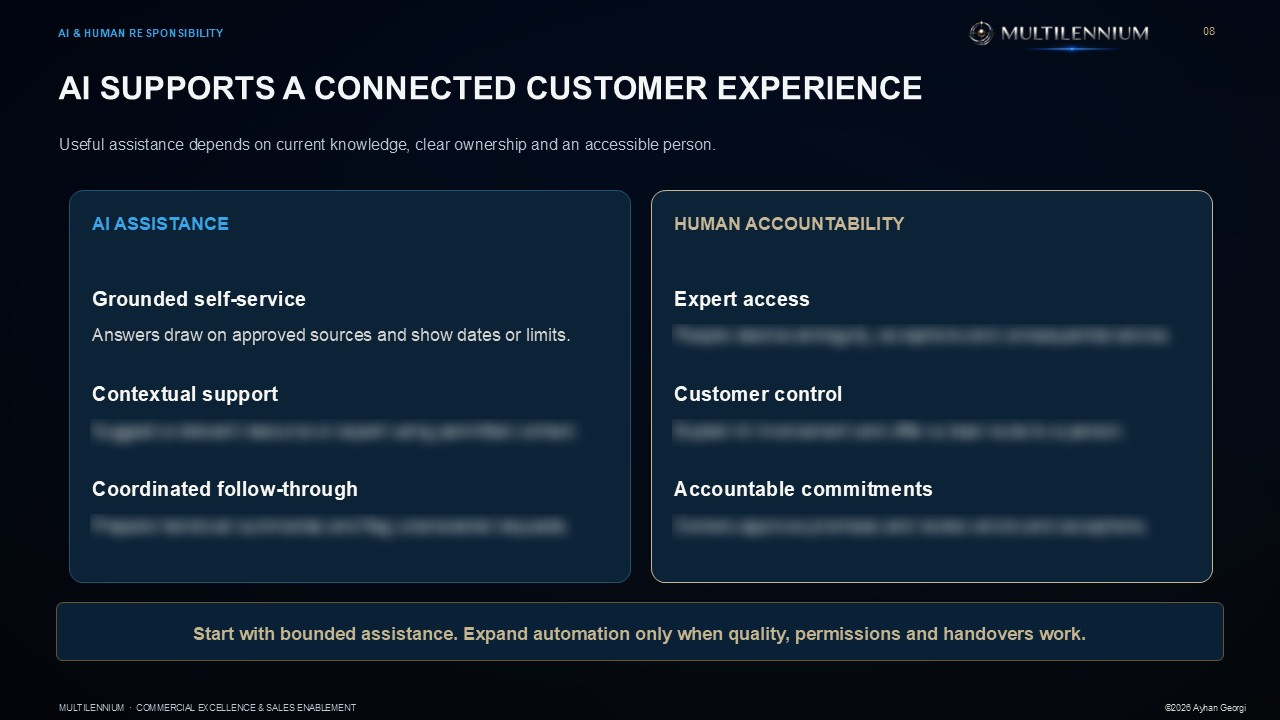
Customer Engagement designs that continuity. It connects self-service, personal support and specialist expertise around the customer’s task, before and after a purchase. The measure is whether the task was resolved and the promise kept - not how many interactions the system generated.
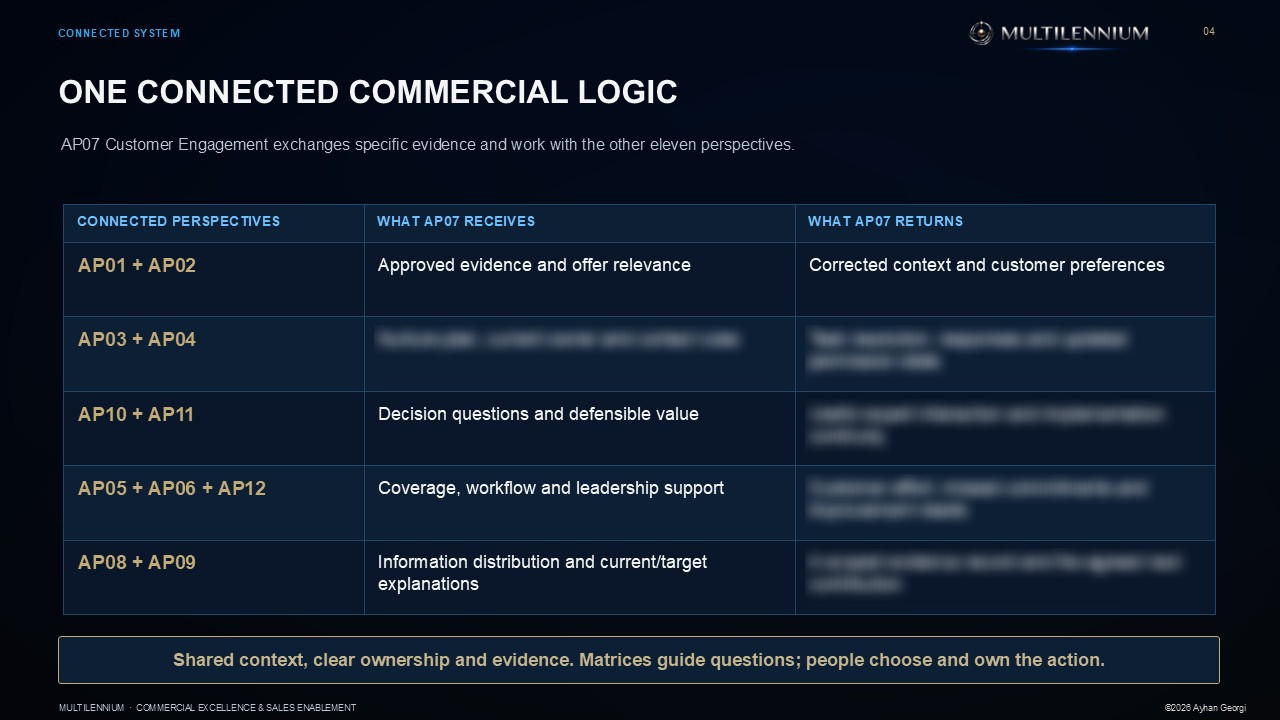
AP03 adds ongoing nurture, including evidence for an active opportunity. AP04 carries the ownership, timing and reason for the next response. Their connection matters most when several teams could contact the same account. One coordinated plan allows Marketing, Sales and Service to contribute without producing contradictory messages or requiring the customer to repeat what is already known.
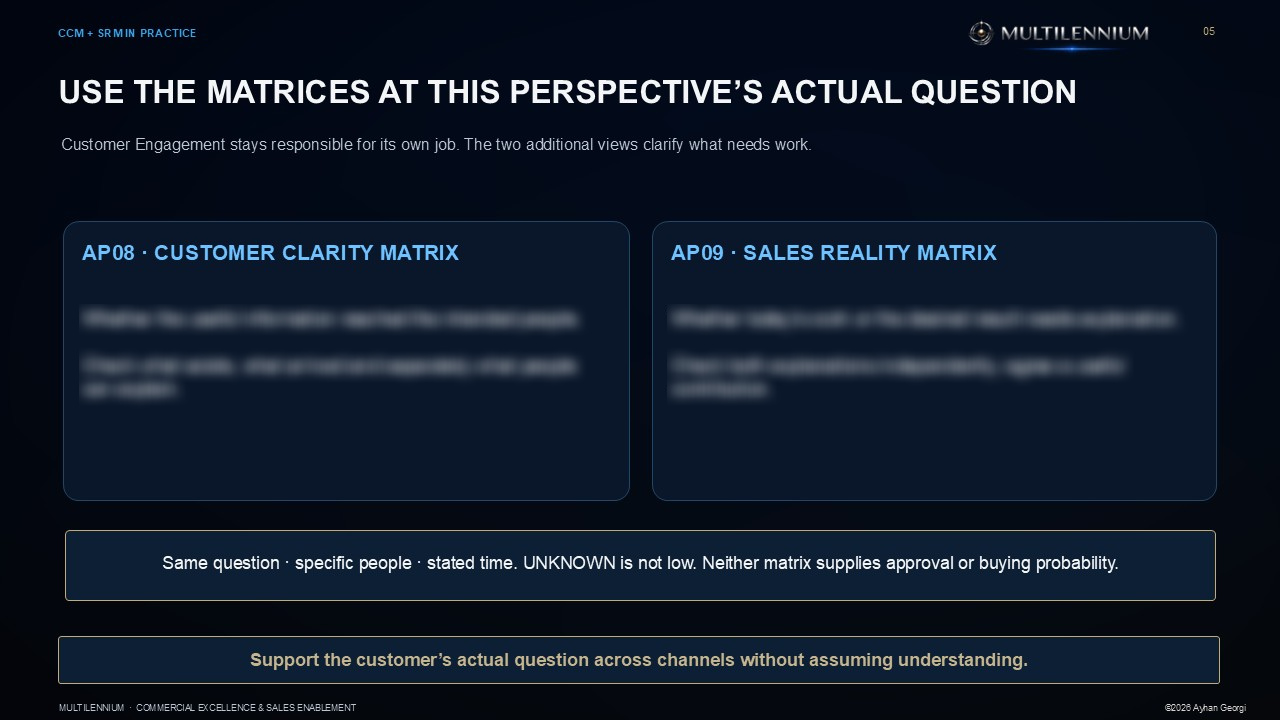
The two clarity perspectives add a practical check here: AP08 makes the relevant information and confirmed sharing visible; AP09 helps select work from current-state and ideal-state explanations. Support the customer’s actual question across channels without assuming understanding.



FOCUS
Customer-task journey; channel and contact choices; contextual handover; response and task-resolution measures.
WHEN TO USE
When customers receive fragmented answers, repeated questions or conflicting contact from different teams.
CONNECTIONS
AP03 Signals, AP04 Lead Management, AP06 Seller Productivity, AP08 Customer Clarity Matrix, AP09 Sales Reality Matrix, AP10 Decision Clarity.
APPLIED PERSPECTIVE 08
Customer Clarity Matrix™
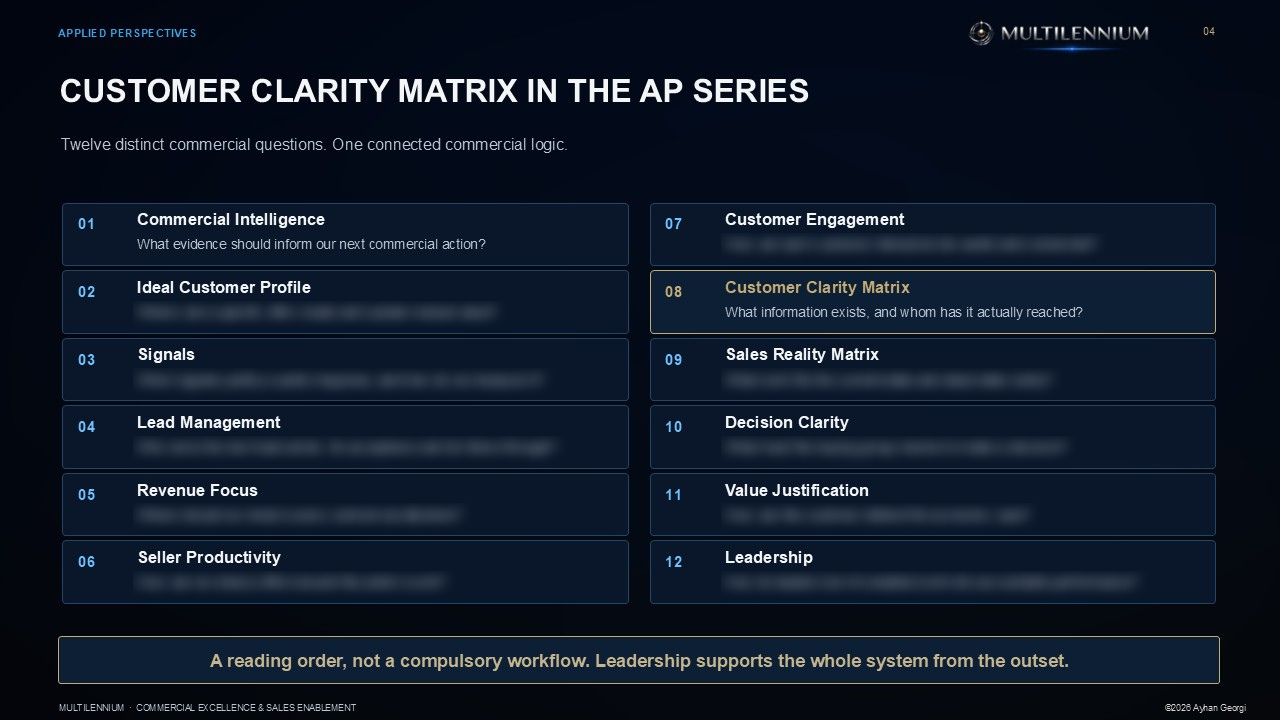
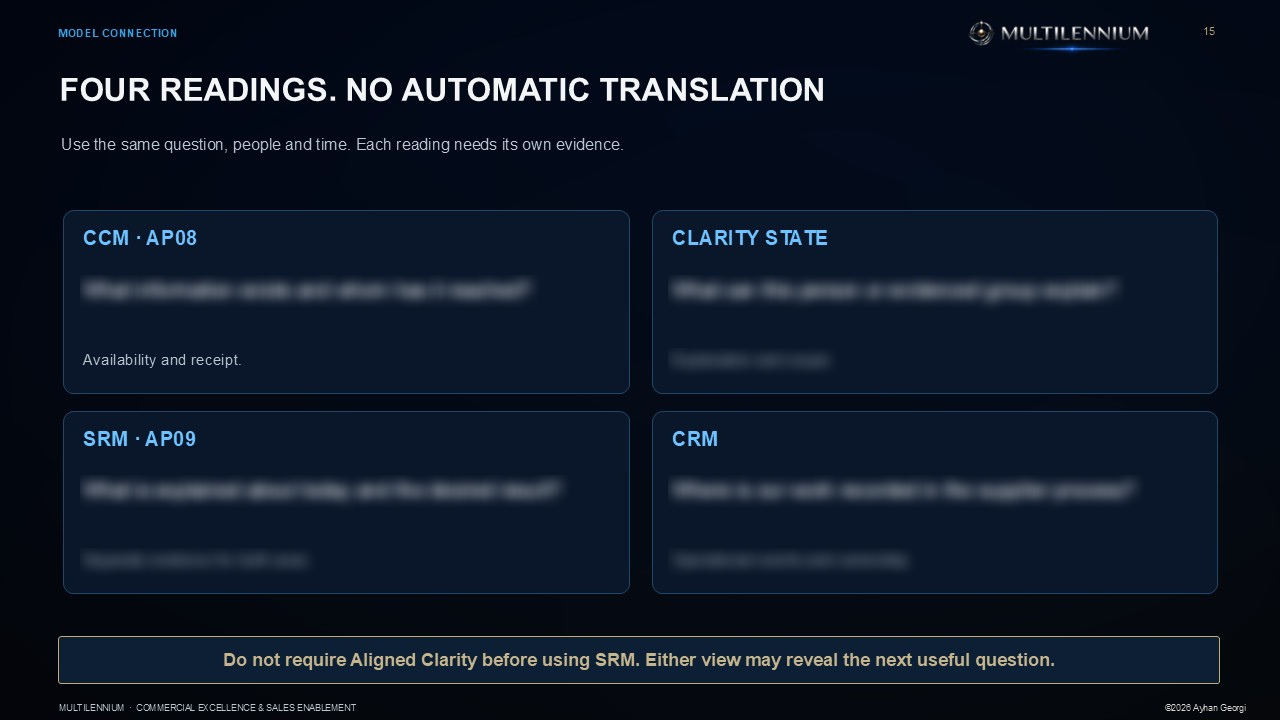
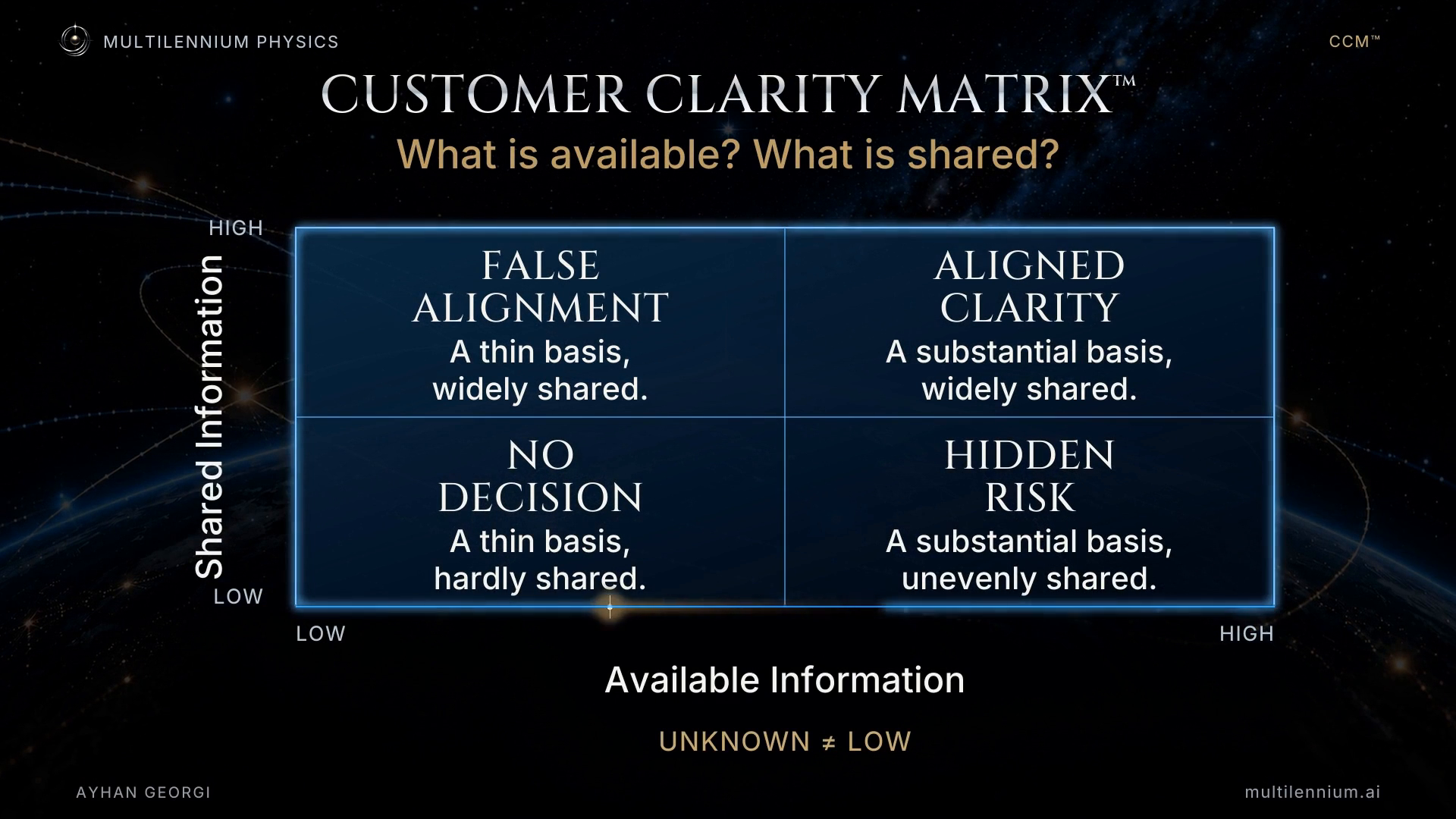
What information exists, and whom has it actually reached? Seeing what exists, what has reached people and what they can explain.
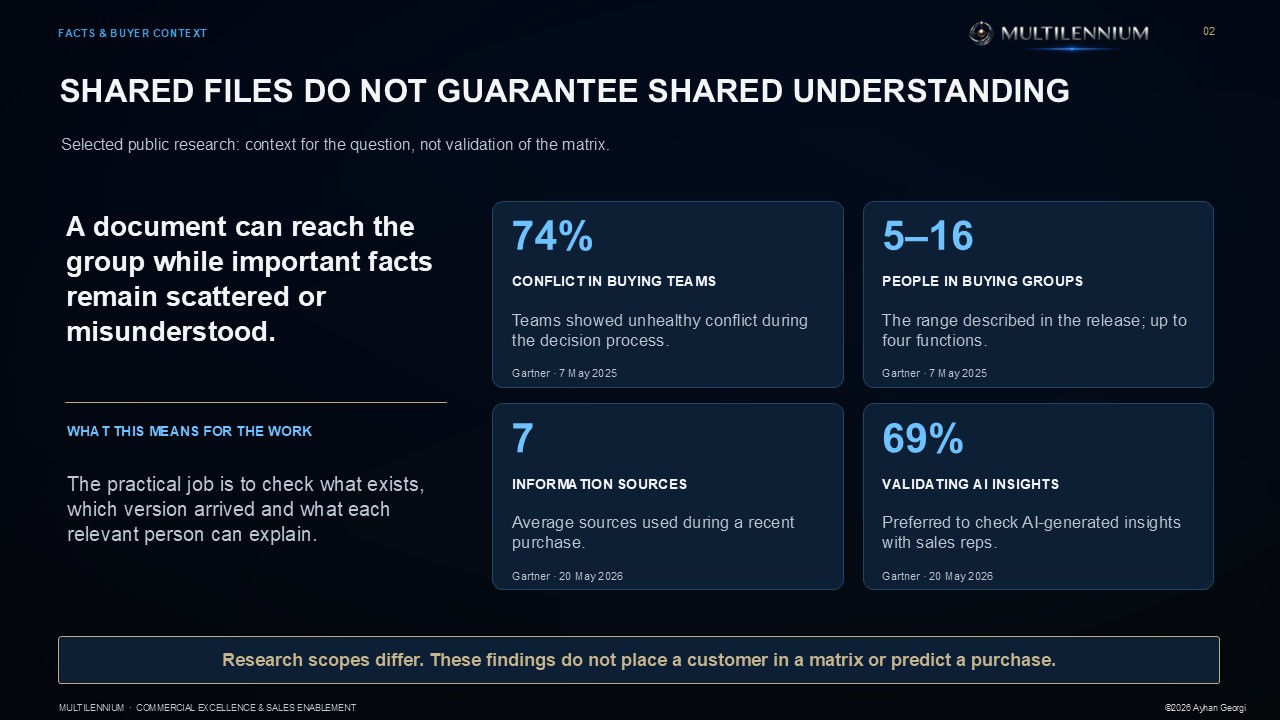
Make the customer’s information position visible: what exists, who received it and what still needs to be explained - without mistaking a shared file for a shared decision.
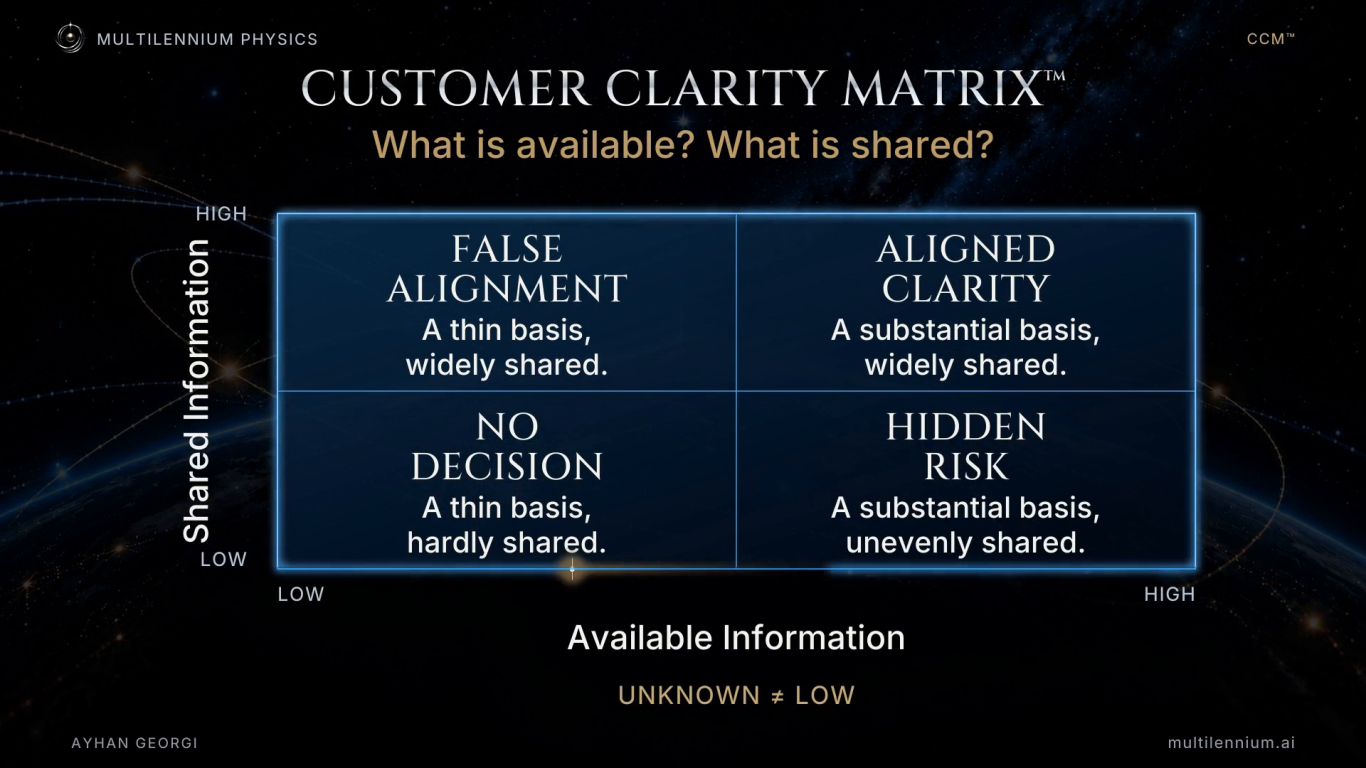
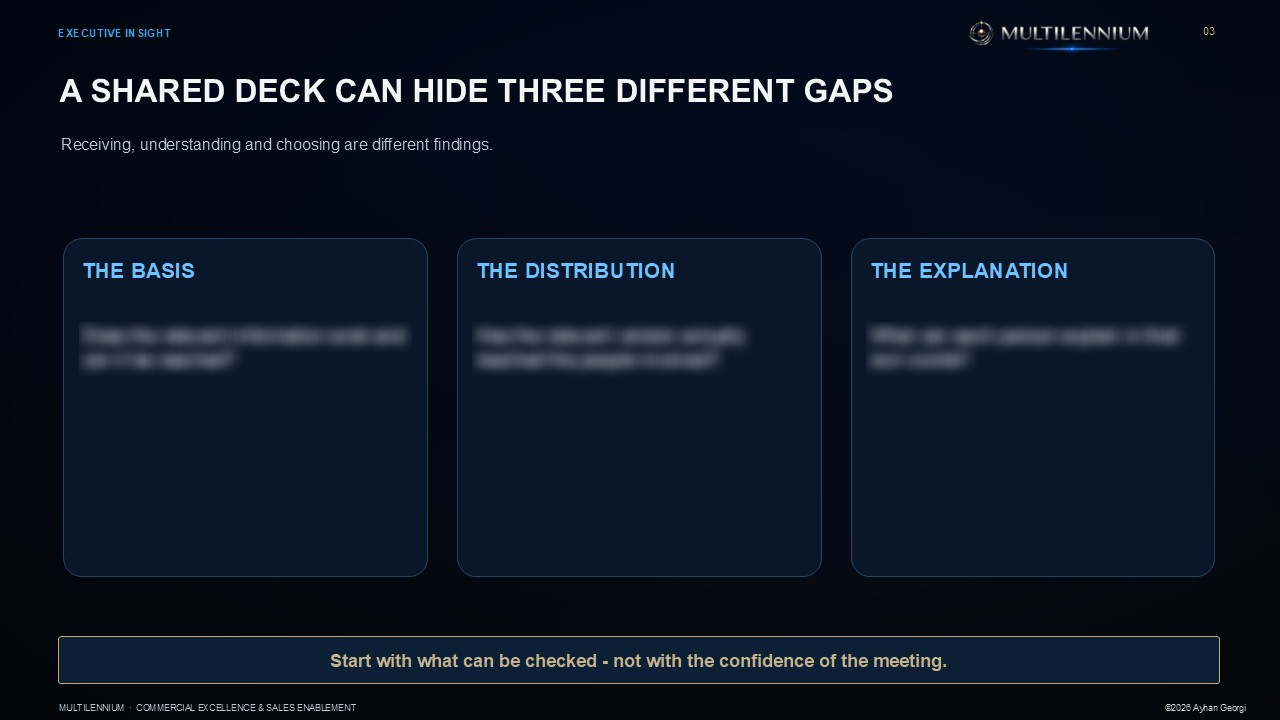
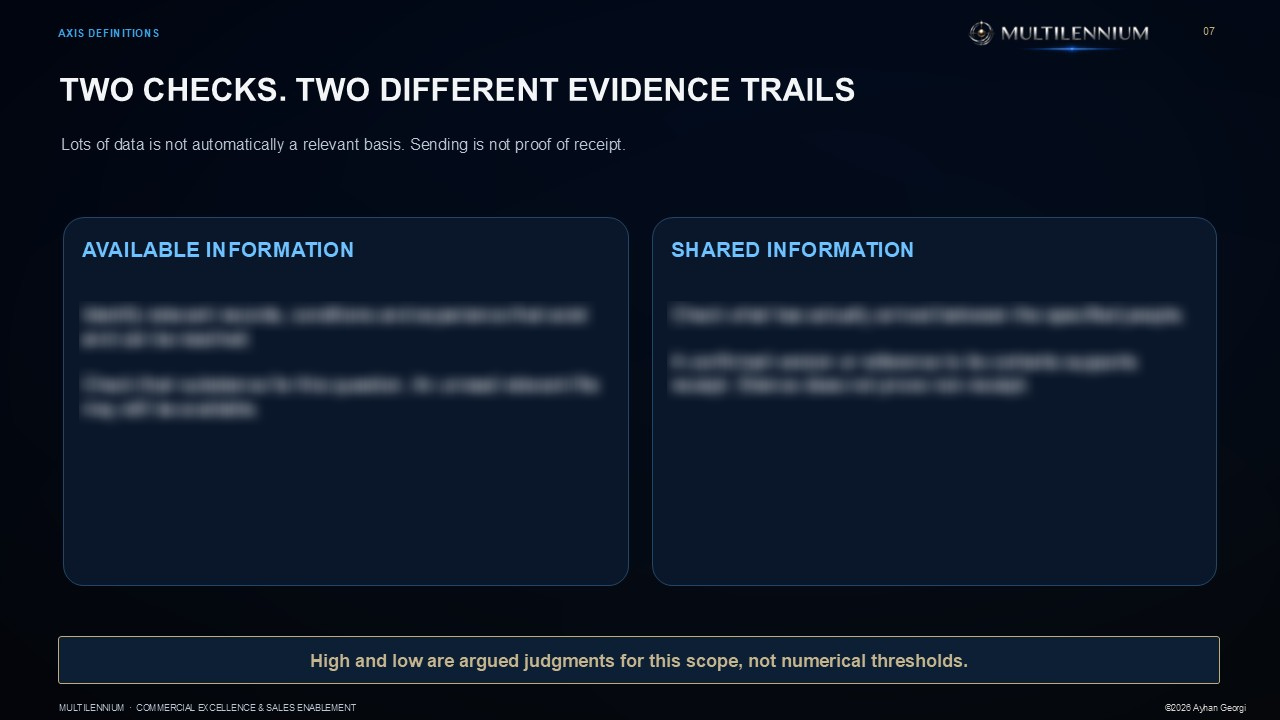
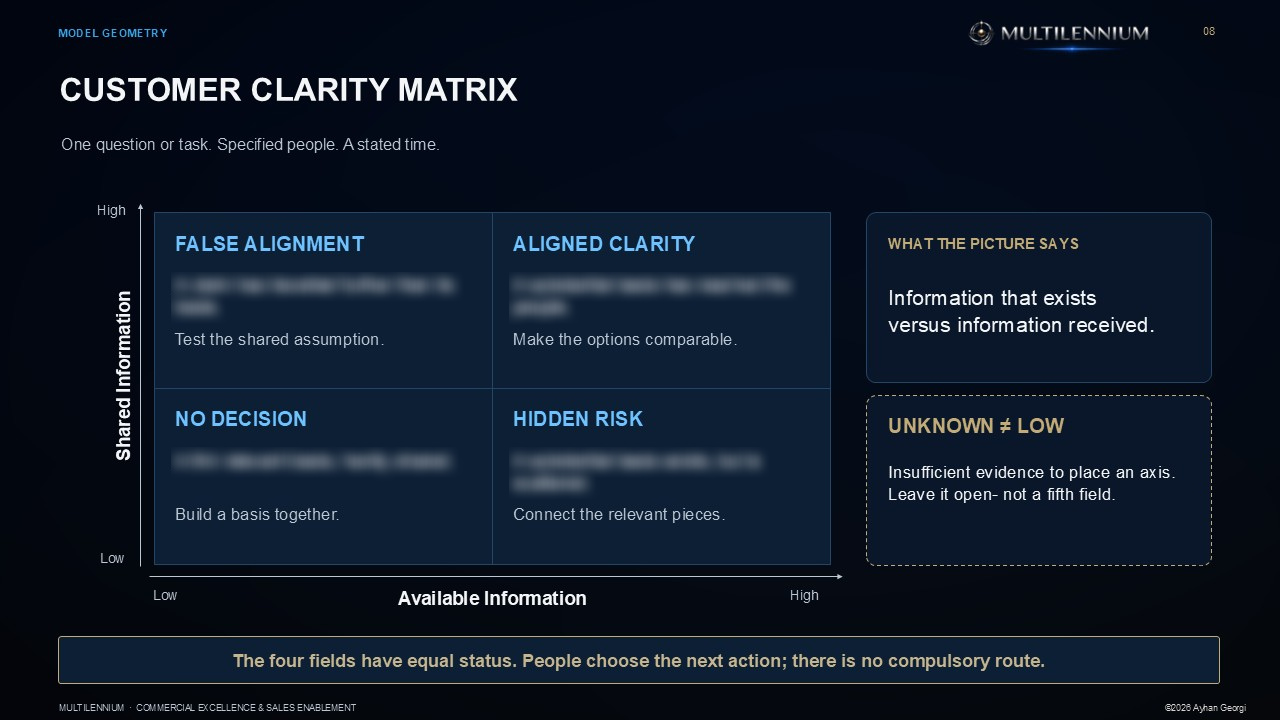
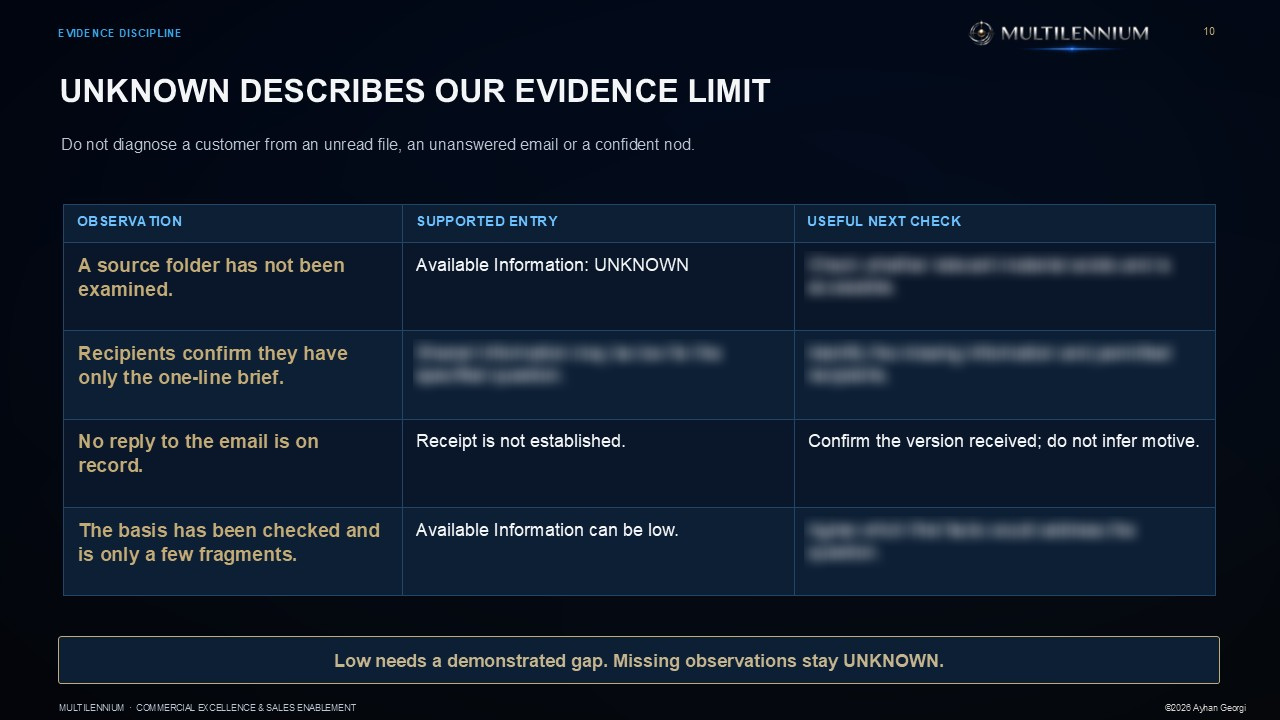
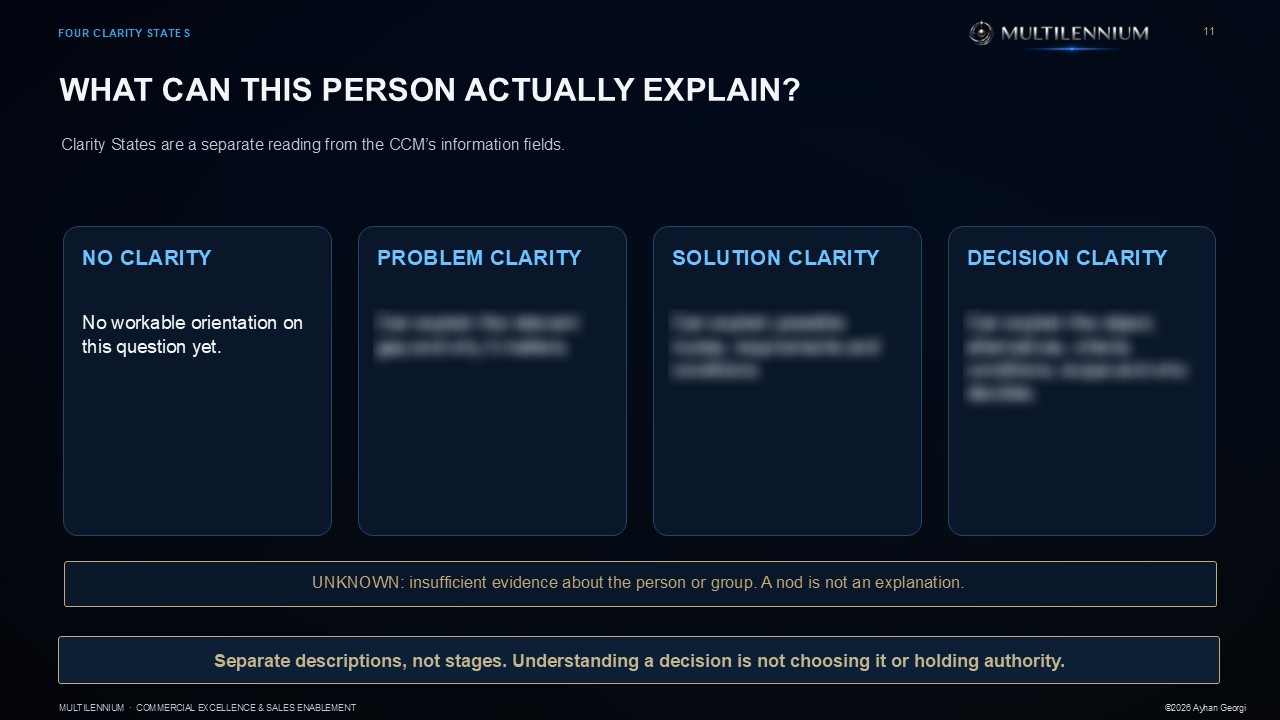
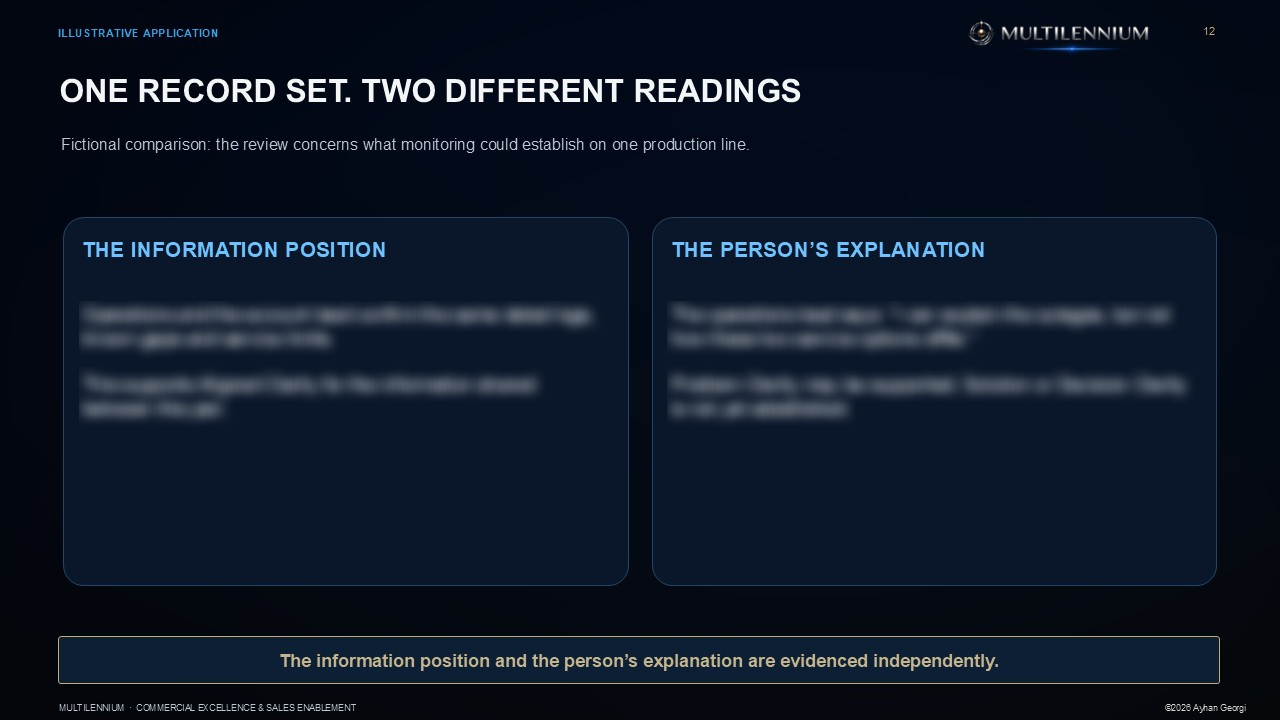
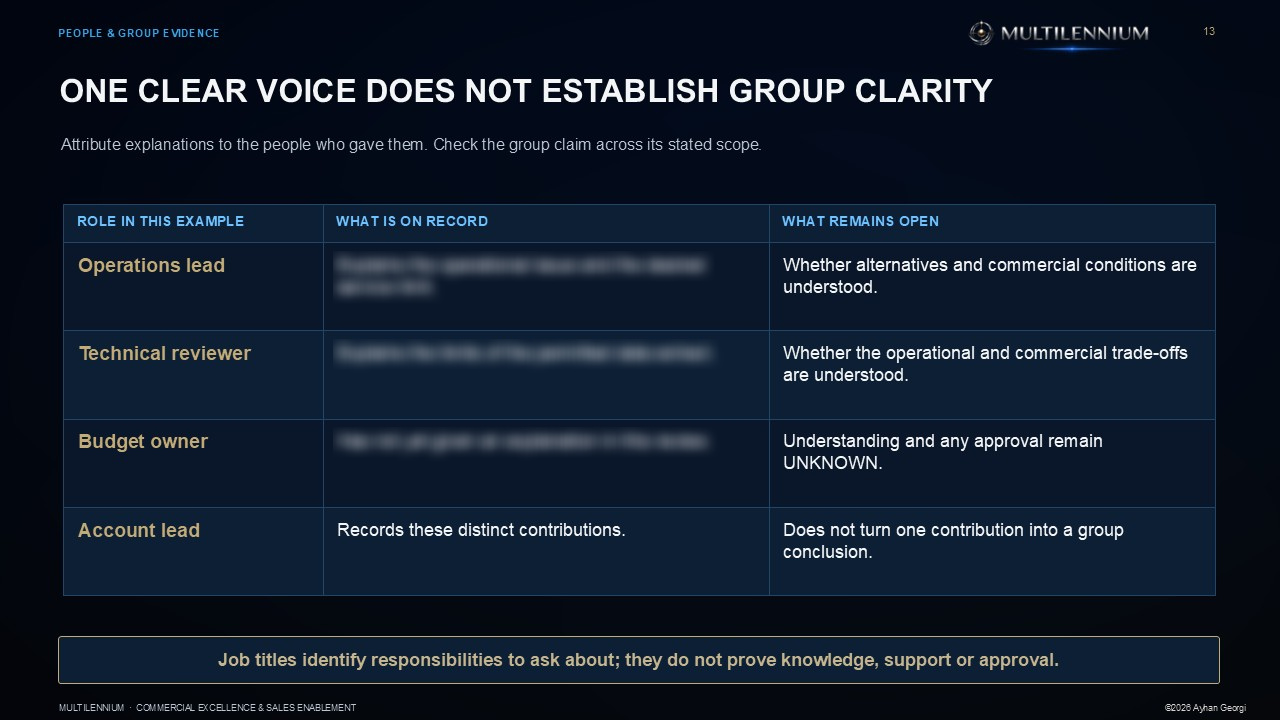
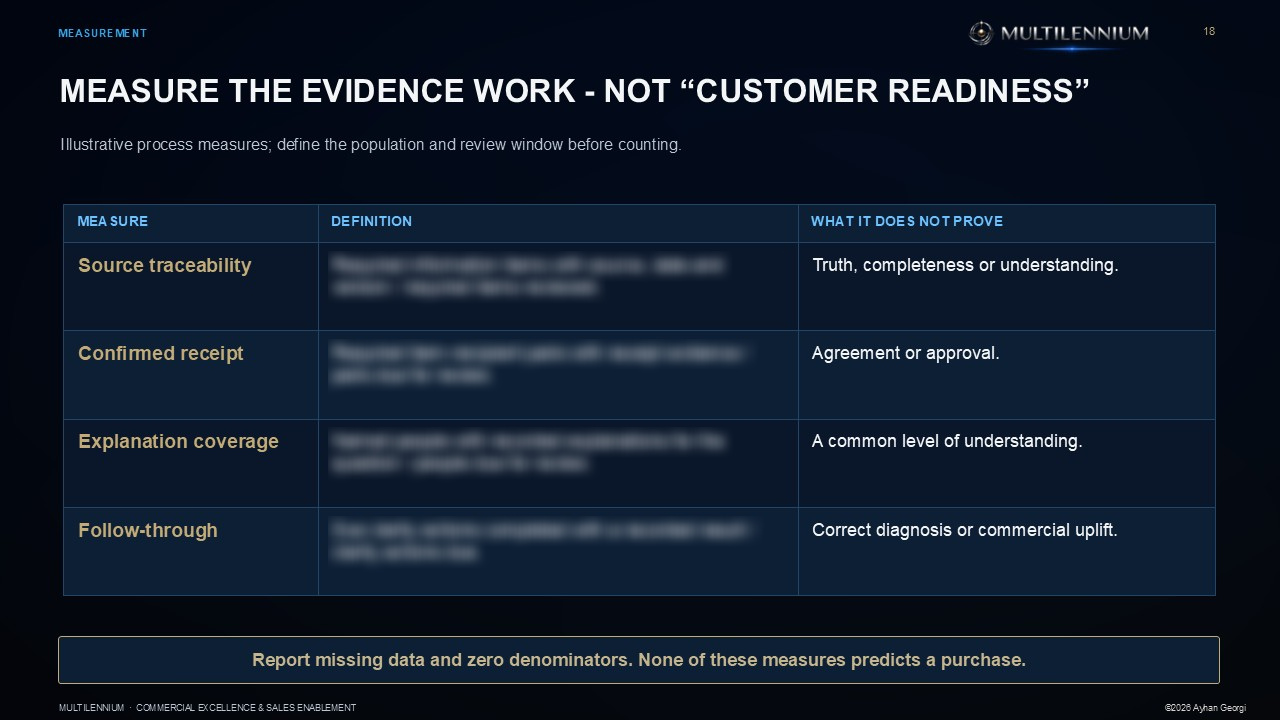
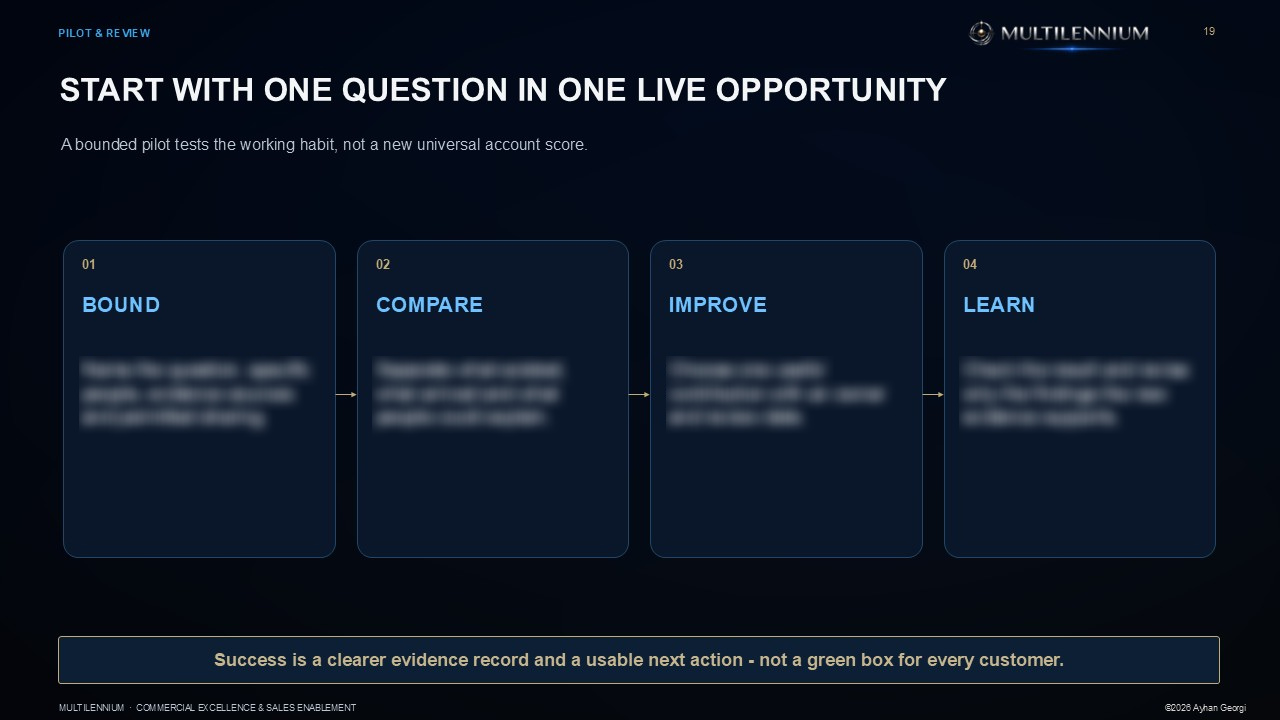
A shared document is not the same as shared understanding. The Customer Clarity Matrix separates the relevant information available from information that has actually reached the people involved. This Applied Perspective shows how to locate scattered evidence, test repeated assumptions and agree useful clarification. Understanding is checked separately, one person and one question at a time. The result is a more usable conversation and evidence record - not a prediction that the customer will buy.
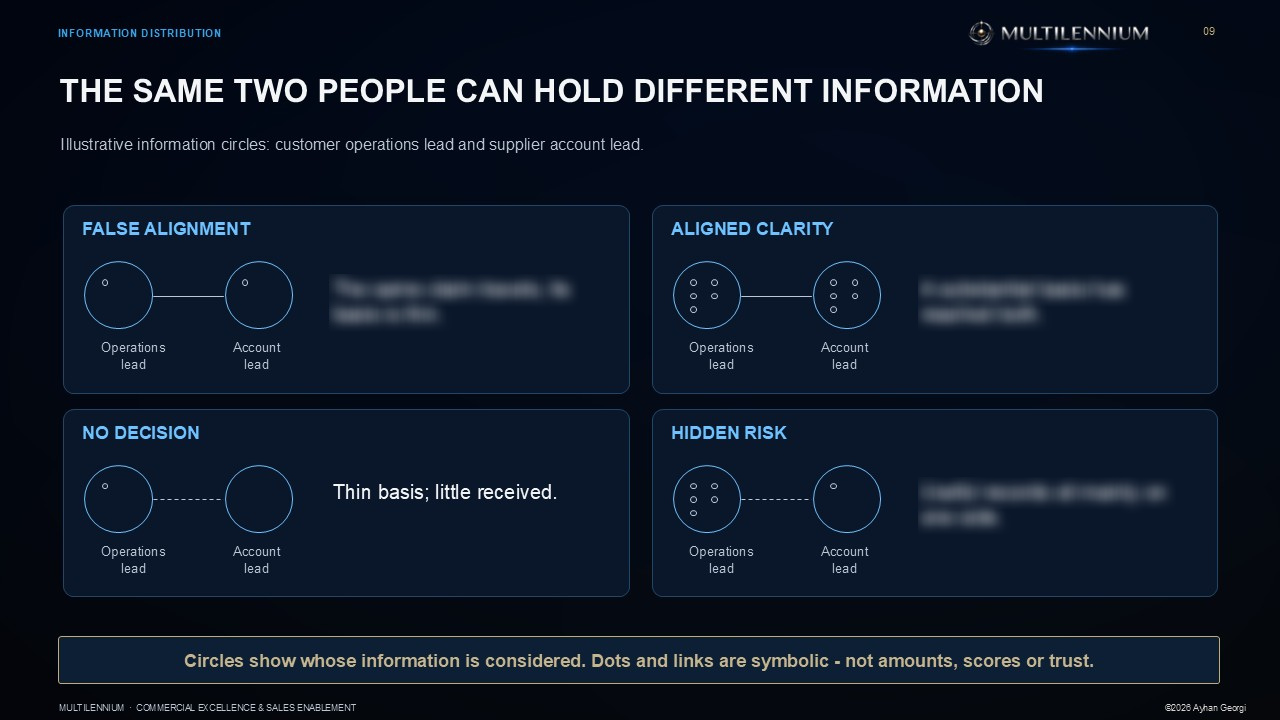
An opportunity can look well documented while the people working on it hold different pieces of the picture. Some information exists but has not travelled. Some claims have travelled widely without a sound basis. And a received document may still be misunderstood.
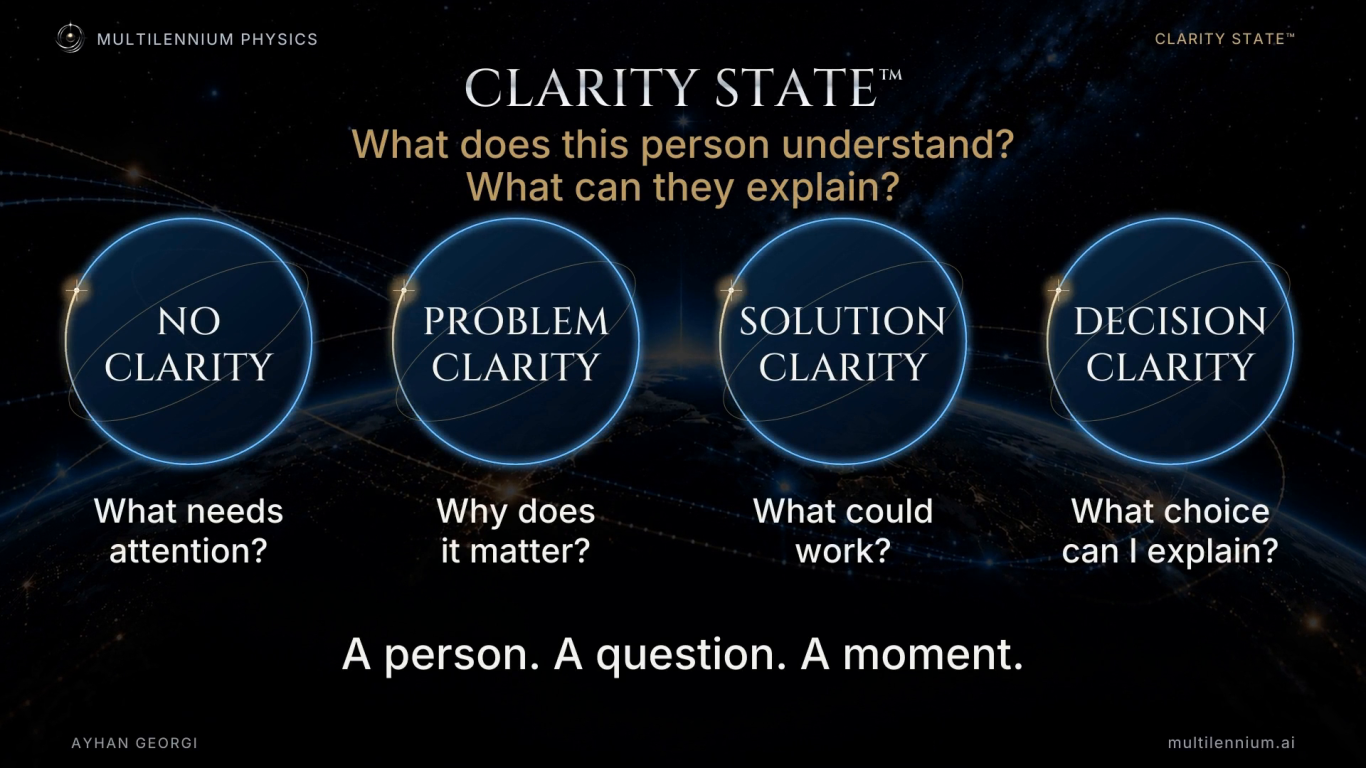
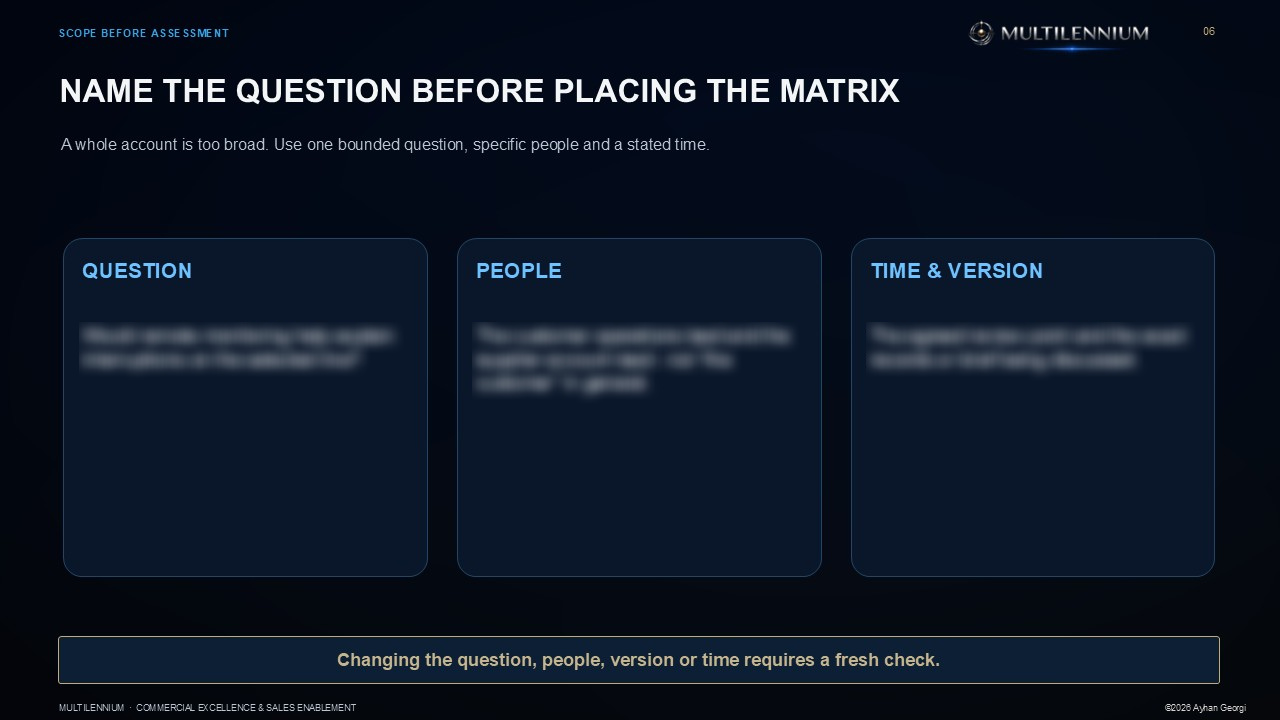
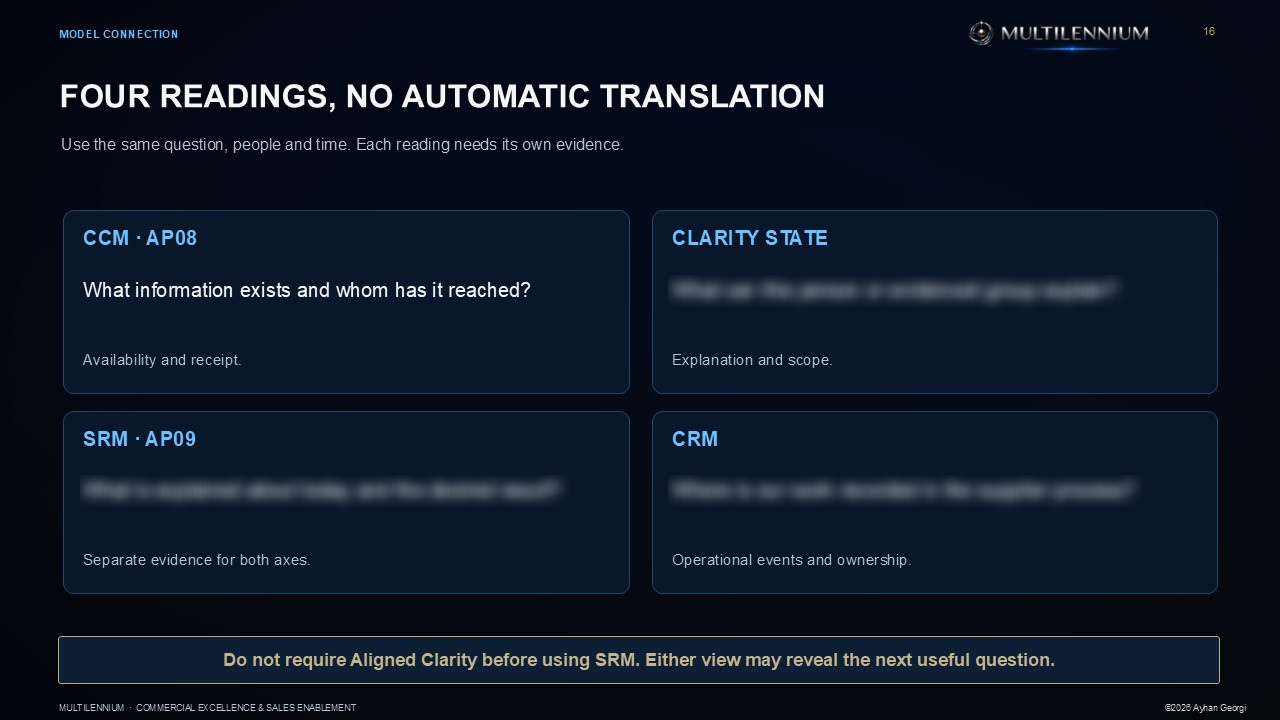
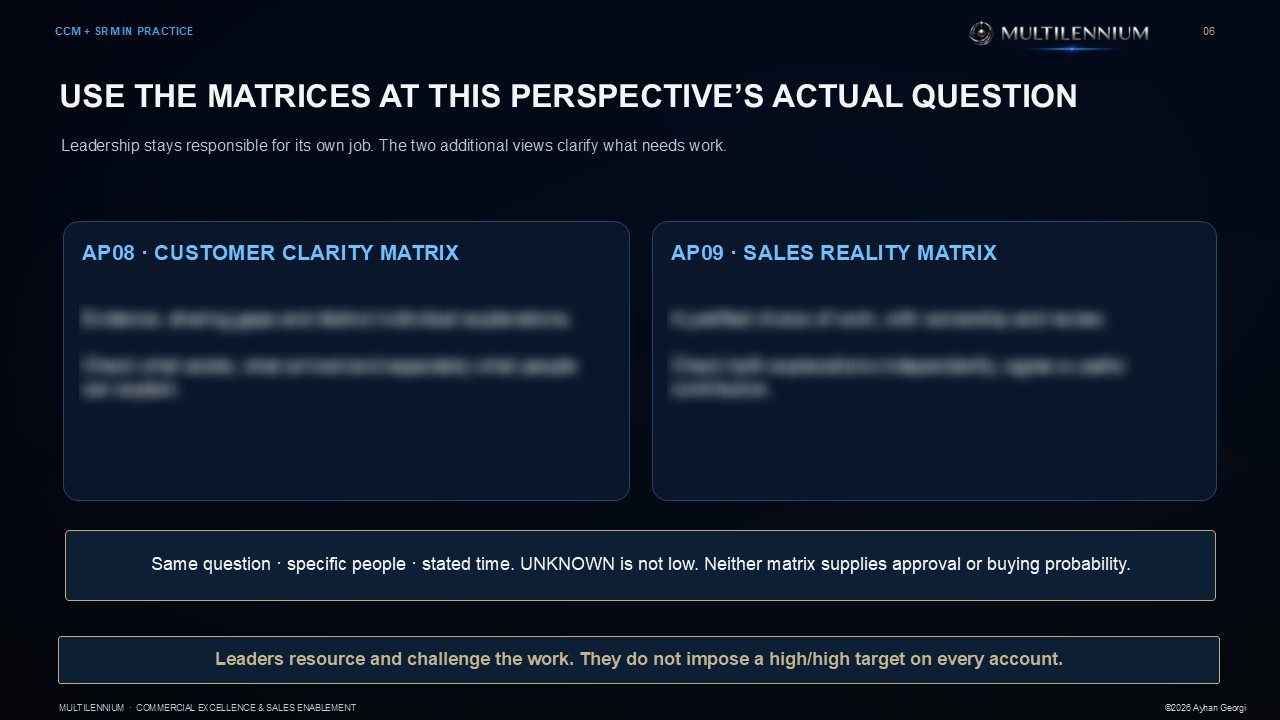
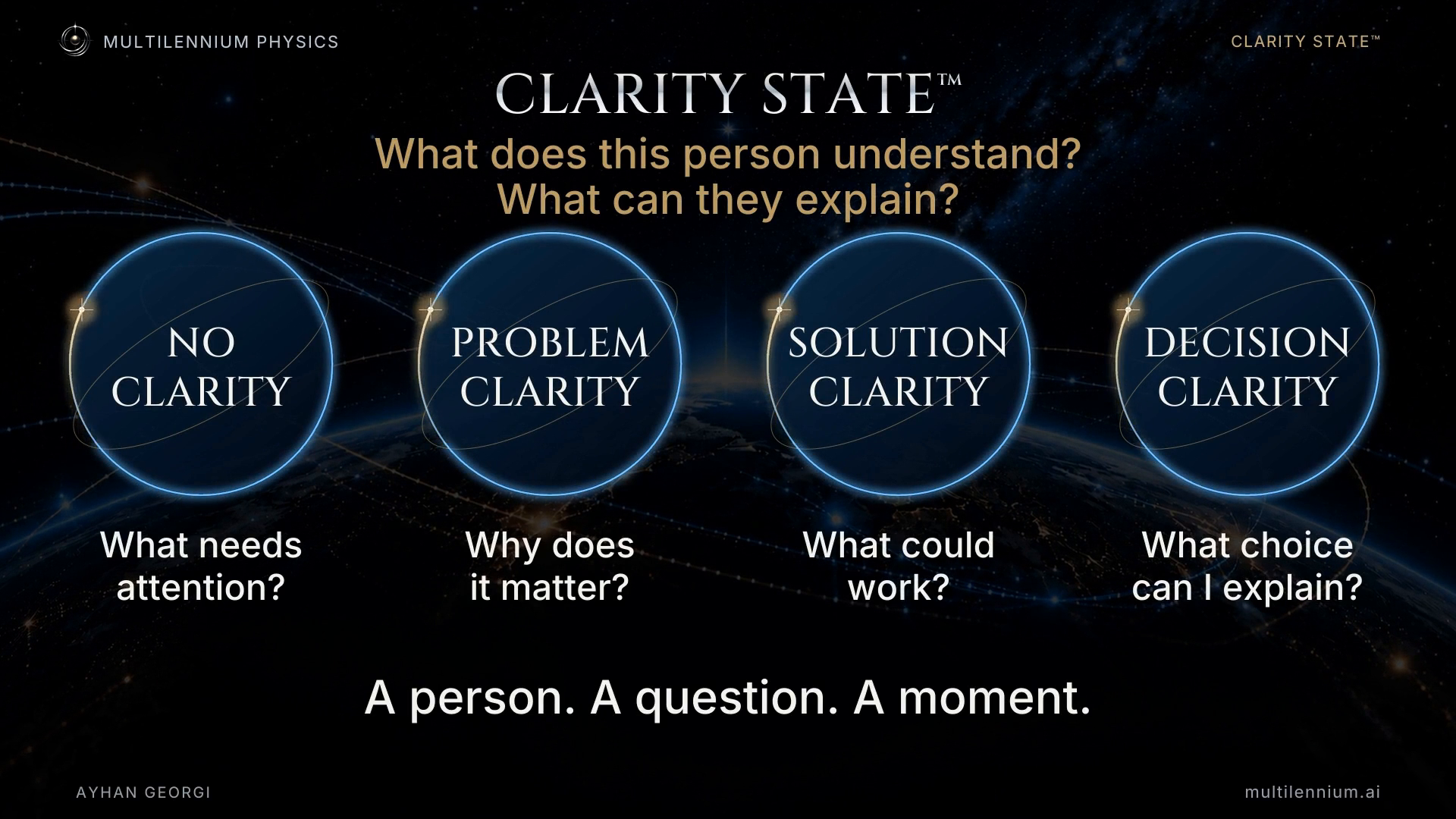
The Customer Clarity Matrix gives Available Information and Shared Information separate axes. Its four fields describe the information position for one question, specified people and a stated time. Clarity States examine a different question: what a person or an explicitly evidenced group can explain.
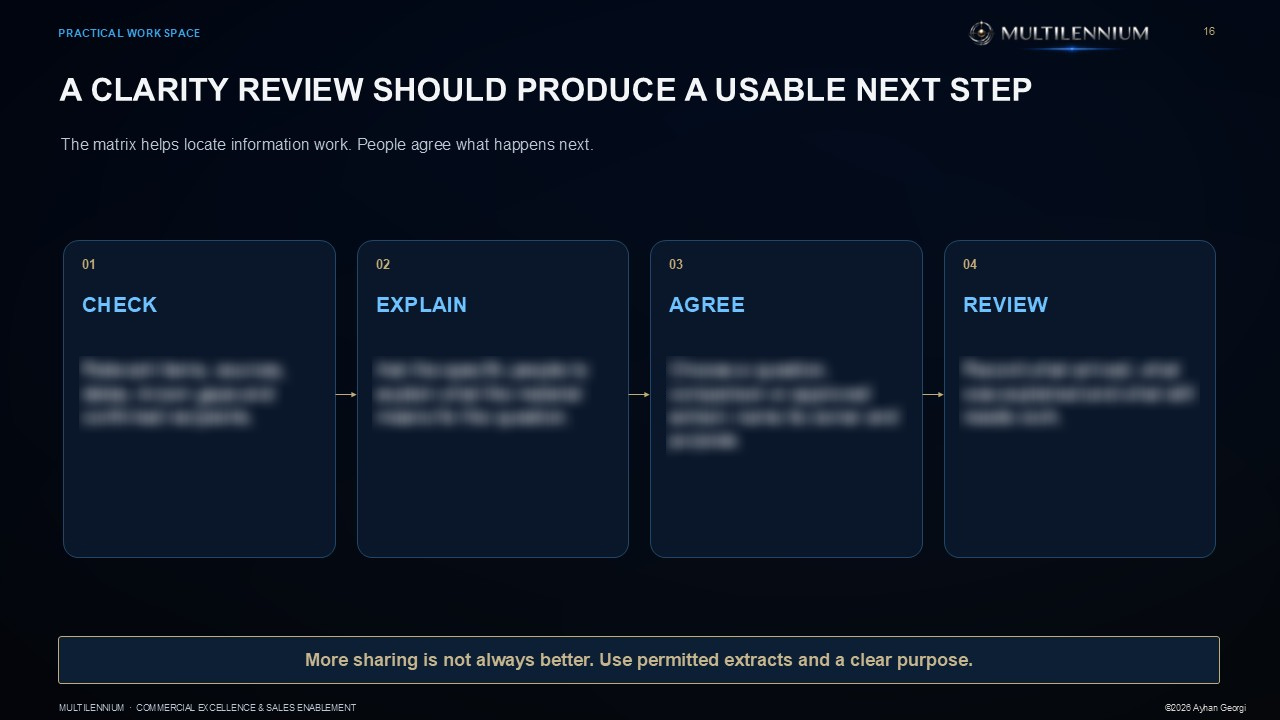
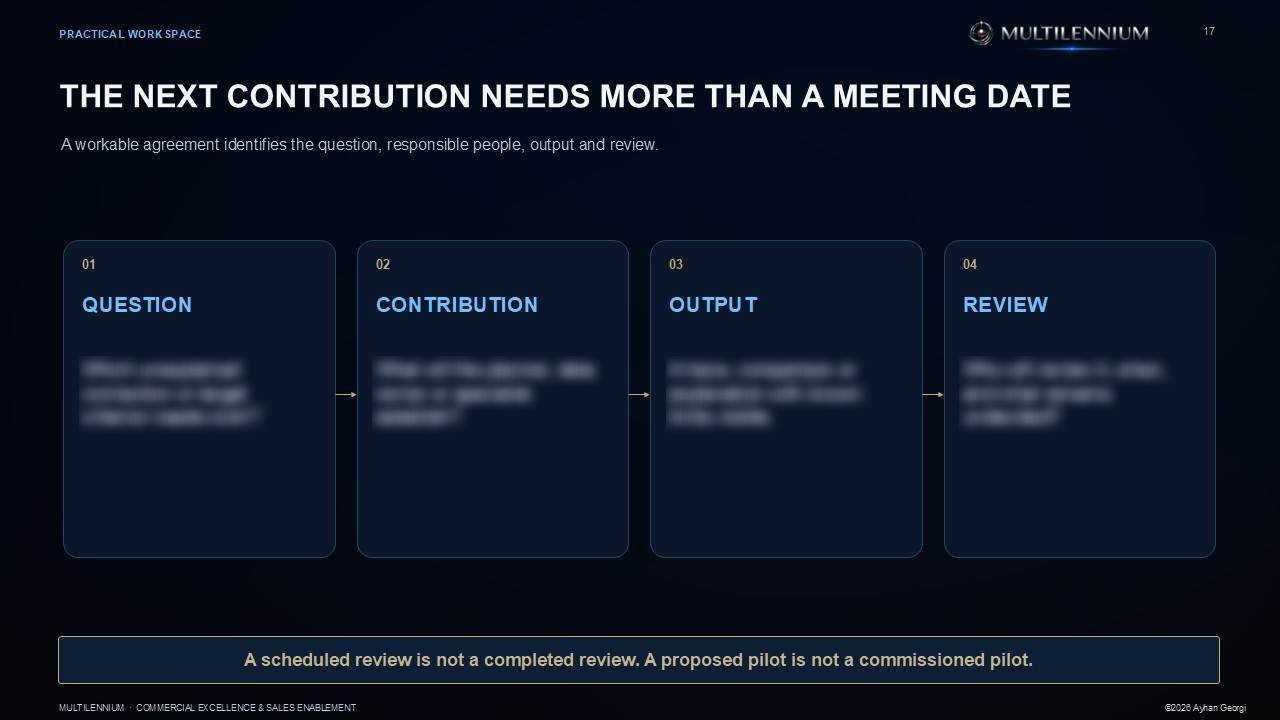
Use the result to agree the right contribution: build a first basis, connect permitted extracts, test an assumption or compare options. Keep the source, version, responsible role and open question attached to the next action.
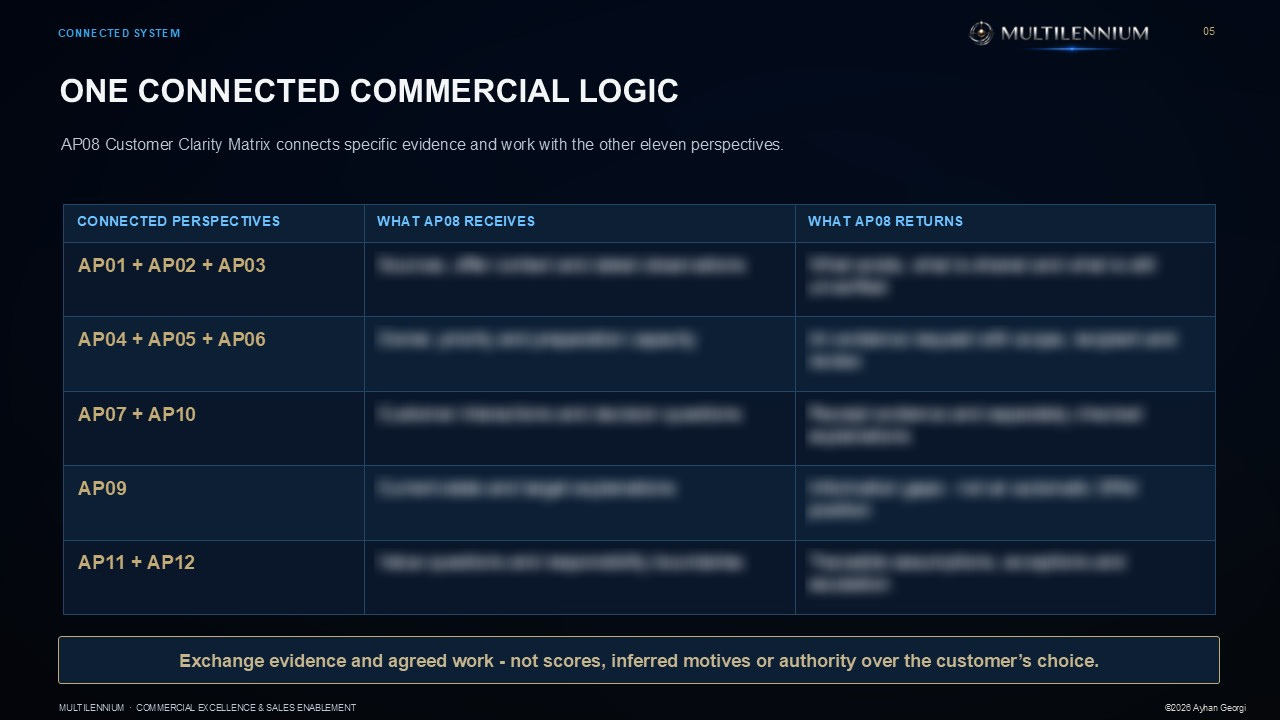
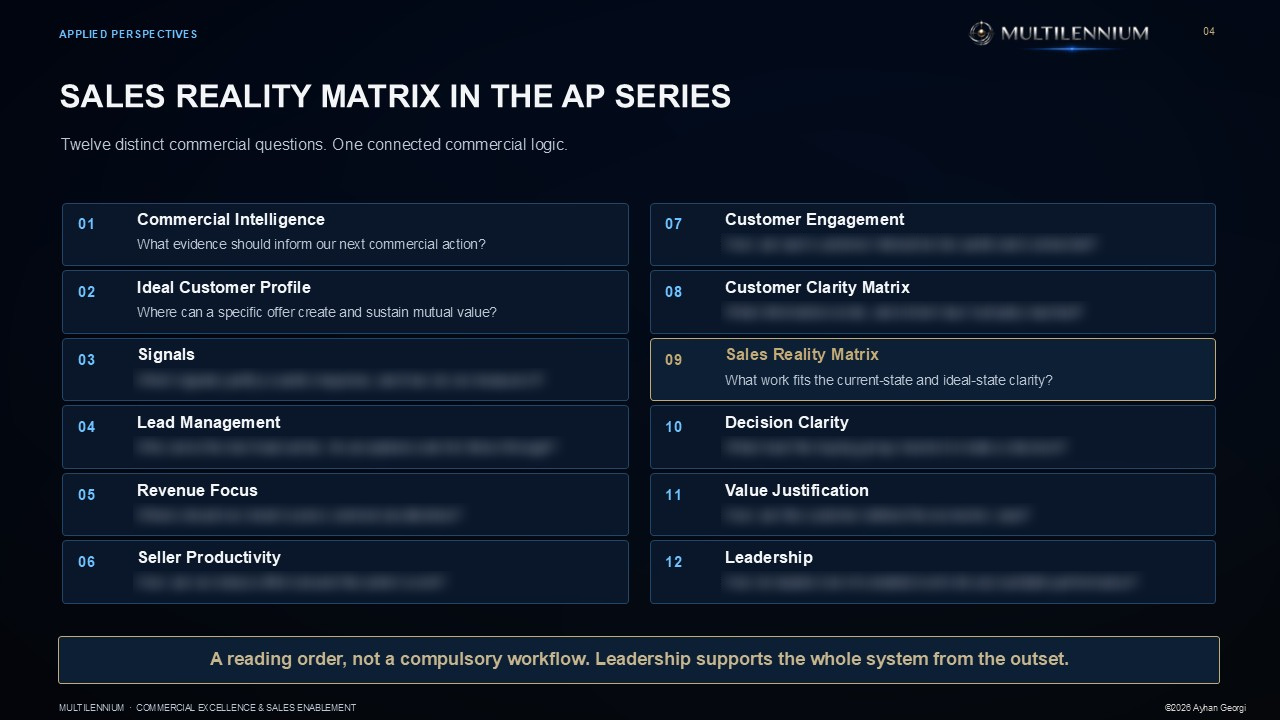
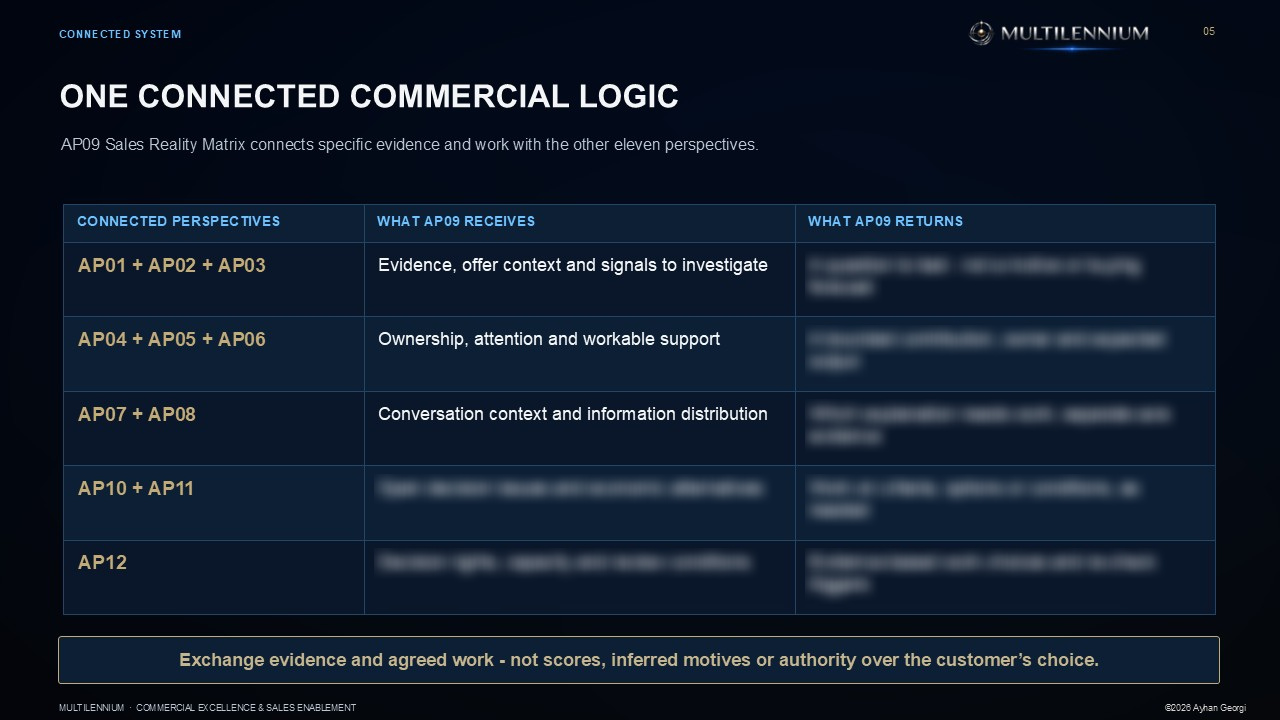
Within One connected commercial logic, AP01 supplies the evidence, AP07 carries the interaction and AP09 helps select work from independently evidenced current and target explanations. AP10 supports the customer’s decision work. No field grants authority, proves agreement or guarantees an order.



FOCUS
Scoped information review; availability and receipt evidence; separate explanation check; agreed clarity action.
WHEN TO USE
When files are shared but assumptions differ, relevant evidence is scattered or a proposal advances without a common basis.
CONNECTIONS
AP01 Commercial Intelligence, AP04 Lead Management, AP07 Customer Engagement, AP09 Sales Reality Matrix, AP10 Decision Clarity, AP11 Value Justification, AP12 Leadership.
APPLIED PERSPECTIVE 09
Sales Reality Matrix™
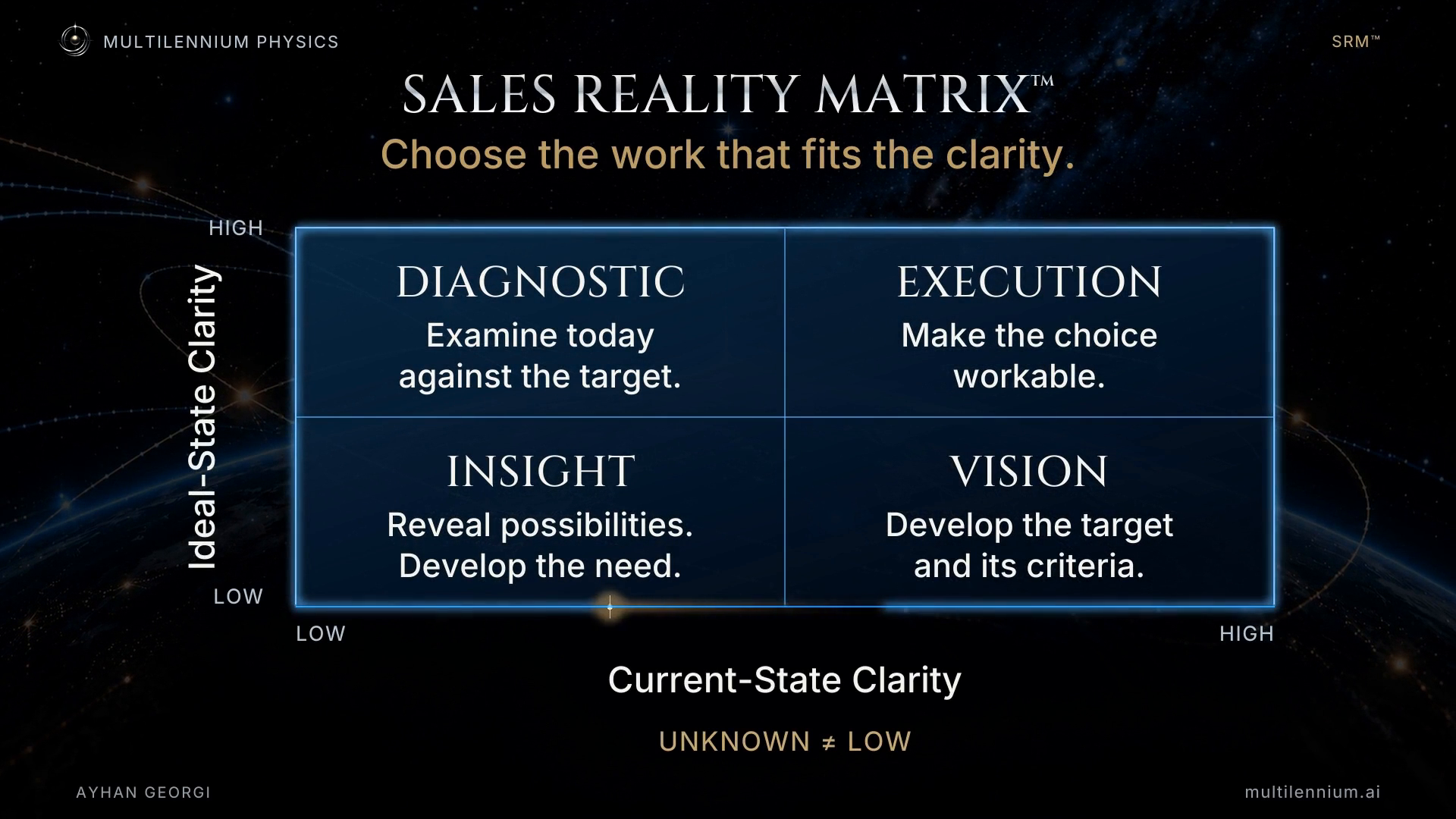
What work fits the current-state and ideal-state clarity? Choosing useful sales work from what the customer can explain today and wants next.
Choose a useful next contribution by examining today’s work and the desired result separately - with evidence, a clear question and human responsibility.
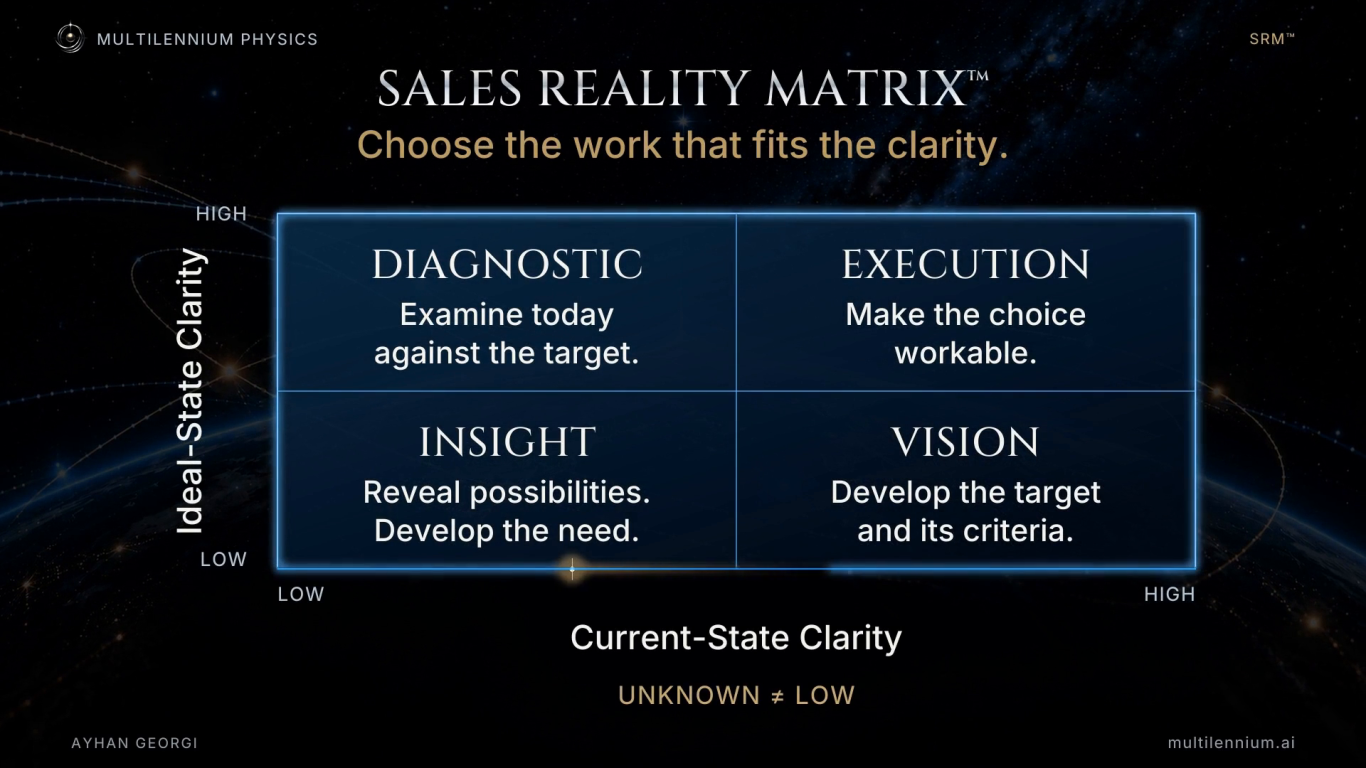
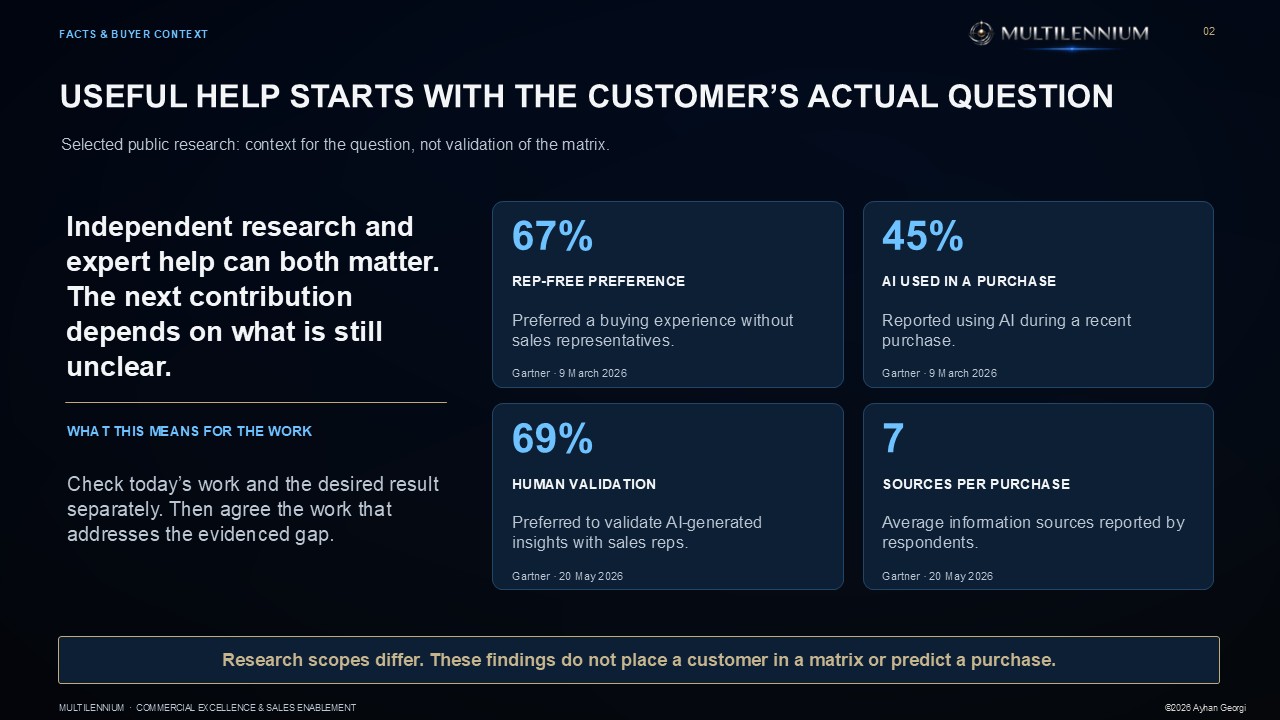
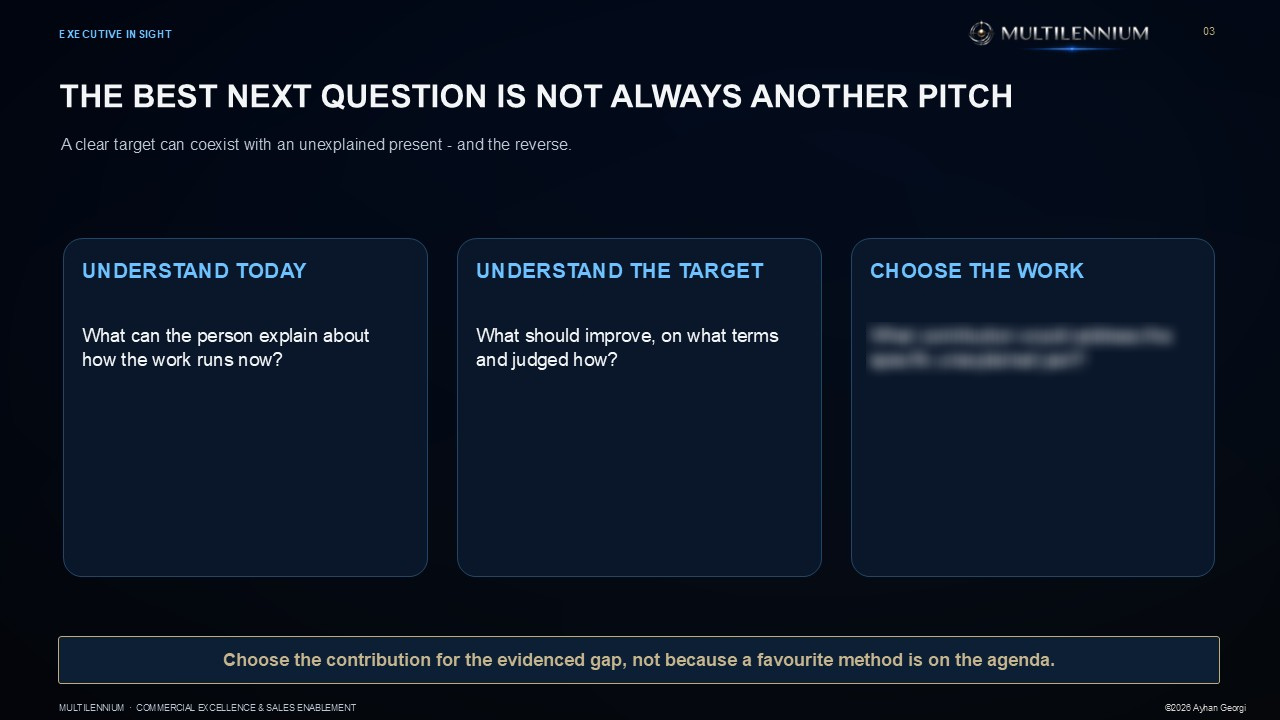
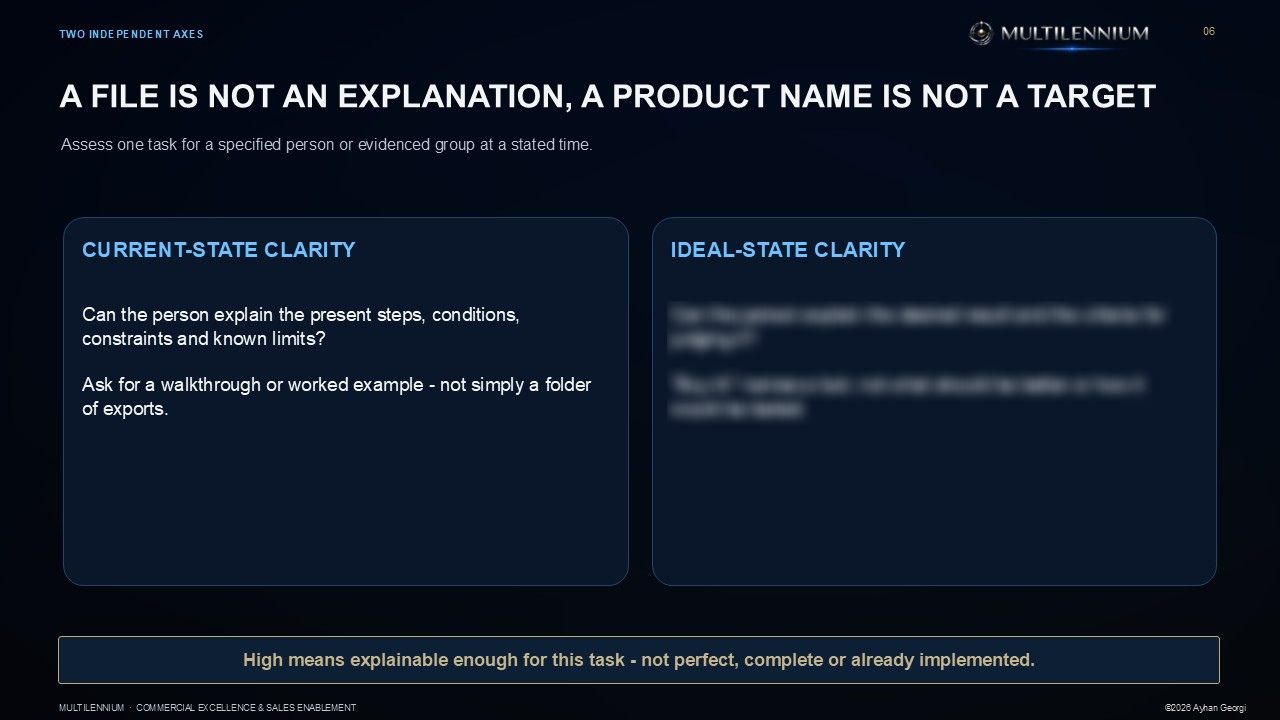
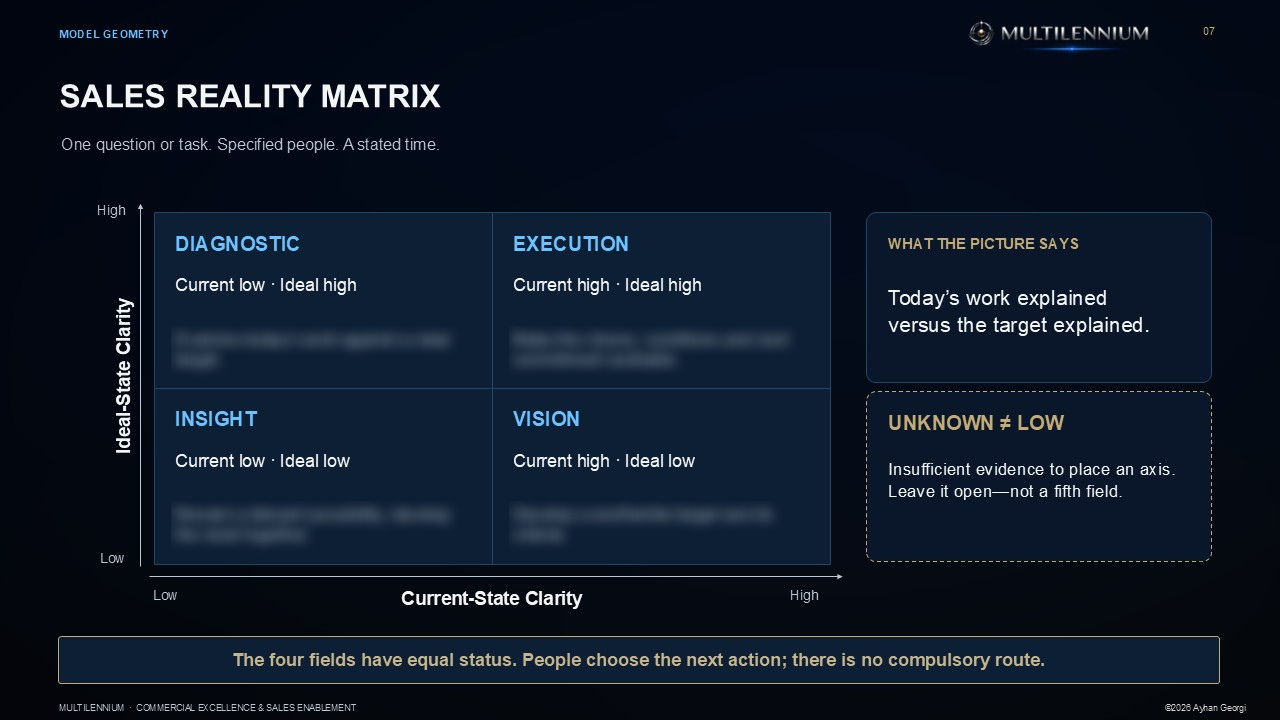
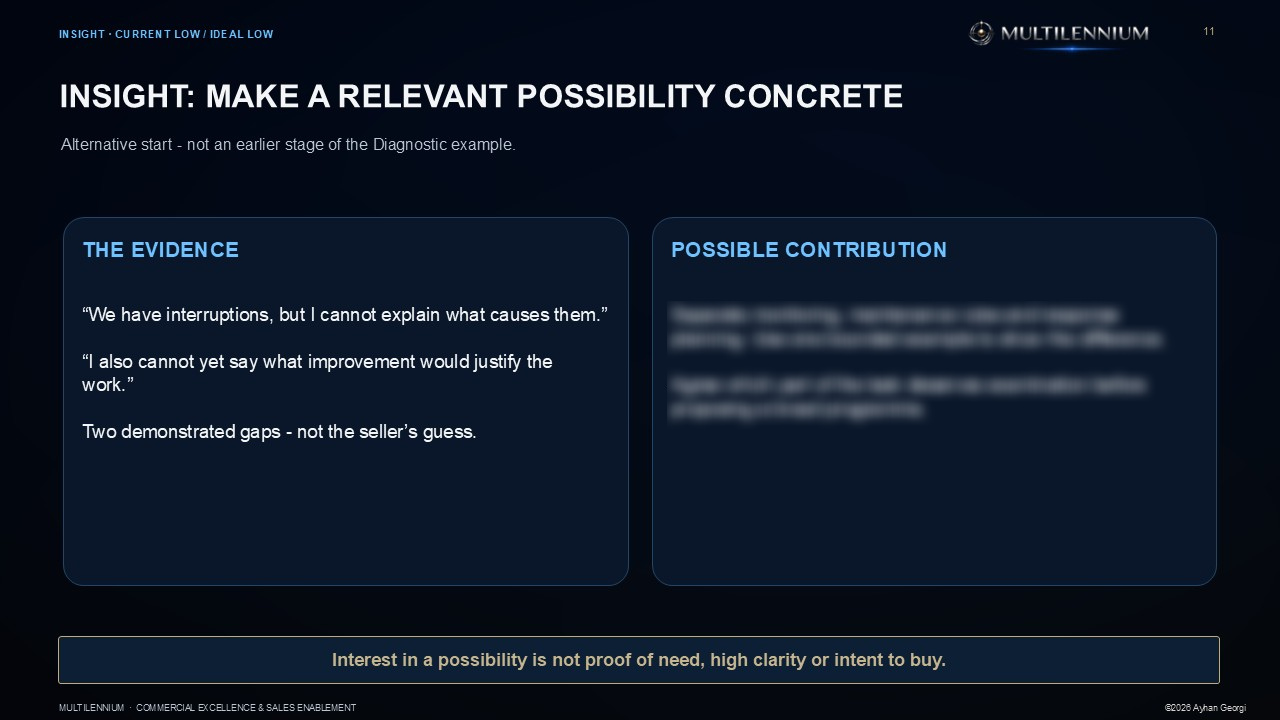
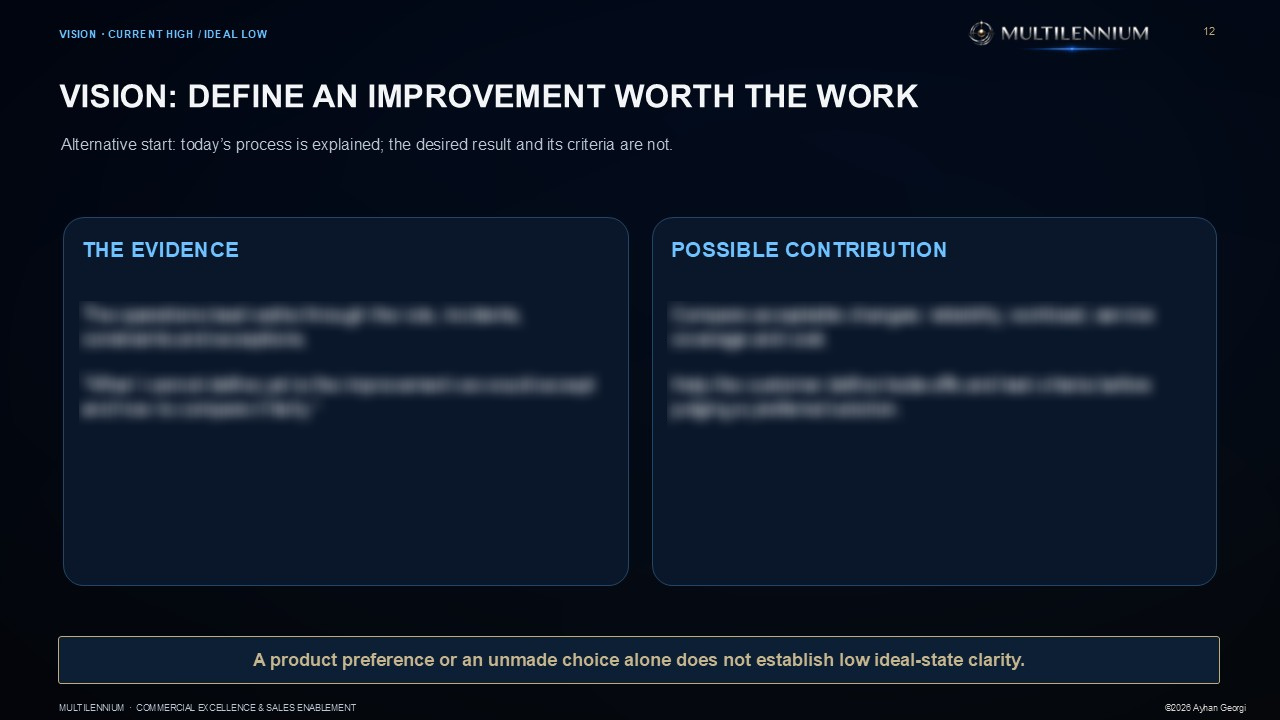
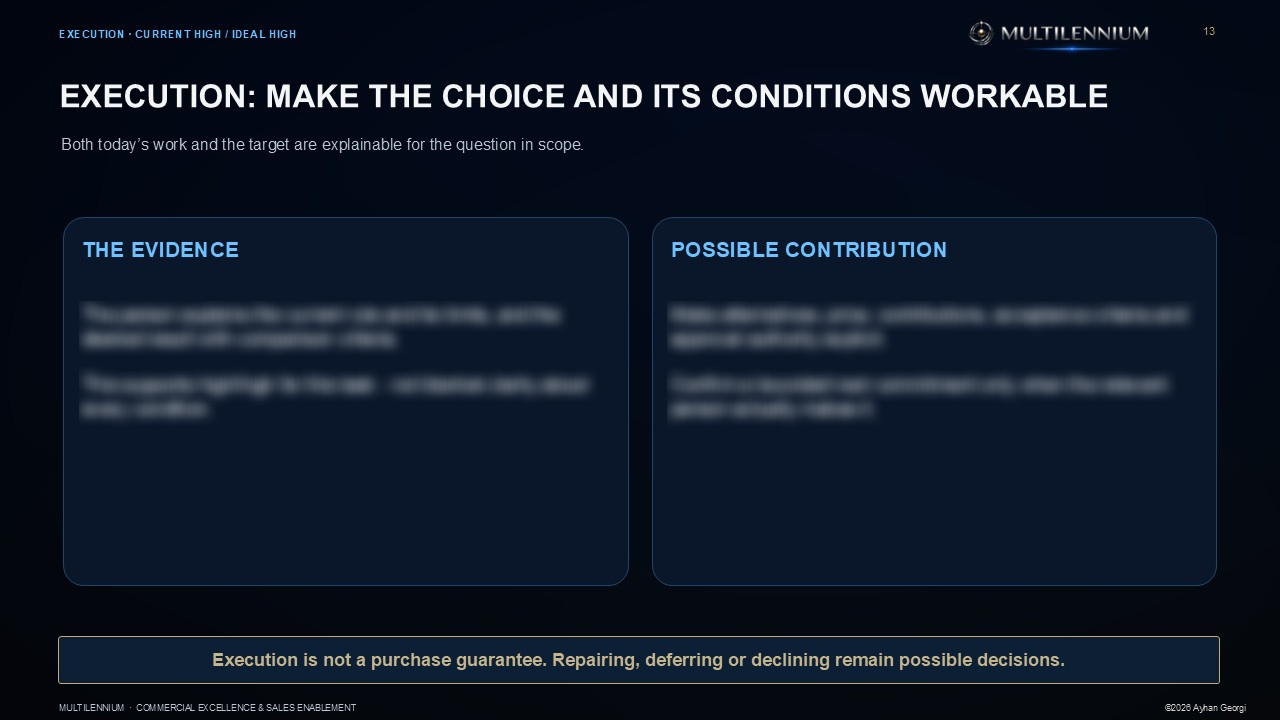
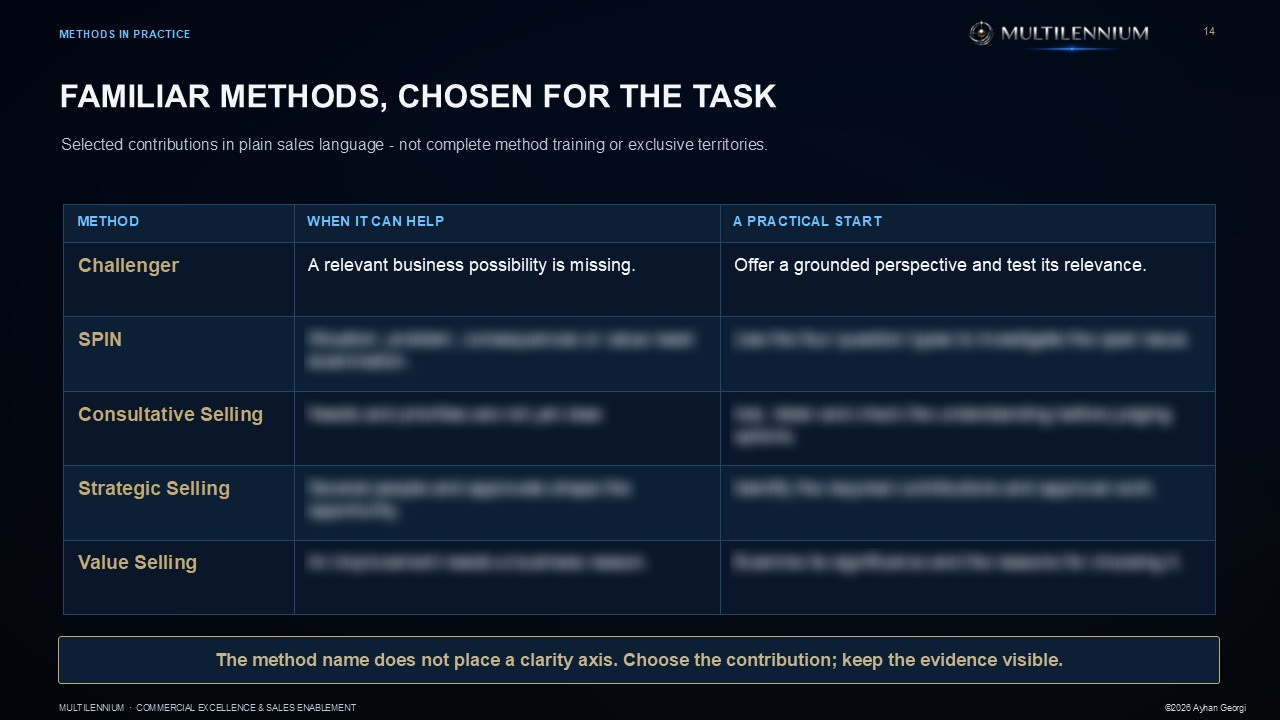
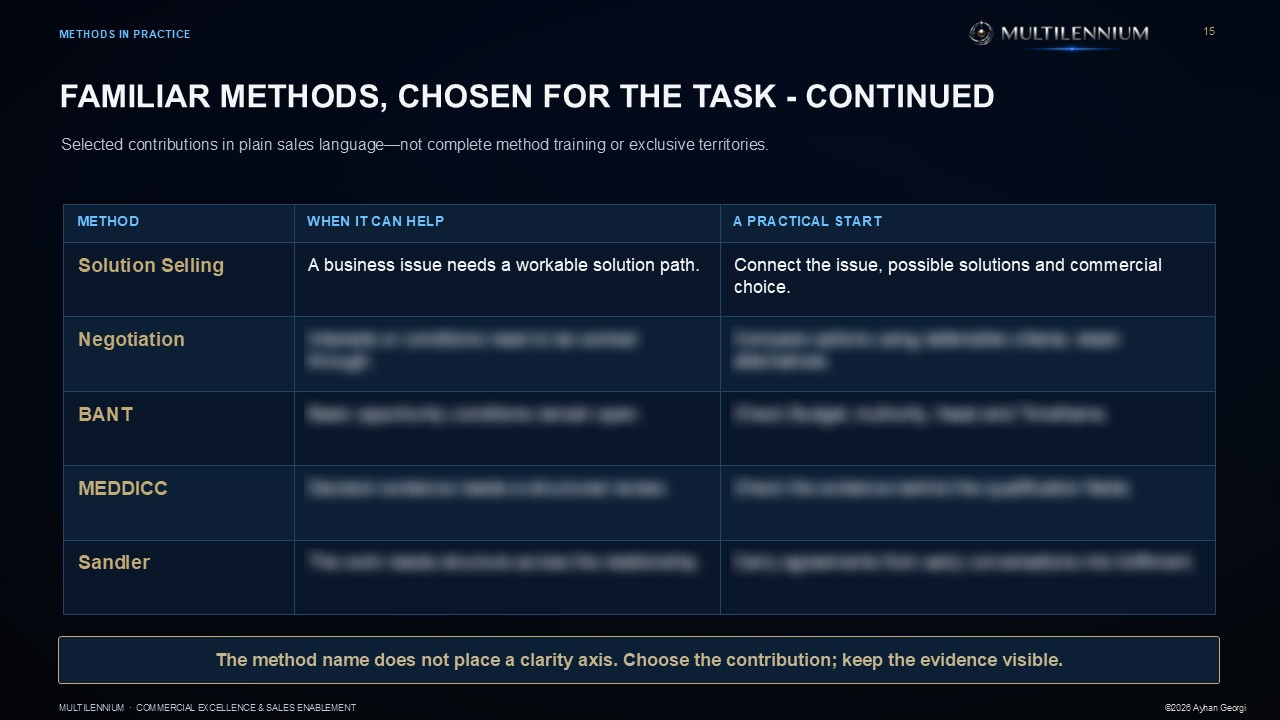
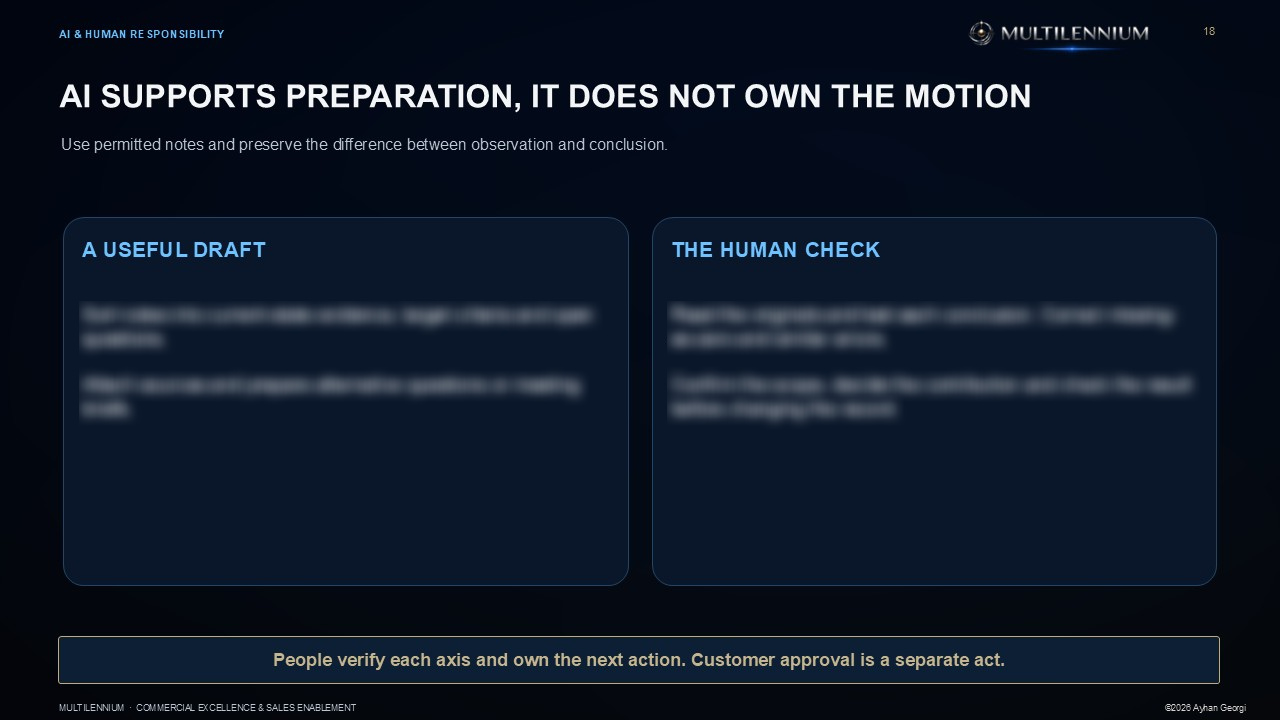
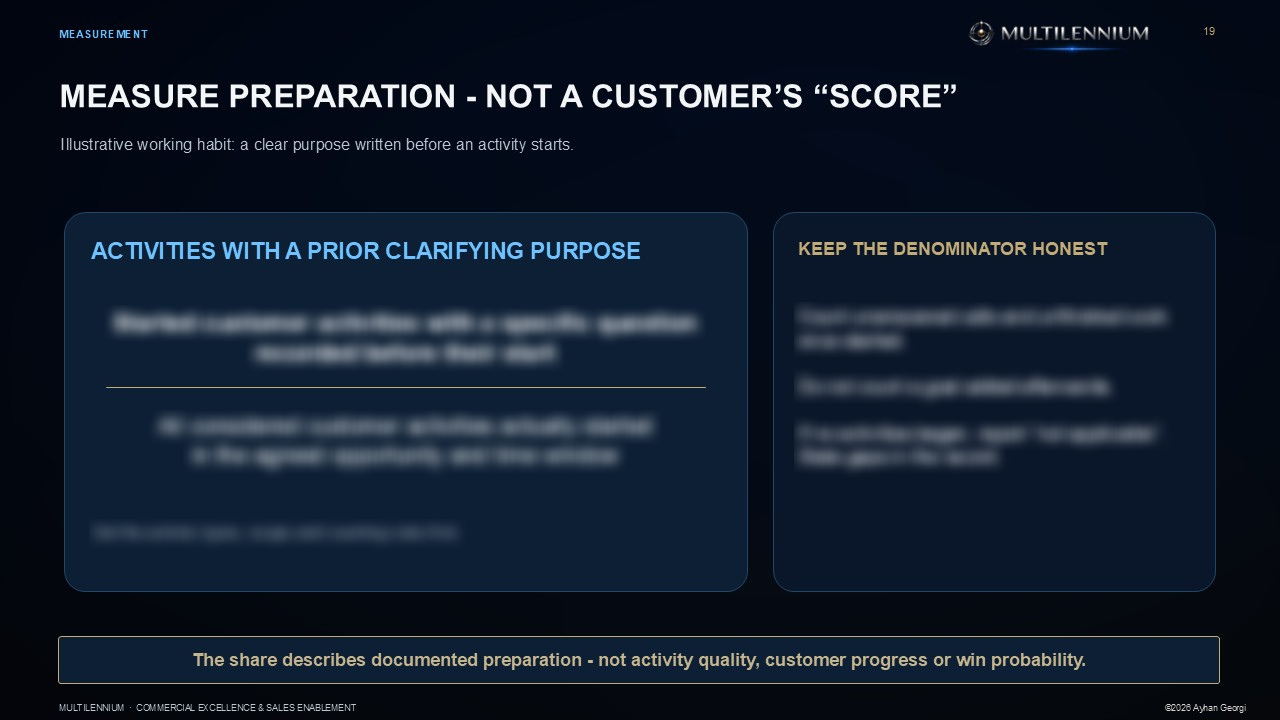
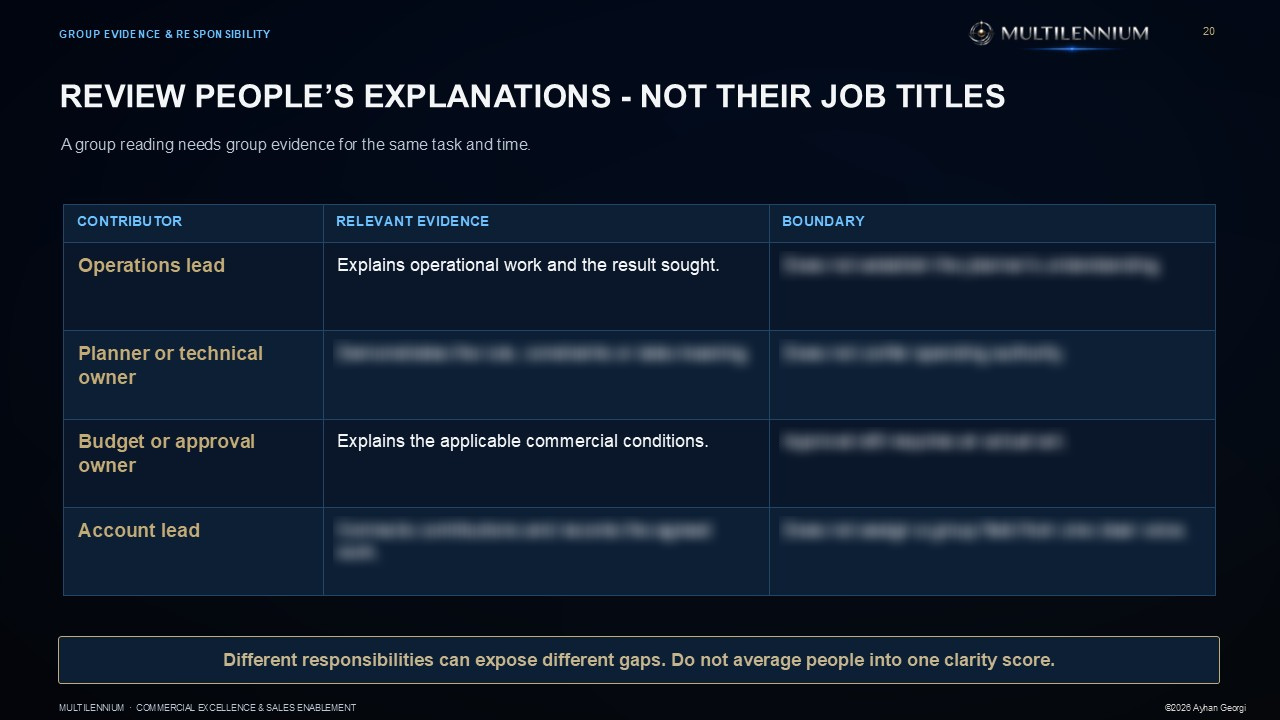
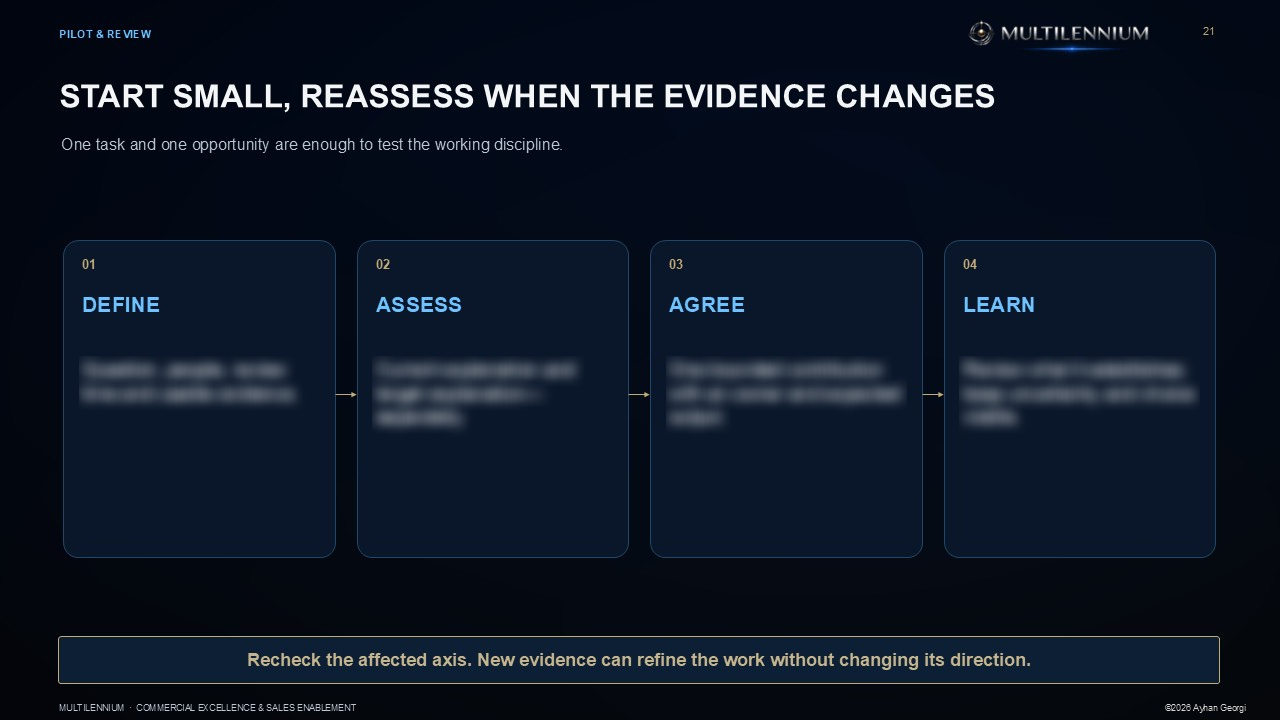
The same sales routine does not help every customer situation. The Sales Reality Matrix examines two separate questions: what can the customer explain about today’s work, and what should improve, on what terms? The answers guide Insight, Diagnostic, Vision or Execution work. This Applied Perspective shows how to choose familiar sales methods for the task, agree a bounded contribution and review what changes. The four motions are not funnel stages or guarantees of a purchase.
A customer may know exactly what should improve but be unable to explain why the current work falls short. Another may understand today’s process thoroughly while the desired result remains unclear. Giving both the same presentation misses the difference.
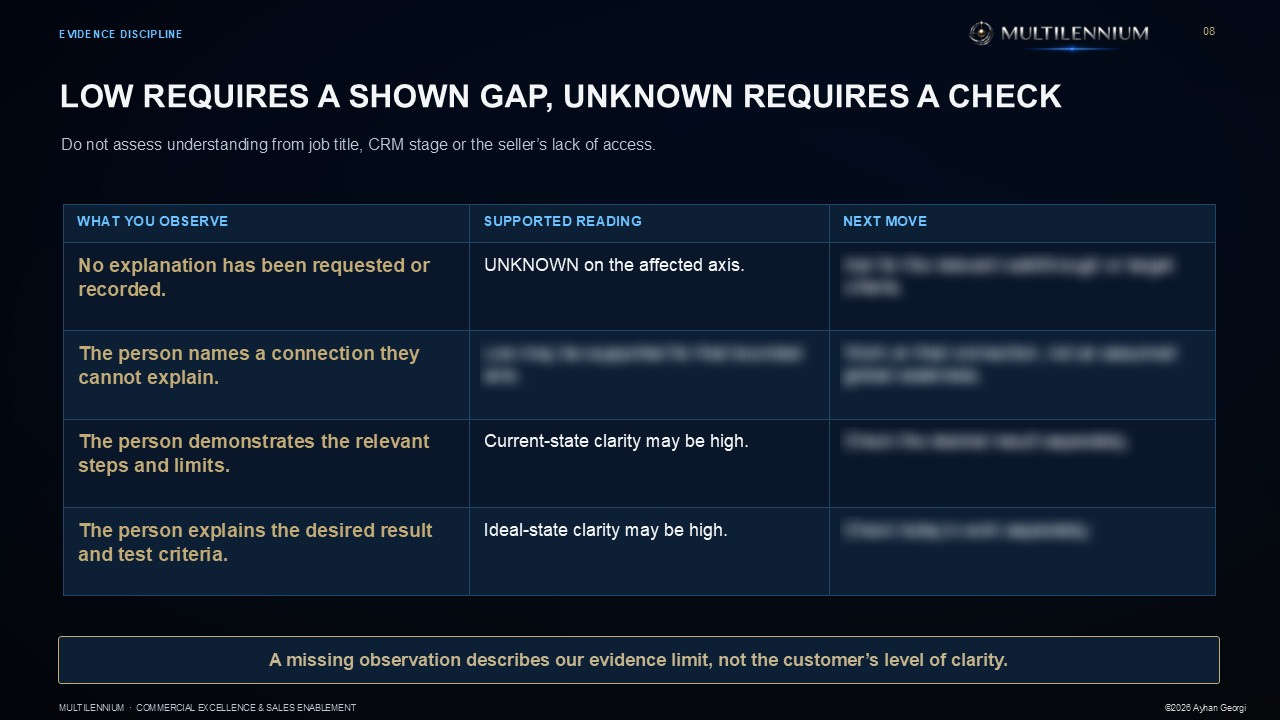
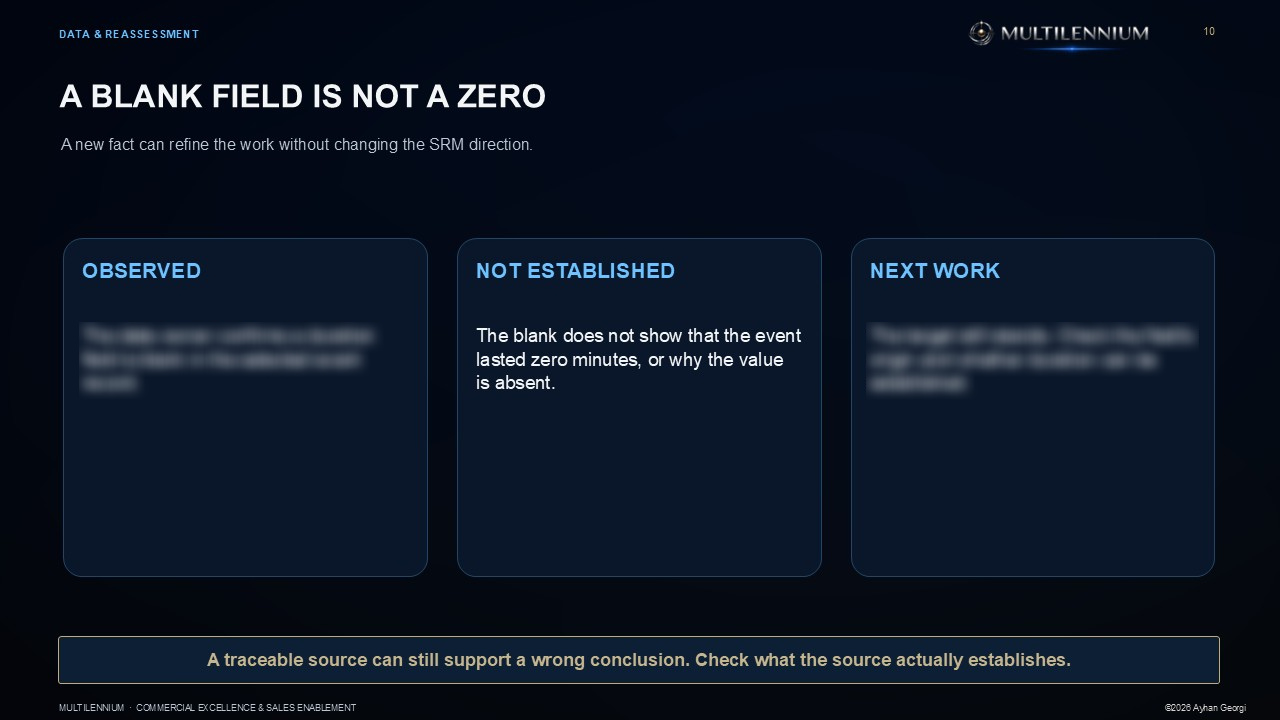
The Sales Reality Matrix separates Current-State Clarity from Ideal-State Clarity. Each is grounded in what a specified person or evidenced group can explain, demonstrate or interpret about the same task at a stated time. Missing evidence stays unknown.
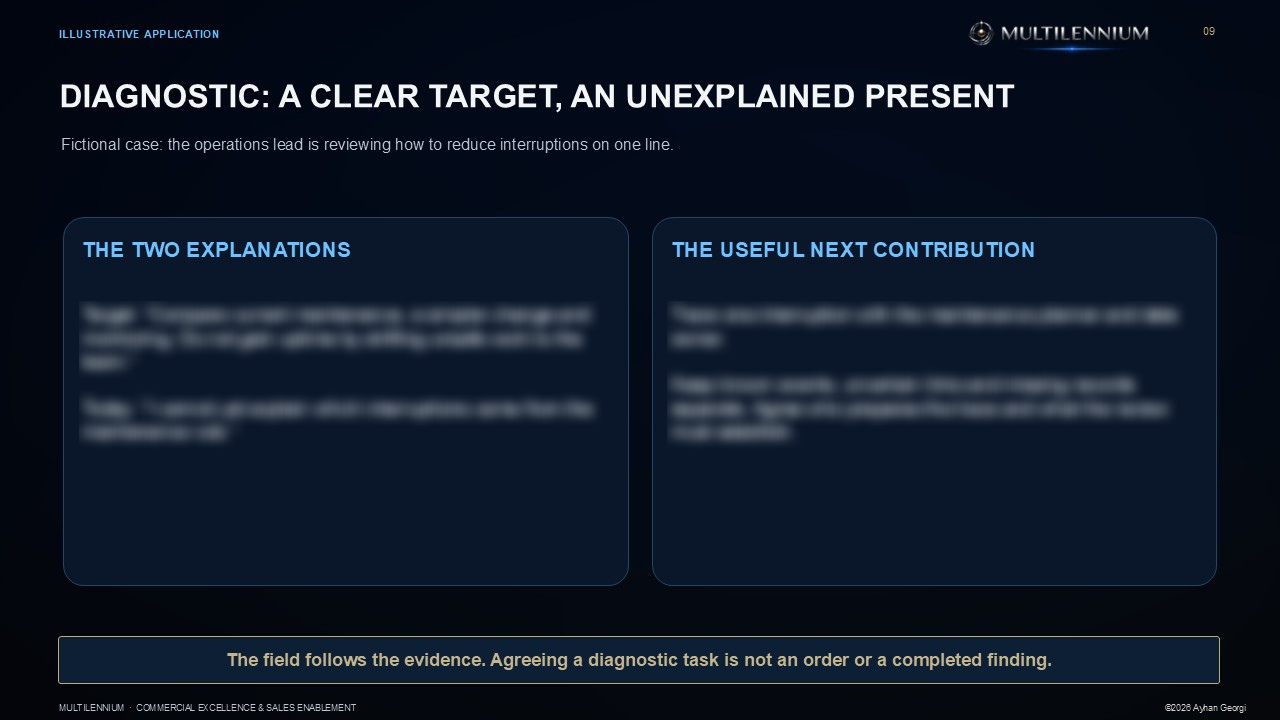
Insight makes a relevant possibility concrete. Diagnostic examines today’s work against a clear target. Vision develops a worthwhile target and its criteria. Execution makes the choice, conditions and next commitment workable. These are equally available directions, not a required sequence.
The perspective connects familiar sales methods with the work needed. It does not replace those methods, map CRM stages to customer understanding or turn a completed checklist into a customer decision. AP08 describes the information position; AP10 and AP11 help with decision work and the economic case. People choose, agree and review the contribution.



FOCUS
Independent current/target assessment; practical work selection; method contribution; explicit owner and review.
WHEN TO USE
When the team has many sales methods but is unsure which contribution the current customer question needs.
CONNECTIONS
AP01 Commercial Intelligence, AP05 Revenue Focus, AP06 Seller Productivity, AP07 Customer Engagement, AP08 Customer Clarity Matrix, AP10 Decision Clarity, AP11 Value Justification, AP12 Leadership.
APPLIED PERSPECTIVE 10
Decision Clarity
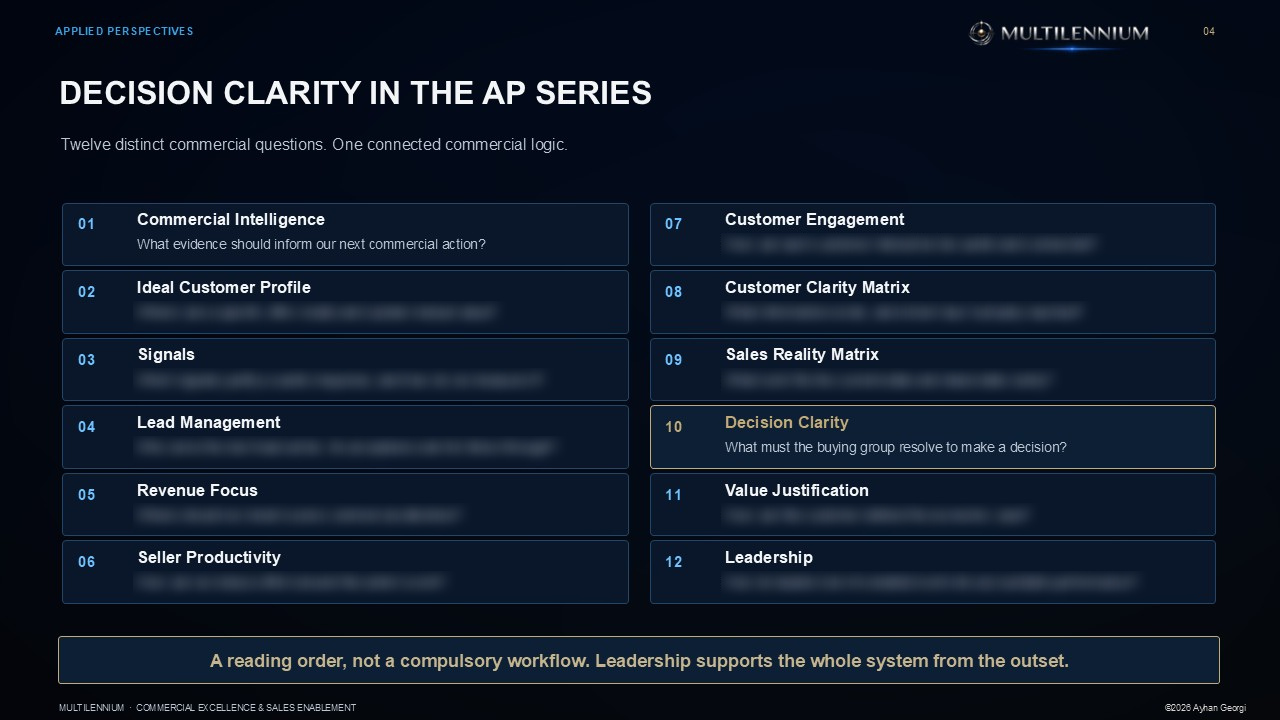
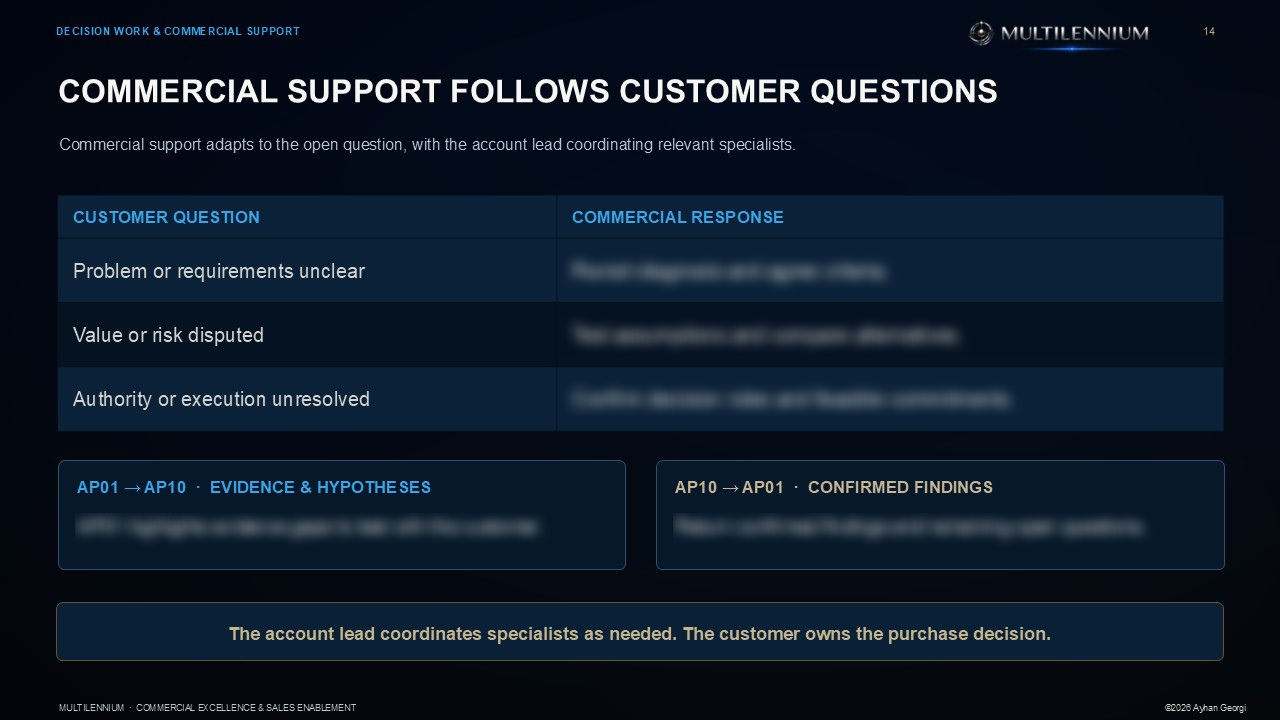
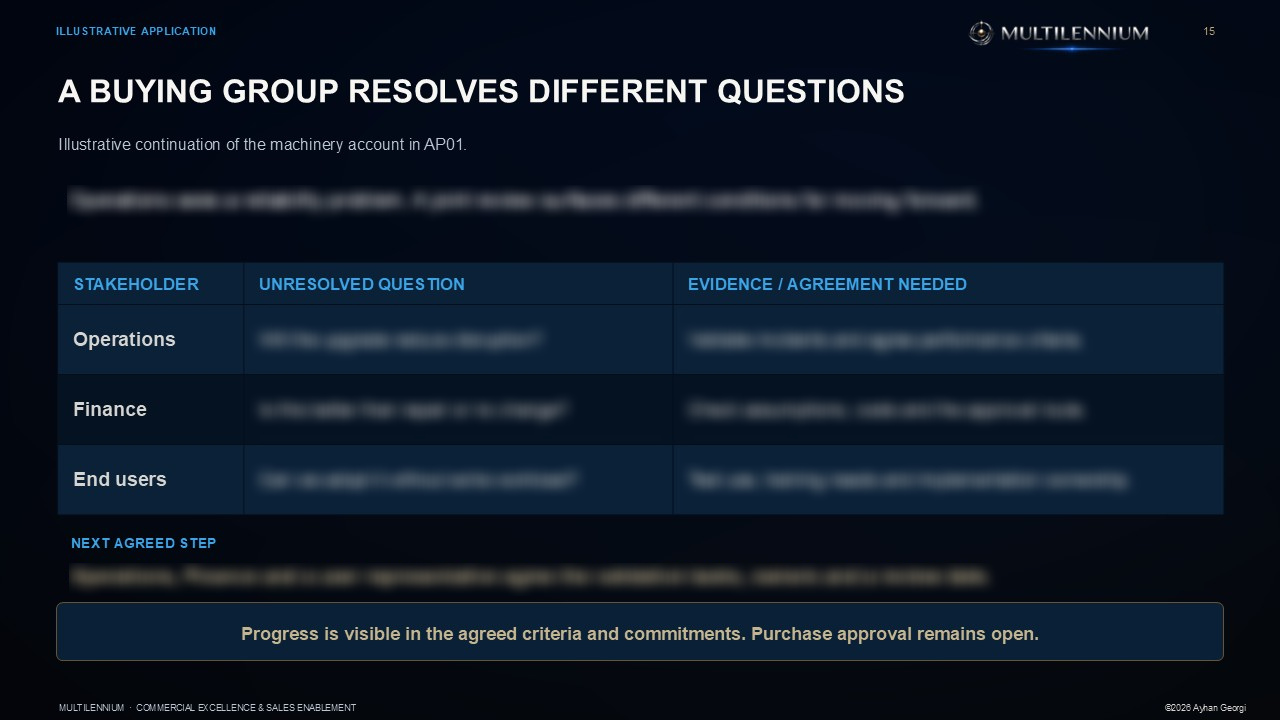
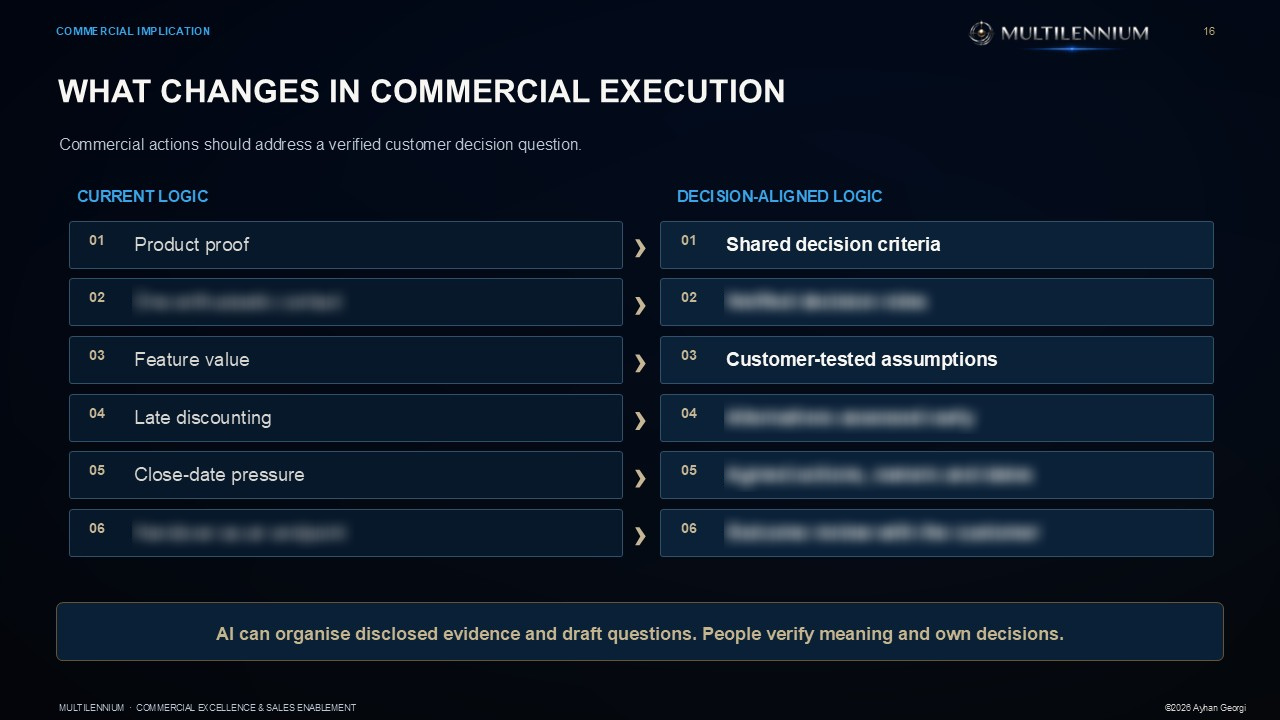
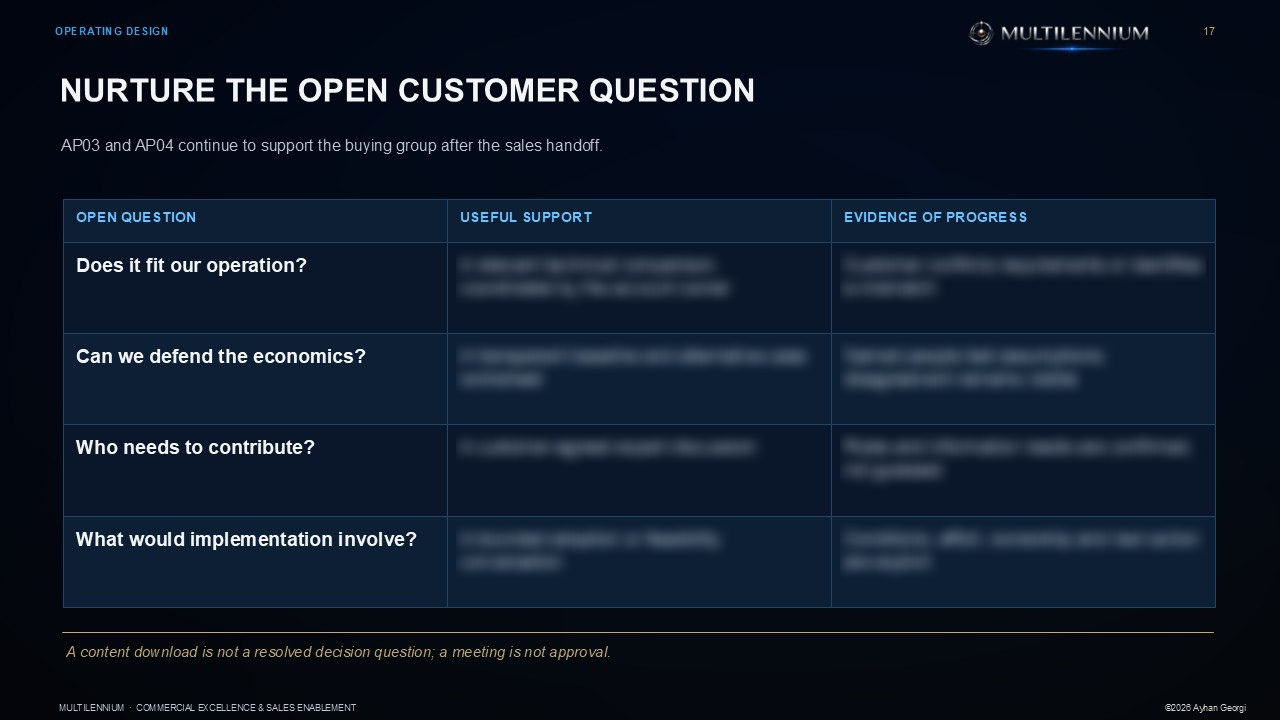
What must the buying group resolve to make a decision?
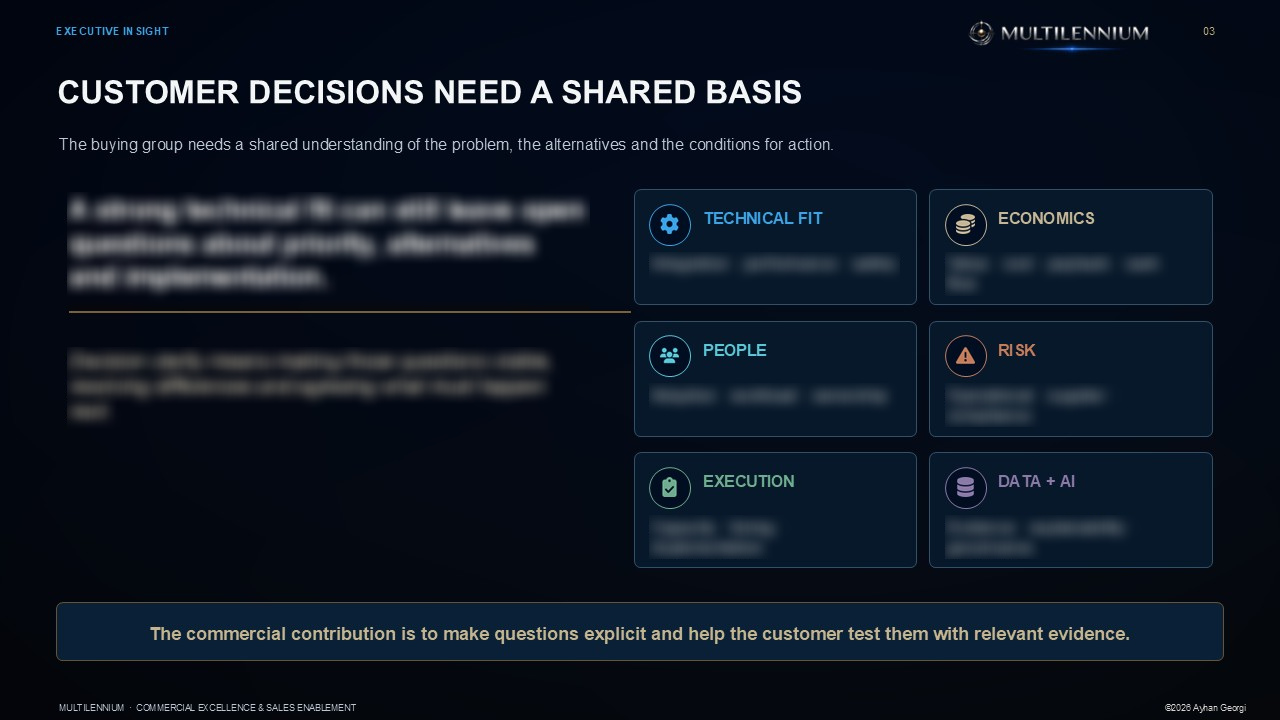
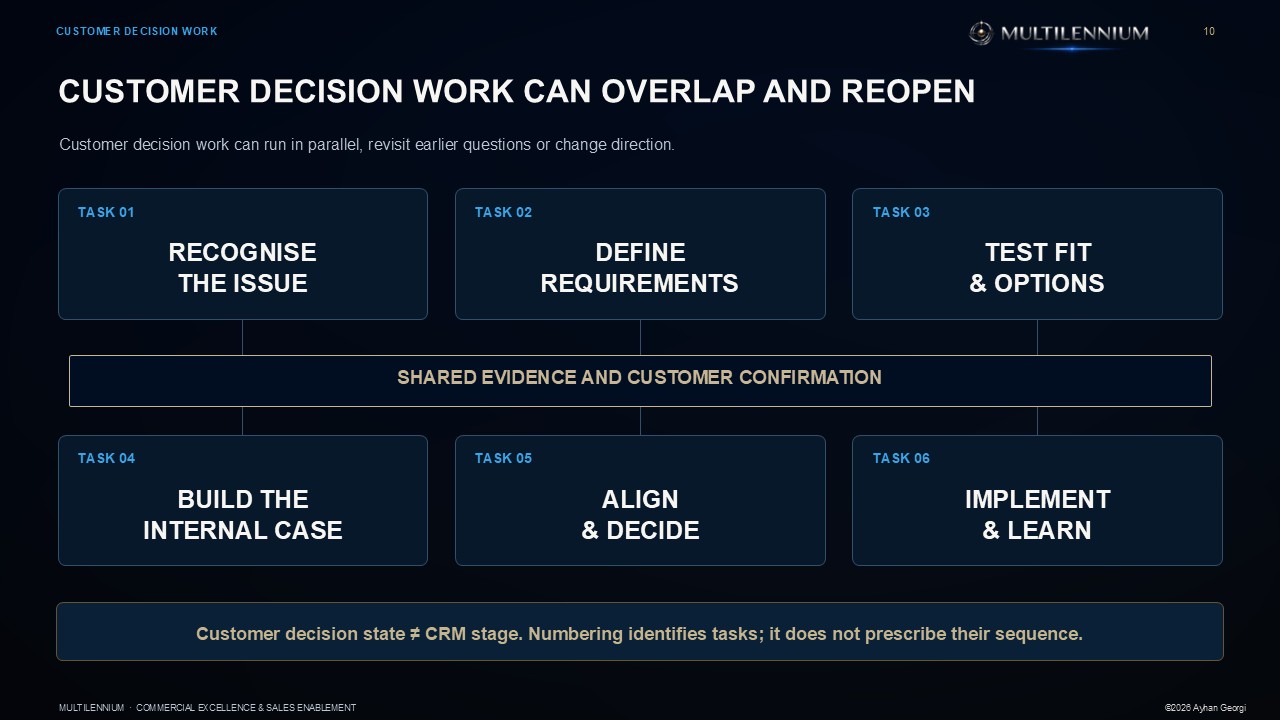
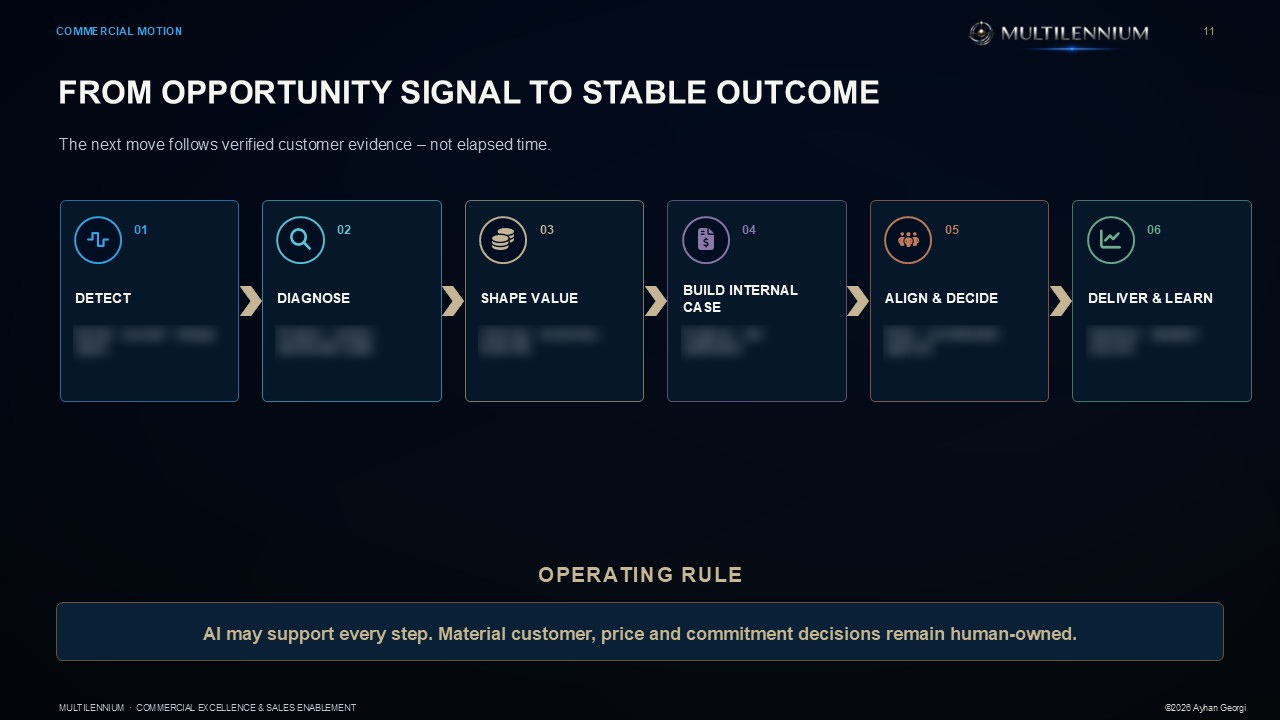
Make the customer’s unresolved questions visible so the buying group can compare alternatives, test the case and decide on a shared basis.
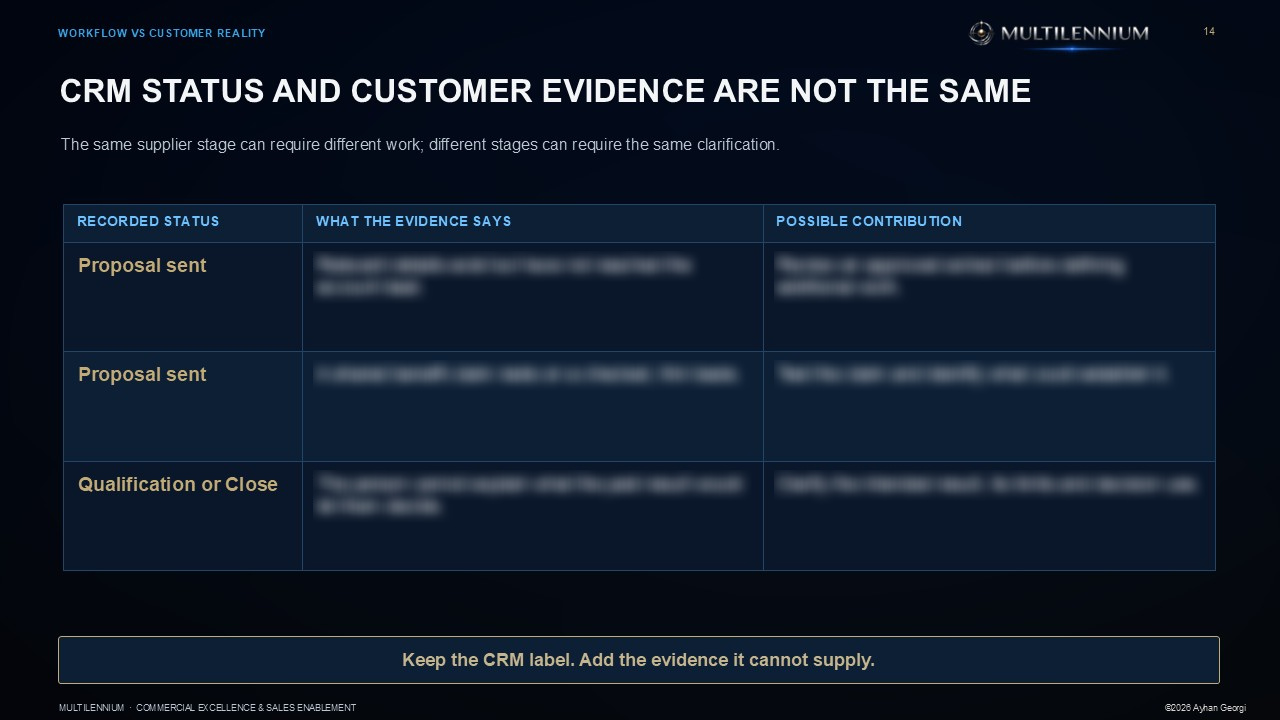
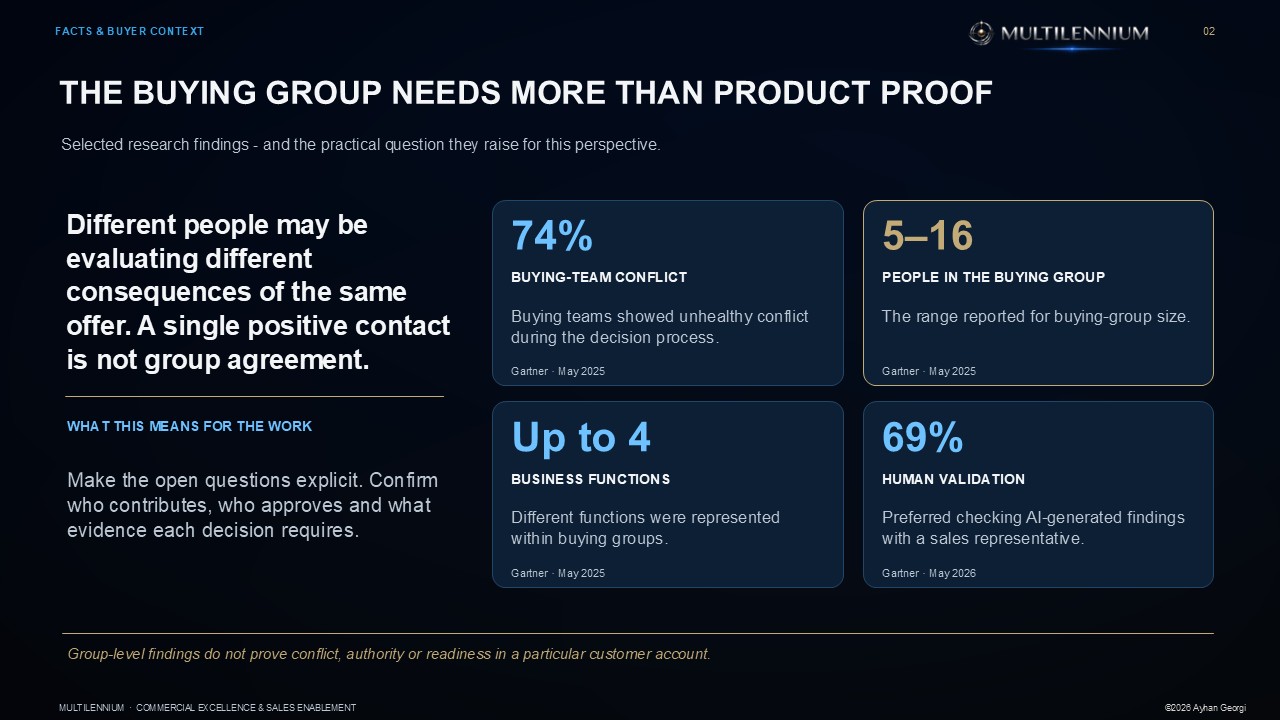
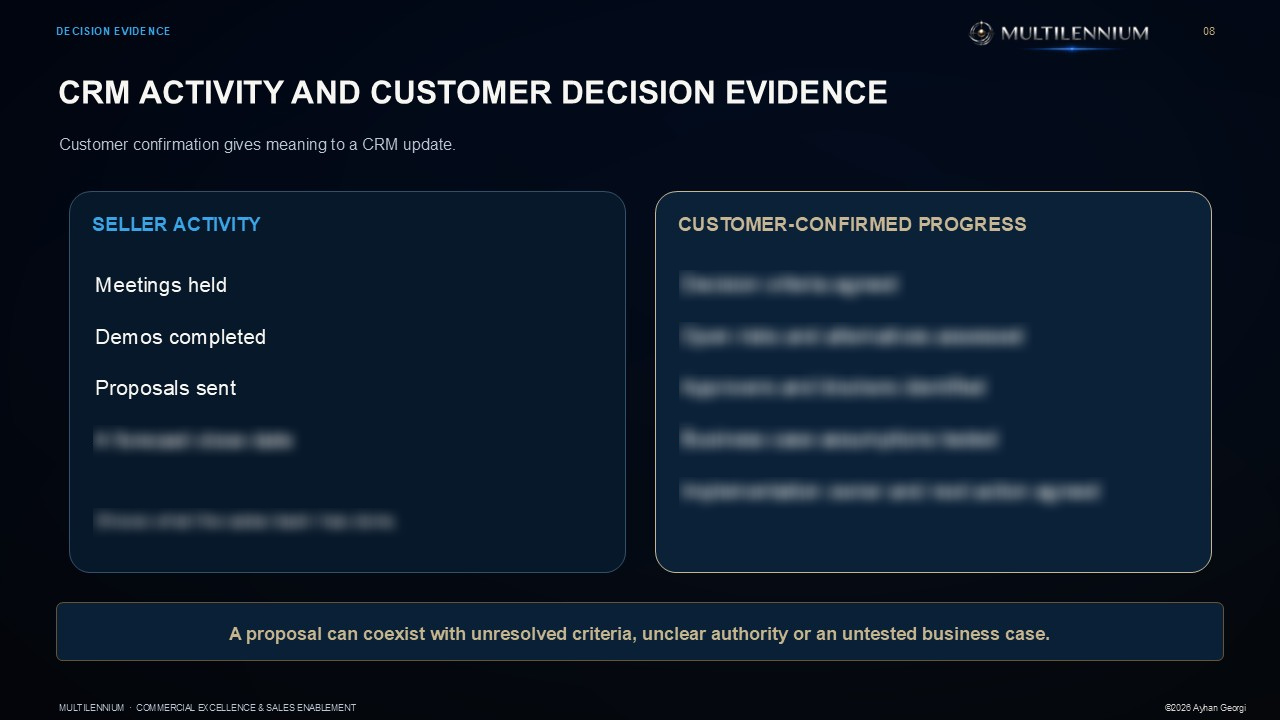
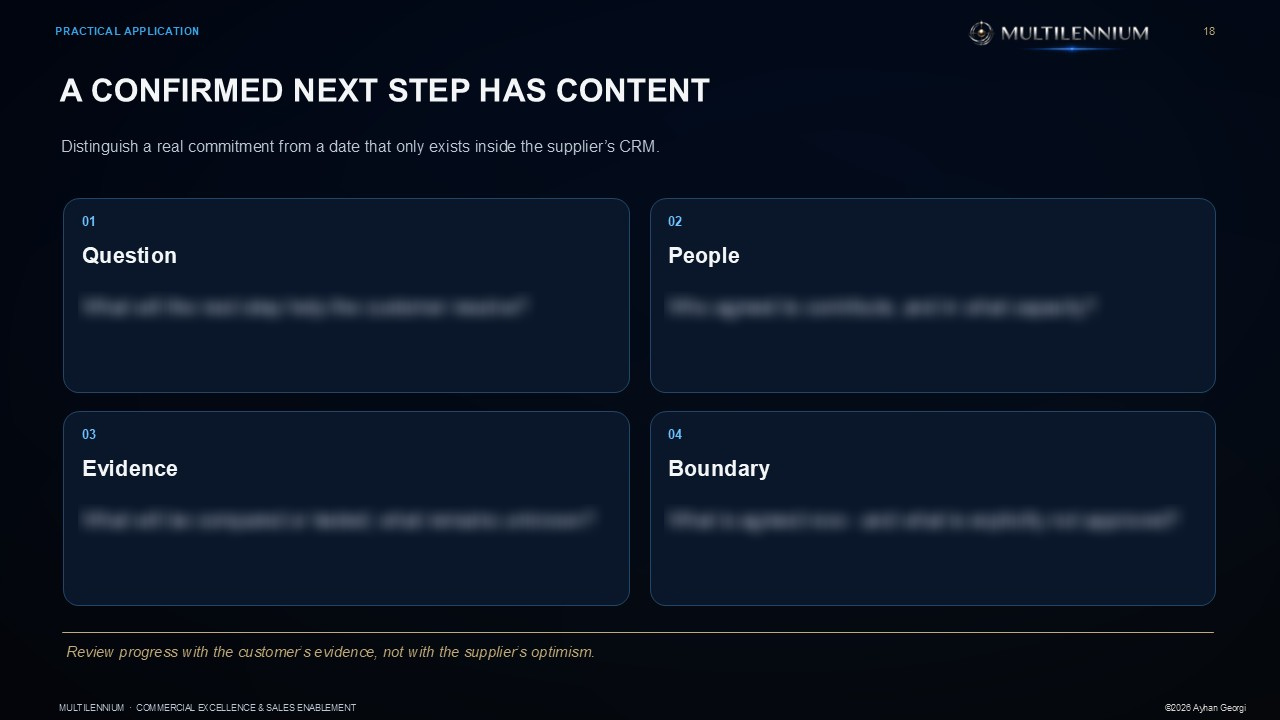
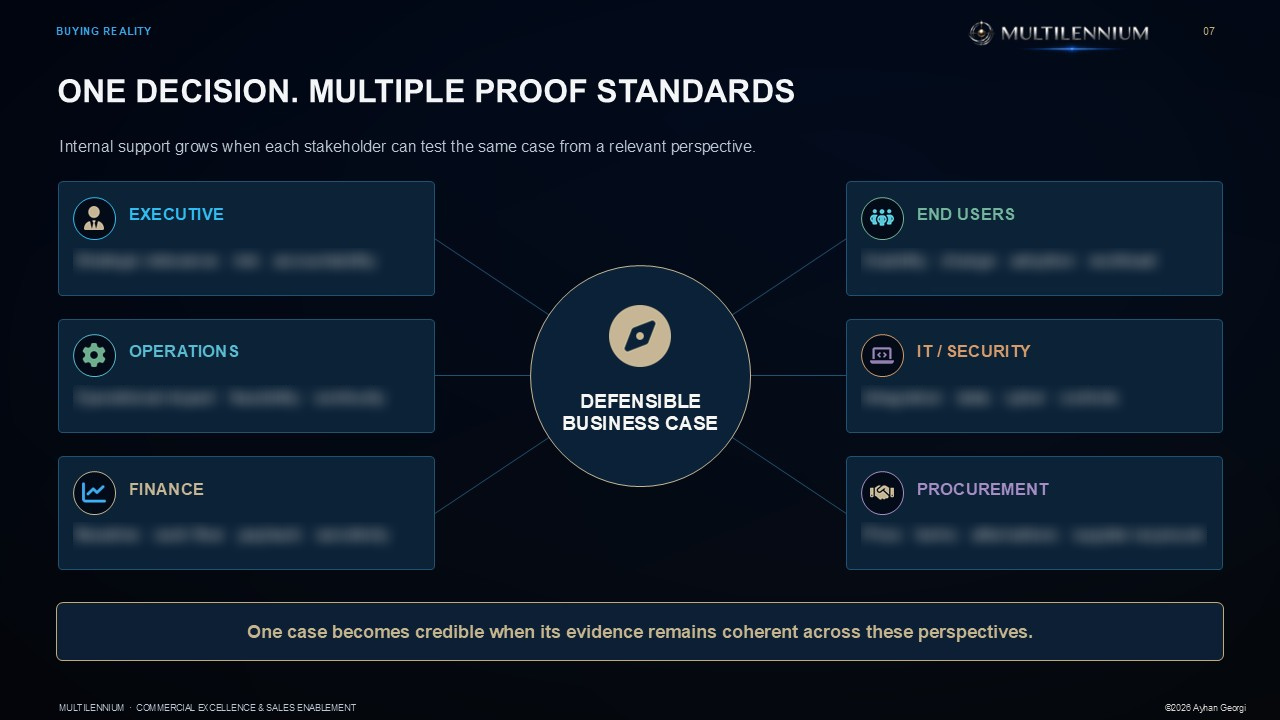
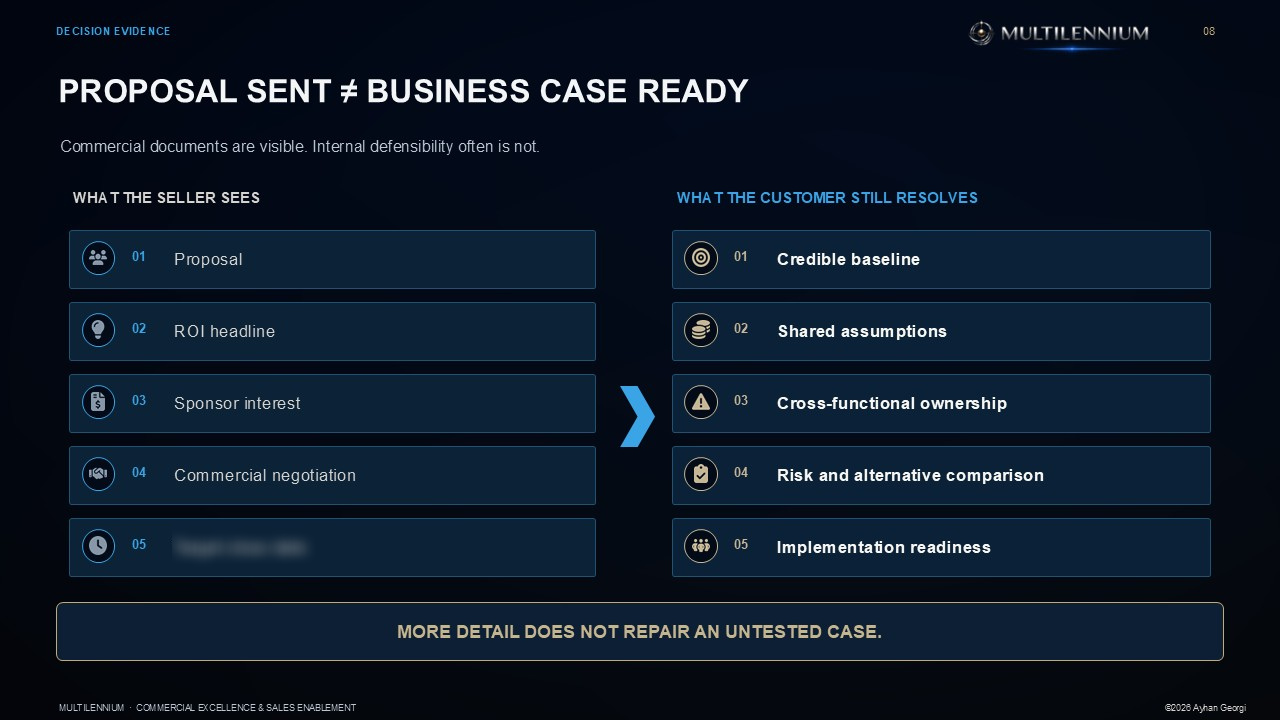
The proposal has been sent. That tells you what the seller has done. It does not tell you whether the customer can make the decision.
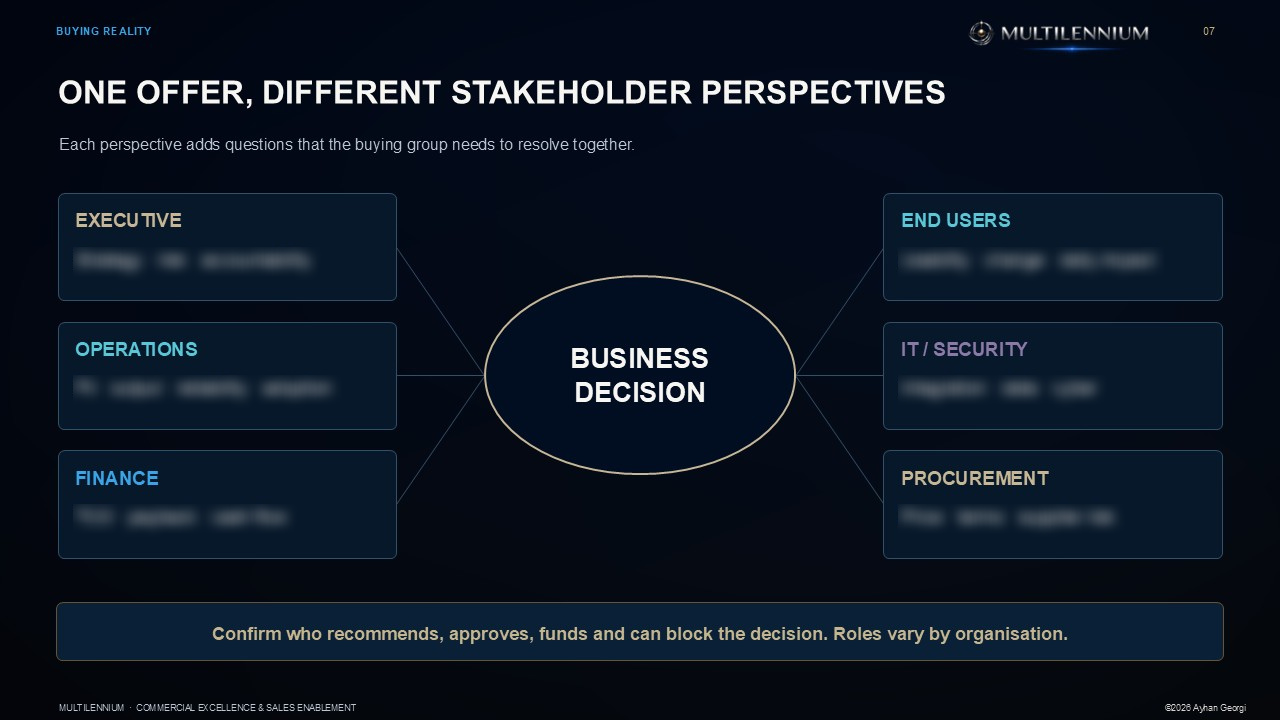
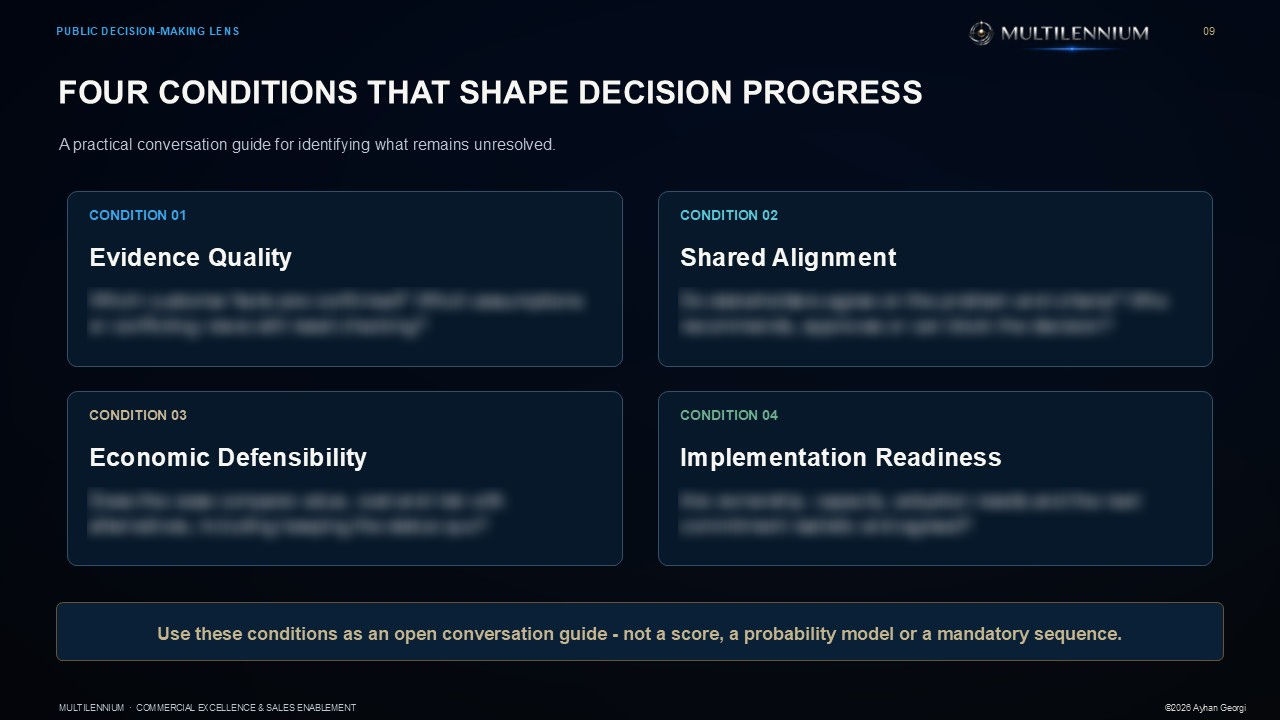
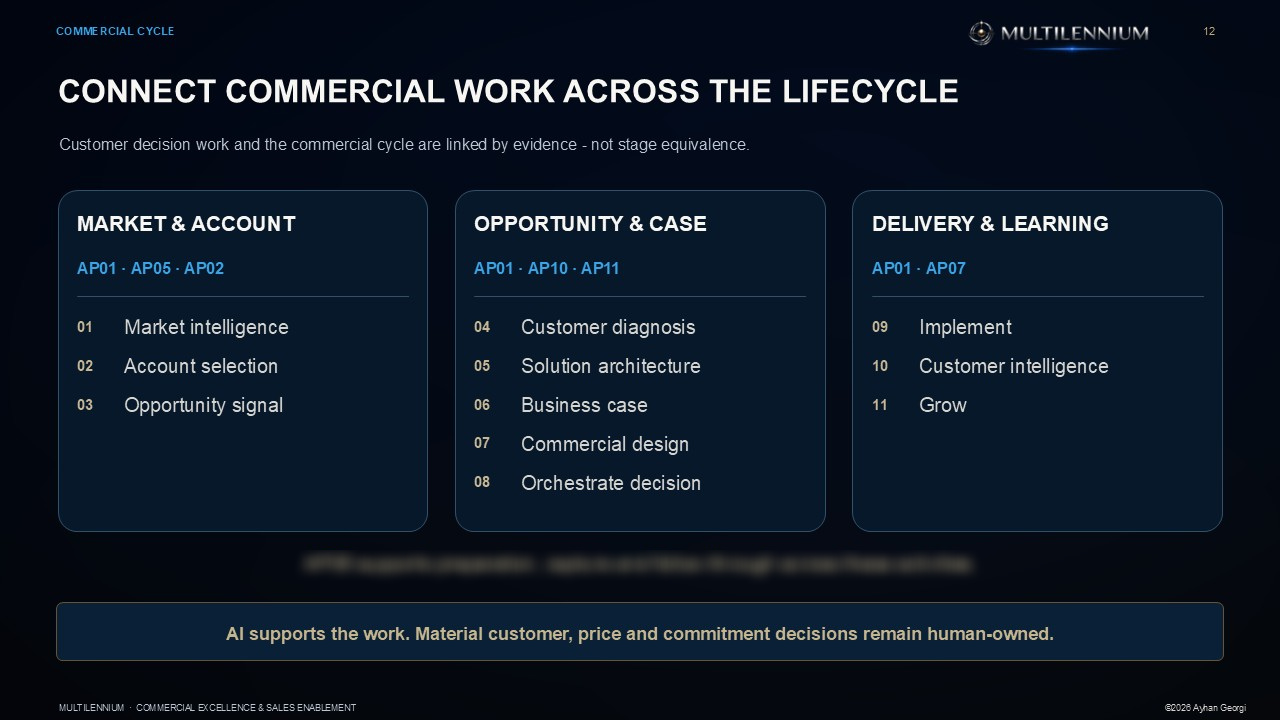
Decision Clarity brings the unresolved work into view: the problem, alternatives, criteria, economics, responsibilities and conditions for implementation. Different people may need different evidence about the same choice. Their involvement and agreement must be established, not inferred from a title or a positive meeting.
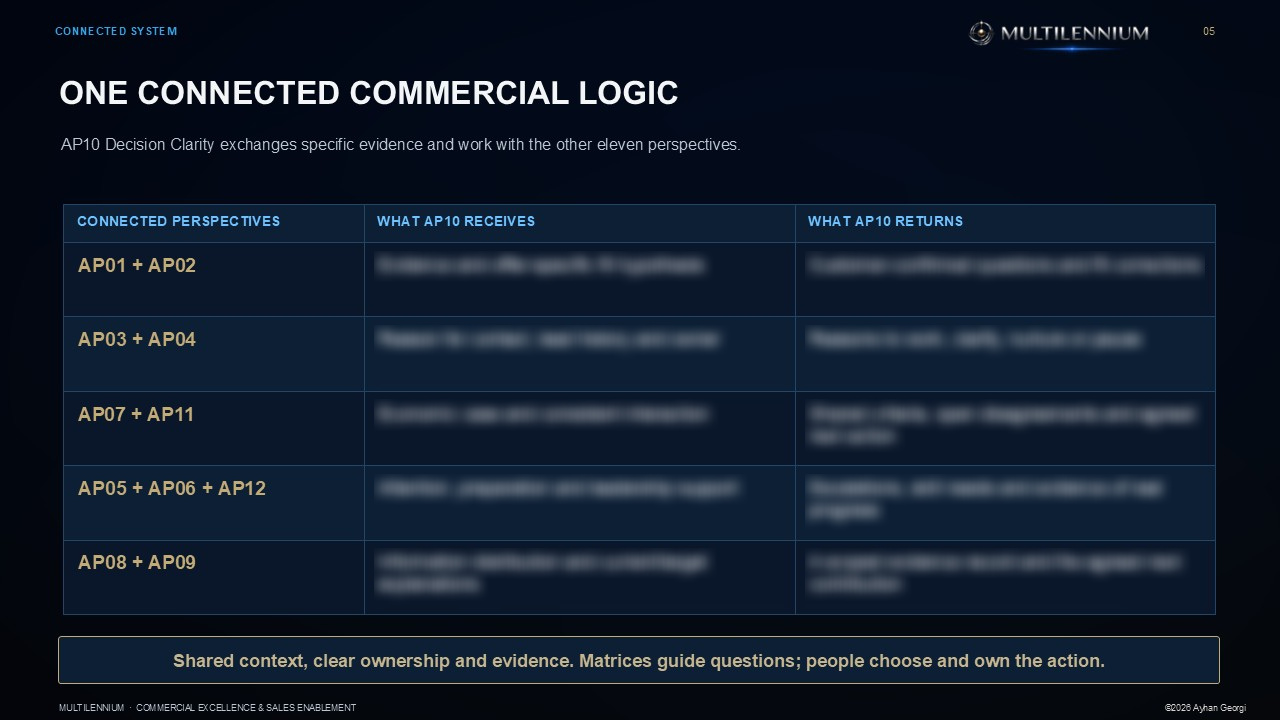
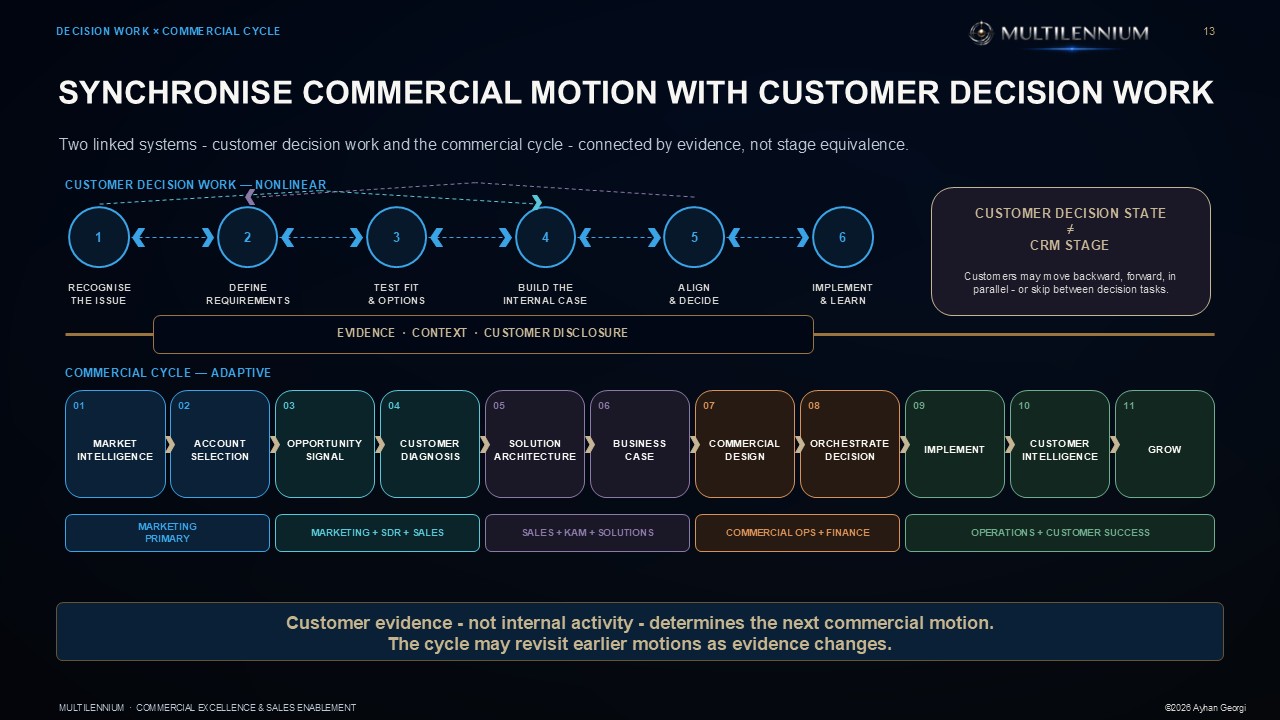
This perspective connects the evidence in AP01 with the business case in AP11 and the experience in AP07. AP03 and AP04 keep useful support and clear ownership in place after the first handoff. Customer questions may overlap, change or reopen; the response follows that reality rather than treating a CRM label as proof of progress.
The two clarity perspectives add a practical check here: AP08 makes the relevant information and confirmed sharing visible; AP09 helps select work from current-state and ideal-state explanations. Decision support resolves the customer’s open questions; receipt alone is not agreement.



FOCUS
Customer-question map; evidence and responsibility gaps; agreed next-step definition; role-relevant support plan.
WHEN TO USE
When a live opportunity has activity and interest but no clear agreement about what must happen next.
CONNECTIONS
AP01 Commercial Intelligence, AP03 Signals, AP04 Lead Management, AP07 Customer Engagement, AP08 Customer Clarity Matrix, AP09 Sales Reality Matrix, AP11 Value Justification.
APPLIED PERSPECTIVE 11
Value Justification
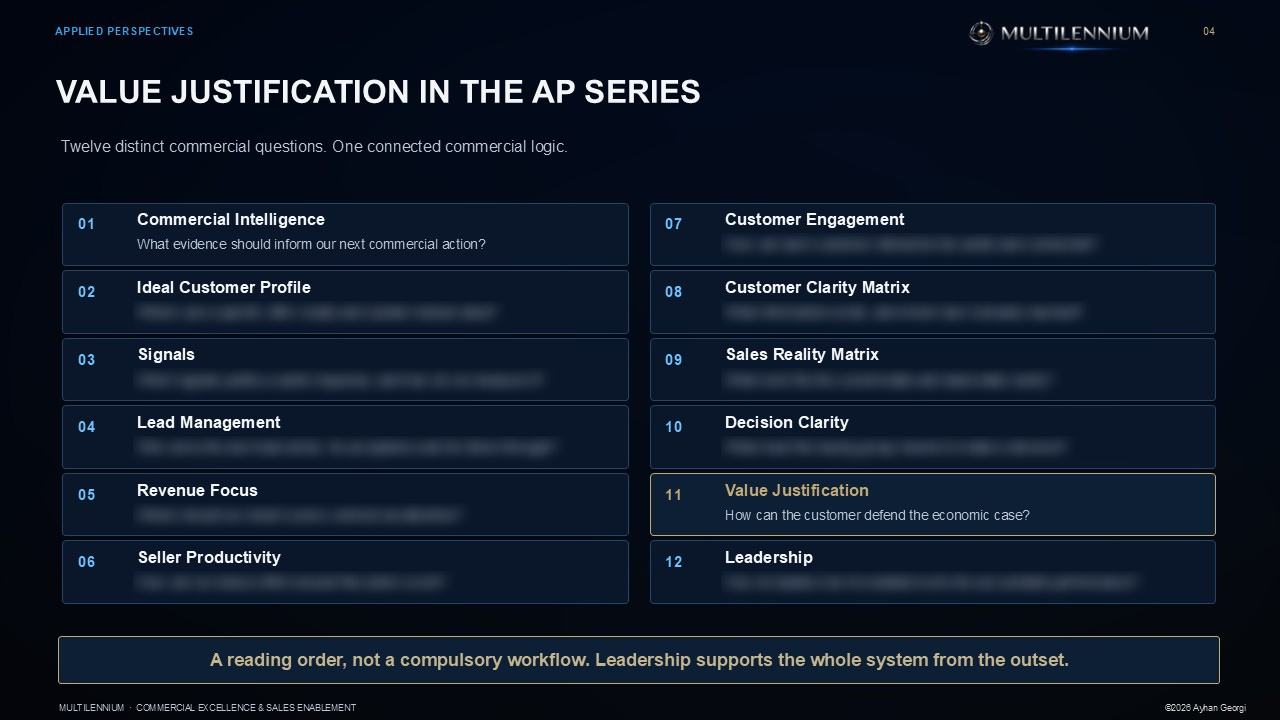
How can the customer defend the economic case?
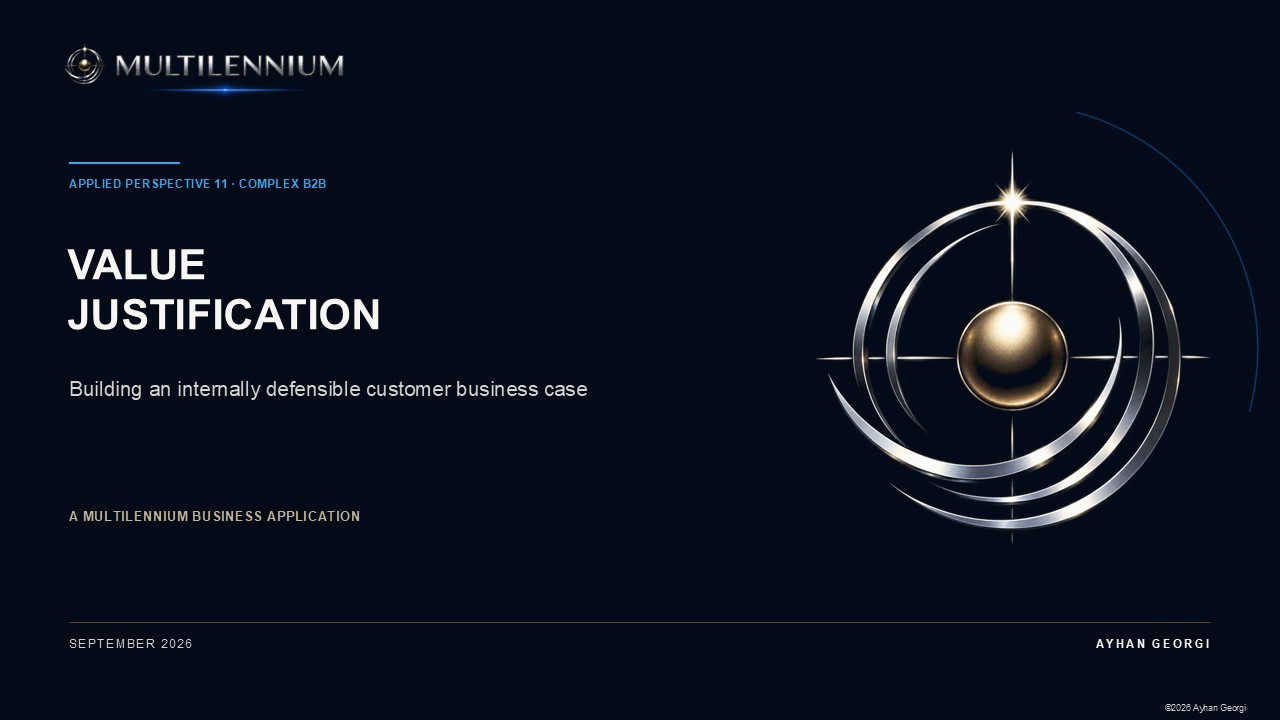
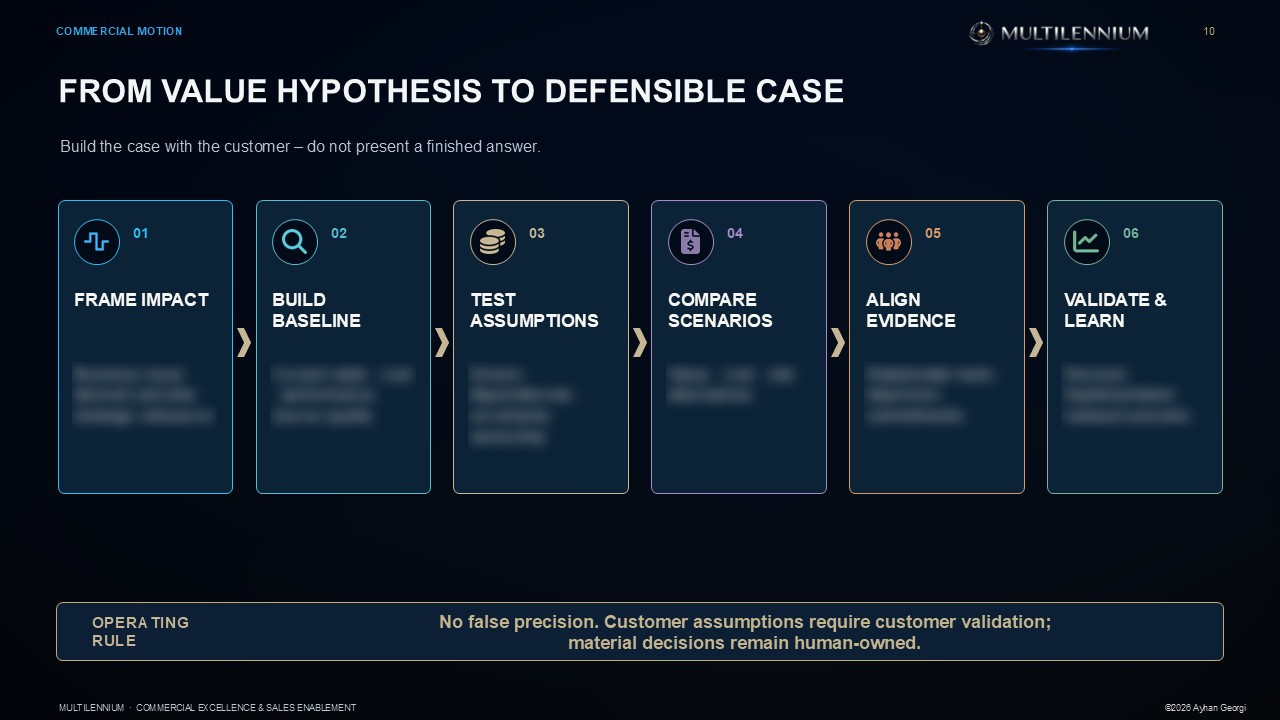
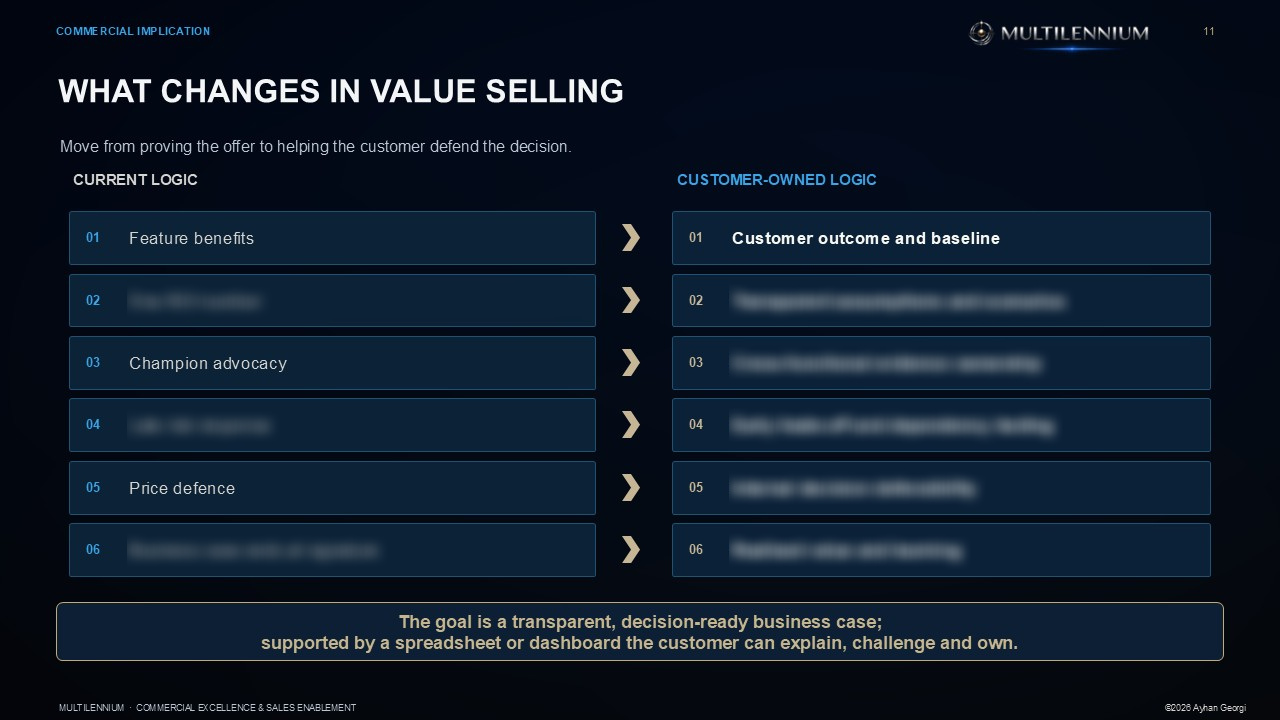
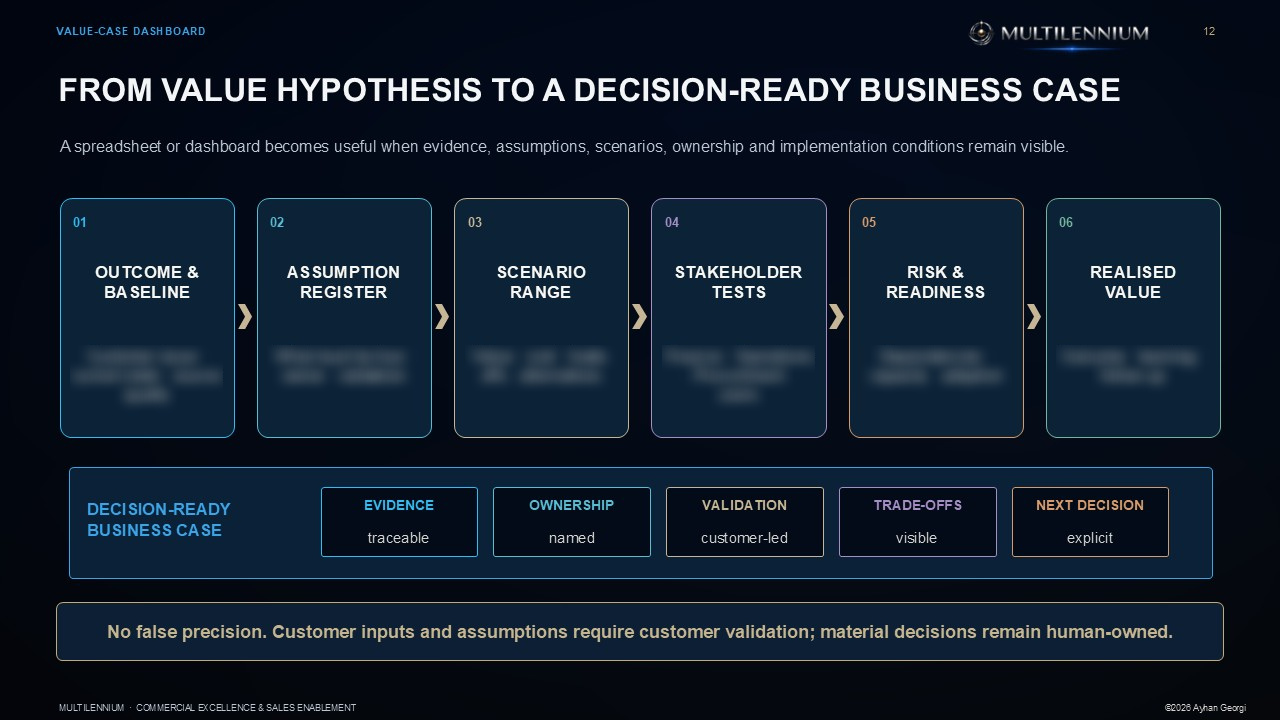
Build a business case the customer can examine and defend, with a credible baseline, explicit assumptions and a fair comparison of alternatives.
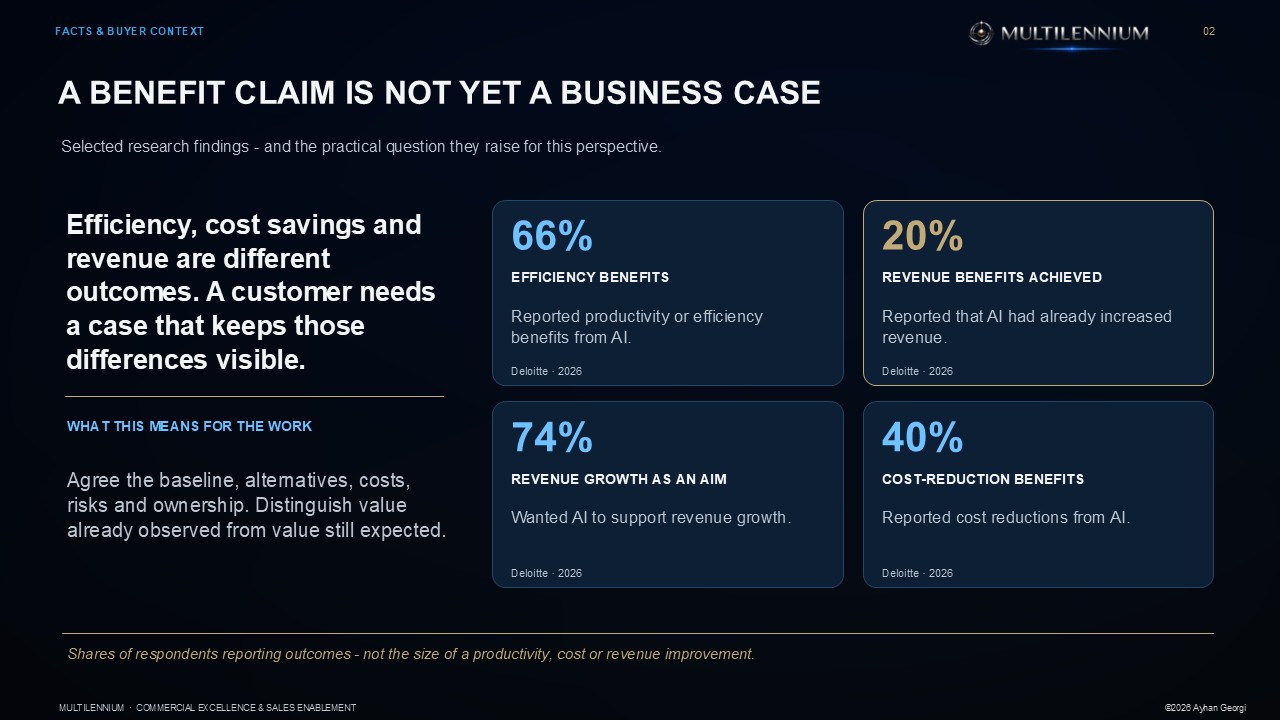
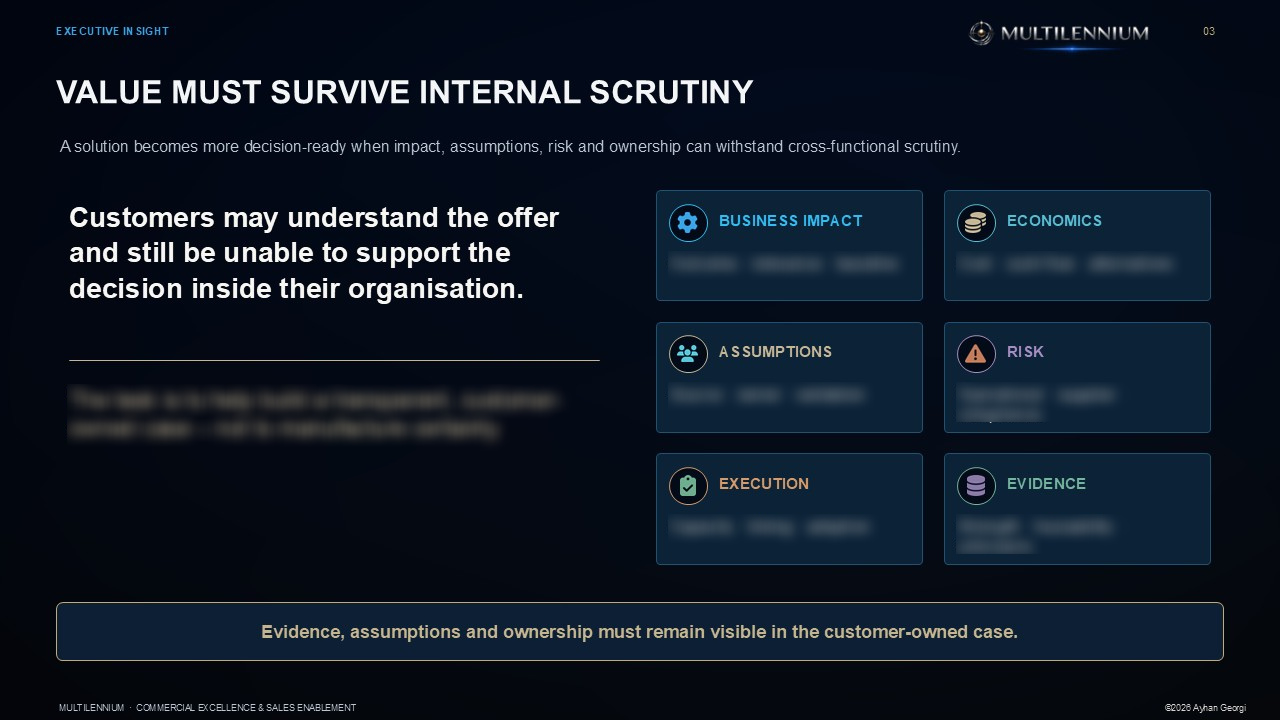
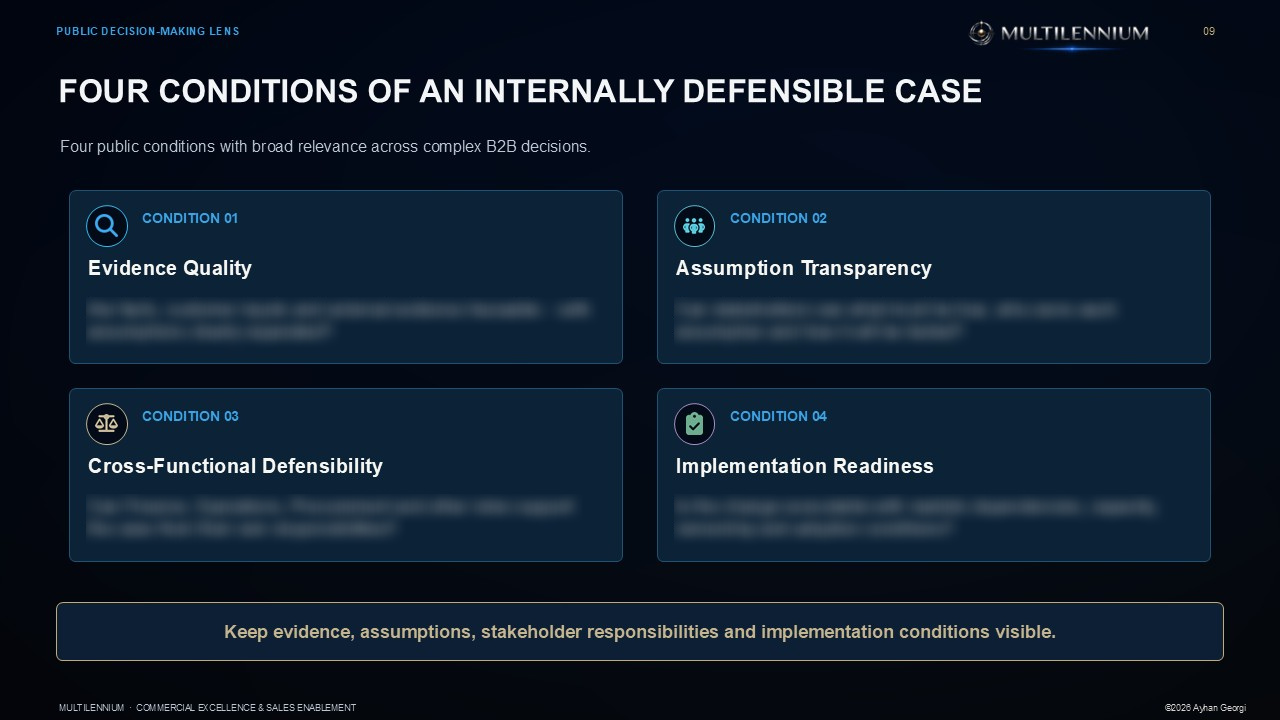
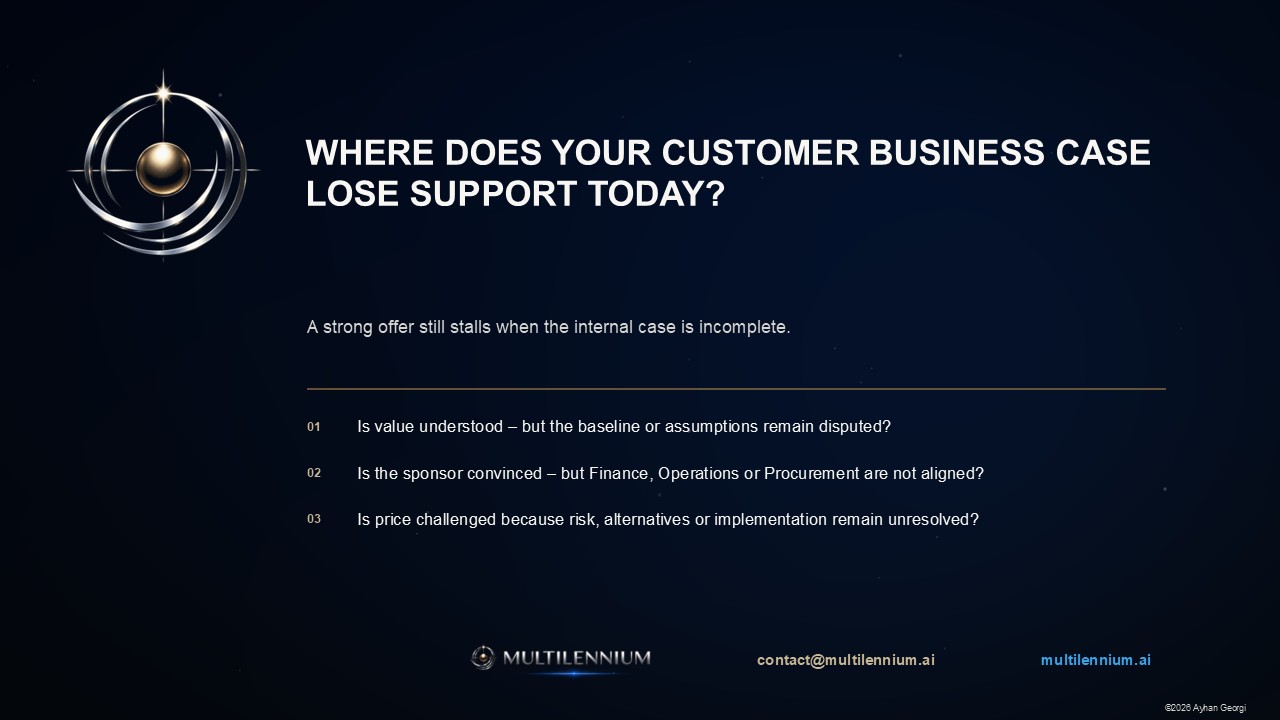
A compelling value statement is not yet an internally defensible business case. The customer needs to understand where the number comes from, what must be true and what implementation will require.
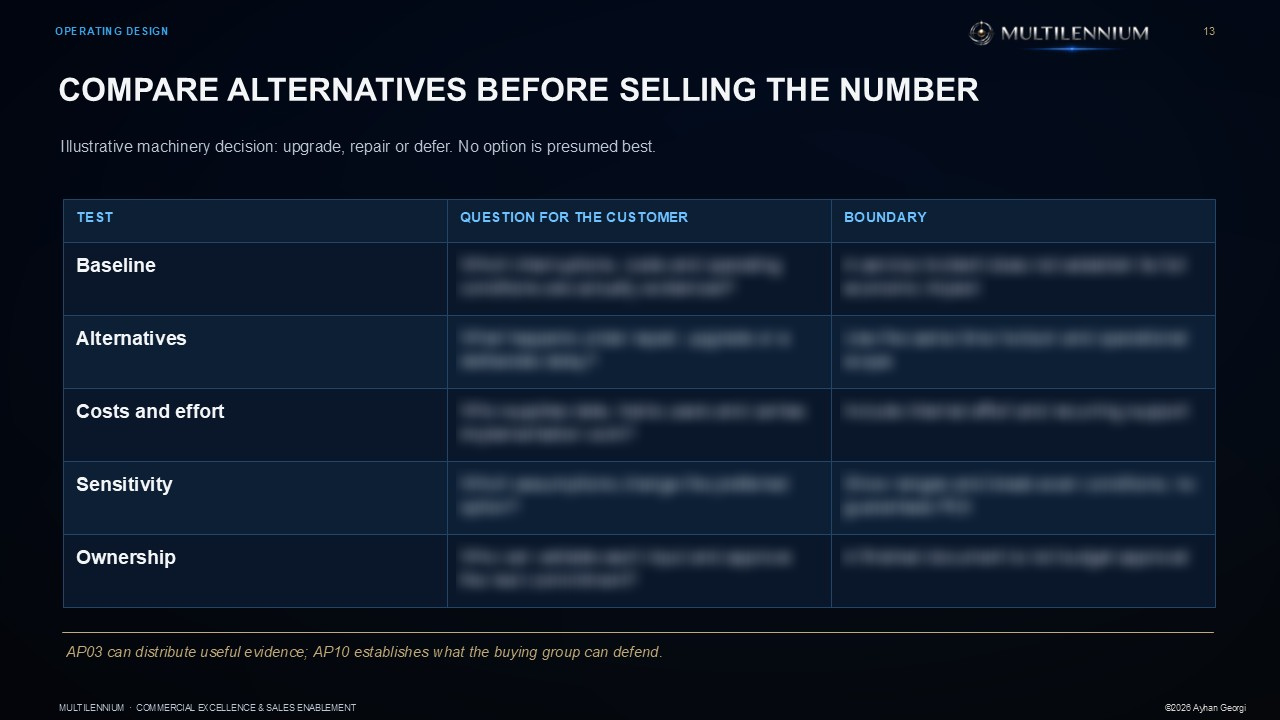
Value Justification connects the expected outcome to a customer-owned baseline, alternative courses of action, costs, risks and responsibilities. It preserves the distinction between an assumption, a validated input, an agreed commitment and value that has actually been realised.
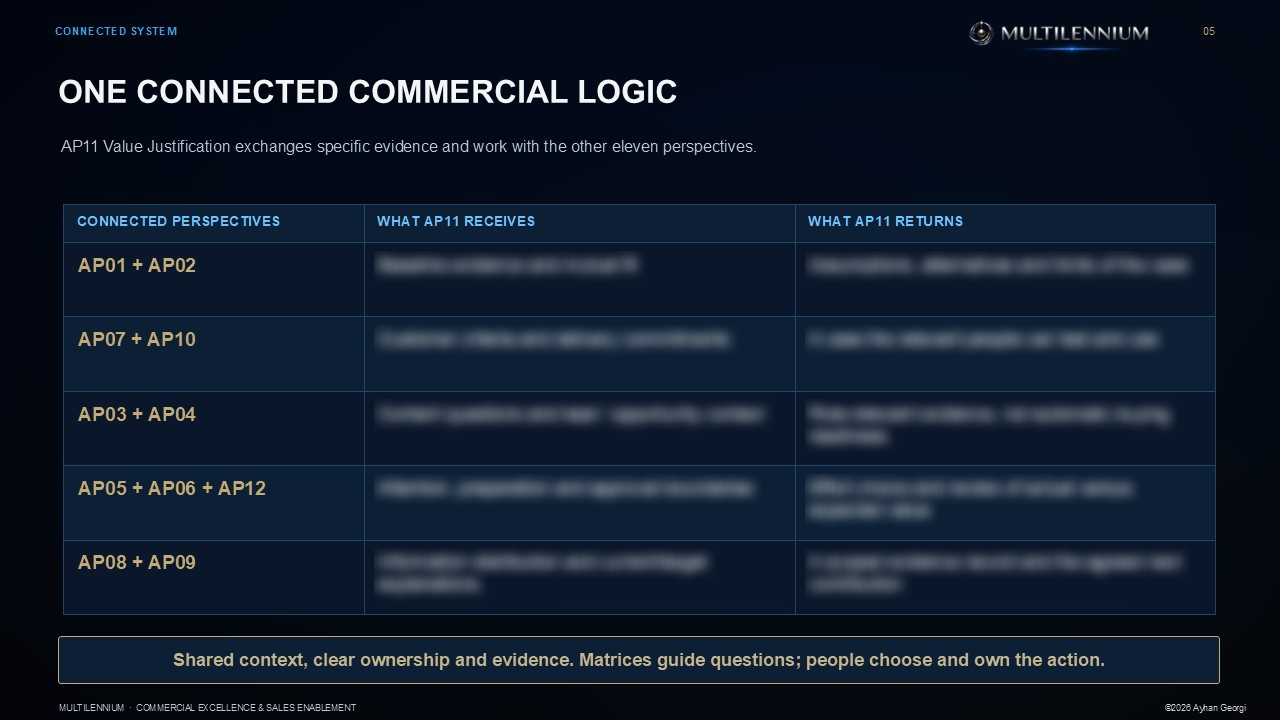
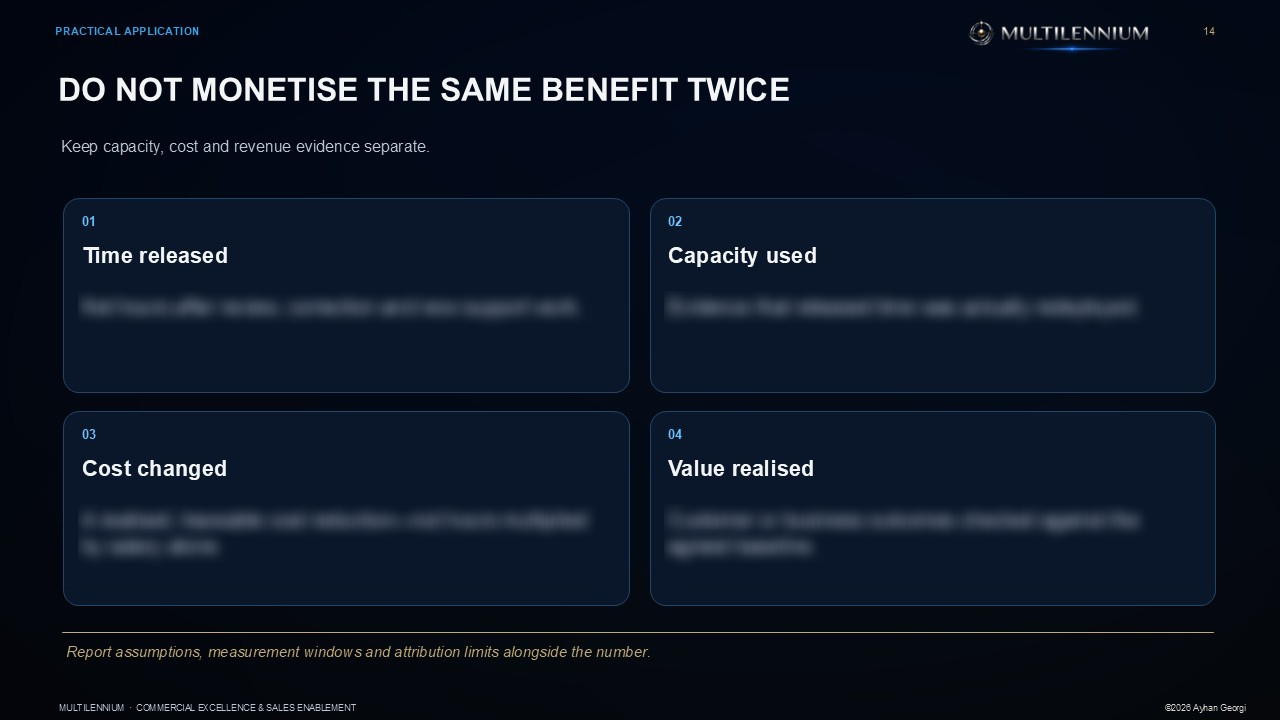
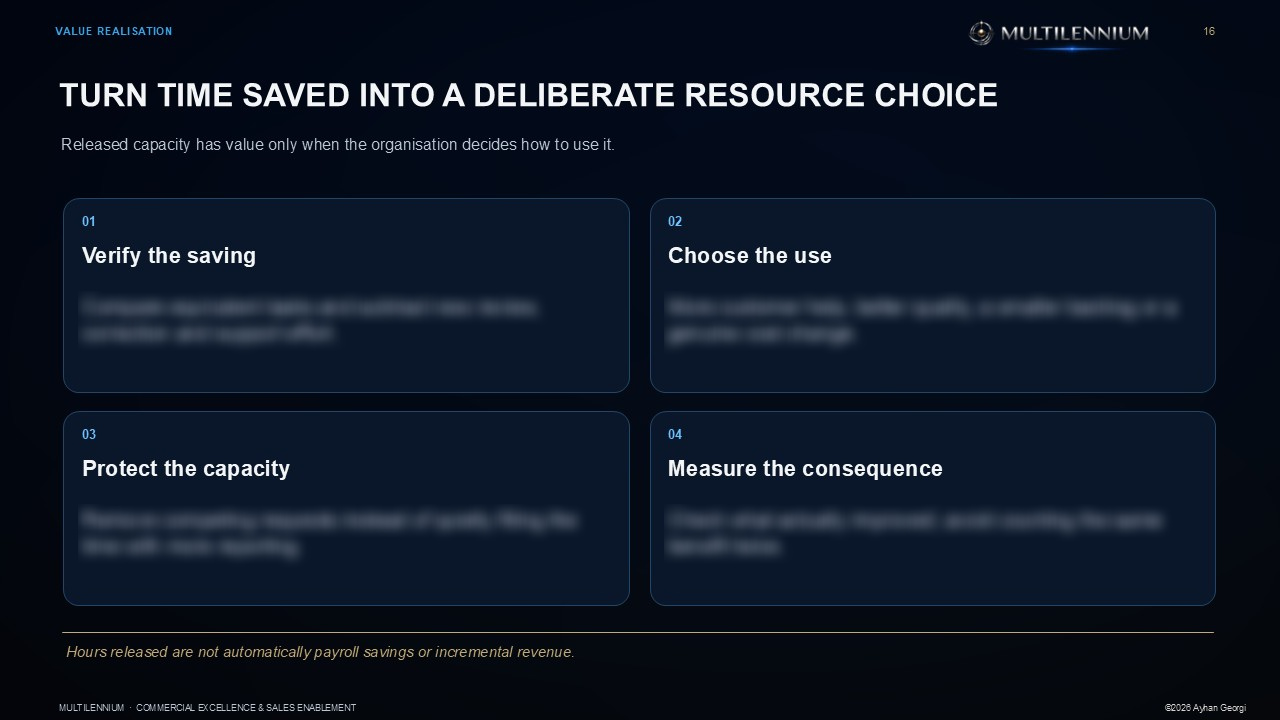
The updated perspective also addresses a common AI business-case error: treating time released as both a cash saving and revenue without showing what changed. AP03 can supply role-relevant evidence during the sales process; AP04 keeps the request and next owner connected. AP12 owns the internal resource decisions that turn a plausible benefit into something the organisation can test.
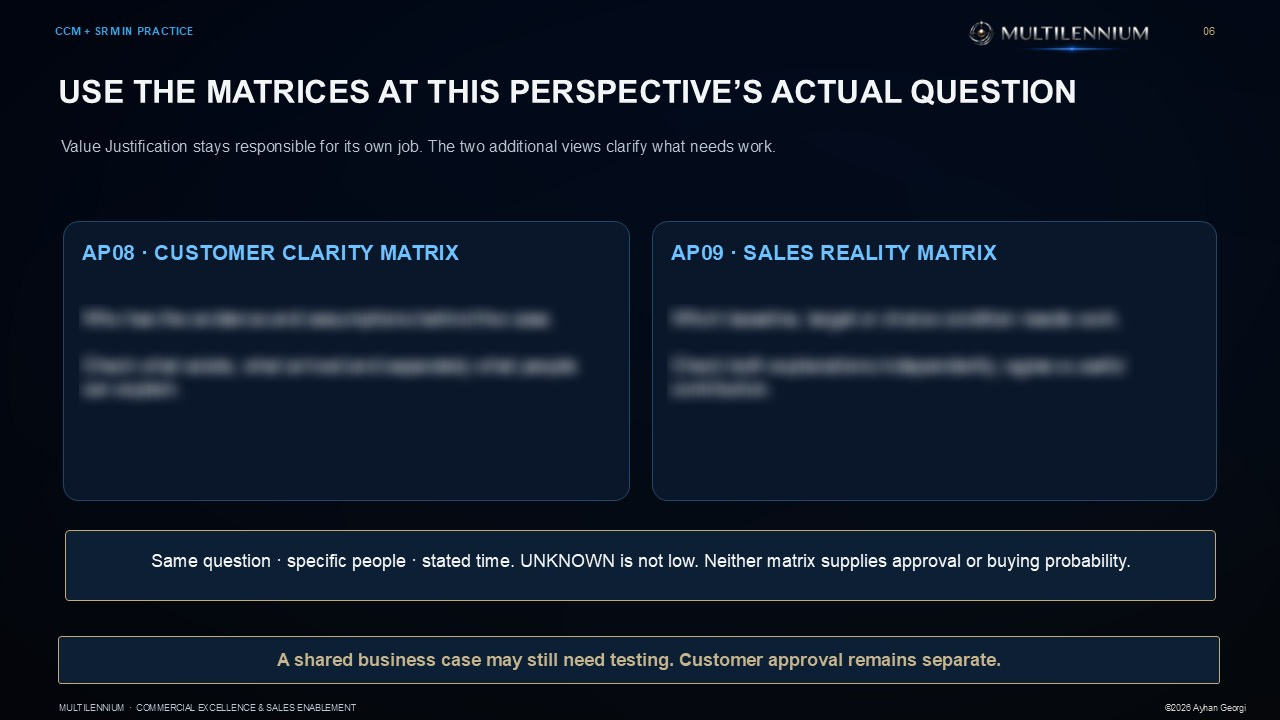
The two clarity perspectives add a practical check here: AP08 makes the relevant information and confirmed sharing visible; AP09 helps select work from current-state and ideal-state explanations. A shared business case may still need testing. Customer approval remains separate.


FOCUS
Baseline and assumption register; alternative comparison; stakeholder evidence checks; value-realisation measures.
WHEN TO USE
When the offer is understood but the economics, implementation conditions or internal case remain disputed.
CONNECTIONS
AP03 Signals, AP04 Lead Management, AP08 Customer Clarity Matrix, AP09 Sales Reality Matrix, AP10 Decision Clarity, AP12 Leadership.
APPLIED PERSPECTIVE 12
Leadership
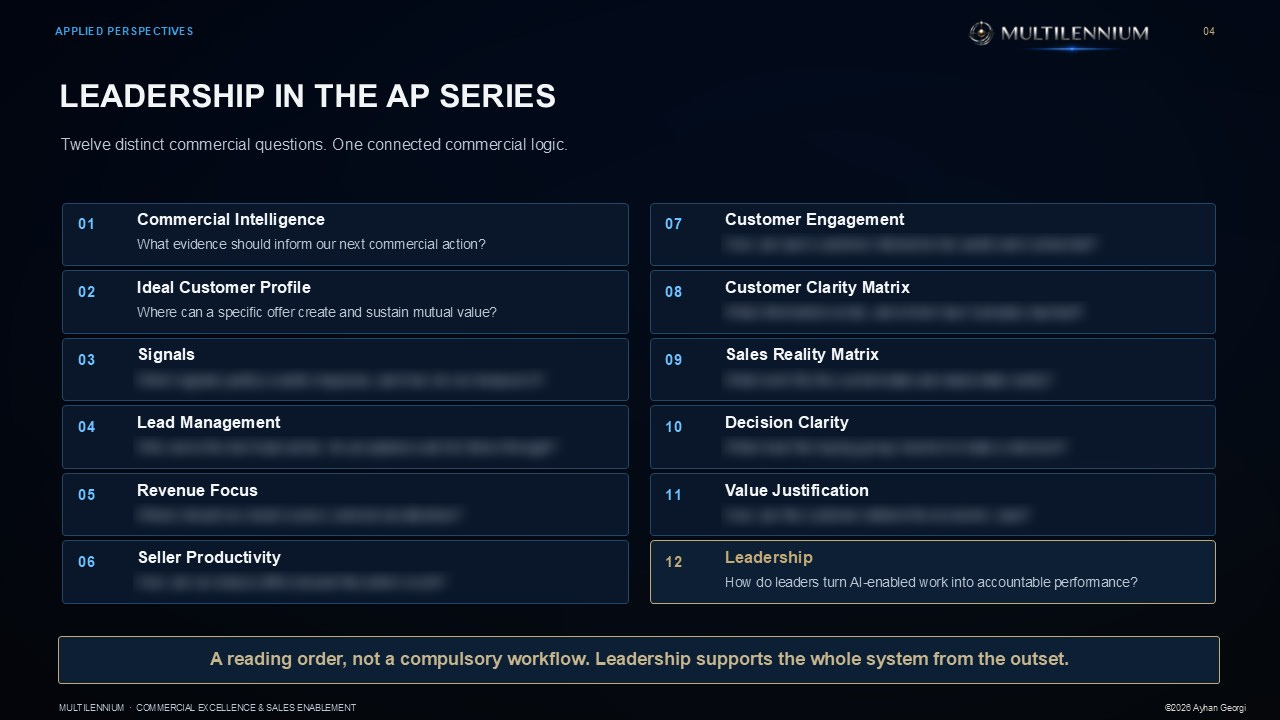
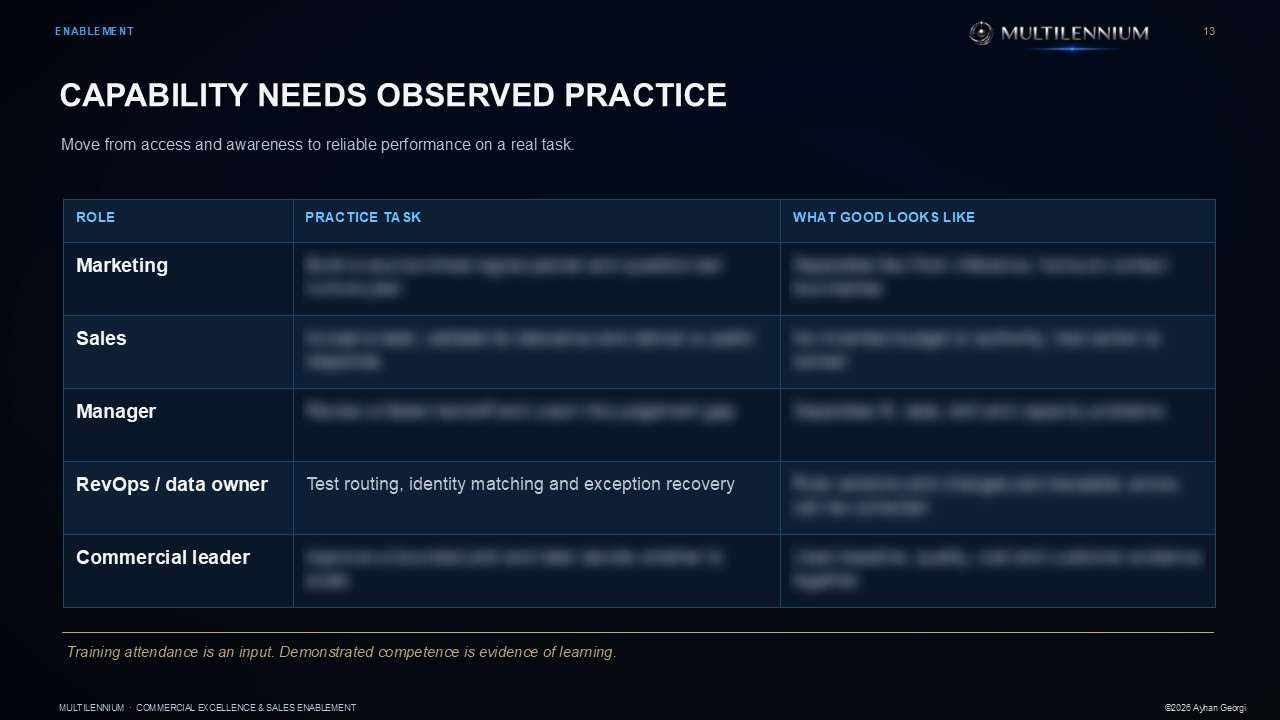
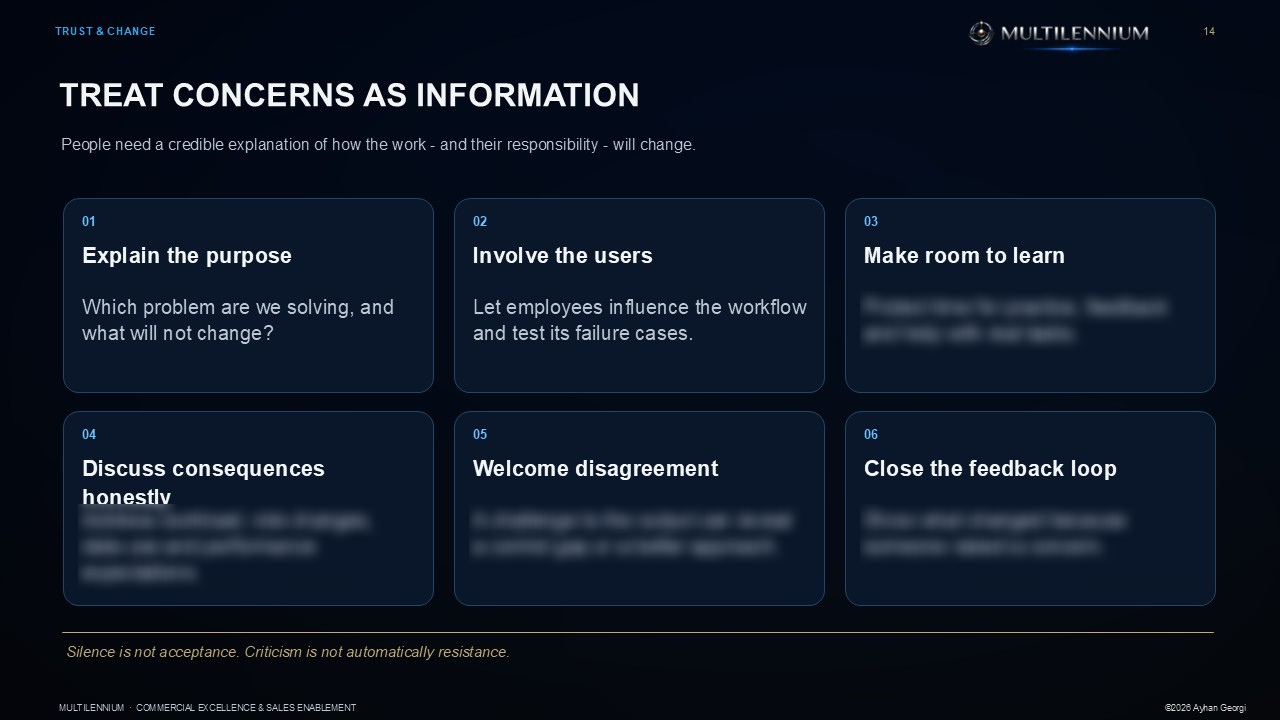
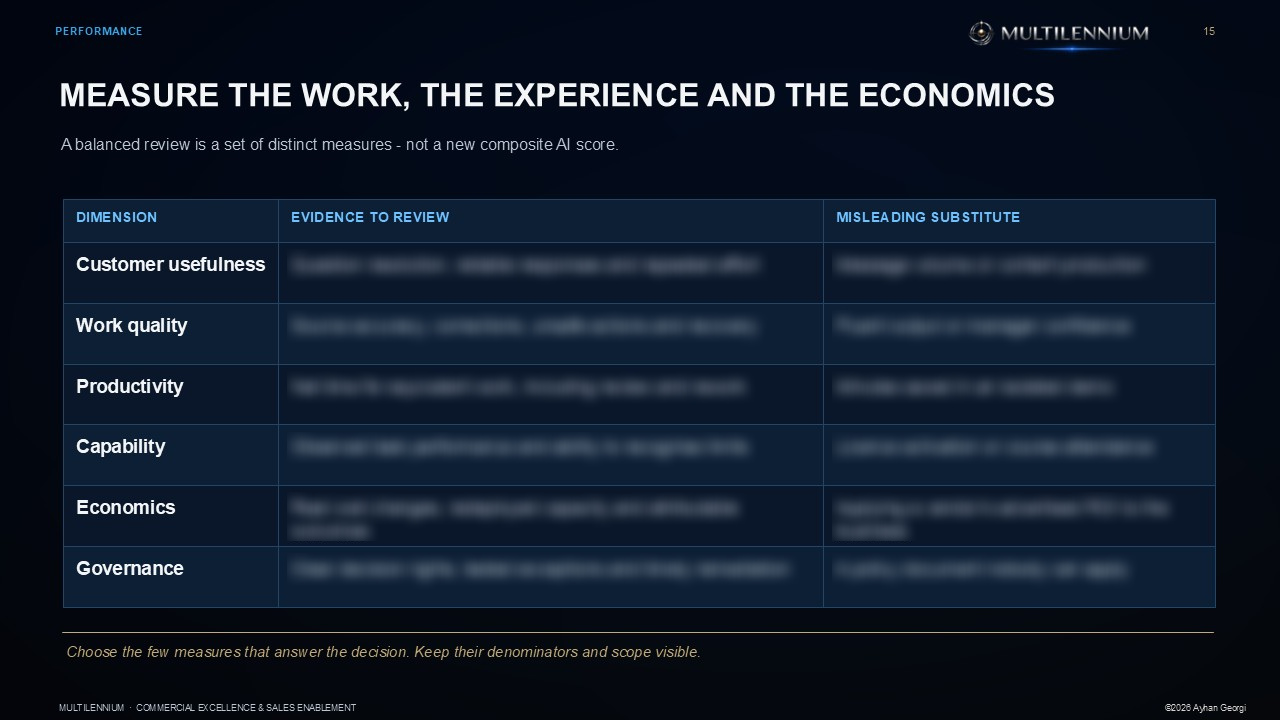
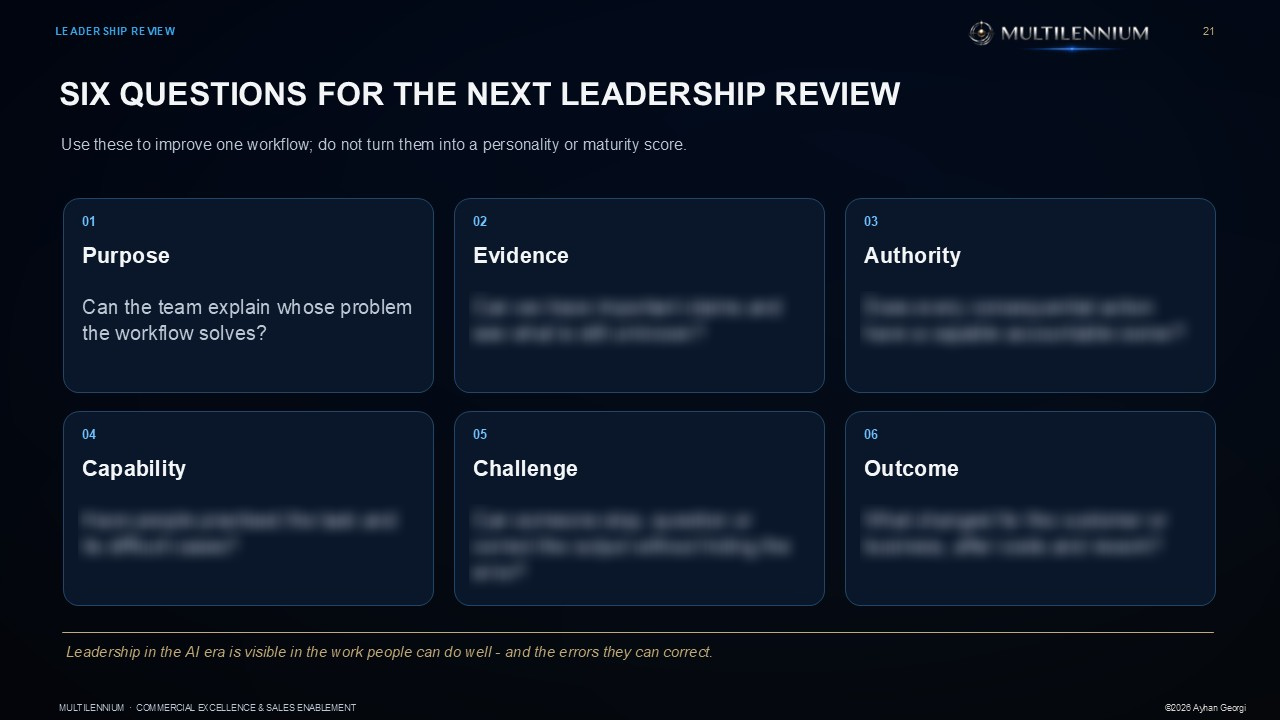
How do leaders turn AI-enabled work into accountable performance?
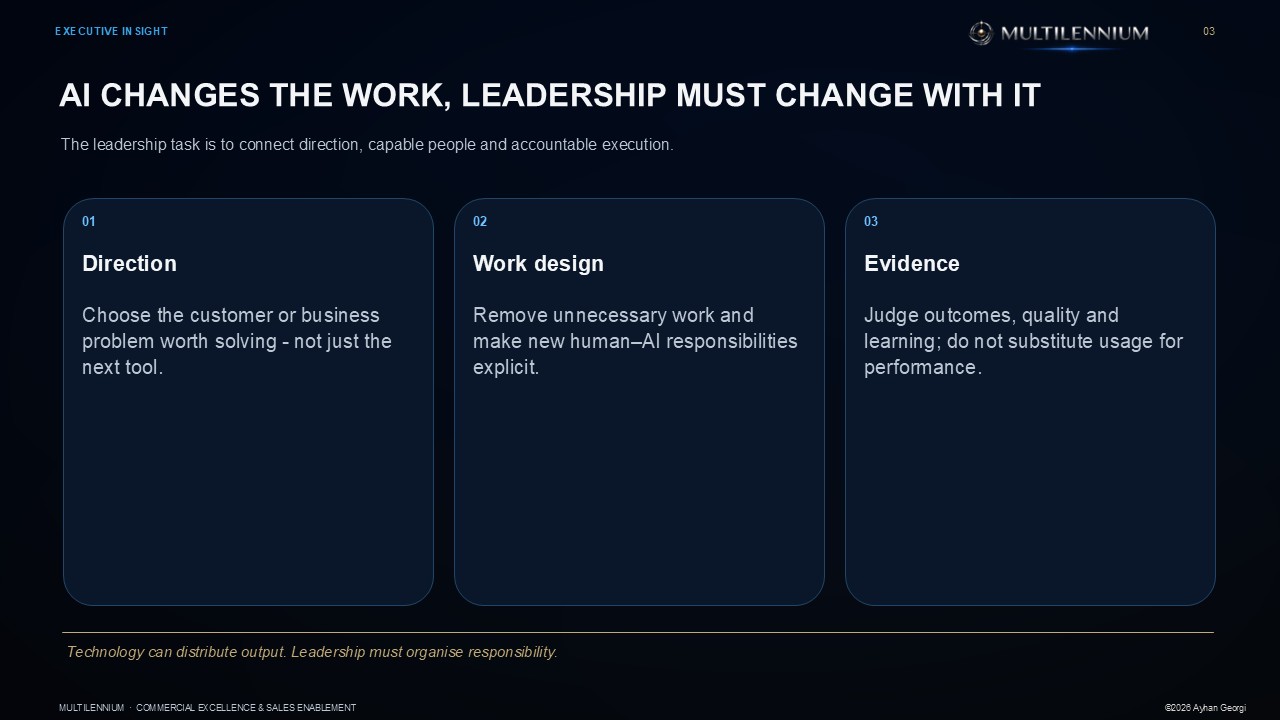
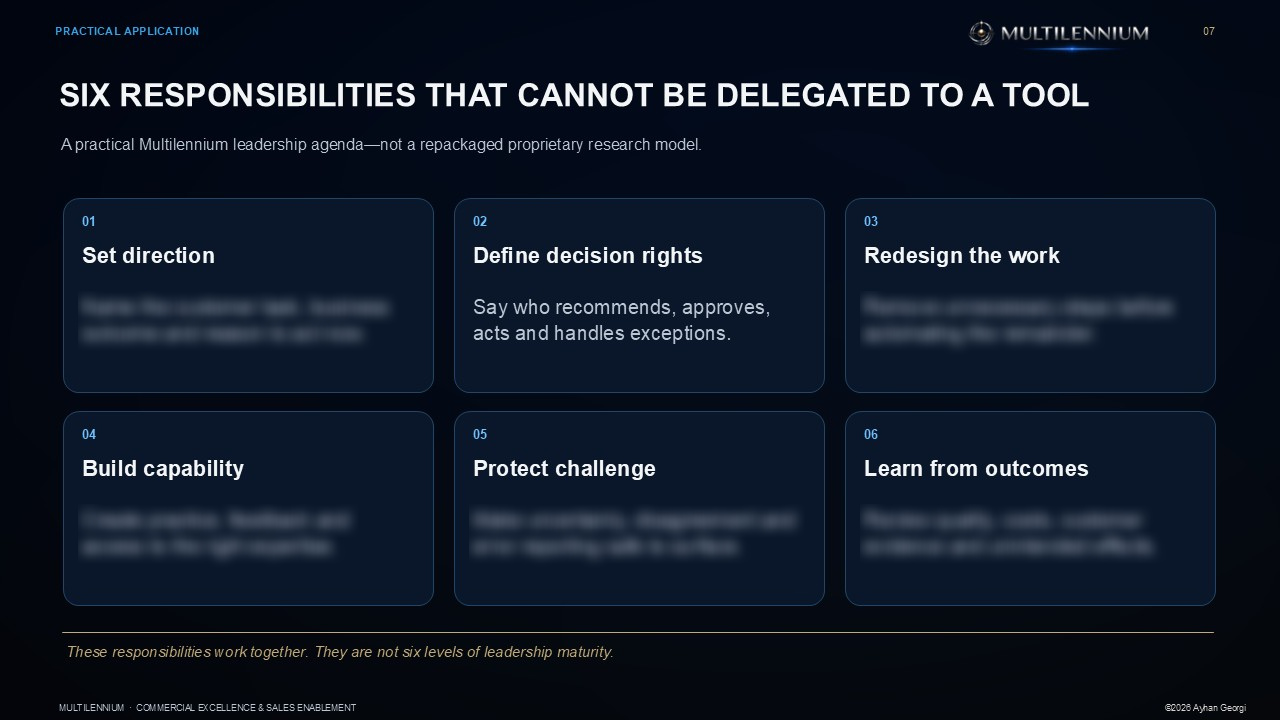
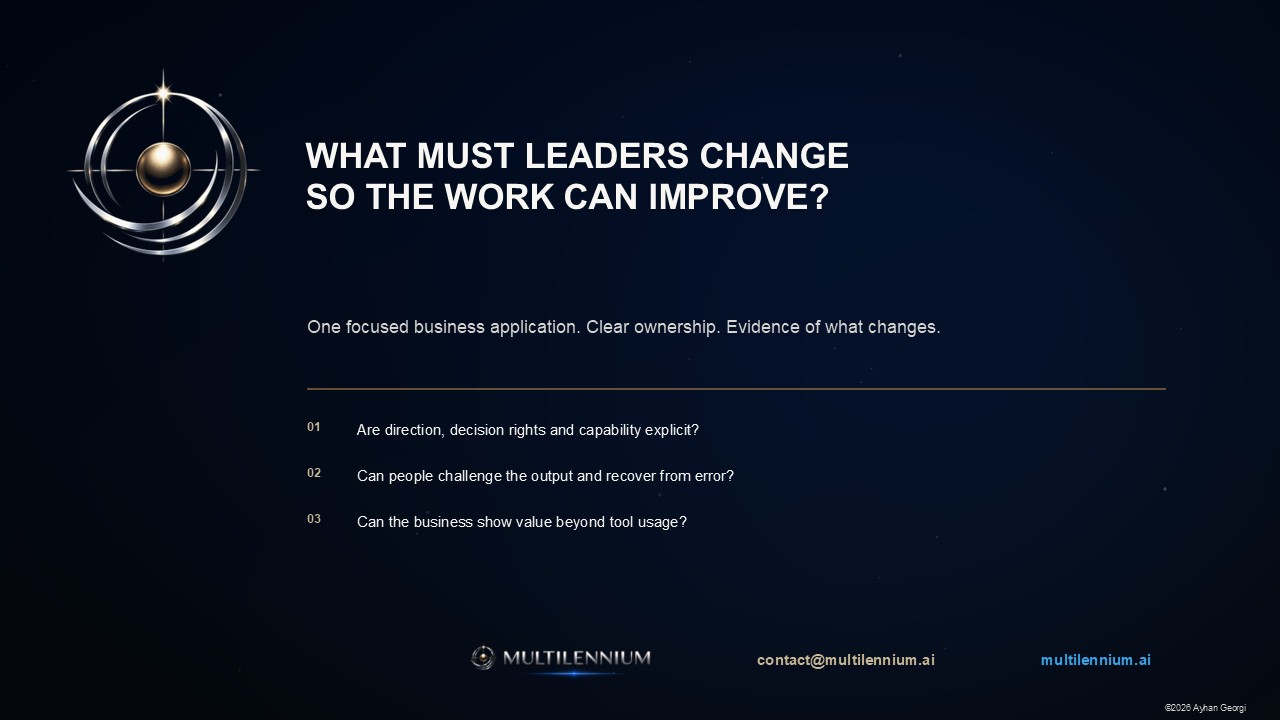
Lead AI-enabled commercial work with clear direction, explicit decision rights, capable people and evidence of what actually improves.
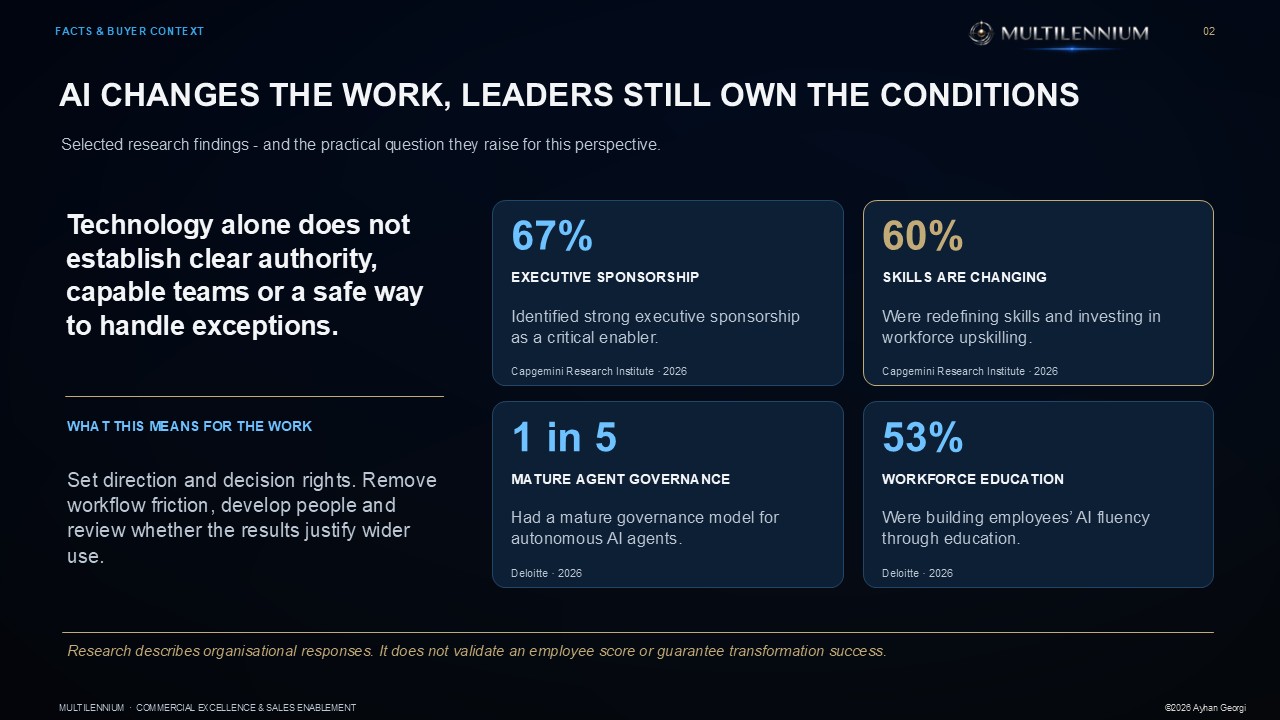
The leadership question is not how many people have access to AI. It is whether the organisation has changed the work, developed the capability and made responsibility clear.
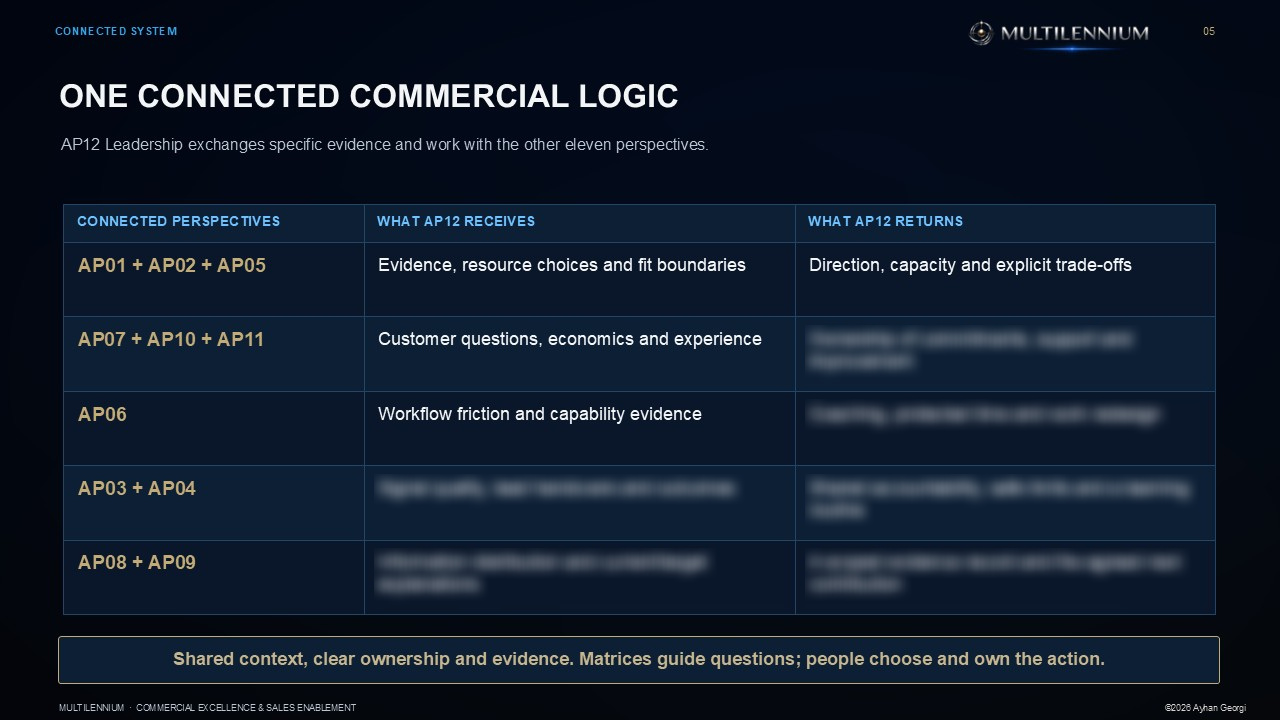
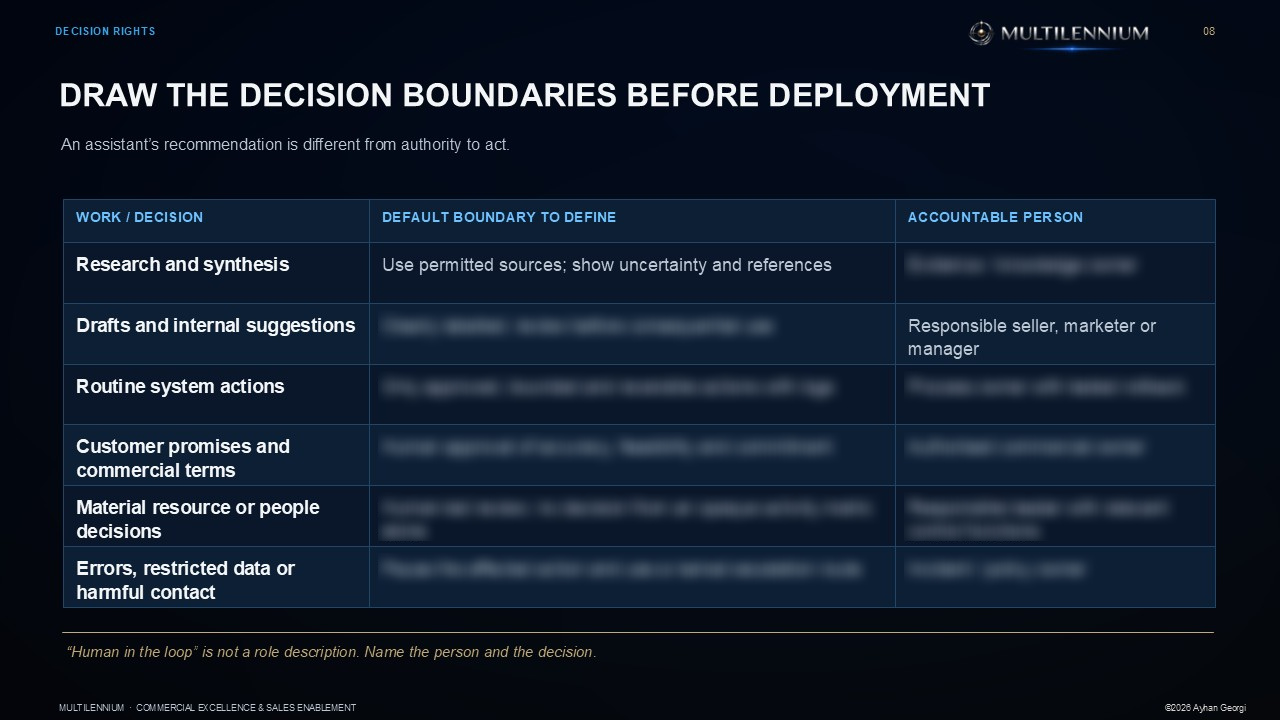
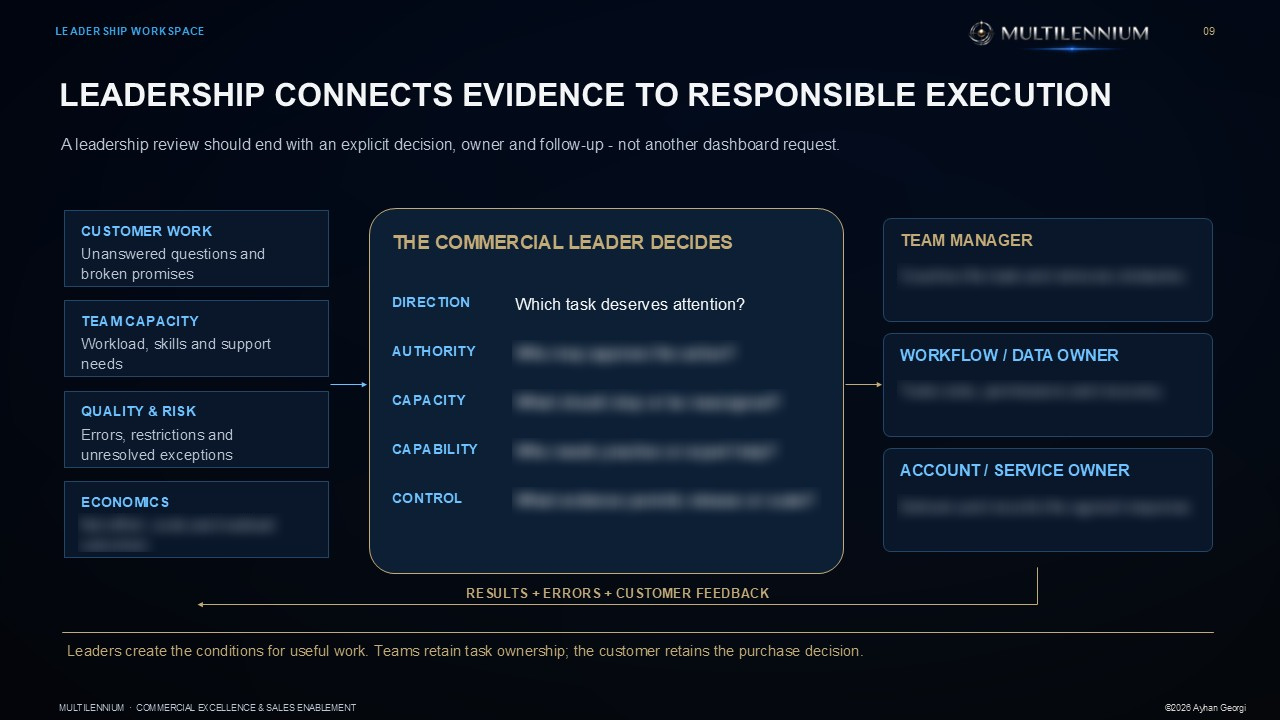
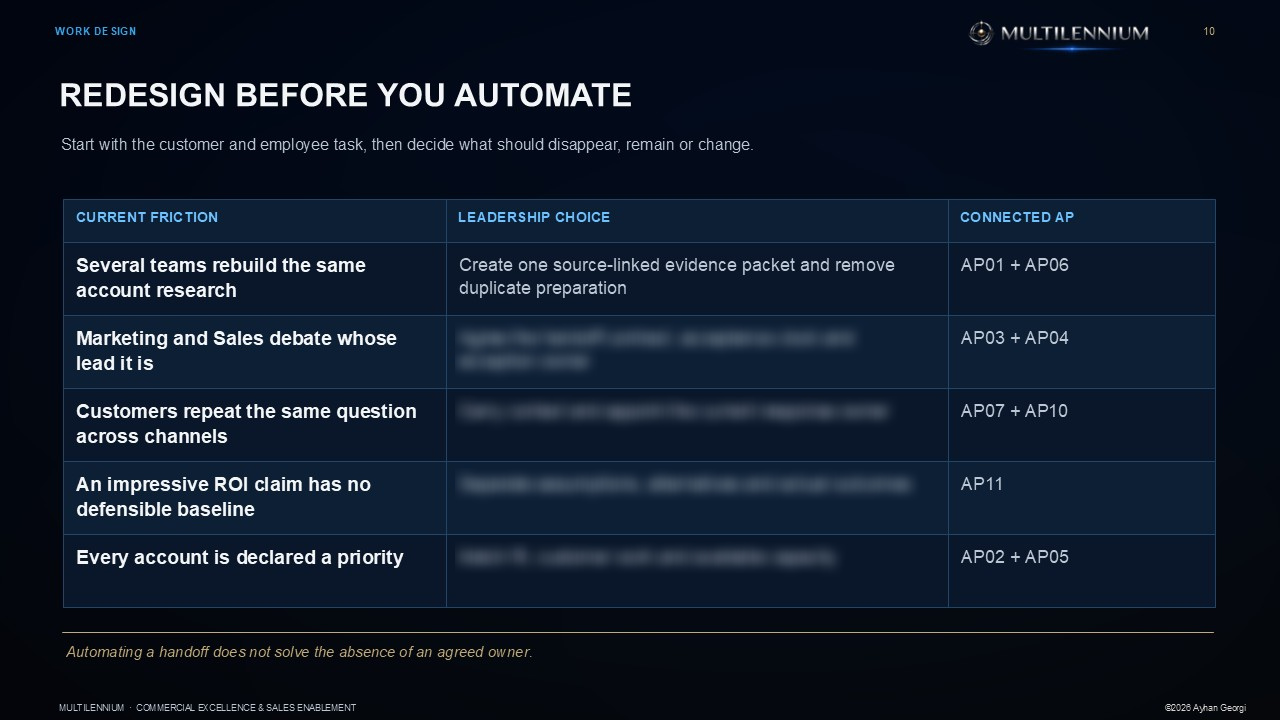
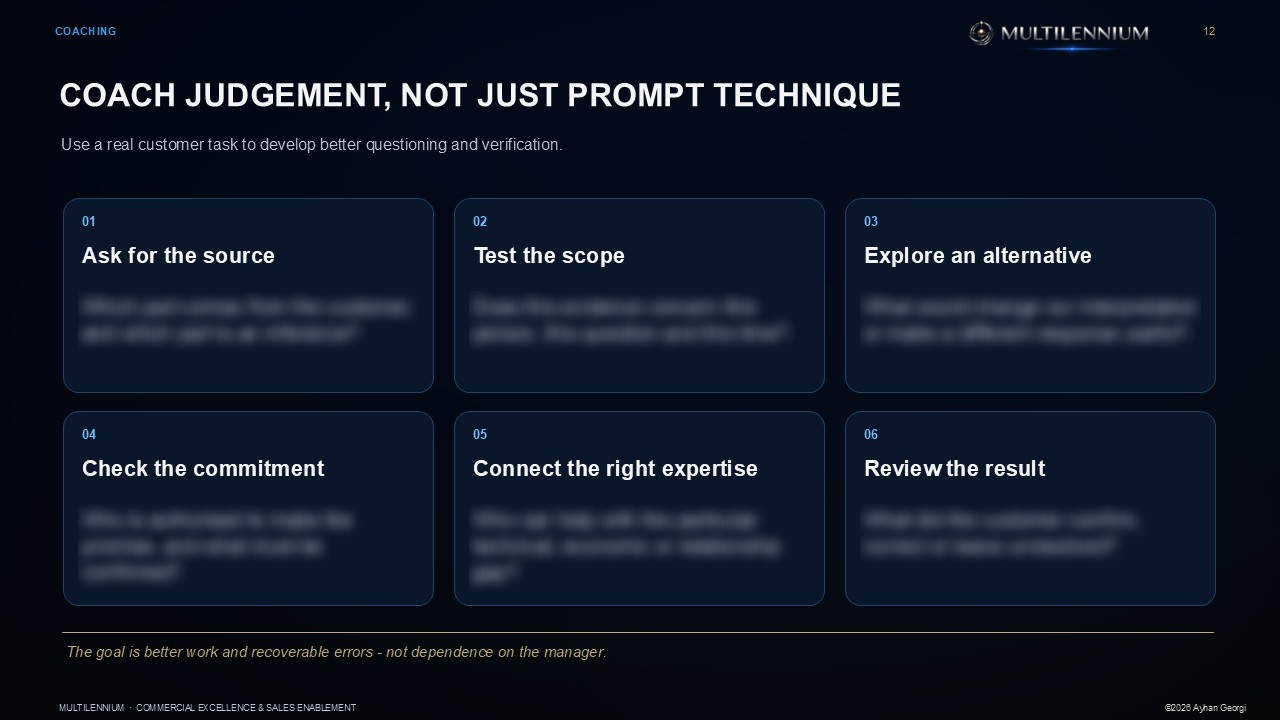
Leadership in the age of AI and digitalisation connects direction, decision rights, workflow design, practice, constructive challenge and outcome learning. Leaders decide which customer problem matters, which actions require approval and what people need to perform the task well. They also remove unnecessary work rather than adding another reporting layer.
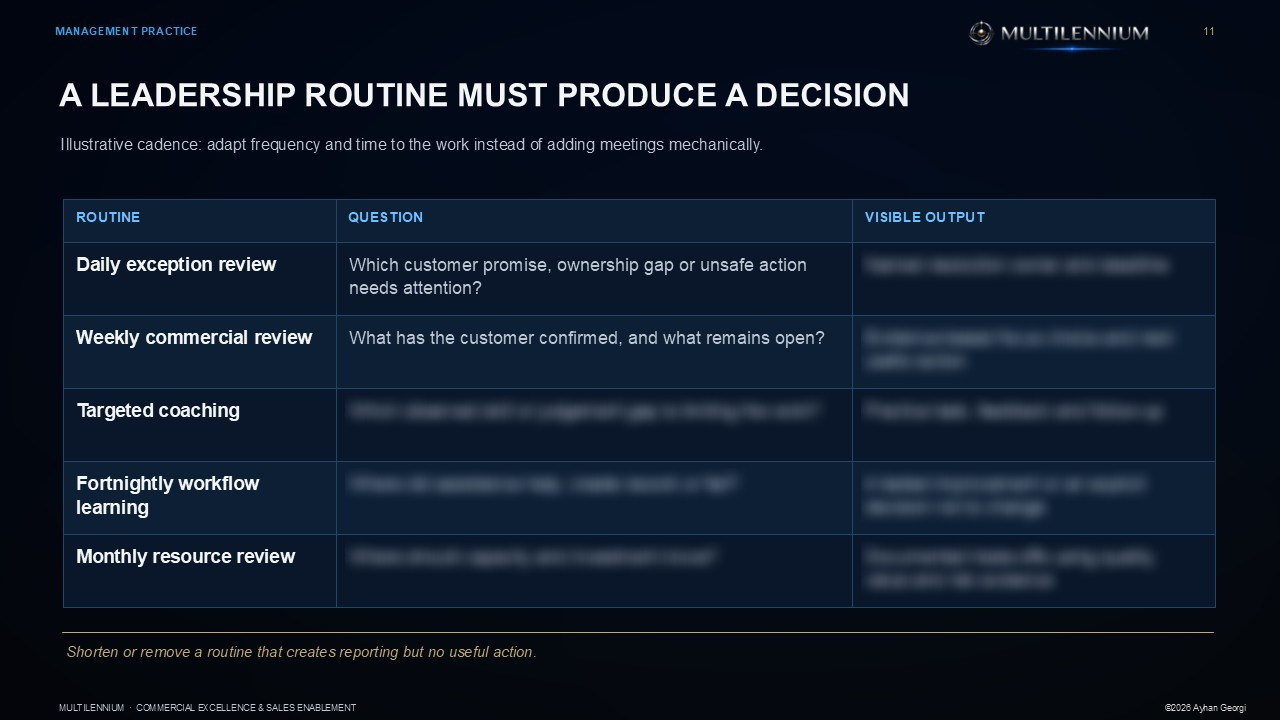
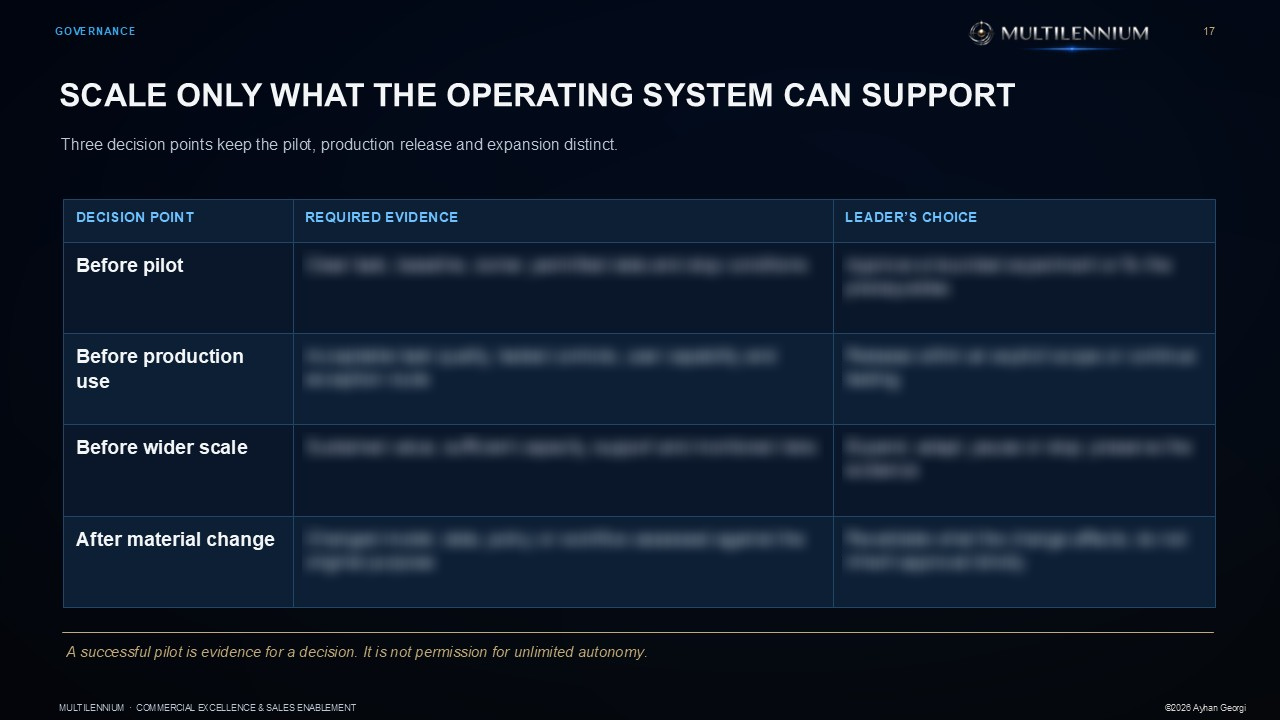
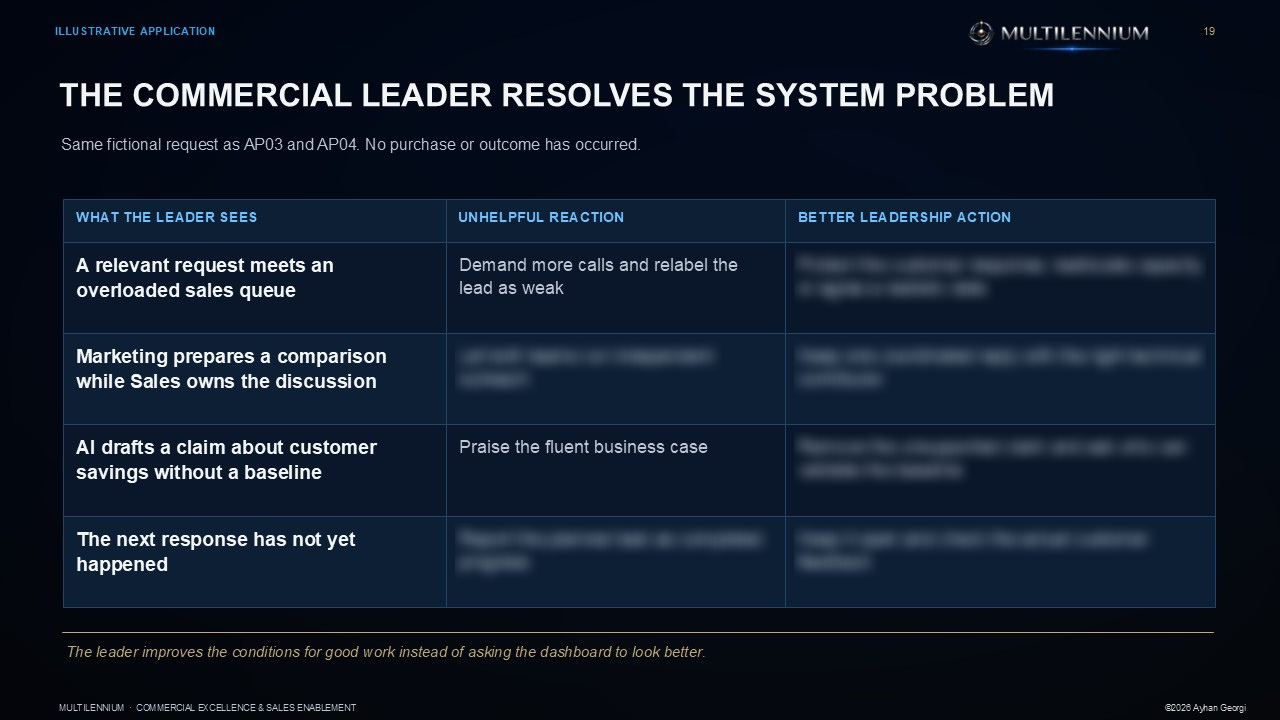
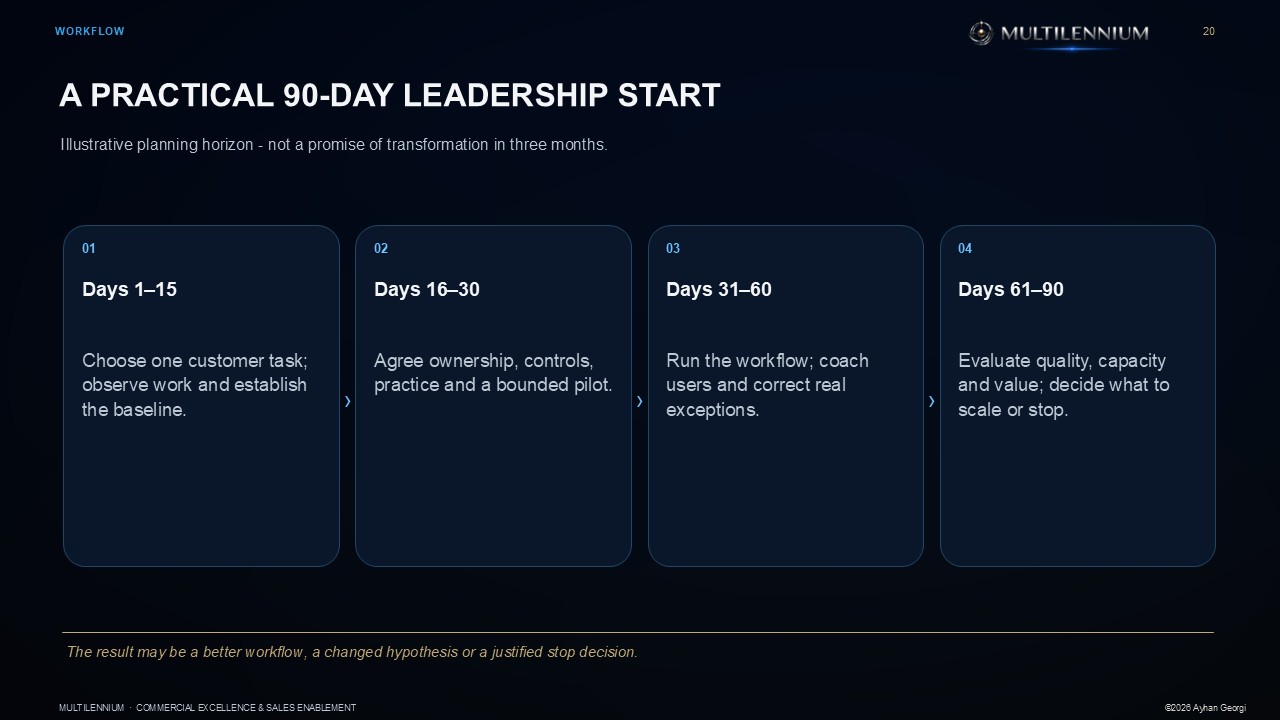
AP12 connects the entire series: evidence and fit inform priorities; customer decision work and economics shape support; Signals and Lead Management expose response and ownership problems; Seller Productivity and Customer Engagement show what happens in daily work. A practical leadership review asks for observed examples, recognises uncertainty and makes a decision about what to improve, scale, pause or stop.
The two clarity perspectives add a practical check here: AP08 makes the relevant information and confirmed sharing visible; AP09 helps select work from current-state and ideal-state explanations. Leaders resource and challenge the work. They do not impose a high/high target on every account. separate.










FOCUS
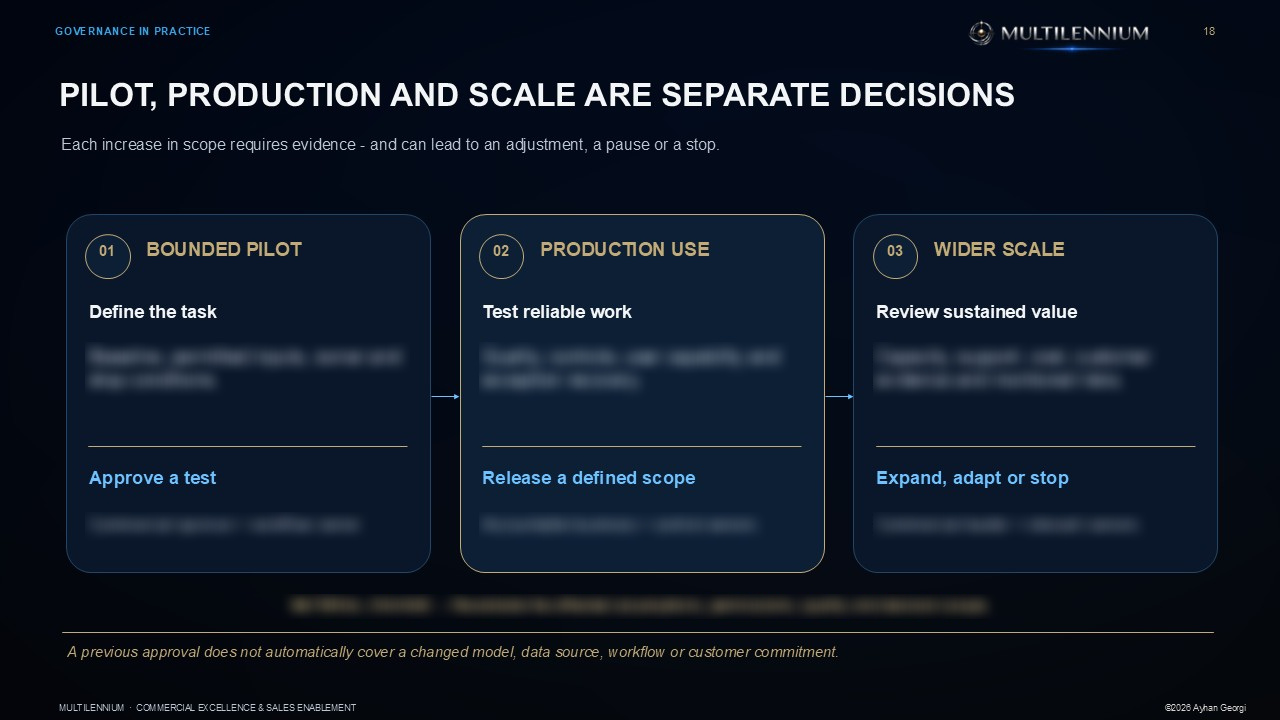
Leadership operating agreement; decision boundaries; coaching and practice plan; pilot-to-scale criteria; outcome review.
WHEN TO USE
When AI adoption is growing but accountability, work design, capability or realised value remain unclear.
CONNECTIONS
AP01 Commercial Intelligence, AP02 Ideal Customer Profile, AP03 Signals, AP04 Lead Management, AP05 Revenue Focus, AP06 Seller Productivity, AP07 Customer Engagement, AP08 Customer Clarity Matrix, AP09 Sales Reality Matrix, AP10 Decision Clarity, AP11 Value Justification.

CONSULTING ✦ ENABLEMENT ✦ COACHING
AI-DRIVEN COMMERCIAL EXCELLENCE
AND
B2B DECISION-MAKING
Multilennium helps complex B2B sales organisations improve how customers reach internally defensible decisions -using their existing CRM, data and approved AI tools, while keeping judgement and accountability human.
Consulting, enablement and coaching for decision clarity, sales leadership, value justification, opportunity quality and seller productivity.
How We Work

Your existing CRM, data sources, approved AI tools and sales processes provide the starting point for every consulting, training and coaching engagement. The work is tailored to your commercial priorities, the needs of your teams and your organisation’s requirements for data use and approval. A new platform or system replacement is not assumed.
Where technical changes are needed, I help clarify the commercial requirements and work with your IT team or existing implementation partners. My contribution is use-case definition, workflow design, training, coaching and adoption support. Technical implementation and system operation remain with your designated technical teams or providers.
Responsible AI use, evidence verification, governance and adoption are integrated across every programme.
Where relevant, programmes are enriched by selected perspectives from Multilennium Physics™ on how complex B2B decisions actually develop.
Available as executive workshops, modular training programmes, sales academies, team enablement, coaching and train-the-trainer formats. Programmes are delivered in English and German. Business conversations can also be conducted in Turkish and Italian.
START A CONVERSATION
ABOUT

Understanding decisions. Improving commercial performance.
A strong offer can still end in “no decision.” Understanding why, and helping organisations move forward, is at the heart of my work.
For more than twenty years, I have worked in Sales Excellence, Sales Enablement, Commercial Transformation and Leadership Coaching, as a salesperson, consultant, trainer, coach and corporate leader. At a global enterprise, I designed and led a Sales Excellence function spanning 25+ locations, multiple business units and a complex matrix. Across all these roles, one question has stayed with me: why do people decide and act the way they do?
For the past two years, I have pursued that question systematically: researching, analysing real sales situations, challenging familiar assumptions and drawing on thousands of conversations with practitioners. Recurring patterns emerged in how people interpret information, weigh consequences and justify action. That work has become MULTILENNIUM PHYSICS™.
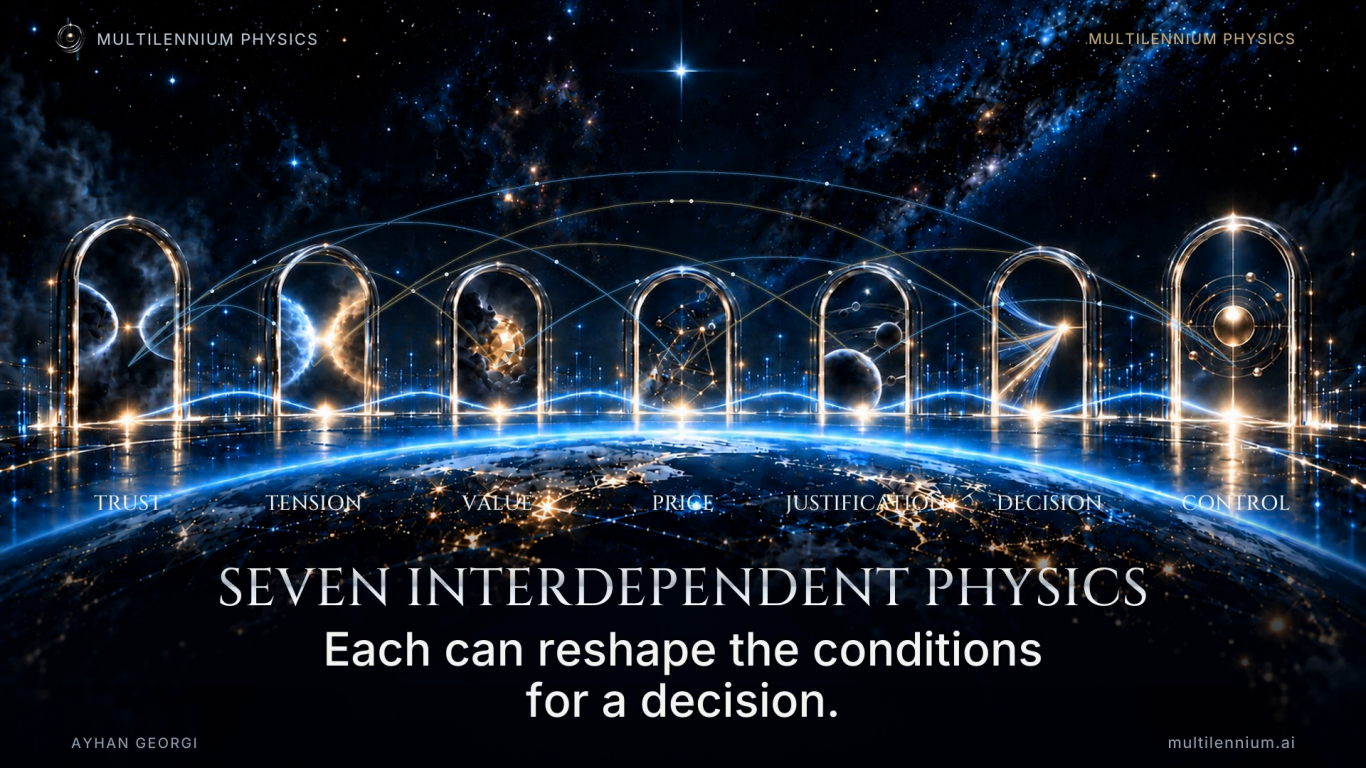
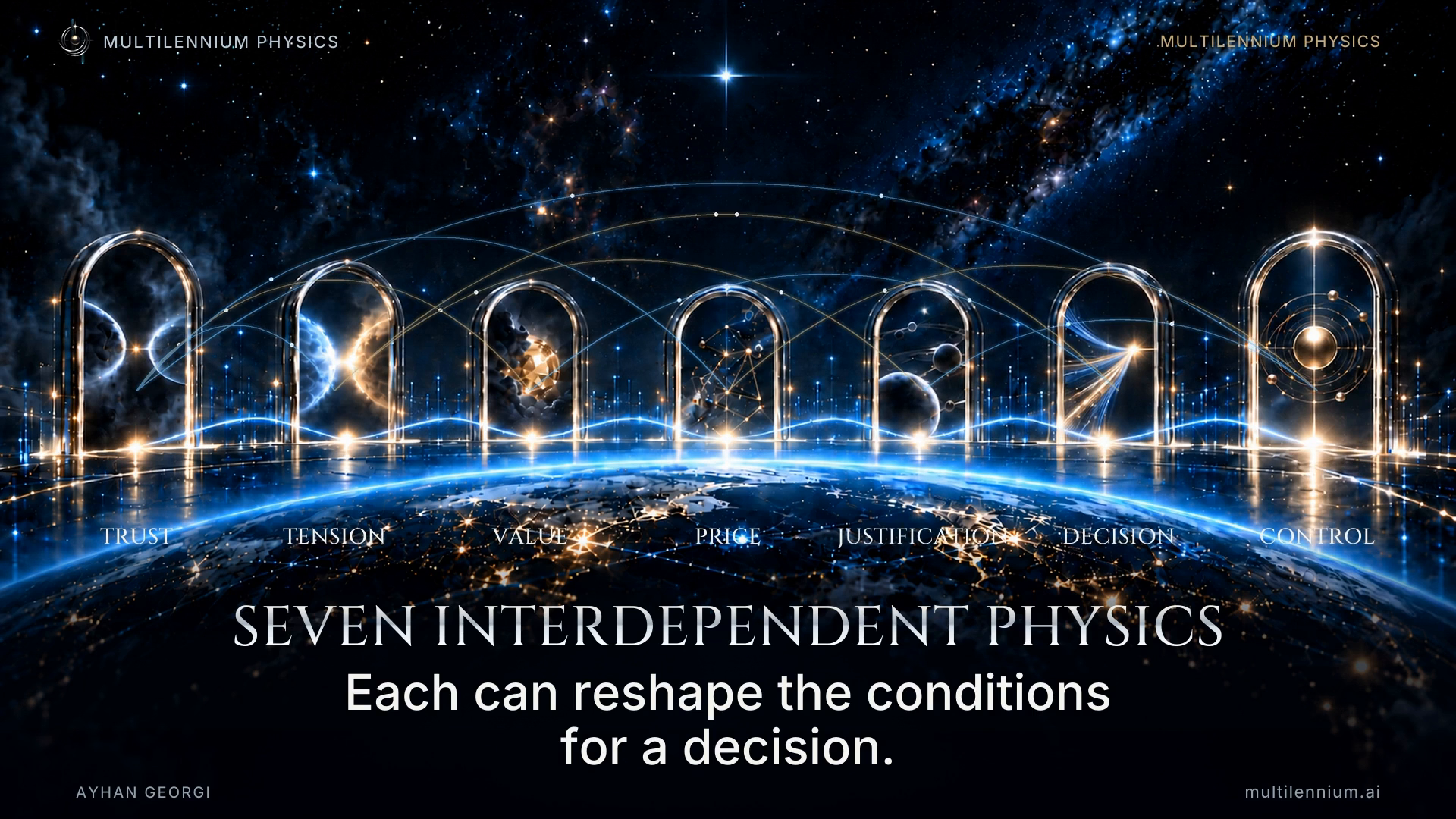
MULTILENNIUM PHYSICS looks at B2B decisions through the lens of forces: what creates movement, what generates resistance and why promising opportunities stall. It explores the hidden mechanics beneath visible sales activity. It examines how trust, tension, value, price, justification, decision and control interact, and how their relationships can reshape the customer’s decision reality.
In a world shaped by AI and digital channels, more information alone does not solve the central challenge: reaching a decision that people can understand, support and justify. Changing conditions demand new tools.
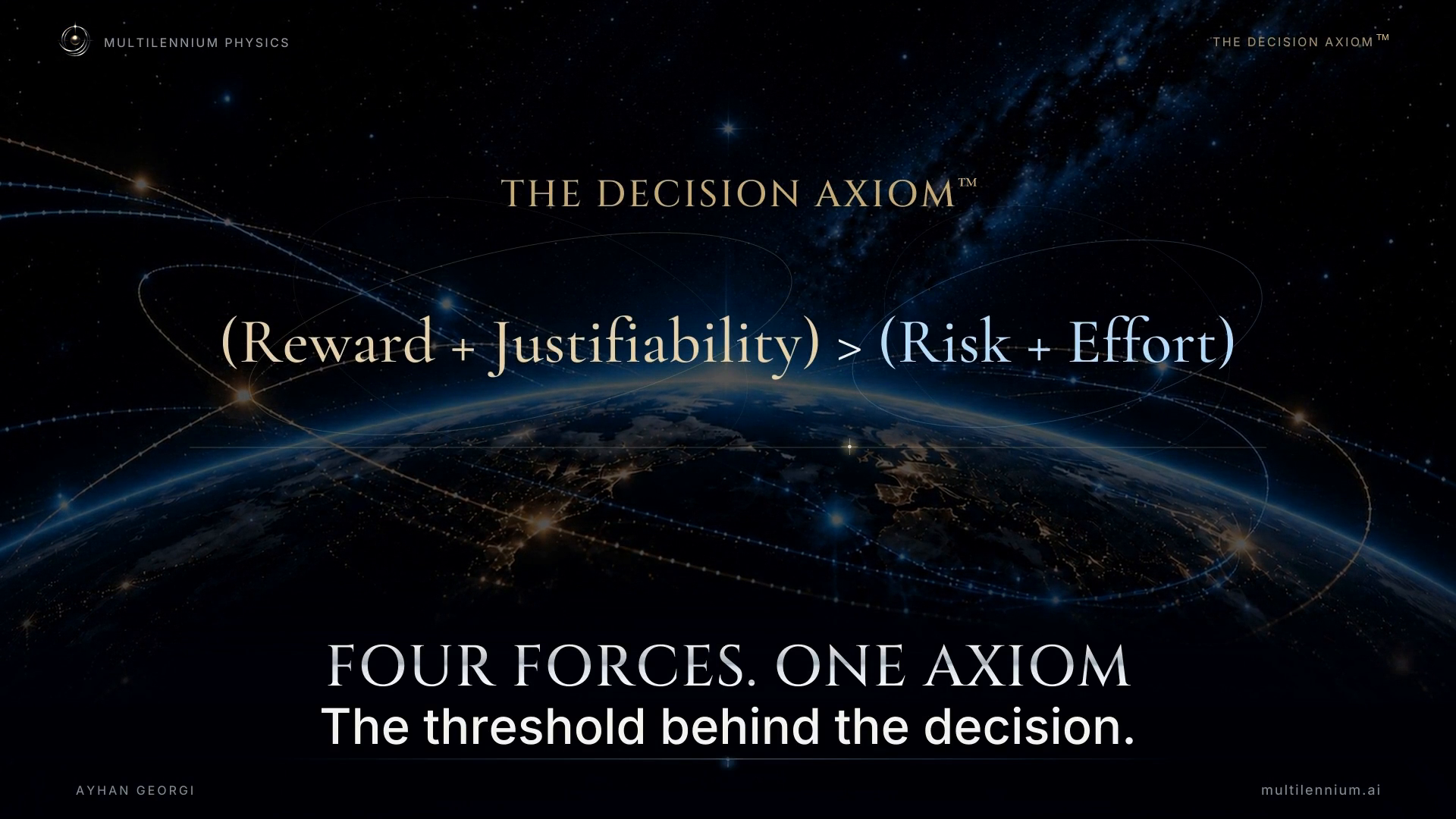
For this reason, the perspective is connected with practical decision models and frameworks, including the Decision Axiom™, MULTILENNIUM PHYSICS™, Customer Clarity Matrix™, Clarity State™ and Sales Reality Matrix™. Together, they help us ask more precise questions:
- What information is available, and what is actually shared?
- What does each person understand and explain?
- Which work fits the situation now?
These frameworks are brought to life in twelve Applied Perspectives (01–12). Each examines a specific dimension of commercial reality through the same underlying lens. Together with the book and the frameworks, they form one integrated system, built on a shared logic, harmonised in language and synchronised in how each part connects to the others. Each element stands on its own, yet gains its full meaning within the whole.
My conviction is that the future of sales depends on our ability to help customers develop clarity, recognise relevant possibilities and make choices they can justify and take responsibility for. That requires judgment, contribution and the willingness to reconsider our own assumptions.
The same conviction shapes my consulting, training and coaching. I help organisations strengthen sales capabilities, improve customer conversations, align commercial priorities and equip leaders to turn change into everyday practice. This includes the practical, responsible use of AI in sales, connected to the people, decisions and workflows it needs to support.
My ambition is to help shape the paradigm shift in modern sales and to give people practical tools to work within it. Through Multilennium, these strands come together in one coherent concept: a book that offers a new perspective on decisions, Applied Perspectives that translate it into concrete commercial situations, and practical support for the teams and leaders working to improve commercial performance.
MULTILENNIUM PHYSICS™
The Hidden Mechanics of B2B Decisions in a Nonlinear World

Coming soon

Coming soon

Coming soon

Coming soon
Coming soon
Imprint
Legal Notice, AI Transparency Notice and Privacy Policy
A. Legal Notice
1. Service Provider and Website Operator
Information pursuant to Section 5 of the German Digital Services Act
(Digitale-Dienste-Gesetz – DDG) and Section 18(1) of the German Interstate Media Treaty
(Medienstaatsvertrag – MStV)
Ayhan Georgi
Schillerstraße 33
40237 Düsseldorf
Germany
Website: multilennium.ai
Email: ayhan.georgi@gmx.de
Telephone: +49(0)1622948970
Ayhan Georgi is the service provider and legally responsible operator of this website.
2. Person Responsible for Journalistic-Editorial Content
Insofar as this website contains journalistic-editorial content, the person responsible pursuant to Section 18(2) of the German Interstate Media Treaty is:
Ayhan Georgi
Schillerstraße 33
40237 Düsseldorf
Germany
B. Artificial Intelligence Transparency and Editorial Responsibility
1. Use of Artificial Intelligence
Artificial intelligence systems may be used on this website as supporting tools for purposes including:
research and information analysis;
content structuring;
drafting and linguistic revision;
translation;
the development of visual concepts;
the creation or editing of illustrations and other visual material.
The use of artificial intelligence as a supporting tool does not transfer editorial responsibility to the AI system or to its provider.
2. Human Review and Editorial Responsibility
All original editorial content published directly by the website operator is subject to substantive human review and editorial control by Ayhan Georgi before publication.
Ayhan Georgi has the authority to:
amend content on substantive grounds;
reject content;
request further review or verification;
approve content for publication.
Ayhan Georgi assumes final editorial responsibility for content published directly by the website operator.
A purely formal review, such as automated spell-checking or grammatical correction alone, is not treated as substantive human review.
3. Content-Specific AI Disclosures
Where disclosure is required under Article 50 of Regulation (EU) 2024/1689 on artificial intelligence or under another applicable law, the relevant disclosure will be provided clearly, distinguishably and accessibly no later than the first interaction with or exposure to the relevant content or system.
This applies in particular to:
an AI system that interacts directly with users, unless it is already obvious that the user is interacting with an AI system;
AI-generated or AI-manipulated image, audio or video content that constitutes a deepfake;
AI-generated or materially AI-manipulated text published for the purpose of informing the public about matters of public interest where the content has not undergone sufficient human review or editorial control and no natural or legal person assumes editorial responsibility for its publication;
automatically generated social-media content where disclosure is required under Section 18(3) of the German Interstate Media Treaty.
Depending on the relevant content, a direct disclosure may use wording such as:
“AI-generated image”;
“AI-generated or AI-manipulated content”;
“You are interacting with an AI system”;
“This text was generated or materially edited using artificial intelligence and has not undergone substantive human review.”
The general information contained in this notice does not replace any disclosure that must be placed directly next to the relevant content, system or function.
4. Human-Reviewed AI-Assisted Text
Where artificial intelligence has assisted in drafting text that is published for the purpose of informing the public about matters of public interest, no separate AI label will be omitted unless:
the text has undergone substantive human review or editorial control; and
Ayhan Georgi assumes editorial responsibility for its publication.
Where these conditions are not met, the relevant text will be labelled directly and clearly.
5. Machine Translations
The optional IONOS Website Translator generates translations of visible website content in real time.
Unless a translated version is expressly identified as having undergone substantive human review, translated content generated by this function is machine-translated and has not been reviewed by a human.
The following notice should be displayed in direct connection with the translation function or translated content:
“Machine-translated content – not human-reviewed. The translation may contain inaccuracies. In case of discrepancies, the original English version prevails.”
Privacy Policy
1. General Information and Scope
This Privacy Policy explains the nature, scope, purposes and legal bases of the processing of personal data in connection with the use of the website:
multilennium.ai
It applies to the website functions and services described below.
Should additional services be introduced, including a contact form, newsletter, online shop, embedded videos, maps, social-media plugins, advertising services or additional analytics tools, this Privacy Policy will be updated before or when such services are activated.
2. Controller
The controller within the meaning of Article 4(7) of the General Data Protection Regulation is:
Ayhan Georgi
Schillerstraße 33
40237 Düsseldorf
Germany
Email: contact@multilennium.ai
Telephone: 0162-2948970
3. Hosting and Technical Provision of the Website
This website is hosted and technically provided using services supplied by:
IONOS SE
Elgendorfer Str. 57
56410 Montabaur
Germany
When the website is accessed, technically necessary information may be processed in order to establish the connection, deliver the requested website content, maintain security and diagnose technical errors.
This information may include:
the IP address of the requesting device;
the requested website, page or file;
the date and time of access;
the referring website or URL;
browser type and browser version;
operating system;
device type;
technical connection and request information.
The purposes of this processing are:
the secure and reliable provision of the website;
the transmission of website content;
the prevention and investigation of misuse or attacks;
technical troubleshooting;
the maintenance and improvement of system stability.
The legal basis is Article 6(1)(f) GDPR. The legitimate interests pursued are the secure, reliable and technically functional operation of the website and the protection of the website and its visitors against misuse and security threats.
IONOS SE processes the relevant data as a technical service provider and, insofar as it processes personal data on behalf of the controller, as a processor within the meaning of Article 28 GDPR.
Technical access and security data are retained only for as long as they are required for website delivery, security monitoring, troubleshooting and abuse prevention. Data may be retained for a longer period where a specific security incident must be investigated or where statutory retention obligations or legal claims require continued storage. The data will otherwise be deleted or anonymised.
4. IONOS SiteAnalytics
This website uses IONOS SiteAnalytics for statistical evaluation and technical optimisation.
IONOS SiteAnalytics may determine information using a log file or a pixel. According to IONOS, SiteAnalytics does not use cookies.
The following information is processed:
referrer information;
the requested website or file;
browser type and browser version;
operating system;
device type;
time of access;
IP address in anonymised form.
The IP address is transmitted when a page is requested and is anonymised directly after transmission. It is then processed without a direct personal reference.
The data is used exclusively for:
statistical evaluation of website use;
technical optimisation of the website;
identification of general usage patterns;
improvement of website performance and stability.
The legal basis is Article 6(1)(f) GDPR. The legitimate interests pursued are the technical optimisation, secure operation and improvement of the website.
No individual user profiles are created by the website operator through IONOS SiteAnalytics. According to IONOS, SiteAnalytics data is not passed on to third parties.
5. IONOS Website Translator
5.1 Description of the Service
This website may provide the optional IONOS Website Translator.
The service translates visible website content into selected languages in real time. The translations are generated automatically and cannot be manually edited within the translation service.
The translation function is not required in order to access the original English-language website.
5.2 Consent
The translation service is activated only after the visitor has given consent through the website’s consent interface.
Where information is stored on or accessed from the visitor’s device, the legal basis is Section 25(1) of the German Telecommunications Digital Services Data Protection Act
(Telekommunikation-Digitale-Dienste-Datenschutz-Gesetz – TDDDG).
The legal basis for the subsequent processing of personal data is Article 6(1)(a) GDPR.
Consent is voluntary. Refusing consent does not prevent access to the original website. It only prevents the optional translation function from being loaded.
Consent may be withdrawn at any time with effect for the future through the “Privacy Settings” function provided on the website. Withdrawal does not affect the lawfulness of processing carried out before the withdrawal.
5.3 Data Processed
When the translation service is activated, the following information may be processed insofar as technically required:
IP address;
browser and device information;
operating system;
date and time of access;
requested page;
selected source and target language;
visible website content required for translation;
technical connection information;
consent and privacy-setting information.
5.4 Purpose
The data is processed for the following purposes:
activation and provision of the requested translation;
transmission of the visible website content to the translation service;
delivery of the translated content;
maintenance of the security and functionality of the translation service;
recording and management of the visitor’s consent decision.
5.5 Recipients
Recipients of the data may include:
IONOS SE;
technical service providers used by IONOS to provide the translation function;
hosting, network and security providers involved in the technical delivery of the service.
The website operator does not use the translation function to create personal visitor profiles.
5.6 Possible Processing Outside the European Economic Area
Depending on the technical infrastructure used for the optional translation service, it cannot be excluded that data may be processed outside the European Union or the European Economic Area.
Where such a transfer takes place, it will be based on the requirements of Chapter V GDPR, including, where applicable:
an adequacy decision by the European Commission under Article 45 GDPR;
appropriate safeguards under Article 46 GDPR, particularly standard contractual clauses;
another legally permitted transfer mechanism.
Further information concerning the safeguards applicable to a specific transfer may be requested from the controller.
5.7 Storage
The website operator does not create a separate translation profile.
Data connected with the translation request is retained only for as long as necessary to provide, secure and technically administer the translation service, unless legal obligations require longer retention.
Consent-setting information may be retained for as long as necessary to remember the visitor’s choice and to demonstrate that valid consent was obtained. It will be deleted or reset when it is no longer required, when the visitor resets the settings or where continued retention is no longer legally justified.
6. Contact by Email
Visitors may contact the website operator by email.
When an email is sent, the following personal data may be processed:
name;
email address;
message content;
date and time of communication;
attachments voluntarily provided;
technical email and communication metadata.
The data is processed for the purpose of:
receiving and responding to the enquiry;
communicating with the sender;
taking steps requested before entering into a contract, where applicable;
maintaining records where required for legal or evidentiary purposes.
Where the enquiry relates to a contract or steps requested before entering into a contract, the legal basis is Article 6(1)(b) GDPR.
For other enquiries, the legal basis is Article 6(1)(f) GDPR. The legitimate interest is the appropriate and efficient handling of enquiries addressed to the website operator.
The email service is provided through GMX, a service operated by:
1&1 Mail & Media GmbH
Karlsruhe Branch
Brauerstr. 48
76135 Karlsruhe
Germany
Email data may therefore be processed by the email service provider as part of the technical transmission and storage of the communication.
Email content will not be sold. It may be disclosed only where:
this is necessary to respond to the enquiry;
a technical service provider is involved in providing the communication service;
disclosure is required by law;
disclosure is necessary for the establishment, exercise or defence of legal claims; or
the sender has consented to the disclosure.
Email correspondence is deleted when the enquiry has been conclusively dealt with and no contractual, statutory, evidentiary or legal reason for continued retention remains.
7. Cookies and Storage on End Devices
According to IONOS, the core MyWebsite Now service does not use cookies. IONOS SiteAnalytics also does not use cookies.
No advertising cookies or behavioural marketing tools are used by the website operator in connection with the services described in this Privacy Policy.
Technically necessary information may nevertheless be stored on or retrieved from the visitor’s device where this is required to:
deliver the website;
retain privacy and consent settings;
secure the website;
provide a service expressly requested by the visitor.
Where such storage or access is strictly necessary, it is based on Section 25(2) TDDDG.
Optional services that are not strictly necessary, including the translation service where applicable, are activated only after consent under Section 25(1) TDDDG and Article 6(1)(a) GDPR.
8. Categories of Recipients
Personal data may be disclosed to the following categories of recipients where this is necessary and legally permitted:
hosting and technical infrastructure providers;
website and analytics service providers;
email and communication providers;
providers involved in the optional translation function;
professional advisers, including legal or tax advisers, where necessary;
courts, public authorities or law-enforcement authorities where disclosure is legally required;
other recipients where the data subject has given valid consent.
Personal data is not sold to third parties.
9. General Storage Principles
Unless a more specific storage period or criterion is stated in this Privacy Policy, personal data is retained only for as long as necessary for the purpose for which it was collected.
Data may be retained for a longer period where this is required because of:
statutory retention obligations;
contractual documentation requirements;
the establishment, exercise or defence of legal claims;
an ongoing security incident;
a binding request from a public authority or court.
When the relevant purpose and legal basis cease to apply, the data is deleted or anonymised unless continued retention is legally required.
10. Provision of Personal Data
Technical connection data is automatically required in order to provide the website. Without this processing, the website cannot be transmitted to the visitor’s device.
Providing information in an email is voluntary. However, without a valid return address and sufficient information concerning the enquiry, the website operator may be unable to respond.
Consent to the optional translation service is voluntary. Refusing consent has no negative effect on access to the original English-language website.
11. Rights of Data Subjects
Subject to the applicable statutory conditions, data subjects have the following rights:
the right of access under Article 15 GDPR;
the right to rectification under Article 16 GDPR;
the right to erasure under Article 17 GDPR;
the right to restriction of processing under Article 18 GDPR;
the right to data portability under Article 20 GDPR, where applicable;
the right to object under Article 21 GDPR;
the right to withdraw consent at any time with effect for the future;
the right to lodge a complaint with a competent data protection supervisory authority.
A withdrawal of consent does not affect the lawfulness of processing based on consent before its withdrawal.
Requests concerning data-protection rights may be sent to:
Ayhan Georgi
Email: ayhan.georgi@gmx.de
The controller may request appropriate information to verify the identity of the person making the request.
12. Right to Object
Where personal data is processed on the basis of Article 6(1)(f) GDPR, the data subject has the right to object to the processing at any time on grounds relating to their particular situation.
Following an objection, the relevant personal data will no longer be processed unless the controller demonstrates compelling legitimate grounds for the processing that override the interests, rights and freedoms of the data subject, or unless the processing is necessary for the establishment, exercise or defence of legal claims.
Where personal data is processed for direct-marketing purposes, the data subject has the right to object at any time. Following such an objection, the personal data will no longer be processed for direct-marketing purposes.
The website operator does not currently carry out direct marketing through the website functions described in this Privacy Policy.
13. Right to Lodge a Complaint
Data subjects have the right to lodge a complaint with a data protection supervisory authority, particularly in the Member State of their habitual residence, place of work or place of the alleged infringement.
The supervisory authority responsible for the website operator in North Rhine-Westphalia is:
Landesbeauftragte für Datenschutz und Informationsfreiheit Nordrhein-Westfalen
Kavalleriestraße 2–4
40213 Düsseldorf
Germany
Postal address:
Postfach 20 04 44
40102 Düsseldorf
Germany
14. Automated Decision-Making and Profiling
No automated decision-making producing legal effects or similarly significant effects within the meaning of Article 22 GDPR is carried out through the website functions described in this Privacy Policy.
The website operator does not create personal visitor profiles through the functions described in this Privacy Policy.
15. Data Security
Appropriate technical and organisational measures are used to protect personal data against accidental or unlawful destruction, loss, alteration, unauthorised disclosure or unauthorised access.
The website is transmitted using encrypted HTTPS communication.
Despite appropriate security measures, the transmission of data over the internet cannot be guaranteed to be completely secure in every circumstance.
16. Changes to This Privacy Policy
This Privacy Policy may be updated where:
legal requirements change;
the website is technically modified;
new services or providers are introduced;
existing processing activities change.
The version published on this website at the relevant time applies.
Last updated: 23 August 2026
© Ayhan Georgi. All rights reserved.